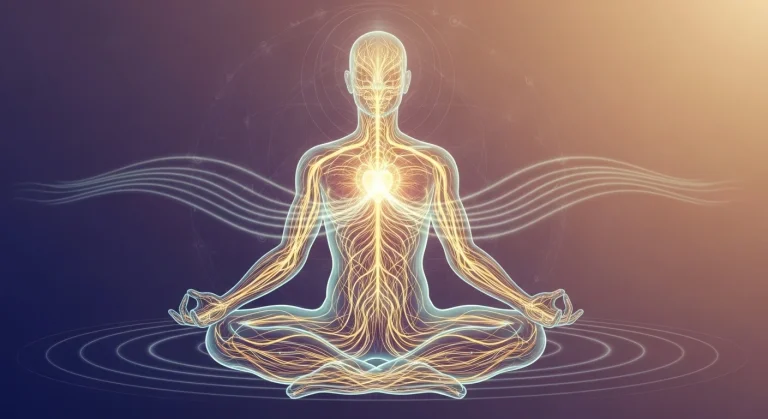
The Surrender to the Love That Was Always There—The Hand Uncurls
You have organized your life around protecting yourself from this love, and you have done it so well that the protection has become invisible to you—it is simply the shape of how you move through the world now. The fist has been closed so long that your hand no longer remembers it was ever open, and you do not even think of it as a fist anymore. You think of it as yourself.
But your body knows. Your body is tired. And there is a love that has been waiting—not arriving, not new, but simply waiting for your hand to uncurl and remember what it always held.
The Fist Around the Stone
Picture a hand closed around a stone. Not gripping it—that would suggest effort, and there is effort, but it is old effort now, so old that the muscles no longer know the difference between holding and being. The palm is warm from the stone’s weight. The knuckles are white. If you were to look at this hand from across a room, you would think: there is someone protecting something. There is someone who will not let go.
But the stone is not a weapon. The stone is not even something foreign that fell into the palm by accident. The hand closed around it deliberately, a long time ago, when the hand believed that holding tight was the only way to keep something safe. The hand believed that love was dangerous—that if it loosened even one finger, the stone would fall, or the love would pour out and be lost, or something precious would be taken.
So the hand has held. For years. For longer than years. And what you are beginning to feel is not that you have been wrong to hold—but that the holding itself has become the prison. The fist is no longer protecting you. It is the cage.
Why can’t you let the love that was always there reach you?
Because you learned, long ago, that love was not safe. Not because anyone told you that in words, but because you watched what love looked like when it was not guarded—how it made people small, how it made them available for hurt, how it was used against them. And so you made a choice, a child’s choice, a wise choice under the circumstances: you would love nothing so completely that anything could be taken from you. You would keep something back. You would hold the most valuable thing in a closed fist and never open it.
The love that is waiting for you now—the love that has always been there, underneath the protection, underneath the story you told yourself about what it meant to be strong—that love does not require you to become small. It does not ask you to be available for harm. But it does ask you to uncurl your fingers. And every time you think about doing that, the same ancient fear rises: if I open my hand, I will lose my grip. I will lose myself. I will be taken. The exhaustion you feel is not the weight of the stone. It is the cost of refusing to believe that your open palm could be as safe as your closed fist. It is the cost of a life spent bracing.
Begin with the smallest betrayal.
You do not need to open your hand all at once. The image of surrender that lives in your mind—the image of total release, of a hand that flies open like a door swinging wide—that image is what keeps you from beginning. It feels impossible because it is not real. Real surrender is ordinary. Real surrender is your smallest finger, the one that holds the least, the one you will miss the least, learning to straighten.
That one finger. Not the whole hand. Not yet. Just permission for one small betrayal of the story you have been telling yourself about what safety means. This might look like saying yes to something you want instead of no to something you fear. It might look like letting one person see you. It might look like admitting, to yourself in the dark, that you are tired of holding. It might look like sitting with the fear itself—not moving toward it or away from it, just letting it be there while you notice that you are still alive, still whole, still yourself, even while afraid. The fear is not a sign that opening is dangerous. The fear is what always arrives when you stop running.
If you are carrying grief alongside this, if the protection you built was against loss that actually happened, real help from a good therapist or trusted people in your life is not weakness—it is wisdom. A spiritual reading of this difficulty is never a reason to skip the care it deserves. The protection you built served you. Now it is time to let something else serve you. A body that learns to receive. A heart that remembers it can open. And underneath it all, that love that never left, still warm from the palm.
| What runs through your mind | What’s actually true |
|---|---|
| If I open my hand, I’ll lose control and everything will fall apart. | You have already survived the hard thing. An open hand is not a fall—it is permission for the ground to hold you. |
| Surrendering to love means I’ll become weak and available for hurt. | Surrender is the strongest thing you can do. It takes infinitely more power to uncurl than to hold. |
| I have to be ready before I can let go. | You will never feel ready. Readiness is what arrives on the other side of the first small opening. |
| If I open my hand, the stone will fall and I’ll have nothing. | The stone was never yours to hold. What was always yours is what the open hand discovers—and that hand is warm. |
A little help, while you’re here
- Sit with your closed hand for two minutes without trying to change it. Notice the ache in your palm, the heat of the stone. This is not weakness—this is honest attention. Then, still not trying to change anything, straighten one small finger and hold it straight for one breath. That is enough.
- Tell one person something true that you have been afraid to say out loud. Not the biggest thing. One true, small thing. Notice that the sky did not fall and you are still standing.
- When the fear comes—and it will—do not try to logic it away. Sit with it like you would sit with a frightened animal. Say to it: I am learning to open. You do not have to understand that yet. You do not have to approve. Just watch.
The Hand Uncurls
There is a moment that comes, not when you have decided to surrender, but when you are tired enough to stop deciding. When the effort of holding is finally, visibly more painful than the fear of releasing. That moment is not dramatic. There is no lightning. There is only your hand, the same hand that has held the stone for so long, beginning to straighten. One finger. Then another. And what happens next is not that the stone falls—it is that your fingers learn they were never meant to be a cage. They were meant to reach. They were meant to give. They were meant to touch.
And the love that is waiting—the love that has always been there, underneath the protection, in the warmth of your own palm—does not arrive as something new. It arrives as recognition. As permission. As the simple, vast truth that you have been safe all along. Not because nothing bad ever happened. Not because you will never know loss again. But because you are not the hand closing around the stone anymore. You are the hand opening. You are the palm that learns to receive. You are the fingers that straighten, slowly, in their own time, and discover that the ground is underneath them, the sky is above them, and the love that has been waiting all along is in the simple fact of your own uncurling.
Not dims. Not fades. Uncurls. Reaches. Receives. Becomes.