

Nicole Series Part 5: Boundaries as Spiritual Practice
From Gaslighting to Dignity
When we think of boundaries, we often imagine hard lines drawn in anger or defense. But boundaries are not walls—they are the clear edges of our dignity. They are how we teach the world to treat us, and just as importantly, how we remind ourselves of our own worth.
Each mentorship I hold is a quiet unfolding—a living invitation to meet yourself more honestly, more gently, and more wholly than ever before. Within this sacred space, clarity, joy, and alignment are not only possible, but inevitable.
With Nicole, this unfolding meant learning that peace would not arrive through explaining herself into exhaustion or persuading someone to behave. Her peace would be protected by simple, steady boundaries—spoken humbly, enforced clearly, and lived with dignity in the spaces that matter to her.
Naming the Weather (So Self-Trust Can Return)
The first true shift came when Nicole stopped debating the fog and named what was happening. “I can see it. I can see the manipulation. I can see it all unfolding for me.” That recognition was not small—it was liberating.
For months she had been second-guessing herself, especially in shared spaces where he kept reappearing. When she asked him to stop showing up at children’s drop-off, he replied, “I’m hardly doing it on purpose.” Nicole told me, “I didn’t want to fight it, because I knew he’d gaslight me again.”
Gaslighting isn’t just lying; it’s the steady erosion of self-trust. It confuses the compass so thoroughly that even obvious lines feel negotiable. The moment she named the pattern, the ground firmed beneath her feet. She didn’t need the debate; she needed the boundary.
Transition: Once truth is named, the next step is not a speech. It’s a sentence.
The Power of a Clear No (Quiet, Steady, Sufficient)
When Nicole began reclaiming herself, it sounded deceptively simple: “I’m not shaking your hand. I don’t want to see him. I don’t feel comfortable.” No performance, no autobiography. Just reality, stated once.
I reminded her, “You don’t even have to be nice to him. You just go right to indifferent. You enter a space and you’re not the slightest bit impacted whether he’s there or not. You own the space.”
A boundary is not a push; it’s a place to stand. At work, at the school gate, online—Nicole wasn’t trying to move him. She was choosing where she would live: inside her safety, inside her belonging, inside her joy.
Transition: Even the clearest “no” rests easier when others stand with you.
Community as Boundary: “If You Don’t Feel Safe, We Don’t Feel Safe”
Sometimes a single sentence dissolves months of self-doubt. When Nicole confided in her friend, the woman said, “I believe you.” Nicole shared, “I just cried and cried. It was such a relief.”
Support widened. “There’s a group of women… they said, ‘If you don’t feel safe, we don’t feel safe.’” Individual boundaries gain protective strength in community. When one woman stands in her truth, others recognize their own. Safety is never only personal; it is shared.
Transition: And still, the heart of this work is spiritual—about the posture we hold toward ourselves.
Dignity Over Drama (The Spiritual Dimension of Boundaries)
Many women fear that boundaries make them “mean.” Nicole carried some of this anxiety. I kept bringing her back to one word: dignity.
“What’s most important is that you feel dignified… You don’t owe him an explanation. He thrives on impact, even if it’s negative. Your power lies in becoming untouchable.”
This is the spiritual dimension: a boundary is a prayer you live. It says, I am no longer available for what diminishes me. I am worthy of peace. Grounded in dignity, a boundary protects without hardening the heart.
Nicole’s life began to reflect this. She stopped engaging in back-and-forth debates. She muted his digital presence. She aligned with allies. And she allowed partnership to be part of protection—without surrendering her agency. Earlier, I had framed it simply: “There is one person who can put an end to this. It’s your husband. Stand behind him as a shield.” Truth and structure, together, gave her body space to breathe.
Transition: To help her see the change she was living, we held up a mirror.
The Practice You Can See (Before/After, In Plain Sight)
Table: Nicole’s Boundary Journey
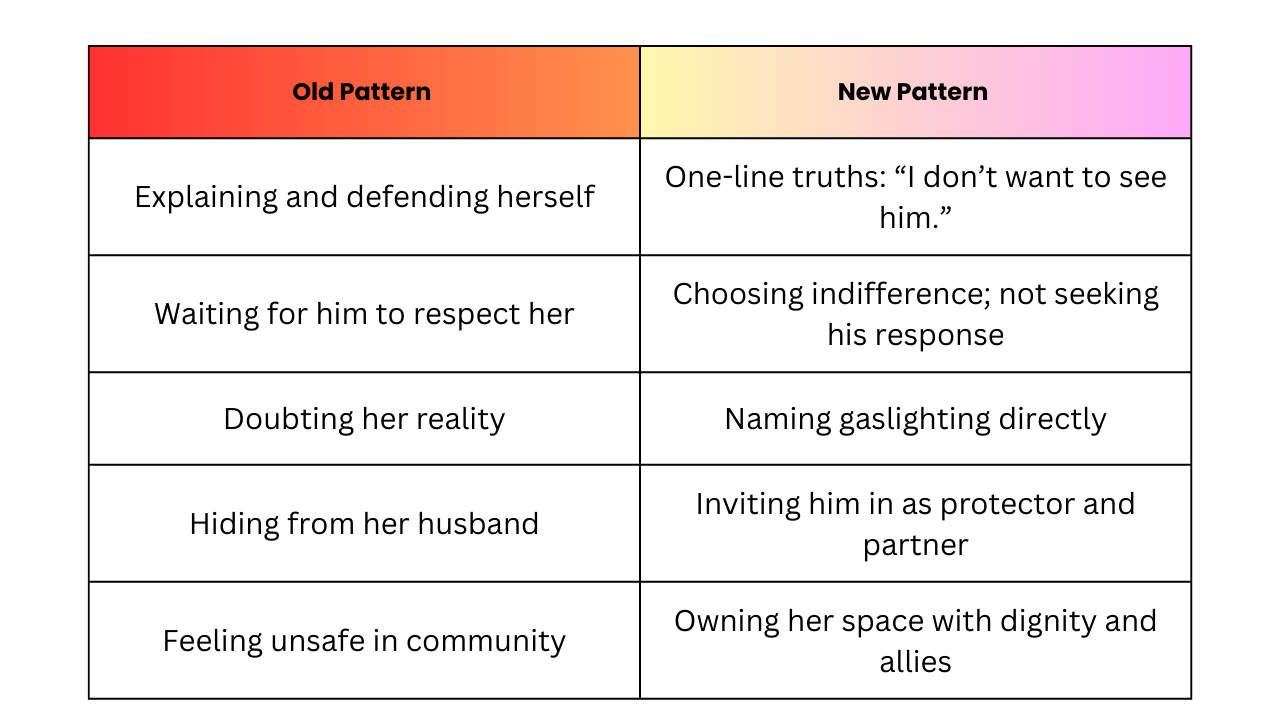
This wasn’t just a list; it was a mirror. Nicole could finally see how far she had come.
Transition: As the lines clarified, her nervous system told the story in an even more honest language: sensation.
Boundaries Regulate the Body (The Nervous System as Witness)
The body keeps the score—and it also keeps the relief. Nicole had often described the toll of proximity to manipulation: shaking hands, tight chest, spiraling thoughts. With clean boundaries, she added rhythm around those moments—four slow exhales, soften the jaw, feel the feet, let the surge crest and pass—before and after difficult encounters. She didn’t suppress emotion; she let it complete.
Then came a quiet sentence that said everything: “I used to get this pain in my chest, and I don’t feel this pain anymore.”
Boundaries are not only psychological; they are physiological medicine. When the line is clear, the body can rest.
Transition: And when a mother’s body rests, a child’s nervous system learns something new about the world.
Boundaries as Generational Repair
Nicole noticed what many mothers see: a daughter scanning her face for signs of safety. By practicing calm, clean boundaries, Nicole taught her children—wordlessly at first—that safety matters, voice matters, love is not a bargain. She put words to it, too: “I can teach her about red flags, things no one teaches girls.” Her boundary became her daughter’s inheritance.
Transition: Even strong boundaries can leak energy if we don’t notice the smaller openings. We closed those, too.
Closing the Leaks (So Energy Returns to You)
After the big “no’s,” we named the subtle drains:
- Micro-justifications: over-explaining to people who have already minimized your experience.
- Silent scanning: checking profiles, feeds, location dots—each glance refuels the loop.
- Polite compliance: agreeing to niceties (a handshake, a shared lane) that violate your truth.
- Second chances without evidence: hoping “this time” will be different when the pattern hasn’t changed.
Nicole’s daily law became simple: No biography. No bait. No borrowed timelines. Clear, kind, brief—and back to life.
Transition: Boundaries are not punishments. They are permissions—to live, to breathe, to belong to yourself again.
Owning Public Space (Without Apology)
What I want for every woman is this: to walk into any room without shrinking. Nicole’s sentences were small, and they built a larger life: “I’m not shaking your hand. I don’t want to see him. I don’t feel comfortable.” She began moving freely again—at work, at the school, online—without rehearsing confrontations or outcomes.
Indifference isn’t coldness; it’s freedom from entanglement. Dignity isn’t distance; it’s nearness to yourself.
Closing Reflection
Nicole’s journey reminds us: boundaries are not punishments; they are sacred declarations of worth. Each time she said no—with calmness, with clarity—she said yes to her own life.
If you recognize yourself here—the fear of being “mean,” the exhaustion of explaining, the longing for peace—remember: your boundaries are not selfish. They are holy. And they will carry you back to yourself.
Call to Action
- Explore Mentorship if you’re ready to reclaim your boundaries as sacred practice.
Your worth is not up for debate. Your dignity can be your daily law.