

Awaken Your Soul: How to Tap Into Divine Energy for Healing and Purpose
You already know something is there.
Not as a theory you read somewhere. Not as a concept you find intellectually interesting. But as a felt presence — underneath the busyness, beneath the noise, beneath even the exhaustion. Something that doesn’t go away. Something that, when you are very still, you can almost touch.
You’ve probably tried to explain it. Probably given up explaining it. Because the people who haven’t felt it look at you strangely when you try, and the people who have felt it don’t need you to explain at all.
This is where we begin. Not with a definition. Not with a technique. With the simple acknowledgment that what you are sensing is real — the divine energy you are reaching toward is not somewhere else. It was never somewhere else. It is the very ground you are standing on.
The Paradox You Are Living
Here is the thing that trips almost everyone up at some point on this path.
You seek the divine. You meditate, you read, you attend, you practice. And the more sincerely you seek, the more it seems to recede — like a horizon that moves as you walk toward it. And so you wonder: Am I doing something wrong? Is there something more I need to learn, some key I haven’t found yet?
But what if the seeking itself — held too tightly — is the very thing creating the distance you feel?
Rumi didn’t say the Beloved was hidden. He said the Beloved was closer than your own breath, obscured only by the noise of a self too busy looking outward to notice what was radiating from within.
Divine energy isn’t a reward for sufficient spiritual effort. It isn’t a level you reach after enough practice. It is what you are made of — the animating light that holds the whole living system of you together right now, in this breath, before you have done a single thing to deserve it.
The invitation isn’t to find it.
The invitation is to stop, long enough, to feel it.

What Gets in the Way — and Why It Isn’t Your Fault
You know the feeling of being truly present — really, genuinely here — in your own life. And you know how rare it is.
Most of the time, something else is running. The mental commentary that never quite stops. The low hum of worry beneath ordinary moments. The habit of living slightly ahead of yourself, always preparing for the next thing, never quite landing in this one.
This isn’t a weakness. It’s what happens to a tender person in a relentless world. Over time, the layers accumulate — not as failures, but as protections. The defended places. The parts that learned to stay guarded. The exhaustion that comes from holding yourself together across years of doing and managing and showing up.
And underneath all of it, very quietly: the self that has been waiting to be felt.
Not fixed. Not improved. Simply — felt. Met. Allowed to breathe.
This is what blocks divine energy from being experienced as a living reality rather than a distant concept. Not sin. Not spiritual inadequacy. Simply the weight of a life that has prioritized doing over being for long enough that being begins to feel like a foreign language.
The grace in this — and there is grace — is that the weight can be set down. Not all at once. But genuinely, and with surprising tenderness.
How Divine Energy Actually Moves
Let’s talk about what this energy actually is — not abstractly, but in a way you might recognize.
You have felt it. In moments of complete presence — watching light move across water, sitting with someone you love in genuine silence, the sudden clarity that arrives after a long cry. In the moment a piece of music reaches somewhere inside you that nothing else could access. In the stillness after deep prayer, or deep laughter, when for a few seconds the mind is simply quiet and the heart is simply open.
That quality — that aliveness, that spaciousness, that sense of here, yes, this — is divine energy as lived experience.
It moves through the places in you that are soft. Through honesty. Through genuine feeling. Through the willingness to be present with what is actually happening, rather than the curated version you present to the world and, sometimes, to yourself.
It does not move particularly well through performance. It doesn’t respond much to spiritual ambition — the part of the seeking self that wants to be seen as evolved, as healed, as further along. That part is real, and human, and very understandable. But it is a slightly closed fist.
Divine energy needs an open hand.
Three Ways to Open
These are not steps. Not a system. Think of them as orientations — three ways of turning the attention that allow what was always present to become perceptible.
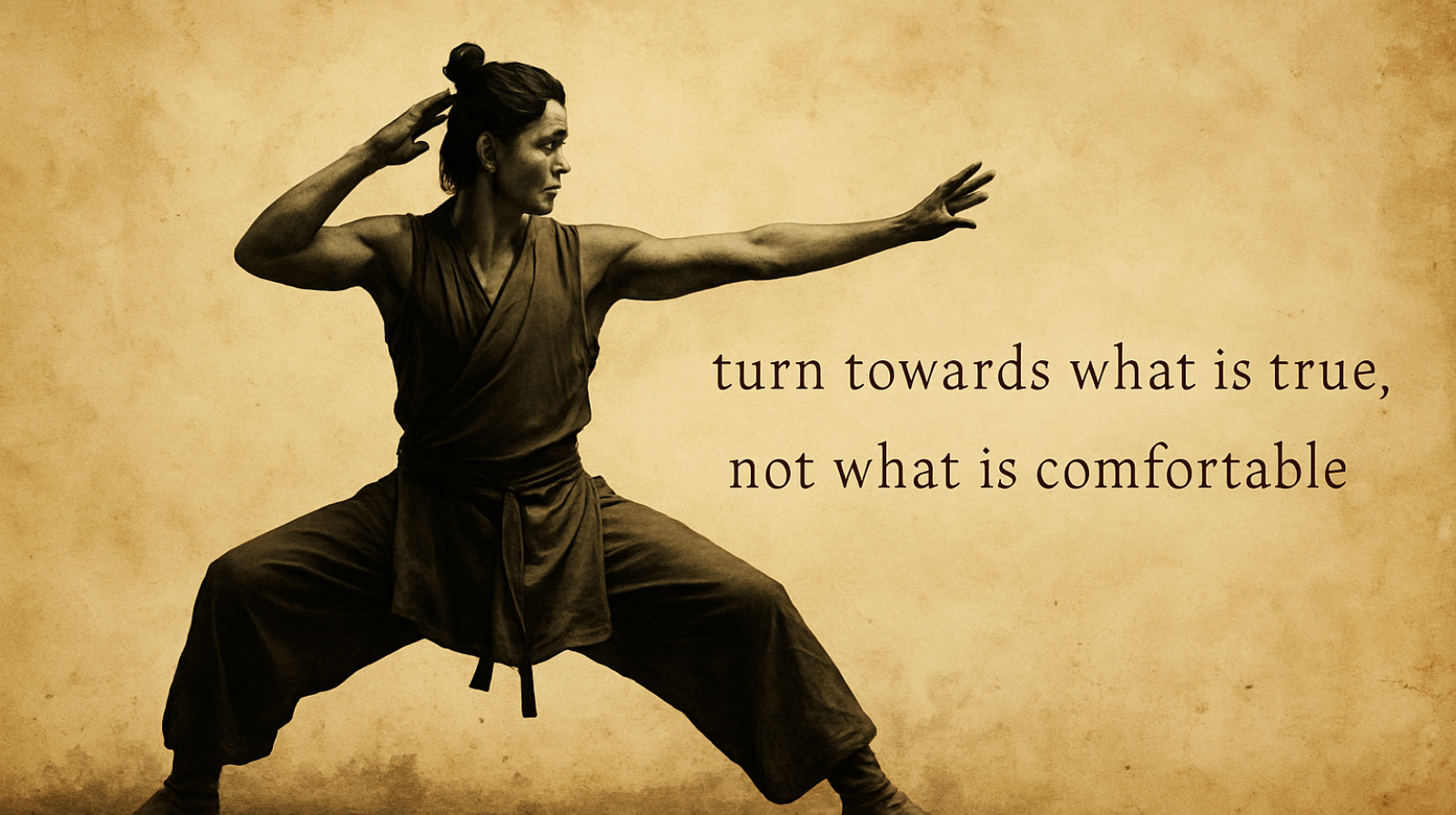
Turn toward what is true, not what is comfortable.
There is always something you know — quietly, in the body — that you have not yet fully acknowledged. Maybe it is about a relationship. Maybe it is about how you are spending your energy. Maybe it is the grief you have been managing around rather than moving through.
Divine energy lives very close to truth. When you turn toward what is actually true for you — even the inconvenient parts, even the tender parts — something opens. Not because honesty is a virtue to perform, but because reality, met honestly, is where the divine is always already waiting.
Slow down beyond what feels comfortable.
Most of us have found a pace of life that keeps us just busy enough to avoid the deeper questions. This isn’t conscious — it’s just what happens when the inner life feels too large or too uncertain to sit still inside. Busyness becomes a kind of kindness we extend to ourselves.
But the deeper current of your life cannot be heard at that speed.
You don’t need a retreat. You need ten minutes of genuine stillness. Not productive stillness, not directed meditation with an outcome in mind, but the kind where you sit down, breathe, and simply allow whatever is present to be present. No agenda. No arrival point. Just you, as you actually are, in contact with the life moving through you right now.
That contact is everything.
Let yourself be moved.
Divine energy is not a concept you understand. It is a reality you feel. And feeling requires a certain willingness to be touched — by beauty, by grief, by the startling grace of an ordinary moment that suddenly opens into something vast.
If something moves you, let it move you. Don’t explain it away. Don’t step back behind the glass of ironic distance or intellectual analysis. Stay in the feeling long enough to receive what it is carrying.
The mystics called this wajd — the state of being found, of being reached. You don’t manufacture it. You simply stop blocking it.
On Healing and Purpose — Gently
Here is something worth saying slowly.
Healing and purpose are not two separate destinations you travel toward one at a time. They are the same movement, made from the inside out.
When the deeper layers of you begin to soften — when what has been held begins to be released, when the defended places gradually open — what emerges isn’t an empty space. It is you. More of you than was previously accessible. The particular quality of presence, the specific kind of seeing, the unique form of love and attention that only you carry.
Purpose, understood this way, is not something you find or build or achieve. It is something that becomes visible as the layers between you and yourself thin.
You don’t have to figure out what you are here to do. You have to be willing to be more fully who you already are.
And the divine energy that you sense beneath everything — that presence, that light, that knowing that doesn’t go away — is both the source of that becoming and its constant, patient companion.
It has been with you for as long as you have been you.
It is with you now.

A Practice, If You Want One
Not a prescription. An invitation.
Once a day — or once a week, wherever you are — find five minutes of genuine solitude. Not the kind where you are technically alone but mentally in three conversations. Real solitude. Quiet.
Sit comfortably. Place one hand on your chest.
Breathe slowly. And instead of asking for something — guidance, clarity, direction, healing — simply offer a kind of inner greeting. As though saying hello to something that has been quietly waiting for you to notice it.
You don’t need to feel anything dramatic. You don’t need to feel anything at all, at first.
Just the willingness to show up.
Over time — not immediately, but over time — something in the quality of your inner life will shift. Not because you did the practice correctly. But because you showed up honestly.
That honesty is the practice.
Closing
There is an old idea in the Sufi tradition that the heart is a mirror. When it is polished — through honesty, through stillness, through genuine inner attention — it reflects the divine light that was always shining on it.
You are not here to generate that light.
You are here to remove what is covering the mirror.
And the covering is not as thick as it sometimes feels. It has never been as permanent as the long days of exhaustion and forgetting have made it seem.
Begin with one honest breath. One moment of genuine presence. One small turning — away from the performance of being alive, and toward the actual, unadorned, irreplaceable experience of it.
That turning is the whole path, offered in a single gesture.
And it is available to you right now, in this moment, exactly as you are.