

Nicole Series Part 7: Anger as a Sacred Signal
Transforming Shame into Self-Advocacy
There is a moment in every mentorship journey when the emotions we fear most come to the surface. For some, it is grief. For others, it is loneliness. For Nicole, it was anger. She had lived believing anger was dangerous—that it made her unworthy, that it proved she was broken. Whenever anger rose, shame followed quickly after: I’m too much. I’m failing. I shouldn’t feel this way.
Each mentorship I hold is a quiet unfolding—a living invitation to meet yourself more honestly, more gently, and more wholly than ever before. Within this sacred space, clarity, joy, and alignment are not only possible, but inevitable.
With Nicole, part of that unfolding meant reclaiming anger—not as destruction, but as a sacred signal pointing her back to truth. To understand how revolutionary this was for her, we have to name the ground she was standing on: a childhood shaped by volatility—“My dad would have been very explosive, very temperamental… my mom would close her ears”—and, years later, an affair relationship that echoed those early imprints through manipulation, mixed signals, and gaslighting in public and shared spaces. Anger wasn’t random. It was her body telling the truth.
The Lie of Shame (and What Anger Really Says)
Nicole named a core belief: “I feel so unworthy all the time. I hate this feeling.” Shame had become a reflex. It insisted she was the problem—unworthy as a mother when her daughter mirrored her anxiety, unworthy as a wife because she had strayed, unworthy as a woman for feeling anger at all.
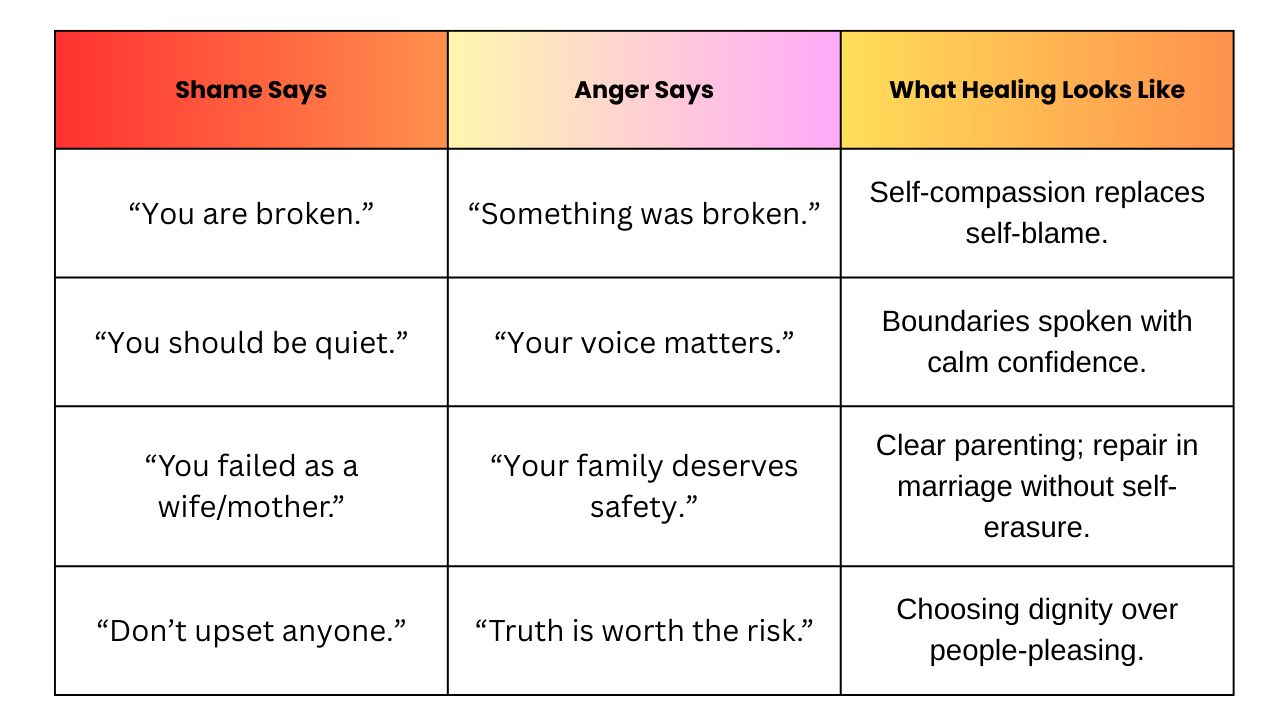
I reflected the counter-truth she could not yet hold: “Any genuine emotion is pure.” And also: “Your anger stands between you and your true strength.” Shame says you are the problem. Anger says there is a problem. That difference is everything.
Transition: Once shame loosens its grip, anger can do what it was made to do—clarify.
Anger as Clarifier (Seeing What’s Real)
When her ex appeared at the gym, smiling as though nothing had happened, Nicole felt heat rise: “I feel angry when I see him at the gym… is that right?” (She was naming the complex social field around him, including his wife’s presence.) Her instinct was to judge the feeling, to push it down.
But anger was clarity. It was her body refusing to normalize what harmed her. When I named the dynamic—“He created the dynamic—he toyed with you to create the need to be loved by him”—the fog began to lift. She stopped blaming herself for the intensity of her reactions. She started using anger as a cue to set clean boundaries: “I’m not exercising with him. I don’t feel comfortable.”
Small sentences. Revolutionary outcomes.
Transition: Still, clarity is only half of the work; the other half is finding a voice that is steady.
From Suppression or Explosion → Steady Voice
Nicole’s family map taught her two responses: explosive anger (her father) or shut-down silence (her mother). “We didn’t talk about problems.” As an adult, she often over-corrected: apologizing for boundaries, staying quiet when people minimized her pain, spiraling when texts went unanswered.
What emerged now was a third way: letting anger move through without collapse. When her sister attacked her—“She called me a psychopath, putting all this on my Instagram…”—Nicole said, “I didn’t bite. I was like, okay Hannah, I don’t want to have an argument.” For the first time, she neither exploded nor disappeared. She stood in her center and chose calm truth.
That is the sacred work of anger: not to destroy, not to repress, but to power our courage to speak clearly and hold our line.
Chart: Shame vs. Anger
Transition: As her voice clarified, so did her alliances. Anger, honored, invited the right people closer.
When Anger Builds Connection (Not Isolation)
Anger, held with dignity, did not push everyone away. It clarified the ground and invited aligned support. Nicole shared that her athletics coach was unequivocal—“He was very strong on this not being okay, that I’m not comfortable at training, that this is a problem. Women in sport need a chance to excel, and it’s already difficult for women.” Clarity called him forward.
Then the women’s circle around her: “There’s a group of women… they’ve gone to the gym management and said they don’t feel safe in the gym with this man here… ‘If you don’t feel safe, we don’t feel safe.’” Anger named cleanly became a catalyst for sisterhood. Her voice gave others permission to use theirs.
Transition: And even beneath words, there is a physical arc to anger that needs completion.
Let the Body Finish the Song
Anger lives in the body as much as in words. Nicole noticed that when she allowed tears and tremors to complete, relief arrived: “I kind of later in the day, I got a bit stressed out, and I kind of had a bit of a cry about it yesterday.” I encouraged a simple instruction for somatic completion: “Let the music play through you… you are the instrument.”
Not dramatizing, not suppressing—just letting the wave finish. The result was steadiness. Boundaries got cleaner, breath fuller, presence more available.
Transition: From there, the practical effects were tangible—at home, in community, and in her own mind.
What Anger Made Possible
- Direct Boundaries: “I’m not exercising with him.” “I don’t feel comfortable.”
- Discernment: When minimizers poked holes, she noticed the tactic rather than doubting herself.
- Community Safety: Her clarity strengthened the practices and protections around her.
- Family Repair: She modeled anger without threat—teaching her daughter that truth and safety can co-exist.
Closing Reflection
Nicole’s story teaches us that anger is not what destroys us. Silence, shame, and self-abandonment do. When honored, anger is sacred. It clarifies manipulation. It fuels boundaries. It gathers allies. It teaches our children that truth matters more than people-pleasing.
To every woman who has been told to soften, to smile, to swallow the fire: your anger is not your flaw. It is your compass.
Call to Action
- Explore Mentorship if you’re ready to treat anger as sacred signal—guiding voice, boundaries, and repair.
Your anger isn’t your downfall. It’s your beginning.