

Devotion to Self: Healing Trauma and Reclaiming Wholeness
For many survivors of childhood trauma, the concept of discipline feels too harsh, too foreign. Not because we’re lazy or unwilling. But because our bodies, weary from survival, crave something far more tender than willpower: devotion.
Devotion to self is love, aimed inward.
I found myself at that exact crossroads. Despite years on the healing path, I was feeling unsafe in my body again, spinning inside the endless loops of complex PTSD. I’d worked so hard, yet peace still felt far away. I didn’t need more practices. I needed softness. I needed to come home.
So I asked myself, “What would it mean to devote myself—completely, sacredly—to my own healing?”
Forty days felt intuitively right. Biblical, even. Not because of any doctrine, but because something ancient in me remembered that forty days could be a container strong enough to hold transformation.
And it was.
When Devotion Becomes a Trauma-Informed Spiritual Practice
At first, I tried to overhaul everything—diet, movement, emotional work, all at once. It backfired. I felt overwhelmed. That’s the danger of trauma: we believe healing has to be punishing to be effective.
But healing isn’t a military bootcamp.
It’s a long, slow exhale.
So I simplified: one hour a day of spiritual healing—no more, no less. One hour devoted to emotional processing for PTSD, to meet the pain within me that had never been held.
Inner Child Healing Begins with Gentle Attention
Every morning, I closed my eyes and invited the parts of me still frozen in the past—my inner children—to come forward.
They did.
My five-year-old self. My seven-year-old. My ten-year-old.
All showed up in the exact clothes I remembered.
I didn’t fix them. I felt them.
I loved them.
I let them express what had never been expressed. The grief. The terror. The rage.
And when I did, they began to shift.
They brightened. They softened. They returned to light.
Healing Childhood Trauma Through Presence, Not Perfection
With time, more versions of me appeared—teenagers, young women, even adult selves who had been abandoned in moments of heartbreak, fear, or self-betrayal.
Each one had a message.
Each one carried something sacred.
I sat with all of them. No agenda. No fixing. Just presence.
And they transformed before my eyes—from faded shadows into radiant beings of strength.
This is inner child healing at its core: integration, not repair. Reconnection, not replacement.
Emotional Alchemy: How to Release Repressed Emotions Safely
Some mornings I sobbed. Others, I raged as if a storm whirled inside of my very being.
It looked chaotic.
It felt like liberation.
Emotion is energy in motion. And these emotions—rage, grief, terror—had been trapped in my body for decades.
Once felt, they passed.
And underneath them, I found peace.
Markers of Transformation Through Devotion
Spiritual Awakening After Inner Healing
Around day 30, the inner children stopped coming. At first, I was confused—was it over?
But then, my body began to speak in a new way.
My liver called out for attention. I could feel an ache. I focused there in meditation and was stunned by what I saw.
Heavy metals.
Stored emotions.
Toxic energy that needed to be cleared.
And I did.
Energetic Detox for Trauma and the Body
With help from my guides, I watched the heavy metals dissolve under divine frequencies. I felt my body shift—my digestion, my mind, even my breath changed.
Later, I found heavy metals in my brain as well—passed down through generations, exacerbated by environment, hiding in the background of my dissociation.
And they cleared, too.
This is the intersection of emotional healing and physical detox—a sacred partnership that brings the soul fully back into the body.
Reclaiming Your Body After Dissociation
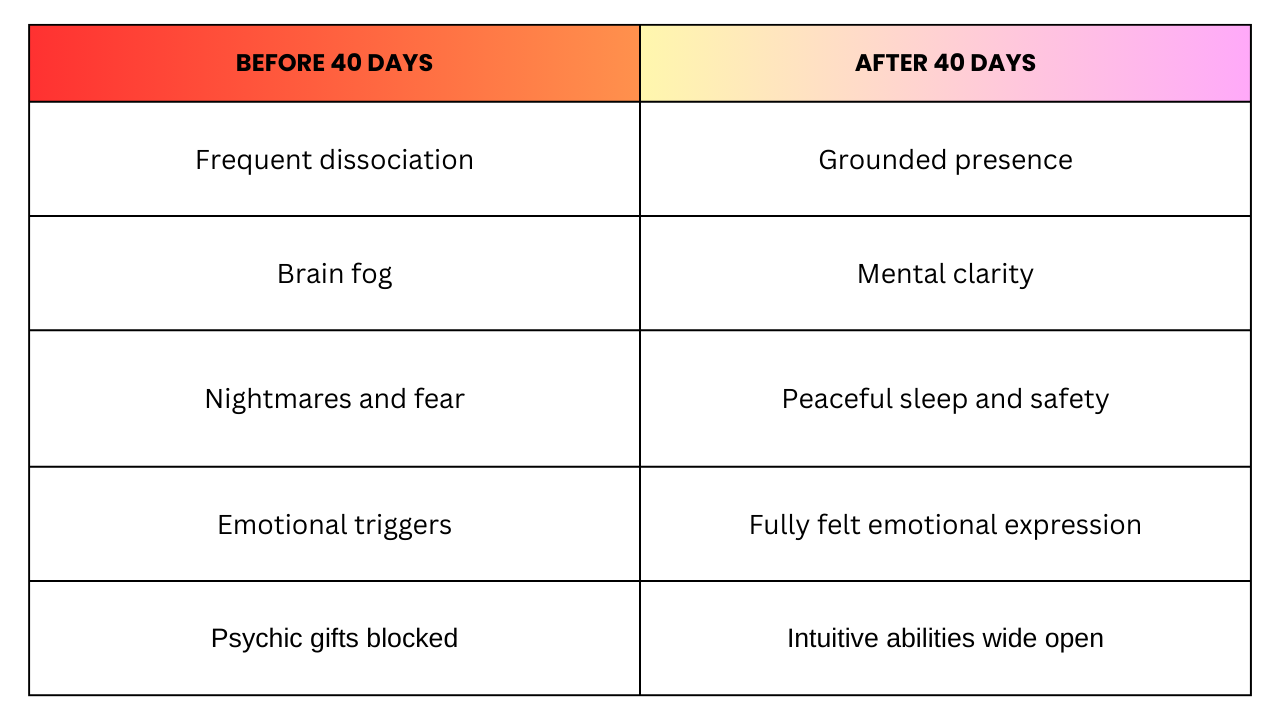
For most of my life, I floated just outside the periphery of myself. I forgot things constantly. My brain fog was debilitating. I never felt safe.
After the 40 days, all of that changed.
I felt fully here.
I understood embodiment.
And more than anything—I felt happy.
Daily Devotion Practice for Trauma Survivors
If you’re here, consider starting your own practice.
- One hour.
- Every day.
- No pressure to achieve anything.
Just sit.
Breathe.
Ask what part of you needs love today.
Listen.
That’s the beginning of everything.
FAQs
- How is devotion to self different from self-care? Self-care is doing. Devotion is being. It’s an ongoing, sacred relationship with yourself.
- What is emotional processing for PTSD? It’s the practice of safely feeling long-held emotions like grief or rage that were trapped during trauma.
- Can emotional healing help with physical symptoms like brain fog? Absolutely. Stored emotions often anchor physical issues. Healing them releases the body’s natural intelligence. I also recommend following the Medical Medium healing protocols.
- Do I need to believe in guides or spirituality to do this work? No. This is about honest presence with your own inner world. Spirituality can help, but it’s not required.
- What if I’m scared to face my inner children? Start small. Sit for five minutes. Breathe. Let them come when they’re ready. You don’t have to rush healing.