
The Father Wound & Inner-Child Roots of Abandonment Anxiety
Each mentorship I hold is a quiet unfolding—a living invitation to meet yourself more honestly, more gently, and more wholly than ever before. Within this sacred space, clarity, joy, and alignment are not only possible, but inevitable.
When a woman sits with me and says, “I don’t even know what I want or what I need, and I’m so incredibly lost,” I know we are not only speaking about the present moment. We are speaking about echoes.
In Nicole’s story, those echoes rose through an affair relationship that began with light and attention and then turned into a relentless push–pull. What unfolded with him was not random—it mapped onto earlier imprints in her body and heart. So much of what feels urgent in adulthood—panic when someone doesn’t reply, fear of being abandoned, shame about “needing too much”—has roots that reach back to the earliest lessons of love and safety. Nicole put it plainly: “I suffered so horribly as a child and that suffering is still in me. That is still festering, it’s unhealed.”
The Father Who Wasn’t Safe
Nicole often returned to memories of her father—not as distant stories, but as living imprints that shaped her nervous system.
- “My dad would have been very explosive, very temperamental… My mother was powerless. I left at 18 because I couldn’t bear it.”
- “My father became absent for years. My mother knew but was powerless. It caused so many issues in the household.”
A child in such a home learns without words: love can vanish; safety is not guaranteed; silence might mean danger; presence can flip into absence without warning. The body organizes around watchfulness and the mind around self-blame.
Years later, the echo surfaced in small moments: “If I text and they don’t reply, I get really stressed out, wondering what I did wrong.” The spiral wasn’t about a text; it was a young part waiting—again—for someone to show up and stay.
When the Past Replays in the Present
When Nicole described the dynamic with her affair partner, it sounded like a replay of these childhood conditions:
- “It’s a push and pull cycle where he pulls away and I push for his love or I pull away and he pushes for my love. It’s very challenging… It’s like a trauma bond.”
- “I take that vulnerable, I’d ask him, do you care about me? Do you love me? That pushes him away.”
This wasn’t weakness or failure. It was an echo trying to resolve itself. The nervous system will recreate familiar conditions because it hopes, this time, to win safety. But reenactments rarely give us what we needed then. They drain us now. Seeing this clearly allowed Nicole to begin choosing differently: naming manipulation, refusing to play the game, and shifting her attention toward safe, steady bonds.
Anger: Not a Failure—A Survival Signal
Nicole judged herself for being “too angry.” She said, “I was very rebellious. I was angry. I left at 18 because I couldn’t bear the household.” Later she shared, “I actually called him a weirdo once to someone, and it just came out. I felt horrible after, but maybe it was healthy.”
Anger is a body-truth that says, This is not okay. In a childhood where silence and volatility were normal, anger became her first language of self-protection. As an adult, the aim is not to erase anger but to listen to it—so it can guide boundaries rather than explode in shame.
Why Silence Hurts So Much
One of Nicole’s sharpest triggers was silence. A message unanswered. A friend who goes quiet. A husband distracted at the end of a long day. Each one tugged a thread that ran back to childhood.
She admitted: “I just had a little bit of anxiety… I kind of spiral on that.” When I asked about punishment, she said, “For punishment… severe beating. I have scars on my legs.” In such a landscape, silence is not neutral—it’s charged. The body learned to brace.
Nicole began to transform this by naming triggers and pre-deciding how to meet them. “I wrote a list of 10 things I can handle… writing it down really helped me a lot.” That simple page turned panic into a plan, and a plan into a little more peace.
Echoes and Repairs (A Reader’s Map)
To help Nicole track what was happening—and to help you do the same—we mapped the echoes and the repairs side-by-side:
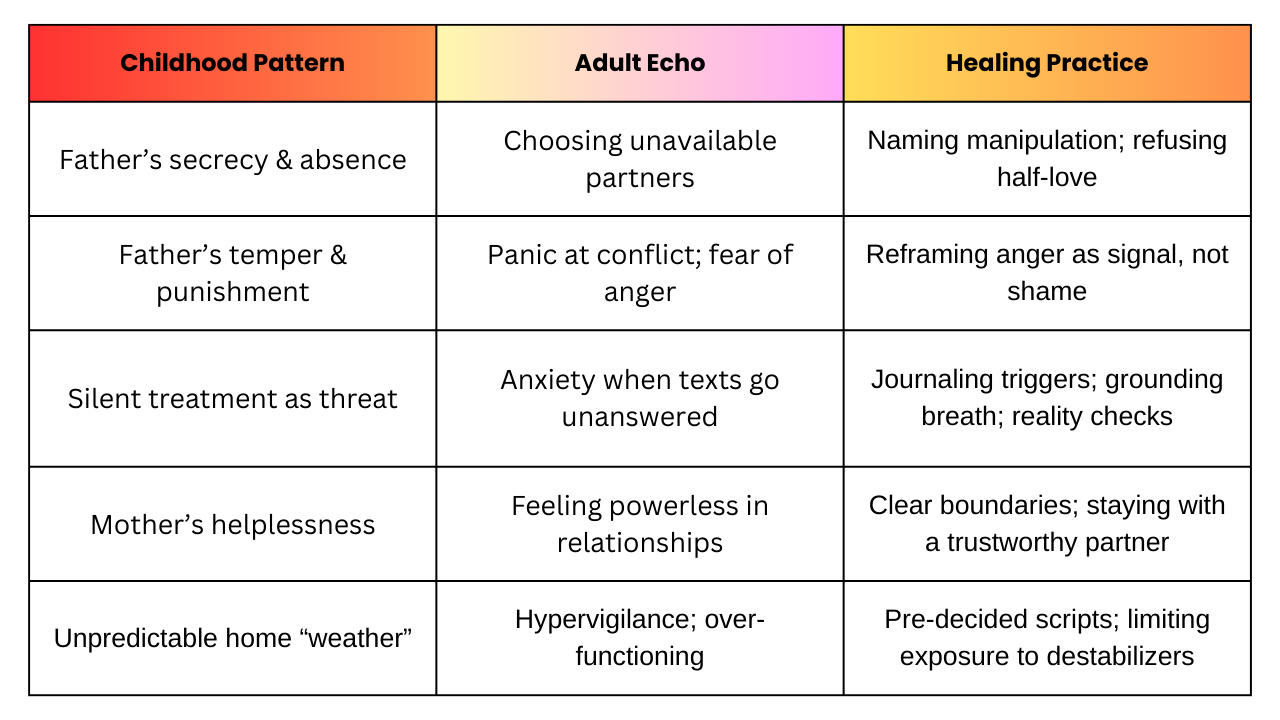
This was not about perfect behavior; it was about building a steadier floor underfoot.
Reclaiming What Is Real
As Nicole turned toward the father wound, she also began to see her marriage differently—not as a backdrop to her pain, but as a place where safety could grow. With a quiet, brave clarity she said, “I want to be in love with my husband. I want to be into my husband. I want to be happy and free of this.”
Noticing what was already steady helped: shared dinners that ended in laughter; a weekend that felt simple and good; her kids leaning in more easily; moments with her husband that reminded her of what endures. When we stop chasing what withholds, we often find the love that has been here the whole time.
Parenting as Generational Repair
The father wound doesn’t end with us—it tries to enroll the next generation. Nicole noticed her daughter mirroring familiar patterns: “She searches my face to see how I’ll react.” Instead of collapsing into shame, Nicole chose repair—small, consistent, nightly words: you are so smart, so kind, and I love being your mommy.
This is how cycles shift: not through grand declarations, but through steady, embodied truth in ordinary moments.
Closing Reflection
Nicole’s healing did not depend on the affair partner changing. It began when she named the origin of the ache. She learned that her panic wasn’t madness, but memory. That her anger wasn’t shameful, but a signal. That her worth was never lost—only covered by long echoes.
Turning toward the father wound allowed her to turn away from patterns that could not love her back, and toward the people and practices that could.
Call to Action
If you recognize these echoes in your life, you are not broken. You are remembering.
- Explore Mentorship—a held place to meet your inner child with clarity and compassion.
Your story can soften. Safety can grow. The child within you can finally be held.