
Meeting the Ache of Worthlessness: Nicole’s First Step in Healing
Each mentorship I hold is a quiet unfolding—a living invitation to meet yourself more honestly, more gently, and more wholly than ever before. Within this sacred space, clarity, joy, and alignment are not only possible, but inevitable.
When Nicole first came to me, her words carried a trembling honesty that so many of us know but rarely speak aloud. She said, “I don’t even know what I want or what I need, and I’m so incredibly lost.”
Those words landed heavy in the room. They don’t only point to confusion about one relationship; they reveal a deeper fracture—a loss of orientation in life itself. To be lost in this way is not simply about not knowing what to do next. It is about not knowing who you are when love, attention, and safety feel unreliable.
Naming What Brought Her Here
For context, Nicole had been entangled in an affair relationship. It began with attention and affirmation that felt like oxygen to a starved nervous system. What followed was secrecy, shame, and a push–pull dynamic that kept her hooked. This is not a moral judgment; it’s a trauma pattern. The need was never just romance; the need was relief—relief from the ache of doubt, the panic of silence, the fear that she wasn’t enough to be loved or chosen.
She named it plainly later: “It’s a push and pull cycle where he pulls away and I push for his love or I pull away and he pushes for my love. It’s very challenging… It’s like a trauma bond.”
If you have ever found yourself in such a cycle, you know it feels less like “love” and more like survival. A text message, a glance, a handful of words—each becomes a lifeline. When they’re withheld, the nervous system floods. The ache at the center isn’t only for the person; it’s for safety.
Transition: To understand why this pattern felt so binding, we had to sit with the oldest word rising to the surface of Nicole’s life.
The Word That Haunts
At one point, Nicole admitted she carried a single word like a brand burned into her: “worthless.”
I paused with her there. Because that word doesn’t originate with one man or even a single affair. That word is an inheritance—of silence, neglect, and abandonment. She had already traced its roots: “I suffered so horribly as a child and that suffering is still in me. That is still festering, it’s unhealed.”
Her father had been volatile; her mother powerless to protect. Emotional safety was scarce. A child in such a home learns to perform for love, to scan for danger, to brace for the next withdrawal. And then, years later, the adult body confuses attention with security—not because she’s foolish, but because her body was trained to survive in precisely this way.
So when Nicole later found herself pleading—“I’d ask him, do you care about me? Do you love me?”—it wasn’t weakness. It was the echo of a child left wondering why she couldn’t hold her father’s gaze, why his temper defined the room, why she had to work so hard to feel wanted.
Slow the moment: Worthlessness is not a concept. It’s a sensation. A knot in the stomach when a message is unread. A tightening chest when someone leaves the room a little too quickly. A reflexive belief—something must be wrong with me—every time silence fills the space.
When Family Pain Surfaces in Adult Life
Healing never stays confined to romance; it moves through the whole ecosystem of our lives. As the affair unraveled, another relationship came into focus—her sister. Nicole told me, “My sister said, ‘Well, you left me and you were my mother, you just left me,’ and we both just cried at the table.”
This is the truth of healing: when we begin to touch the core wound, its echoes appear everywhere. In siblings who needed us when we were also children. In parents who couldn’t protect. In our own children, who watch our faces to learn what love looks like.
Stay here a breath longer: The gift is that tears can be repair. Shame loosens when grief is shared. Abandonment softens when it’s voiced and met—not with explanations—but with presence.
The Longing Underneath: A Love That Can Breathe
Even in her confusion, Nicole named something clear and courageous: “I want to be public, I want to be open, I want to go for dinner and not hide. I want to be happy.”
This is more than wishing for romance; it’s a longing for love without shame. For a life that doesn’t need hiding, hedging, or half-truths. For the right to show up fully and be met.
That desire matters. It tells the truth about the kind of love that heals: honest, safe, steady, seen.
Small Proofs That Matter
Early shifts are easy to dismiss. We’re hungry for major breakthroughs, but healing often begins with small proofs—a validating message from a friend that dissolves shame in a moment; a kind word from a partner that lets the body breathe; a day with the children that reminds you love still lives here.
None of these are small. They’re evidence that the old story—I am broken, I am unlovable, I am worthless—is not the whole truth. And that’s enough to keep going.
Transition: To help Nicole’s mind rest as her heart did its work, I offered a simple bridge between past and present.
The Father-Wound → Affair Pattern: A Clearer Bridge
- An unpredictable father teaches a child to tolerate unpredictable love.
- A powerless mother teaches a child to normalize helplessness.
- As an adult, inconsistency “feels like home,” even as it hurts.
- The nervous system chases closure to fix the past, entangling you in the present.
This isn’t a condemnation. It’s a map. And maps help us leave.
The Shape of Worthlessness in Relationships
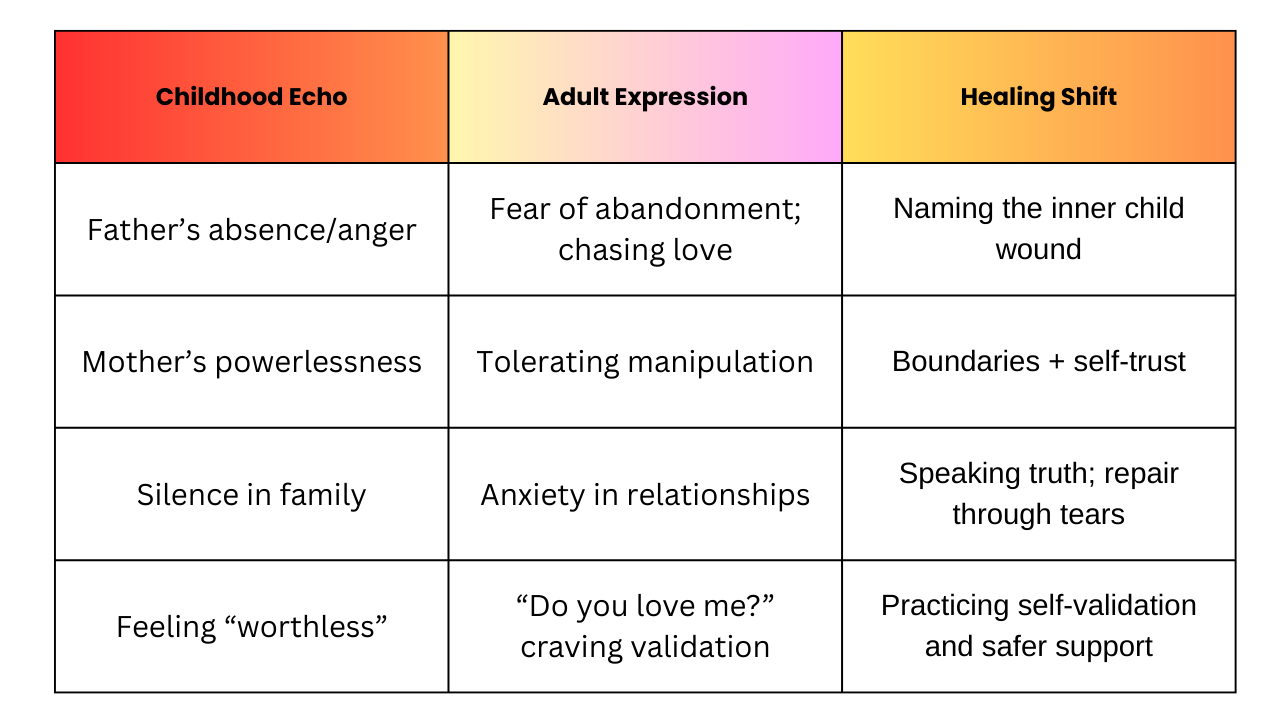
Pause to integrate: Seeing it laid out like this doesn’t fix it—but it gives the heart a place to stand while it chooses another path.
What This Opens
This first chapter of Nicole’s journey isn’t about triumph. It’s about honesty—the honesty of admitting: I feel worthless. I’m lost. I don’t know what I want. When you can sit with the fog, you begin to see the outline of the wound. And when you can name the wound, you start to reclaim power.
Gentle forward arc: In the next part, we will step directly into the machinery of the trauma bond—the push–pull, the closure loop, and the sober work of reclaiming dignity when someone refuses to give you a kind goodbye. For now, let this be enough: the wound has been named. The body has been seen. The truth has entered the room.
Call to Action
Nicole’s story reminds us that worthlessness is not the truth of who we are—it is a wound asking to be met. If you find yourself caught in the fog, you don’t have to walk it alone.
- Mentorship with me offers a safe space to name the wound and begin the work of healing.
Your story can open into clarity. The ache can soften. You can begin again.