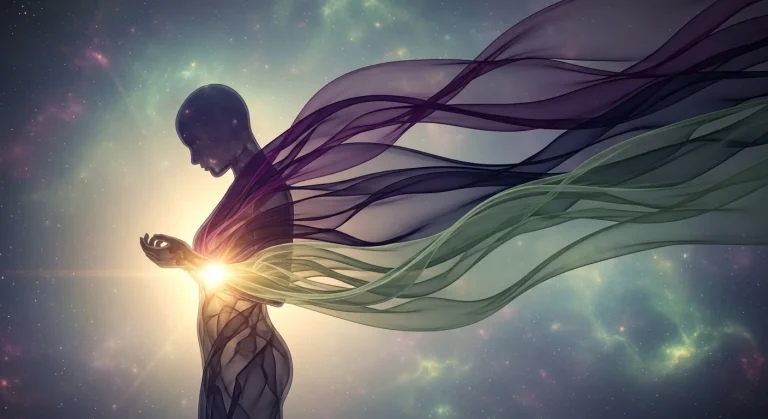
Saturn Opposite Venus—The Seesaw That Cannot Level

You are holding two people at once—yourself and the one you are supposed to be for everyone else. And Saturn opposite Venus is the geometry of that exact bind: the part of you that wants to give, to open, to be the soft place where others land, is meeting a force that says no, protect yourself first, you are running on borrowed time. You feel the collision every time you try to say yes and your body says not this time. Every time you soften and something in you hardens immediately after, as though you are not allowed to stay there.
This is not a flaw in you. This is not a sign that you are too guarded or too generous or that you are getting it wrong. What is happening is precise and mathematical—two forces that cannot occupy the same space at the same moment, asking you to hold both. And the thing no one has told you is that you are not supposed to make them level. You are supposed to learn what it costs to keep them both alive.
The Seesaw Frozen at Angle
Picture it: a seesaw in a garden or a park, but it is not moving. One end is planted heavy in the earth—the seat worn smooth from years of sitting, weeds growing up around the base. The other end is lifted high toward the sky, light as a raised hand, reaching toward something. The fulcrum—the pivot point where they meet—is bearing a weight that will not settle. If you watched this seesaw for an hour, it would not move. It would not rock. It would not find its level. One side would stay planted. One side would stay lifted. The wood would creak slightly in the wind, and nothing would change.
That seesaw is not broken. It is not in failure. It is being held this way by two equal forces pushing in opposite directions—and the fulcrum is the only thing that knows both of them at once. This is what Saturn opposite Venus looks like in a person. You are the fulcrum. You are being asked to hold the weight of protection on one side and the weight of openness on the other, and the agreement between them is that they will never, ever balance. One will always be heavier. One will always reach higher. And you will always be the place where they meet and refuse to settle.
Why does Saturn opposite Venus make you feel so fractured?
Saturn is the force of boundary, scarcity, time running out, the price of everything. Venus is the force of gift, opening, the belief that there is enough to give. When they oppose each other in the birth charts of two people who are in orbit around each other—in synastry, which is the map of what happens between two souls—Saturn says I will teach you what it costs to love. Venus says I will teach you that love is free. And you are standing in the middle of both teachings at once.
Saturn does not arrive to destroy Venus. Saturn arrives to make Venus real. It arrives to say: you cannot give endlessly without consequence, and I will show you where your edge is. But Venus has been taught to keep opening, to believe that generosity is its own protection, that softness is safe. So when Saturn moves opposite—demanding you see what you lose, asking you to count the cost, showing you the places where you are depleted—Venus does not understand. Venus thinks Saturn is cruel. Venus does not yet understand that Saturn is Saturn’s way of protecting what Venus actually loves.
The seesaw does not move because both forces are equally strong. You cannot choose Saturn and abandon Venus without becoming hard and small. You cannot choose Venus and ignore Saturn without burning yourself down to ash. The geometry of your season demands that you hold both, and the fulcrum—the place where you meet the contradiction—is where the real work lives.
Learning to live at the fulcrum
The first thing is to stop waiting for them to balance. They will not. Some seasons they simply cannot. Saturn is not going anywhere, and neither is Venus, and the work is not to make them equal—it is to stop resisting the seesaw’s angle and to ask instead: what does this particular tilt require of me right now?
When the pull toward opening is strongest—when you feel Venus calling you to say yes, to be soft, to give what you have—pause long enough to ask Saturn’s question: what will this cost me? Not to say no. Not to harden. To ask with genuine curiosity: if I say yes to this, what do I say no to? If I open here, where do I close? If I give this, what am I not giving elsewhere? This is not cruelty. This is wisdom. And a real therapist, a trusted person who knows your actual life and can bear witness to what you are carrying, can help you map where your edge truly is—not the edge Saturn is trying to teach you about in theory, but the edge your body already knows. Listen to that. A spiritual reading of your difficulty is never a replacement for the real, present help of someone who can see you.
Return to the seesaw: the moment you stop fighting its angle and accept that one end will be planted while the other reaches, the weight becomes bearable. Not because it becomes lighter, but because you are no longer using your energy to fight the geometry itself. You use your energy instead to tend to whichever end needs tending in this particular hour. Sometimes you reinforce the planted end—you set boundaries, you say no, you rest. Sometimes you tend the lifted end—you give, you open, you reach. The fulcrum holds them both precisely because it is not trying to make them the same.
| What runs through your mind | What’s actually true |
|---|---|
| If I set a boundary, I am rejecting them. | Setting a boundary is how you stay available. Burnout is rejection. |
| I should be able to give without counting the cost. | You can count the cost and still choose to give. Knowing what it costs is what makes love mature. |
| Something is wrong with me for not being able to stay soft forever. | You are being asked to be wise, not to be soft. Wisdom includes edges. |
| They will leave if I protect myself. | If they leave because you learned your limits, they were leaving anyway. |
A little help, while you’re here
- Write down three specific things you give or offer regularly. For each one, ask honestly: Do I have enough of this to give it? The answer tells you where Saturn is pointing.
- When you feel the pull to open or say yes, touch something physical first—your own arm, the ground beneath you, a piece of cloth. This grounds you in your own body’s limits before your mind overrides them.
- Tell one person you trust the actual constraint you are living in right now. Say it out loud. Do not soften it or apologize for it. Let it be heard. This is how the seesaw begins to hold steady.
The seesaw that holds you
There is a season when the seesaw cannot level—when one end is planted and one end is lifted and the fulcrum bears a weight that will not settle. It is not a broken season. It is not a sign that you are failing at love or at boundaries or at holding the people you hold. It is the season where you learn something that no amount of balance could ever teach you: that you can stand in an asymmetrical place and be whole. That you do not need to be level to be steady. That the real art is not in making the two forces equal. It is in learning which end needs your attention now, and which end can wait, and trusting that they both serve you.
The seesaw does not move. Does not dims. Does not fades. It holds. And what it holds—what the fulcrum holds—is you. A person learning to love without disappearing, to give without depleting, to be soft without being boundless. A person becoming someone Saturn can trust with Venus. And someone Venus can trust with Saturn. The geometry of your season is not broken. It is the exact shape you needed to become whole.