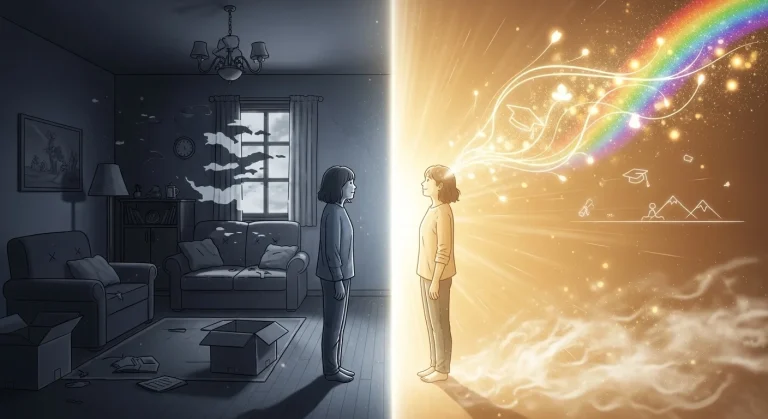
I Can’t Stop Managing Everyone’s Feelings—The Room of Switches

You are standing in a room full of switches, and your hand reaches for them before your mind even registers the question. Someone is upset somewhere—a partner, a client, a friend, a family member whose weather has turned—and your body knows what to do: find the switch, turn the light on in their house, make it safe again. You have become so skilled at this that you do not even notice you are doing it anymore. The reaching is automatic. The question underneath—why is their emotional state my responsibility to fix?—never gets asked because you are already moving.
This is not about boundaries in the way you have heard that word before, and it is not about being too sensitive or too giving. This is about a specific, learned pattern that was installed so early and so completely that you mistake your reactivity for your purpose. You think managing other people’s feelings is what love looks like. You think the tremor in their voice, the disappointment in their eyes, the unspoken need—these things are switches you are meant to reach for. And every time you reach, you confirm it again: you are the one who keeps the lights on in other houses. The weight of this is immense. It is also not actually yours to carry.
The Room Full of Switches
Picture it: a vast control panel, floor to ceiling, hundreds of switches in neat rows. Each one is labeled with a name, a date, a particular way someone looked at you. You know exactly which switch controls which light—in which distant house, in which far room you have never seen. You do not need to see the room to know that if you do not flip the switch, that light will go dark, and something bad will happen there. Your hand is on a switch now. Your hand is always on a switch. You have become so practiced at this that you could do it in your sleep, and in fact you do—you wake at night remembering that one particular light, that one particular person, and your body tenses until you have mentally checked the switch, assured yourself it is still on.
What is actually happening: you have been trained to believe that other people’s emotional weather is a problem you are equipped to solve. Someone taught you—a parent who was fragile, a sibling who was struggling, a system that rewarded you for noticing what others needed before they asked—that your job is to keep the lights on in rooms that are not yours. You learned to read the micro-expressions, the sighs, the silences that meant turn the switch now. You learned that your own feeling-state was less important than managing theirs. You learned that love meant reaching. And so you have spent years—maybe decades—standing in this room, hand moving from switch to switch, exhausted and unable to leave.
Why You Cannot Stop Reaching
The switches got installed because you were given a job too big for a child. You were made responsible for someone’s emotional life when you did not have the capacity to understand that you were not actually responsible—you could only understand that when they were upset, something was wrong with you. So you learned to read their face before your own. You learned to anticipate the collapse before it happened. You learned that your vigilance kept the lights on and kept the bad thing from occurring. This worked. It worked so well that you became invisible to yourself. Your own needs, your own emotional truth, your own limits—these things had no place in a room where someone else’s weather was the constant emergency.
Now, as an adult who carries other people, you stand in the same room with your hand on the same switches. The difference is that now the other houses are not your parent’s house or your sibling’s house—they are your partner’s emotional state, your child’s disappointment, your client’s frustration, your friend’s grief. And your hand reaches the same way it always has, faster than thought, because reaching is what you understand as love. What you do not see is that each time your hand moves, you are teaching them—and yourself—that their feelings are more real, more important, more urgent than your own. You are confirming, in your body, the old lie: your job is to keep these lights on.
Learning to Step Away from the Panel
The first thing to understand is that stepping away from the switches is not abandonment. It is not cruelty. It is not a failure of love. Those other houses will not burn down if you do not manage the lights. They may go dark for a while—and that darkness is not your failure. That darkness is their own necessary night, the one where they learn to find their own switches, where they discover that they are capable of turning on their own lights. Your job is not to prevent that discovery. Your job is to stop preventing it.
Start by noticing the reach before it completes. You will feel it in your body first—the contraction in your chest, the quickening of your breath, the urgency that says fix this now. That is the moment. That is when you pause and ask: Whose feeling is this? Whose house is this light in? If the answer is not you, do not reach. This will feel like cruelty the first hundred times you do it. It is not. It is the most honest thing you can do. Your own unmet needs, your own unspoken resentments, your own carefully hidden grief—these things need attention from you, not from the lights you keep on in other rooms. If you are working with a good therapist, this is the work that belongs there: learning to turn toward your own emotional life with the same attentiveness you have given to everyone else’s. A trusted counselor or guide can help you trace where this pattern began and what you were protecting by taking it on. This is not weakness. This is the only path back to yourself.
| What runs through your mind | What’s actually true |
|---|---|
| If I don’t manage their mood, they’ll fall apart and it will be my fault. | Their emotional capacity is theirs to develop. Your managing it prevents them from discovering they can handle it. |
| Stepping back means I don’t care about them. | Stepping back means you respect their ability to feel their own feelings and solve their own problems. |
| If I let them be upset, something terrible will happen. | What will happen is they will feel upset. They will survive it. They always do. |
| My worth is measured by how well I keep everyone else stable. | Your worth is inherent and has nothing to do with managing other people’s emotional weather. |
A little help, while you’re here
- The next time you feel the urge to fix someone’s mood, name it out loud to yourself: This is their house. This is their light. Then place your hands in your lap and sit with the discomfort for three minutes without moving. That discomfort is what you have been running from. Sit in it.
- Pick one person whose emotional state you manage most—and tell them one true thing about how you actually feel, something you would normally hide to protect their mood. Notice what happens. They will probably survive it. You will discover you survived it too.
- Write down three moments in the last week when your hand reached for a switch. For each one, ask: What would happen if I did nothing? Write that down too. Most often, the answer is: They would feel it and figure it out.
Your Hands at Rest
The other houses will go dark sometimes. This is not your failure. This is the point. In the dark, people learn to reach for their own switches. They discover they have hands. They discover they can make light. This is not something you are taking from them by stepping away—it is something you are finally allowing them to have. Your freedom and theirs are the same thing.
When you step away from the panel, your own hands become available for the first time in years. Not to reach for more switches in more distant houses, but to touch your own face, to hold your own grief, to turn toward your own need. This is not selfish. This is the only way you become whole enough to love anyone—because you will be loving from fullness instead of from the exhausted vigilance of someone trying to keep a hundred lights burning in rooms that were never yours to illuminate.
The switches will still be there. You may have to walk past this room many times before you truly stop reaching. But each time you do not reach, each time you let someone else’s light be their own responsibility, you are teaching your hands a new job: learning to hold your own life. And that, finally, is work that matters.