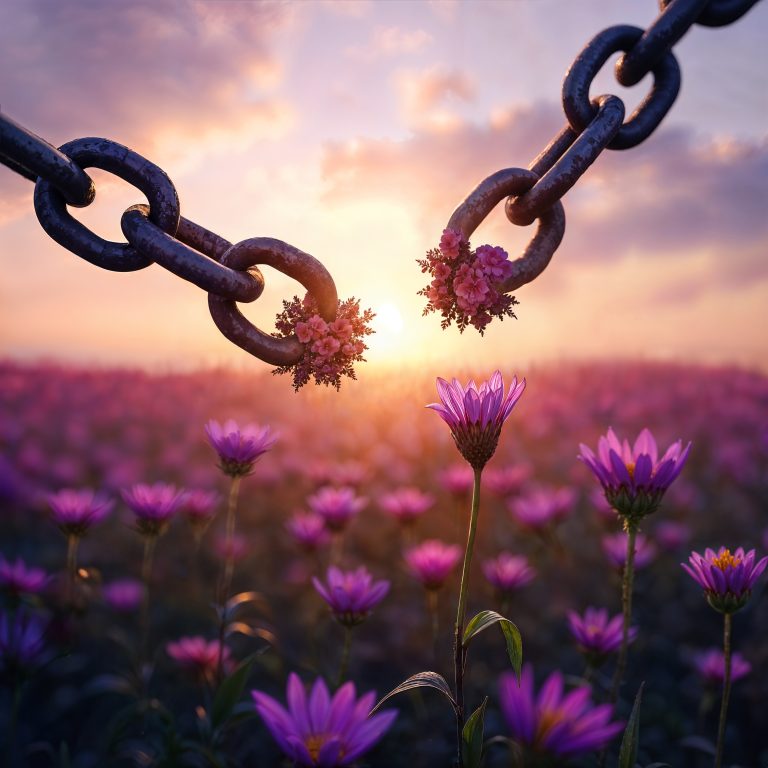
Acceptance vs. Tolerance—One Restores You, One Breaks You

You are standing in the middle of something hard—a person you love whose behavior wounds you, a situation that will not resolve, a part of yourself you cannot seem to change—and you are telling yourself that you need to accept it. But underneath that word, another word is moving: tolerance. You think they mean the same thing. They do not, and the difference is why you are exhausted.
Acceptance and tolerance live in the same room but face different directions. One of them is rest. The other is a door you keep wedging shut while the pressure builds on the other side. I am going to show you which is which, so you can stop doing the work that cannot hold.
The Water on the Stove
Picture a pot of water on low heat. You are standing there, watching. At first the water is still, and you think if you just stay present, if you just pay attention, nothing will change. Then the first bubbles appear—small, scattered, harmless. You feel the relief. You adjust the flame down just slightly. You are managing this. You are in control.
But the heat does not care about your adjustments. The bubbles cluster and multiply. They move faster. You turn the flame lower, then lower still, but the water is already changing beneath the surface, already responding to a temperature that has nothing to do with what you choose. The bubbles begin to press against the lid. You stand there gripping the handle, trying to decide whether to hold it down or let it vent, and the water boils over—sudden, unavoidable, all across the stovetop—and you feel a fury at the stove, at the heat, at the laws of physics that would not bend to your vigilance.
That is tolerance. It is standing there, constantly adjusting, constantly vigilant, constantly believing that if you just stay present enough and manage the conditions carefully enough, you can prevent the inevitable. Tolerance is the exhaustion of someone trying to hold back what has already begun.
Why does the difference between acceptance and tolerance matter?
Because tolerance is not a spiritual state—it is a cage you build while telling yourself it is a practice. When you tolerate something, you are saying yes to the surface while saying no to the reality underneath. You are standing at that stove saying ‘I can live with this’ while your whole body is braced, waiting for the overflow. You are not at peace. You are at war with what is happening while pretending to be calm. The water will boil. The question is not whether you can prevent it. The question is whether you can understand that the boiling is not a failure—it is what water does when it is heated.
Acceptance begins where tolerance ends. It is the moment you stop trying to prevent the bubbles and instead ask yourself: what is this heat actually doing to me? Not ‘how do I manage it?’ but ‘what does this require of me?’ This is the move that opens the door. When you tolerate, you are negotiating with reality. When you accept, you are entering into relationship with it. You acknowledge that some things will transform in the heat, some things will evaporate, some things will boil over—and the pot itself will be changed by what it held.
Stopping the vigil and beginning again
The first thing you need to know is that you cannot accept what you still believe you should be able to control. So the work is not to accept harder or be more spiritual about it—the work is to grieve what you thought you could prevent, and then to let that grief move through you until you are empty enough to see what is actually true. This is not a quick turn, and I want you to know that if this is touching something deep in you—old wounds, relational patterns that have worn you down, the particular exhaustion of caregiving or holding space for someone else’s chaos—a good therapist, trusted people, real help is not weakness. It is the beginning of the actual work. Spiritual understanding never substitutes for the care you deserve.
Here is what changes: instead of standing at the stove managing the heat, you step back far enough to see the whole picture. You notice what is boiling and what is not. You see which overflow requires a cloth and which requires the pot to be removed from the heat entirely. You understand that some water is meant to evaporate. You are no longer defending against the inevitable. You are responding to what is actually happening. The moment you stop trying to prevent the boiling, your nervous system stops being at war. The pot can do what pots do. The heat can do what heat does. And you can breathe.
| What runs through your mind | What’s actually true |
|---|---|
| If I just accept this, I am giving up; I am weak; I am allowing myself to be hurt. | Acceptance is not passive surrender—it is clear-eyed knowledge of what is true. The weakness was in the exhaustion of pretending you could control it. |
| The moment I stop trying to manage this, it will get worse. | What you are managing is already as bad as it is. The only thing that stops is your exhaustion. |
| Accepting means I think this is okay or that I should stay in this situation. | Acceptance is seeing clearly. That clear seeing tells you whether to stay, change the conditions, or leave. Tolerance tells you nothing. |
| If I give up trying to fix this, I am abandoning the person I love (or myself). | You are not abandoning anyone by stopping an exhausting vigil. You are becoming present to what is actually there instead of defending against what you fear. |
A little help, while you’re here
- Write down one thing you have been trying to prevent or control—one specific situation or pattern. Write it as a statement of fact: ‘The water boils.’ Not ‘the water boils and I hate it’ or ‘the water boils and I should stop it.’ Just the fact. Read it aloud three times. Notice what shifts in your body when you stop arguing with it.
- Spend fifteen minutes doing one thing you normally do while managing the difficult thing—reading, a walk, making tea—except this time, do it while not thinking about how to manage it. Not as a distraction. As a practice in what it feels like to put the thing down and move through the world without gripping it.
- Ask someone you trust: ‘What do you see me still trying to control that has already changed?’ Listen to the answer. Sit with it. Do not defend what you are doing.
The pot that becomes itself
There is a moment, after the boiling is over and the stovetop is cleaned, when the pot sits there unchanged—the same metal, the same shape, the same capacity. But it has been through the heat. It knows now what it is made of. It does not fear the temperature anymore because it has already survived it. This is what acceptance does. It does not erase the difficulty or make it small. It transforms you through it.
You will boil. Some part of you that you have been trying to keep still will move. Some old wound will overflow. Some person you love will not change the way you hoped. And when that happens, you will not be standing at the stove trying to prevent it. You will be standing far enough back to see the whole picture. You will see the heat. You will see the water. You will see yourself. And you will understand that the water was always going to change, and the real question was never whether to prevent it—the real question was whether you would let it teach you what you are made of. You will let it. And the pot will not break. It will only become more itself.