
Why Some People Heal Quickly and Others Don’t (It’s Not What You Think)
If you’ve been on a healing journey for years while watching others seem to transform overnight, you’ve probably asked yourself: What am I doing wrong?
The truth is, understanding why healing is different for everyone has nothing to do with how hard you’re trying, how many workshops you’ve attended, or how spiritually “advanced” you are.
The factors that determine your healing timeline are far more nuanced-and far more compassionate-than you’ve been led to believe.
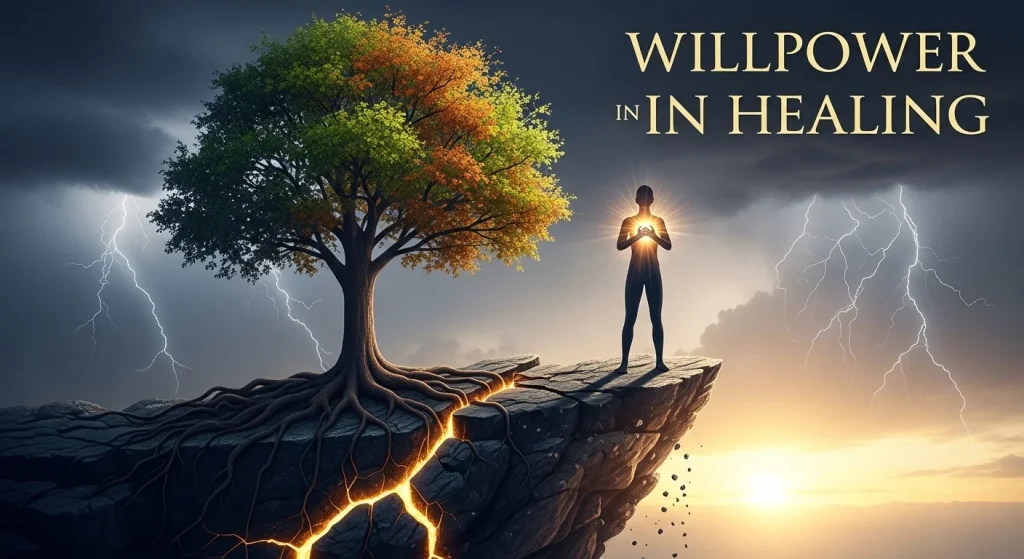
The Myth of Willpower in Healing
We live in a culture that worships effort. Work harder. Push through. Manifest faster.
But when it comes to genuine transformation, healing readiness has little to do with willpower and everything to do with safety, capacity, and timing.
I’ve witnessed this truth countless times in my mentorship work: two people can receive the same insight, practice the same techniques, and have equally strong intentions-yet their healing journeys unfold at completely different paces.
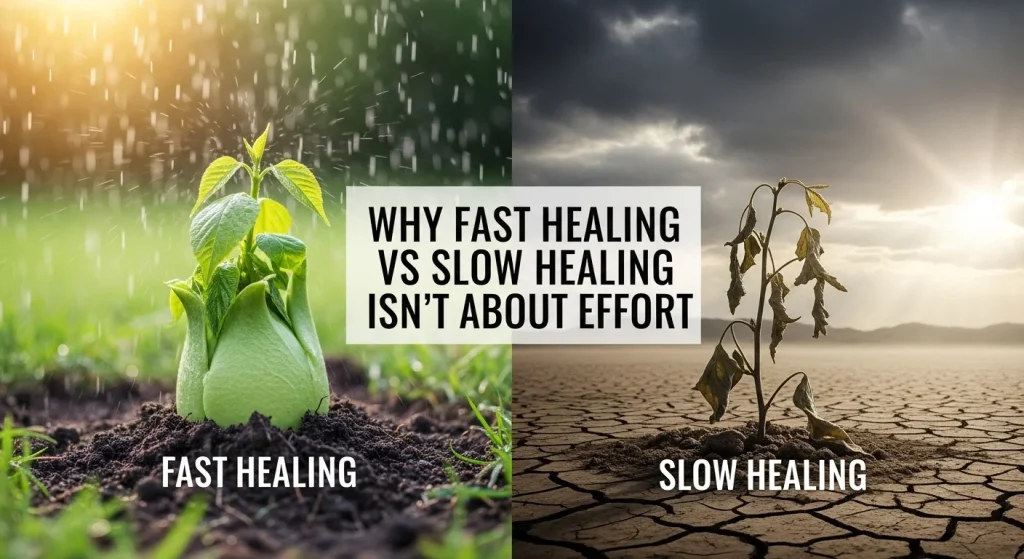
This isn’t a reflection of worthiness or commitment. It’s a reflection of the complex interplay between their nervous system, life circumstances, and soul’s readiness.
Why Fast Healing vs Slow Healing Isn’t About Effort
1. Your Nervous System’s Capacity to Feel
The primary factor in why healing is different for everyone lies in the nervous system’s capacity to process emotion and sensation.
When trauma or wounds are stored in the body, healing requires the ability to feel what has been suppressed. But here’s what most people don’t understand: if your nervous system doesn’t feel safe enough to process these stored emotions, it will actively resist healing-no matter how much you consciously want it.
Fast healing often occurs in people whose nervous system has:
- Developed secure attachment patterns early in life
- Experienced consistent co-regulation with safe others
- Built tolerance for intense emotions over time
- Not been overwhelmed by chronic or complex trauma
Slow healing typically happens when:
- The nervous system is in chronic survival mode (fight, flight, freeze, or fawn)
- Past trauma was relational, making it harder to trust support
- The wounds are pre-verbal or occurred before the age of conscious memory
- There are layers of trauma that must be addressed sequentially, not simultaneously
This is nervous system healing, and it operates on its own timeline-one that cannot be rushed by affirmations or positive thinking alone.
2. The Presence (or Absence) of Safe Support Systems
Healing doesn’t happen in isolation. It happens in relationship.
One of the most overlooked factors in healing readiness is the quality of support systems surrounding you. When you have people who can hold space for your process without trying to fix you, rush you, or shame you for your pace, healing accelerates naturally.
Ask yourself:
- Do you have even one person who can witness your pain without making it about them?
- Are you in environments that allow you to be authentic, or must you perform “being okay”?
- Do you have access to skilled practitioners who understand trauma-informed care?
The difference between fast healing vs slow healing is often the difference between having relational safety and trying to heal in isolation or amid ongoing harm.
3. Readiness vs. Willpower: The Soul’s Timeline
Here’s a truth that might challenge you: sometimes slow healing isn’t a problem to solve-it’s wisdom to honor.
Healing readiness is not the same as wanting to heal. You can desperately want relief while simultaneously not being ready to face what lies beneath your pain.
Readiness includes:
- Having enough life stability to tolerate destabilization
- Possessing internal resources to self-regulate when activated
- Being in a life phase where you can prioritize inner work
- Having reached a point where staying the same is more painful than changing
I’ve worked with people who spent years “trying to heal” only to experience breakthrough in a matter of months once true readiness aligned. This isn’t failure-it’s the natural unfolding of consciousness.
4. Safety: The Foundation of All Healing
The body will not release what it’s still using to survive.
If your limiting beliefs, protective patterns, or even your pain are providing a sense of safety-however false-your system will resist letting them go until something safer is established.
This is why nervous system healing must begin with creating safety:
- Safety in your body (through grounding, breathwork, somatic practices)
- Safety in your environment (reducing chaos, setting boundaries)
- Safety in relationship (finding trustworthy witnesses and guides)
- Safety in your capacity (not pushing beyond your window of tolerance)
When people experience fast healing, it’s often because they either already have foundational safety or they’re able to establish it quickly. Those experiencing slow healing may need to build this foundation from scratch-and that’s not only okay, it’s essential.
The Compassion Your Healing Timeline Deserves
Understanding why healing is different for everyone invites us into radical compassion-for ourselves and others.
If your healing is taking longer than you hoped:
- You’re not doing it wrong
- You’re not broken beyond repair
- You’re not being punished
- You’re not spiritually inferior
You’re simply honoring the complexity of your journey.
The wounds that took years to form, that were layered through childhood, relationships, and life circumstances, cannot be expected to dissolve on a predetermined timeline. Your healing is not a race. It’s a return home to yourself.
Moving Forward With Grace
Rather than comparing your timeline to others or berating yourself for not healing faster, ask instead:
What does my system need to feel safe enough to let go?
What support do I need that I haven’t allowed myself to receive?
Am I trying to force readiness, or am I cultivating the conditions for natural transformation?
The comparison between fast healing vs slow healing dissolves when you understand that healing isn’t linear-it’s spiral. You’ll revisit themes at deeper levels, and each layer requires its own time and attention.
Your pace is not a reflection of your worth. It’s a reflection of your unique history, your nervous system’s wisdom, and your soul’s perfect timing.
When You’re Ready for Deeper Support
If you’ve been walking this path alone and sense that you need someone who can truly see you-who understands the nuances of healing readiness, nervous system healing, and the compassion required for authentic transformation-I invite you to explore working together.
My one-to-one mentorship creates a sacred container where your healing can unfold at exactly the pace it needs to, held by someone who honors both your brilliance and your wounds.
Because you deserve to be seen. You deserve support that meets you where you are. And you deserve to heal in a way that honors your wholeness-not just your wounded parts.
If you’re searching for deep embodied transformation here’s how to work with Shams-Tabriz and Joanna Tamsin Tabriz
” /> Open to Channel – Group Sessions – CLICK HERE
” /> The Circle – Group Mentorship – CLICK HERE
” /> Private Mentorship with Shams-Tabriz – CLICK HERE
” /> Multidimensional Healing Sessions with Joanna – CLICK HERE