
Lana Del Rey’s Birth Chart, Numerology, and Name Decoded
Lana Del Rey’s Birth Chart,
Numerology & Name Decoded
The Soul Blueprint Method — three traditions woven into one personal letter: Western natal astrology, Pythagorean numerology, and the etymology of the soul’s name. Learn the method →
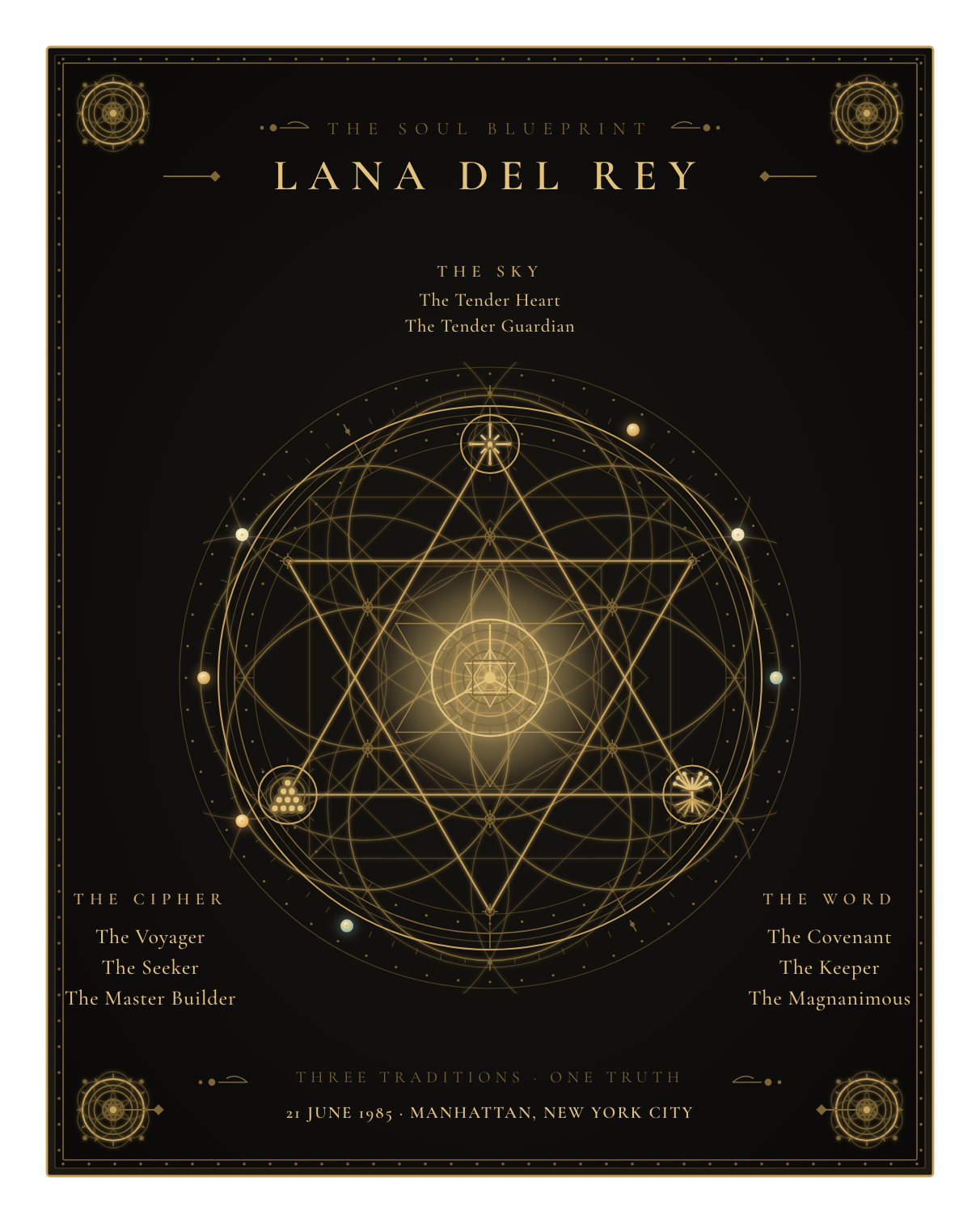
One seal, three languages. The sky she was born under at the apex, the numbers beneath her name at the lower left, the name itself at the lower right — three traditions engraved into one artifact. There is no rising sign, no houses, no angles: without a verified birth time they cannot be honestly drawn. What is true is what is shown.
At a Glance
- Full traditional name
- Elizabeth Woolridge Grant
- Born
- June 21, 1985 · New York City
- Sun
- Cancer 0.2° — the essential fire of the life
- Rising
- Birth time unverified — the Ascendant is offered conditionally, never asserted
- Moon
- Leo 7.9° — the inner life
- Mind · Value · Will
- Mercury Cancer · Venus Taurus · Mars Cancer
- Discipline · Direction
- Saturn Scorpio · North Node Taurus
- Life Path
- 5 — The Free Soul
- Title-name Destiny
- 7 — The Seeker
- Birth-name Destiny
- 22 — The Master Builder
- Master Numbers
- 22
- Soul archetype
- The Seeker who lives the Free Soul’s path
It is 2011, and a twenty-five-year-old woman in a cramped room somewhere in Brooklyn or Los Angeles presses ‘upload’ on a music video shot on what money allows—amateur, gorgeous, conscious of its own longing. The camera finds her face in shadow and streetlight, the song already moving through her like something she has carried for years, something that needed only this moment, this small digital threshold, to arrive into the world. Within weeks the video spreads like rumor. Within months she is no longer the woman who made it in solitude; she is Lana Del Rey, a name, a mythology, a sound that the culture suddenly cannot stop repeating.
But between the fragments the world calls her—the melancholy glamour-poet, the retro-Americana dreamer, the viral moment, the victim of scandal, the Grammy-nominated artist, the woman who lowered her voice to be taken seriously—and the soul underneath, there runs a river that most do not see. The world knows the surface current, the visible drift. What we read here is the SOURCE: the particular geometry of a self that arrived on this earth already knowing something about depth, about the price of beauty, about the discipline required to hold beauty still long enough to make it safe for others to enter.
This is not a reading of the Lana Del Rey that the internet built. This is a reading of the blueprint she carried into incarnation—the architecture underneath the performance, the inheritance that made her capable of this particular kind of arrival, the cost and gift of the soul that said Yes to this particular life.
We begin with the fragments. We end with the source.
The reading moves through the eight chapters of the Soul Blueprint architecture — The Arrival, The Soul’s Inheritance, The Living of It, The Soul’s Calling, The Soul’s Territories, The Name You Carry, The Moment, and The Invitation — and at the end, the same instrument turns gently toward you.
Her soul has a blueprint.
So do you.
The same three languages — the sky, the numbers, the name — are waiting in your own.
The Arrival
She arrived carrying a paradox that has never fully settled: the need to focalize—to draw scattered life inward and make it permanent, enduring, as clear-cut as a photograph—held in constant tension with an emotional nature that needs to shine, to be met with warmth, to have its feeling given radiant and dramatic form. This is the signature of a soul that came to understand something about how to hold depth without being swallowed by it, how to give form to the formless without losing the formlessness itself.
The self that arrived on June 21, 1985 in Manhattan knows itself through its capacity to make home—not as a geography but as an inner sanctuary, a focal point around which scattered life organizes itself. This focalization is her intelligence; it is how she thinks, how she loves, how she sees. And yet the heart that beats beneath this architecture needs an audience, needs permission to sing and roar, needs the warmth that comes from being truly seen and met in one’s fullness. The soul came to learn that these two needs—the need to shelter and deepen on the inside, and the need to be radiant and witnessed on the outside—are not enemies. They are partners. Each one teaches the other how to breathe.
The Soul’s Inheritance
She was born into a lineage of makers—her father a copywriter at Grey Group, shaping language for a living; her mother an account executive at the same firm, learning the art of translation between worlds. Both her parents understood that words are tools, that form can be given to desire and vision, that the right phrase in the right order can change how a person sees themselves. Her sister would become a director of music videos, another form of focalization: the art of making feeling visible, of drawing the ephemeral into the frame.
At age one, the family moved north from Manhattan to Lake Placid, New York—a town of mountains and seasons, of the particular kind of quiet that teaches a child to listen to inner weather. The inheritance was not one of material abundance, though it was comfortable; it was the inheritance of attention to form, of understanding that how you shape something matters, that the container is never separate from what it holds. She inherited parents who worked in the business of persuasion and beauty, who knew that the world could be spoken to, that image and language could be composed into something that moved people. She inherited a sister who would teach her about the moving image, about how to make a moment eternal. She inherited, too, a particular American context—the post-war dream, the mythology of glamour and longing, the sense that beauty itself was a kind of homeland.
The Living of It
The life was lived in descent first, into the territories her soul had come to master: the deep places, the hidden, the vulnerable. In her teenage years, the existential questions that had haunted her from childhood—the preoccupation with death, with mortality, with the impermanence of all things—transformed into something harder to bear. Alcoholism and drug abuse became the language through which she asked her deepest questions. At fourteen, her uncle—an admissions officer at an Episcopal boarding school in Connecticut—secured financial aid that would become a threshold. Kent School was refuge and discipline both: a place that said, You do not have to stay in this particular descent. She has been sober since 2003.
During a year on Long Island with her aunt and uncle, she taught herself guitar. This act—the solitary learning, the building of skill from patience and repetition—was the first real focalization, the first time she took the scattered fragments of her longing and her talent and made them stick, made them permanent enough to build upon. She enrolled at Fordham University at nineteen and studied philosophy with an emphasis on metaphysics: the study of what is real beneath appearance, of essence beneath form. She graduated in 2008 with her degree already in hand—the container already built—and began the work of filling it with voice. The cost was the years of searching, the false starts, the contracts that did not hold. The qualification was this: she knew from lived experience what it meant to pull oneself back from the edge, to focalize scattered life into something that could endure.
If this is what was true for her, what might be true for you?
The Soul’s Calling
Her calling arrived as a voice—literal and metaphorical—and it required the mastery of tenderness. The soul came into this life to speak through the emotional undertow, to think through feeling, to communicate as if language itself were a shelter that could protect the listener. Her Mercury is feeling-toned, intuitive, memory-rich: thought that comes alive through emotional resonance, through the tides of belonging. She speaks the language of the heart. This is not softness; it is precision of another kind—the precision of someone who knows that the most important truths can only be reached through indirection, through image, through the slow accumulation of emotional detail until the listener finds themselves recognized.
Her calling is to demonstrate that a voice need not be loud to be powerful, that tenderness can be fierce, that protection and vulnerability are not opposites but lovers. She came to show the culture something it had nearly forgotten: that depth is an intelligence, that melancholy is a form of sight, that the capacity to hold multiple truths at once—glamour and devastation, beauty and impermanence—is not a wound but a gift. The Free Soul that she is (that Number that marks her life path) needs movement, variation, the freedom to explore multiple territories and refuse to be flattened into a single story.
The Soul’s Territories
Her first most-alive territory is the Architecture of Longing—the space where she builds containers for desire itself, where she takes the formless ache of human wanting and gives it shape, image, lyric, video. This territory holds the entire mythology of glamour and loss that runs through her work: the 1950s–1970s Americana, the vintage imagery, the homemade aesthetic that somehow contains Hollywoodness. Here, she demonstrates what it means to focalize the scattered beauty of a dying era into something that makes others feel safe enough to grieve.
Her second is the Territory of the Body as Truth-Teller—the sensual, steady devotion to presence and touch, to the intelligence of the physical world. She lowered her voice for her breakthrough album because the body knows its own frequency, because the ear recognizes truth when it hears it. Her vocal range, spanning more than three octaves, becomes an instrument of feeling itself—contralto depths that are genuinely hers, not performed. Here, she learned early that love expressed through sound, through the body’s own resonance, is steadfast in ways that words alone can never be.
Her third is the Territory of the Artistic Witness—the filmmaker’s eye in the musician, the way she insists that her music videos are not afterthoughts but integral expressions, shot with cinematic consciousness and retro flair, often made by hands and resources that are humble, that honor the homemade. This territory holds her inheritance from her sister, from the copywriters who shaped language; it is the evidence that she believes form matters, that the container is never separate from the gift.
These three territories meet at a deeper mythology: the mythology of the soul who comes to show others how to hold beauty and devastation in the same breath, who makes witness itself a form of love.
There are twelve domains in the kingdom of any life: The Mark, The Unfolding, The Unseen, The Long Return, The Inheritance, The Encounter, The Alchemy, The Living Tension, The Sight, The Body’s Knowing, The Crossing, The Calling.
The Name You Carry
The names she carries are a kind of prayer, a kind of architecture. Elizabeth—the oath of God, the binding commitment between the divine and the witness. The soul named Elizabeth arrived with a covenant built into her very sound: she would be faithful to depth, to the truths that most fear to speak, to the God-space inside longing itself. Woolridge—derived from the Old English elements that suggest place and weaving, the wool that warms and protects, the ridge that holds ground. The middle name holds the inheritance of protection, of the container that does not collapse, of the capacity to remain grounded even when moving through difficult terrain. Grant—large, great, generous in its scale. The surname carries the Norman legacy of grandness, of an expansiveness that refuses to be diminished.
And then she chose Lana Del Rey—a name that is almost a dream of itself, a name that sounds like the 1950s Americana she loves, like longing given syllables, like a woman who could be the subject of a song rather than its singer. Del Rey carries Spanish consonants, the geography of the American South and West, the mythology of the King—Del Rey, of the King, belonging to the realm of majesty. The name is a focalization: it draws her scattered possibilities into a single, clear, permanent image. It is also a stage name, which means it is a choice—the rare moment when the soul gets to name itself, to decide what it will call out and be called by.
The Moment
In 2011, the viral success of the “Video Games” music video became the moment that fractured her life into Before and After. She had been working, struggling, making music under other names (Lizzy Grant, Lana Del Ray), moving through the necessary obscurity that teaches an artist to trust their own vision rather than the market’s hunger. But the moment she uploaded that video—amateurish, gorgeous, conscious of its own longing—something shifted in the world’s capacity to recognize her. Within weeks, within months, the song spread like a rumor that everyone needed to hear.
What this moment revealed was both gift and price. The gift: that her particular vision—melancholic, glamour-haunted, rooted in a very specific kind of Americana—was not a liability or a dated sensibility; it was needed. The culture was hungry for what she had to say about beauty, loss, and the complicated relationship between desire and devastation. The price: that virality is a kind of violence, that being suddenly visible means being suddenly subject to the opinions, the projections, the cynicism of millions. A year later, her SNL performance would receive scathing critical response. The moment taught her that arrival and exposure are not the same thing as arrival and belonging, that visibility does not guarantee that you will be understood.
But the soul that had already survived the descent into darkness, that had already learned to focalize scattered life into shelter and form, was ready for this second kind of test. The moment did not break her. It clarified her. It showed her that the calling was real, that the voice was needed, that she could endure being seen.
The Invitation
Everything in this reading has been moving toward a single point. The doubleness named in the first chapter, the inheritance, the wound, the calling, the territory, the name, the moment. These are not seven separate truths about Lana Del Rey. They are one truth, named from seven different angles. And they all converge here.
The invitation arrived not as a whisper but as a drowning — the waters of her own feeling rising so high that to remain in the old patterns would mean not survival but dissolution. She was being asked to build something that had never been built before: a way of feeling publicly that did not require her to break, to perform shattering, or to make her vulnerability into spectacle for consumption. The soul moving through her had inherited a lineage of depths — the capacity to enter the underworld of her own psyche, to touch the cold stone at the bottom of the well, to know the names of things others would not speak aloud. But that inheritance had become a trap, a gravity well that pulled her toward crisis, toward the glamorous architecture of self-destruction, toward the belief that beauty required suffering and that suffering proved truth. She was being asked to love her own ground without needing to prove it through collapse.
What was being released was the over-mastered intensity that had shaped her — the need to be the sole keeper of secrets, the one who knew too much, the one who could be trusted with the unbearable because she had already borne it. This was the wound of the adolescent years, the years when alcohol became her first language and death became her constant companion, when she taught herself to speak only through the margins of other people’s songs because her own voice felt too dangerous to claim outright. What was being released was the belief that the depths required control, that to survive one’s own interior landscape one must never rest, never trust, never allow another hand to hold what one had carried alone. The invitation was asking her to set down the armor that had kept her alive — and to discover that being alive meant more than simply surviving.
What was being called toward was simplicity: not the false simplicity of shallow living, but the earned simplicity of a soul that has passed through the underworld and emerged changed but not shattered, bearing gifts instead of wounds. She was being called toward the possibility of steadiness — not the deadening kind that denies the depths, but the kind that knows the depths and chooses to build something lasting from them. The invitation was toward touch: toward the discovery that sensuality and loyalty need not be sacrificed on the altar of intensity, that love could be both deep and gentle, both eternal and present in this moment, in this body, in this particular flesh. She was being called toward the medicine of the earth itself — the understanding that value comes not from crisis but from the quiet accumulation of chosen moments, from the ground you stand on, from the people you say yes to and keep saying yes to, year after year.
What became available because she began to say yes to this invitation was the emergence of a voice that had never existed before — not the voice of the broken girl, not the voice of the seductress, not the voice of the keeper of secrets, but the voice of a woman who could sing without needing to prove she was worthy of singing. The permission to build an entire artistic world around feeling, around memory, around the sacred ordinary — around a Waffle House uniform and a tour boat captain and a marriage that arrived quietly, without announcement, without the scaffolding of public performance. What became available was the discovery that her own ground was enough: that the poetry she had carried for years, the photographs she had taken, the songs she had written in small rooms, were not lesser versions of some greater work but the work itself, the actual work, the only work that had ever mattered. She became available to herself — not as a vessel for other people’s interpretations, not as a screen for projection, but as a presence, a particular presence, with particular hands and a particular voice and a particular way of loving that had nothing to do with anyone else’s permission.
The albums that followed the breaking-through were not redemptions of the earlier self, but continuations of it — a self that had learned to hold both the darkness and the light without choosing between them, without requiring that one prove the reality of the other. The invitation opened a threshold into a kingdom where melancholy and steadiness could live together, where grief did not require abandonment, where sensuality was not dangerous and loyalty was not naive. And still she moves toward it, still she says yes to the next threshold, still the soul keeps arriving — not broken but arriving, the way dawn arrives, inevitable and already real.
She was not late. She was exactly where the soul-clock said she should be. The mission had been inscribed at the threshold of her first breath. What was being asked of her, she has been walking. The naming has been done.
This Is Not Coincidence
The astrology says: Venus on the North Node in Taurus, which names love itself as the soul’s forward direction—steady, sensual, self-earned, grounded in the body and in genuine presence. The numerology independently says: the Title Destiny of 7, the Seeker, moves toward the Birth Destiny of 22, the Master Builder, a soul whose work is to construct something that lasts, that shelters, that transforms the hidden into the visible. The names say: Elizabeth, the oath of God; Woolridge, the place of protection and weaving; Grant, the generous, the great. Three entirely different languages. One truth: She came to build shelters made of feeling, to teach the world that depth is a form of love.
Three entirely different languages. One truth.
This is not coincidence. This is what three independent systems do when they are all telling the truth about the same soul.
The Numbers, Decoded
The numbers are computed, not intuited — each letter takes its Pythagorean value, each name reduces, and any Master Number is preserved rather than collapsed.
You have sat with the chart and the numbers and the name of another soul, and watched how a wound becomes a calling, how the place of least belonging becomes the place of greatest gift, how a life too precisely configured to be coincidence reveals itself when three independent languages are read together.
The reading you have just received was, in its outer form, a reading of her soul. But its inner form was a reading written for yours. You did not arrive without a Blueprint either. May this reading be the beginning of the reading you finally receive of yourself. May the light you carry — in whatever particular, irreplaceable form it has taken inside the specific life you were given.
Some lives carry a pattern this clear.
Yours does too.
You’ve read the shape of her soul. The same three languages — the sky, the numbers, the word — are waiting in your own name and birth date. Begin yours, free, below.
Or, when you’re ready, begin your own full Soul Blueprint reading →
Frequently Asked Questions
What is Lana Del Rey’s birth chart?
Lana Del Rey was born on June 21, 1985 in New York City with her Sun in Cancer, the sign of focalization and emotional intelligence, where identity forms through drawing scattered life inward to create enduring foundations. Her Moon is in Leo, the emotional nature that needs to shine and be met with warmth, to have feeling given radiant and dramatic form. Her Mercury is in Cancer as well—a feeling-toned, intuitive, memory-rich mind that speaks the language of the heart—and her Venus is in Taurus, the sign of steady, sensual devotion and deep loyalty. Her Mars is in Cancer, the will that protects and provides for home and the vulnerable. Saturn in Scorpio names her Great Work as the mastery of depth, trust, and honest power. Because her birth time is unverified, her rising sign cannot be reliably determined.
What is Lana Del Rey’s numerology?
From her public name, Lana Del Rey carries a Title Destiny of 7, the Seeker—the soul called to truth and depth, to the investigation of what lies beneath surface. From her birth name, Elizabeth Woolridge Grant, she carries a Birth Destiny of 22, the Master Builder—the archetype of one who constructs something that lasts, that transforms vision into shelter for others. Her Life Path, derived from her birth date (June 21, 1985), is 5, the Free Soul—the calling toward movement, exploration, and the refusal to be contained by a single story. These three numbers together describe a soul who seeks depth, builds form, and needs freedom to move through multiple territories.
What does the name Lana Del Rey mean?
The name Elizabeth carries the Hebrew roots El (God) and sheba (oath), meaning ‘God is my oath’ or ‘oath of God’—a binding commitment between the divine and the witness. Woolridge, derived from Old English elements, suggests both the wool that warms and protects and the ridge that holds ground—the inheritance of protection and steadiness. Grant, from Norman French, means ‘large’ or ‘great,’ carrying an expansiveness that refuses to be diminished. When she chose the stage name Lana Del Rey, she gave herself a name that sounds like longing given syllables, like a woman who belongs to the realm of majesty and mystery—Del Rey, of the King, a focalization of her scattered possibilities into a single, clear, permanent image.
What is a Soul Blueprint?
A Soul Blueprint integrates three independent traditions — Western natal astrology, Pythagorean numerology, and the etymology of the full birth name — into a single document written as a personal letter to the soul. When you’re ready, you can begin your own.
This reading was prepared in the lineage and methodology of the Soul Blueprint Method — Pythagorean numerology with master numbers preserved, Western archetypal astrology, and a researched etymological reading of the full name. Lana Del Rey’s birth date (June 21, 1985) is sourced from the public record; the birth time is unverified, so the rising sign is offered conditionally and never asserted.
A Soul Blueprint reading · Astrology · Numerology · Etymology · shams-tabriz.com