
Candace Owens’s Birth Chart, Numerology, and Name Decoded
Candace Owens’s Birth Chart,
Numerology & Name Decoded
The Soul Blueprint Method — three traditions woven into one personal letter: Western natal astrology, Pythagorean numerology, and the etymology of the soul’s name. Learn the method →
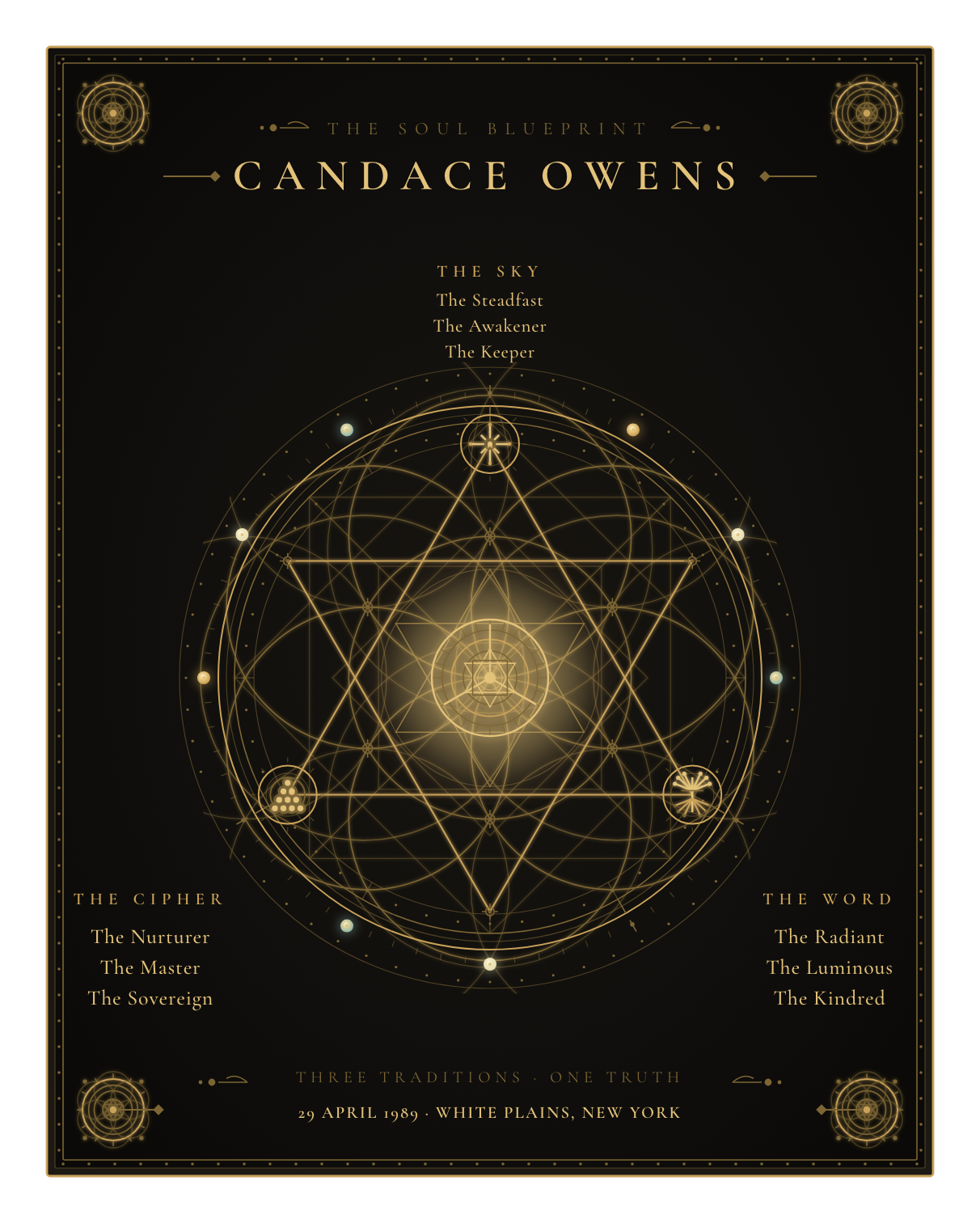
One seal, three languages. The sky she was born under at the apex, the numbers beneath her name at the lower left, the name itself at the lower right — three traditions engraved into one artifact. There is no rising sign, no houses, no angles: without a verified birth time they cannot be honestly drawn. What is true is what is shown.
At a Glance
- Full traditional name
- Candace Amber Owens
- Born
- April 29, 1989 · Stamford
- Sun
- Taurus 9.3° — the essential fire of the life
- Rising
- Birth time unverified — the Ascendant is offered conditionally, never asserted
- Moon
- Aquarius 19.5° — the inner life
- Mind · Value · Will
- Mercury Taurus · Venus Taurus · Mars Cancer
- Discipline · Direction
- Saturn Capricorn · North Node Pisces
- Life Path
- 6 — The Nurturer
- Title-name Destiny
- 44 — The Master Architect
- Birth-name Destiny
- 11 — The Illuminator
- Master Numbers
- 11, 44
- Soul archetype
- The Master Architect who lives the Nurturer’s path
In December 2018, in London at a launch event for a political organization, a young woman stood before cameras and spoke words about a dictator that would echo through the next seven years of her life—words she would claim were misrepresented, words that attached themselves to her like a shadow she could not quite shake free. The light in that room, the certainty in her voice, the machinery already in motion: these are the fragments we see. But beneath the public utterance, beneath the controversies and the retractions and the endless corrections of the record, there is a soul that arrived into this lifetime carrying a signature so specific, so rooted, that all the noise of the world cannot drown out its frequency. The world will call her what she has done, what she has said, what positions she has held—the headlines, the defamation suits, the visa rejections, the betrayals both felt and enacted. The world fragments her into her deeds. But a soul is not its deeds; a soul is the source from which the deeds emerge, the river beneath the surface that carries its own logic, its own wound, its own medicine. This reading goes deeper than the public record. It reads the source.
The reading moves through the eight chapters of the Soul Blueprint architecture — The Arrival, The Soul’s Inheritance, The Living of It, The Soul’s Calling, The Soul’s Territories, The Name You Carry, The Moment, and The Invitation — and at the end, the same instrument turns gently toward you.
Her soul has a blueprint.
So do you.
The same three languages — the sky, the numbers, the name — are waiting in your own.
The Arrival
She arrived carrying the signature of the self that sustains itself—a soul whose identity rests not on permission from the world but on a value that flows from within, steady and embodied as a river that knows its own course. This is the paradox she was born into: a presence so grounded, so deliberate in its sense of self, that it becomes immovable—and an immovable thing, when it is also afraid of losing control, can become brittle. The self-sufficiency that was meant to be her strength—the capacity to endure, to reassure, to hold ground—arrived in a frame that also carried the weight of Saturn in its own house, the master builder who fears inadequacy, who must prove her worth through flawless execution. She did not arrive soft. She arrived ready to build, to achieve, to establish something real in the world. The architecture of her personality is Taurus: steady, sensual, devoted, and utterly convinced of its own foundation. But the ground beneath Taurus, if it cracks, reveals not flexibility but the terror of collapse. She was born to embody value itself—and to discover, through the breaking of that embodiment, that value cannot be proven through perfection alone.
The Soul’s Inheritance
She was born into a lineage split and reformed—her father and mother divorced when she was still becoming conscious of family as a concept, and from age eleven or twelve she was raised primarily by her mother and by her grandparents, inheriting the care-structures they built around absence. Her paternal grandfather was African American, born in North Carolina; her grandmother carried the Caribbean inheritance from Saint Thomas in the U.S. Virgin Islands. These bloodlines—the South, the diaspora, the resilience of families remade—entered her without ceremony, as inheritance always does, woven into her bones before she could name them. She grew up in Stamford, Connecticut, in an era when identity was not yet the central axis around which every voice turned, when a young Black girl in a mostly-white school was simply navigating the ordinary cruelties of being visible and being young. She attended college, pursuing journalism at the University of Rhode Island, the discipline of reporting—of listening, of witnesses, of getting the record straight. She moved into the adult world of work in Manhattan, holding positions as an intern at Vogue, as an administrative assistant, later as a vice president—the slow accumulation of competence and presence that marks a soul learning how to be solid in an institution. She inherited the need to be seen as capable, as worthy of notice, as sufficient unto herself. The family that raised her taught her endurance. The era in which she came of age taught her that visibility itself was a kind of proof.
The Living of It
In the spring of her senior year in high school, when she was seventeen, three white male classmates—one the son of a man who held public office—left her voicemail messages that were death threats, that were racist, that made clear that her presence in their school was a violation they would correct. The school did not protect her. The institution failed. She and her family sued, and they won—$37,500, a number that attempted to compensate for fear, for the failure of the adults who were supposed to guard her, for the knowledge that visibility could mean danger. That wound became her qualification: she knew what it meant to be threatened for existing, to be targeted by a group, to demand accountability from an institution that preferred to deny. Eight years later, in 2016, at the age of twenty-seven, she built a website called SocialAutopsy, designed to expose internet bullies by tracking their digital footprint—a direct answer to the wounds of her adolescence, a tool that would hold people accountable, that would make visible the hidden cruelty. The project collapsed almost immediately, accused of enabling the very doxing she claimed to oppose, caught in the contradictions between exposure and harm. The failure was public. She was publicly aligned with figures from Gamergate, with the machinery of online harassment. She had tried to weaponize visibility itself. What the soul learned, through that collision, was that the desire to protect can become the desire to punish, that the wound of being targeted can become the wound of targeting others, that righteousness and revenge can wear the same face. The signature wound—being made visible as a target—became the signature qualification: she knew exactly how to make others visible, exactly how to draw a target on a person or a group.
If this is what was true for her, what might be true for you?
The Soul’s Calling
She arrived into a body built to speak truth that settles, truth that does not scatter or evaporate into the air like rumor—a voice that comes alive when the mind moves slowly, deliberately, through what is solid and real. The voice is measured because thought itself is patient; words carry weight because they are not spent in haste or hollow enthusiasm. This is a soul summoned to say what endures, to build with language the way a mason builds with stone, each word placed only after it has been tested for its capacity to hold weight.
Yet the calling that arrives through her is more capacious than speech alone. She came to tend—to nourish, to protect, to hold safe what is vulnerable and what has been wounded. The soul moves toward others not from abstraction but from feeling, from the body’s knowledge of what it means to be at risk, to be undefended. Her strength moves sideways, indirectly, as guardian strength does—fierce in its devotion to those it has claimed, patient in the way that protection requires patience.
This is a soul summoned to soothe, to build shelter, to restore what has been broken in the heart’s sense of belonging. The calling is not toward glory or spectacle but toward the work of making whole—the unglamorous, persistent labor of presence, of showing up, of steadying what trembles. She came to demonstrate that authentic nourishment is possible, that a person can be relied upon, that strength need not be cold to be real. The direction the soul is traveling asks her to release the grip of perfectionism, the exhausting need to manage every detail and control the outcome, and instead to open toward compassion, toward faith that something larger than her own vigilance might also tend and heal.
The Soul’s Territories
Her most alive territories have been the spaces where she could establish authority and be visibly central: the platforms and channels she has built, where her voice is unmediated and reaches millions—YouTube has become her kingdom, the place where her image and her words travel directly into the minds of her audience, where she is not filtered through editors or networks or anyone else’s judgment. Another territory has been the construction of alternative political and economic structures: the foundations she co-founded, the ventures she backed or launched, the attempt to build parallel economies and philosophies that would exist outside the mainstream—BLEXIT, the Freedom Phone, the bank initiatives, each one a blueprint for a world remade by her vision, each one animated by the belief that she could architect a better system. The third territory, the most intimate, has been the role of mother and wife—the bodily, sensual, enduring commitments that anchor the soul in something real and unchallengeable: four children born over five years, a marriage to a man whose family includes nobility and power, the creation of a domestic kingdom where her authority is not questioned and her care is embodied in the presence of people who depend on her. These three territories—the public voice, the architectural vision, and the intimate family—are the places where she has felt most alive, most herself, most capable of sustaining something real. They are also the places where the deeper mythology emerges, where the soul’s true work becomes visible.
There are twelve domains in the kingdom of any life: The Mark, The Unfolding, The Unseen, The Long Return, The Inheritance, The Encounter, The Alchemy, The Living Tension, The Sight, The Body’s Knowing, The Crossing, The Calling.
The Name You Carry
The names she carries in the world hold a resonance that pulls from the frequency of light and endurance. They arrive in her as an inheritance—her family’s naming of her as something to be noticed, to be bright, to shine in the particular darkness of a world that did not automatically see her as worthy of light. The middle name speaks to color, to the golden hour, to something precious and warm that does not fade. The surname is the paternal line, the structure she inherited from a father whose presence was not constant but whose name she carries forward into the world. Names are not arbitrary; they are the first spell cast over a life, the first truth spoken into the becoming of a person. In her case, they speak to visibility, to the demand that she shine, that she be seen, that she carry the light forward. The full name, given at birth, holds three distinct frequencies—the light-bearer, the gold, the lineage—and together they compose a calling to be noticed, to illuminate, to matter. But light, unbounded, can become heat. Light without wisdom can become blindness. The names she was given asked her to shine—and she has spent her life learning the difference between illumination and burning.
The Moment
The defining season of her life arrives in late 2016 and reaches its turning point in 2017—a season of rupture and revelation that would reorganize everything she understood about herself and the world. The SocialAutopsy project, launched as an answer to her adolescent wound, collapses under the weight of accusation: she is accused of the very crime she sought to punish, of enabling doxing, of participation in the machinery of harassment. The project is never built. The public failure is mortifying. And in the wreckage of this public shame, something shifts. By late 2017, she has remade herself entirely: she is producing pro-Trump commentary, criticizing the Democratic party, presenting herself as someone newly awakened to a different truth. She describes it as an overnight conversion, a moment in which she ‘realized that liberals were actually the racists’—a claim that erases the complexity, the pain, the machinery beneath. What happened in that gap, in that space between the collapsed project and the new identity, is not fully visible. What is visible is that she chose a new architecture for her authority: instead of exposing bullies from the left, she would become a voice on the right. Instead of claiming to build tools for accountability, she would build platforms for alternative narratives. The season revealed the wound that drives her: not just that she had been targeted, but that she needed to be right, needed to be chosen, needed to establish herself as someone who understood what others could not see. The revelation was that the person who had tried to protect others through exposure was willing to expose others—to target groups, to make claims without full verification, to use the machinery she claimed to oppose—if it meant being on the winning side.
The Invitation
Everything in this reading has been moving toward a single point. The doubleness named in the first chapter, the inheritance, the wound, the calling, the territory, the name, the moment. These are not seven separate truths about Candace Owens. They are one truth, named from seven different angles. And they all converge here.
The invitation arrived not as whisper but as wound—and Candace Owens has spent her adult life deciding whether to answer it or run from it, which is itself the answer.
At seventeen, in the ordinary hallways of her high school in Connecticut, she received three voicemails that were not meant to teach her kindness. They were meant to silence her. The racist threats came from classmates, from boys whose fathers held office, whose families had money enough to assume their children would never face consequence. Her family sued. The settlement came. And something in her—the part of her that needed to feel herself, free and whole and not erased—became a weapon and a shield both, because a soul born under Taurus cannot rest on borrowed ground; she must establish her own foundation or die trying.
This is what the invitation asked of her: Will you build your own authority, or will you wait for permission that will never come?
For years she tried the conventional paths—the journalism degree, the internship at Vogue, the administrative work in Manhattan offices where she rose to vice president because she understood the architecture of power from the inside. She was learning the language of systems, the way institutions speak to themselves. She was building slowly, deliberately, the way her mind moves—grounded, concrete, settling into what is solid and real before speaking. She was not impulsive. She was not reckless. She was learning patience.
But patience and safety are not the same thing, and by 2016, when she launched a platform meant to expose the cruelty of internet mobs, she discovered that the invitation had teeth. The project faced backlash immediately. She was accused of the very thing she meant to oppose. And instead of retreating into the safety of obscurity, she pivoted. By 2017, she was producing videos, launching channels, speaking publicly—no longer asking permission from institutions that had never protected her in the first place. The steady-flowing river that is her essential nature found a new channel.
What was being released? The old compliance. The belief that authority granted by others—by magazines, by firms, by the traditional gates—was the only authority worth having. She released the need to be palatable to power structures that had made it clear they would discard her when convenient. This is the medicine the soul is travelling toward: surrender of the need to control every outcome through perfectionism, through getting everything exactly right. Taurus built the structure; now Taurus had to release the grip and trust that the foundation she had poured was real enough to hold her even as she moved differently.
What was being called toward? The speaking. The unmediated voice. By late 2017, she was no longer writing columns for agency blogs or consulting behind the scenes; she was the figure in the frame, the voice in the video, the public self. She moved into spaces—political movements, media platforms, cultural conversations—where her steadiness, her grounded way of thinking, her refusal to be rushed into conclusions that were not her own, made her a specific kind of presence. She was not performing for approval; she was building an audience around her own authority.
What became available? The power to shape narrative directly. The ability to reach millions without institutional gatekeeping. The freedom to say what she believed without waiting for editorial approval. But also—and this matters—the full weight of consequence. Every word became public, permanent, accountable. The soul that needed to feel herself free now had freedom, but freedom unmediated by institution also means freedom unprotected by it. The inheritance of her own voice became also the inheritance of its full cost.
The invitation is still arriving. It arrives every time she sits before a camera, every time she makes a choice about what to say and what to hold back. The question it asks has not changed: Will you speak from your own authority, even when that speaking costs you? Will you trust the foundation you have built, even when it begins to crack under the weight of what you have chosen to say? She is still answering. The Yes she gave did not settle the matter; it opened it. And opening is where the soul’s real work begins.
She was not late. She was exactly where the soul-clock said she should be. The mission had been inscribed at the threshold of her first breath. What was being asked of her, she has been walking. The naming has been done.
This Is Not Coincidence
The planets in her chart speak the language of control and mastery—Saturn in its own house, the builder afraid of inadequacy; Mercury steady and deliberate, speaking only when sure; Venus devoted and unchanging; Mars protective and territorial. The numbers in her name and birth speak the language of illumination and architecture—Title Destiny 44, the Master Architect; Birth Destiny 11, the Illuminator; Life Path 6, the Nurturer who can become the controller. The names she carries speak the language of visibility and light—the demand to shine, to be noticed, to burn bright. Three entirely different languages. One truth: she arrived to learn that the structures she can build will fail, and that her freedom lives in the release of needing them to succeed.
Three entirely different languages. One truth.
This is not coincidence. This is what three independent systems do when they are all telling the truth about the same soul.
The Numbers, Decoded
The numbers are computed, not intuited — each letter takes its Pythagorean value, each name reduces, and any Master Number is preserved rather than collapsed.
You have sat with the chart and the numbers and the name of another soul, and watched how a wound becomes a calling, how the place of least belonging becomes the place of greatest gift, how a life too precisely configured to be coincidence reveals itself when three independent languages are read together.
The reading you have just received was, in its outer form, a reading of her soul. But its inner form was a reading written for yours. You did not arrive without a Blueprint either. May this reading be the beginning of the reading you finally receive of yourself. May the light you carry — in whatever particular, irreplaceable form it has taken inside the specific life you were given.
Some lives carry a pattern this clear.
Yours does too.
You’ve read the shape of her soul. The same three languages — the sky, the numbers, the word — are waiting in your own name and birth date. Begin yours, free, below.
Or, when you’re ready, begin your own full Soul Blueprint reading →
Frequently Asked Questions
What is Candace Owens’s birth chart?
Candace Owens was born on April 29, 1989, with her Sun in Taurus—the sign of embodied self-sufficiency, steadiness, and value rooted from within. Her Mercury is also in Taurus, giving her a deliberate, grounded mind that speaks slowly and only when sure. Her Venus in Taurus makes her love sensual, steady, and devoted; her Mars in Cancer drives her will toward protection and provision; and her Saturn in Capricorn places mastery and earned authority at the center of her psychological structure. The birth time is unverified, so a fixed rising sign cannot be reliably determined.
What is Candace Owens’s numerology?
Candace Owens carries three numerological pillars: her Title Destiny number is 44 (the Master Architect, from ‘Candace Owens’), her Birth Destiny number is 11 (the Illuminator, from ‘Candace Amber Owens’), and her Life Path is 6 (the Nurturer). These master numbers and the Life Path archetype together compose a soul signature oriented toward building, illuminating, and caretaking—but each of these frequencies, when unbalanced, can invert into control, blindness, and manipulation.
What does the name Candace Owens mean?
The etymology of her given and family names could not be fully recovered, but their resonance in her life is clear: they compose a calling toward visibility and light, toward being noticed and seen. The first name carries the frequency of luminosity; the middle name suggests something golden and precious; the surname carries the paternal lineage. Together, they ask the soul to shine—a demand that has organized much of her life.
What is a Soul Blueprint?
A Soul Blueprint integrates three independent traditions — Western natal astrology, Pythagorean numerology, and the etymology of the full birth name — into a single document written as a personal letter to the soul. When you’re ready, you can begin your own.
This reading was prepared in the lineage and methodology of the Soul Blueprint Method — Pythagorean numerology with master numbers preserved, Western archetypal astrology, and a researched etymological reading of the full name. Candace Owens’s birth date (April 29, 1989) is sourced from the public record; the birth time is unverified, so the rising sign is offered conditionally and never asserted.
A Soul Blueprint reading · Astrology · Numerology · Etymology · shams-tabriz.com