
Kurt Cobain’s Birth Chart, Numerology, and Name Decoded
Kurt Cobain’s Birth Chart,
Numerology & Name Decoded
The Soul Blueprint Method — three traditions woven into one personal letter: Western natal astrology, Pythagorean numerology, and the etymology of the soul’s name. Learn the method →
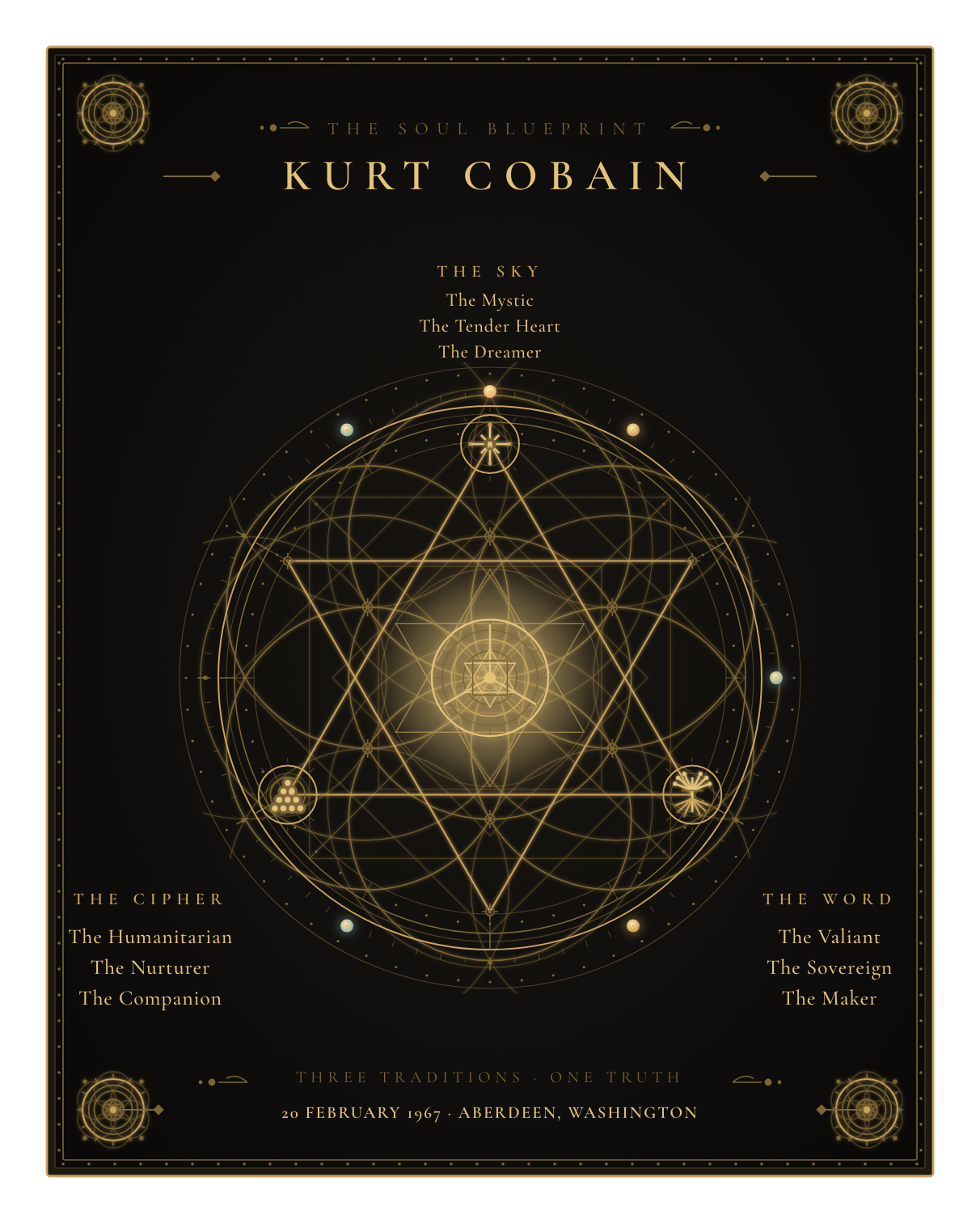
One seal, three languages. The sky he was born under at the apex, the numbers beneath his name at the lower left, the name itself at the lower right — three traditions engraved into one artifact. There is no rising sign, no houses, no angles: without a verified birth time they cannot be honestly drawn. What is true is what is shown.
At a Glance
- Full traditional name
- Kurt Cobain
- Born
- February 20, 1967 · Aberdeen
- Sun
- Pisces 1.5° — the essential fire of the life
- Rising
- Birth time unverified — the Ascendant is offered conditionally, never asserted
- Moon
- Cancer 9.1° — the inner life
- Mind · Value · Will
- Mercury Pisces · Venus Pisces · Mars Scorpio
- Discipline · Direction
- Saturn Pisces · North Node Taurus
- Life Path
- 9 — The Humanitarian
- Title-name Destiny
- 6 — The Nurturer
- Birth-name Destiny
- 6 — The Nurturer
- Master Numbers
- None preserved at the final layer
- Soul archetype
- The Nurturer who lives the Humanitarian’s path
The greenhouse in Seattle held the light of early spring 1994, the kind of light that breaks through after months of rain—gold and thin and almost unreal. Inside that space, surrounded by the green growing things that ask nothing of us but water and time, a man sat alone with the weight of the world he had accidentally become. Millions had heard his voice crack open their own loneliness through a speaker; he had become, without choosing it, the spokesman for an entire generation’s unnamed sorrow. And yet the fragments the world collected and named—the rock star, the addict, the reluctant prophet, the genius—these were surface breaks in a river whose source ran much deeper and far older than any fame could reach. They saw the foam and called it the whole current. They saw the rapids and mistook them for the river itself. But the source—the original thrust of soul that arrived in that body on a winter day in 1967—that source carried something far more precise and far more devastating: a self built to dissolve, a heart that could not help but feel what others could not bear to feel, a will that had learned to go all the way down into the dark and stay there. This reading descends to that source. It does not ask what the fragments meant. It asks what was arriving, why it arrived, what it was called to do, and what the soul was being asked to surrender so that something true could speak through the wreckage.
The reading moves through the eight chapters of the Soul Blueprint architecture — The Arrival, The Soul’s Inheritance, The Living of It, The Soul’s Calling, The Soul’s Territories, The Name You Carry, The Moment, and The Invitation — and at the end, the same instrument turns gently toward you.
His soul has a blueprint.
So do you.
The same three languages — the sky, the numbers, the name — are waiting in your own.
The Arrival
He arrived carrying the paradox of the self unmade—a soul that could not hold a fixed shape, that lived by yielding rather than grasping, that found itself most alive in the moment of dissolution and service. The gift was boundless empathy, the capacity to feel the whole world’s wound as his own, to be a conduit for what society had no language for. But the architecture of such a self is precarious. A soul built to surrender must live constantly at the threshold between form and formlessness, between the self and the sacred other. To serve something larger than the personal ego is the Piscean’s inheritance; but the cost is that the boundaries of the self grow permeable, sometimes dangerously so. He came with a mind that moved by symbol and feeling rather than linear argument, a voice that could speak in metaphor and image, a capacity to love without condition or demand. Beneath all of this ran a will of extraordinary intensity—a force that went all the way down, that did not know how to do anything halfway, that had learned to sustain itself through sheer depth of commitment. But a will this concentrated, paired with a self this dissolving, creates an internal war: the part of him that wanted to serve redemptively colliding always with the part that had no ground to stand on. The arrival was a gift wrapped in a paradox, and the paradox was written into every cell: he came to heal by feeling, but the feeling had nowhere to come home to.
The Soul’s Inheritance
He was born into a lineage of makers and musicians—his grandmother a professional artist, his uncle a band member, his great-uncle an Irish tenor whose voice had been trained and disciplined into beauty. The gift of artistic sensibility was not new to his body; it lived in the blood already, waiting. His father was a mechanic, a man who worked with his hands and understood the logic of machines; his mother was a waitress, a woman who served others for a living. Neither parent had chosen the life they found themselves in, and by the time he was nine years old, their marriage had fractured—a wound that announced itself to him in the unmistakable language of loss. The divorce altered something fundamental in his orientation to the world. Before it, there had been a house, however imperfect. After it, there was no house at all. He grew up in Aberdeen, Washington, a timber town whose economy was already beginning to collapse, a place where aspiration and beauty seemed almost transgressive, where the ordinary grind of survival left little room for art or dream. And yet his family had carried art into that place anyway—through his grandmother’s work, through his uncle’s music, through the knowledge that something other than the visible material world existed. He came into a world that was broken, economically fragile, uncertain—but a world that had never forgotten that beauty and music were real.
The Living of It
The wound arrived early: at nine years old, the family broke, and something in him broke with it. The charts show that his emotional nature was built for nurturing, for being nurtured in return, for the making of a felt home—and yet the home that should have sheltered that sensitivity was coming apart. His father tried to make him into something he was not—enrolling him in wrestling and baseball despite his complete lack of interest—and he found the only language available to him: he failed, deliberately and utterly, refusing to participate. At fourteen, on his birthday, he chose a guitar over a bicycle, and that choice marked the threshold. The guitar became his real home, the one structure that would not abandon him. He dropped out of high school two weeks before graduation, a choice that looked like failure to the world but was, for him, a refusal of a structure that could not hold what he actually was. By his twenties, he had formed a band—Nirvana—and begun to channel everything he carried into the voice, the songs, the raw transmission of feeling made audible. But the cost became visible almost immediately. The success that came with Nevermind in 1991 was overwhelming; he had wanted to be heard, but he had not wanted to be visible, and the world demanded both. He became uncomfortable with his own prominence, resenting the way the media scrutinized his personal life, the way he had become a symbol rather than a human being. The pain in his body—chronic stomach trouble that no one could diagnose, bronchitis that would not heal—these grew louder as the noise around him grew louder. He began to use heroin in 1986, initially to manage the physical pain; by the end of 1991, as his band was becoming famous, the addiction had deepened. The living of it meant learning that the gift of boundless feeling came with a price: there was no place in the world large enough to hold what he could feel.
If this is what was true for him, what might be true for you?
The Soul’s Calling
His calling was to speak the unspeakable—to give voice and form to the formless grief that an entire generation carried but could not name. His gift was a mind that moved by symbol and resonance rather than argument, a capacity to compress an entire emotional truth into a single image or a three-minute song, to make the listener feel seen and understood in their loneliness. The songs he wrote—’Smells Like Teen Spirit,’ ‘Come as You Are,’ ‘Lithium,’ ‘Heart-Shaped Box’—these were not intellectual constructs. They were transmissions from the depths, images that arrived whole and demanded to be shared. His voice itself was an instrument, cracking with genuine emotion, refusing the polish and distance that most mainstream singers maintained. The calling was to democratize sorrow, to insist that pain and alienation and doubt were not shameful but were actually the truest things a human being could feel. He was being asked to become a translator between the inner world and the collective—to take the formless grief and give it a structure through which millions of people could recognize themselves. But the paradox of the calling was that it required him to be vulnerable in public, to remain permeable and open, at the exact moment when fame was demanding that he become invulnerable and closed. The voice that gave him his power was the same voice that left him defenseless.
The Soul’s Territories
The territory of songwriting held him entire—a space where formless feeling could become structured without losing its authenticity, where the image and the symbol could do what argument never could. In this territory, he was not broken; he was a translator, a conduit for something larger than himself, and the work itself was healing even as it cost him. The territory of loyalty to his collaborators—to Krist Novoselic, with whom he had formed the band, to Dave Grohl, who came as drummer and partner, to Buzz Osborne of the Melvins, who had introduced him to the music that had saved his life—these relationships held a tenderness and commitment that showed a man capable of profound connection and faithfulness. The territory of resistance and witness—his vocal advocacy for the voiceless, his opposition to racism and homophobia, his pro-choice stance—showed a soul that could not rest while others were being harmed, that understood his platform as a responsibility to those with less power. In each of these territories, the same signature appears: a willingness to be vulnerable in service of something true, a refusal to separate the personal from the political, a capacity to sustain commitment through genuine feeling rather than ego. These territories were not escapes from the wound; they were where the wound became medicine for others. They point toward a deeper personal mythology—one in which the soul’s shattering is not a failure but a doorway, in which the capacity to feel everything is both the greatest gift and the greatest burden.
There are twelve domains in the kingdom of any life: The Mark, The Unfolding, The Unseen, The Long Return, The Inheritance, The Encounter, The Alchemy, The Living Tension, The Sight, The Body’s Knowing, The Crossing, The Calling.
The Name You Carry
The name Kurt carries the etymology of the courteous, the noble, the one who bends toward others with respect—a name that spoke to a soul built for service and tenderness. But the surname Cobain arrived from a much older lineage: Irish ancestors named Cobane, shoemakers from Carrickmore in Ulster who had emigrated from the old country into the new one, carrying with them the skills of their hands and the weight of displacement. The Cobain name itself was not originally Cobain but had been transformed in the American space, as so many Irish names had been, into something slightly different. To carry this name was to carry the inheritance of displacement and making—of people who had built their lives through craft, through work, through the capacity to create something solid from materials at hand. Yet the first name and the last name tell different stories. Kurt speaks to courtesy and nobility; Cobain speaks to craftsmanship and diaspora, to the humble making that sustains life. The whole name—Kurt Cobain—holds this tension: a soul called to serve and to honor others, living through the inheritance of displacement and practical making. It is a name that says both I am here to be of service and I am the child of makers who had to start over. That contradiction was not incidental to who he was; it was structural. The name promised what the life would struggle to deliver: a way to be noble and grounded at once, to serve without being consumed, to make without losing oneself.
The Moment
In March 1994, three weeks into spring, the machinery of his life reached a critical pressure. He had overdosed in Rome in early March on champagne and rohypnol—a moment that announced clearly what he had been trying not to say. He went through intervention, detox, the machinery of rescue that society offers when it finally acknowledges that someone is drowning. But the intervention itself revealed the paradox that had become unbearable: he was being asked to save his own life, to choose recovery and stability, to accept the help that was being offered. And yet the soul that had arrived in 1967 was not built for stability or security. It was built for dissolution and service. The trying to become someone other than what he was—someone grounded, someone who could rest, someone who could accept the sufficiency of what he had—this effort itself was draining what little remained. The moment revealed that the cost of living had become unsustainable, that the gift and the wound were inseparable, and that there was no way forward that did not require him to become someone fundamentally different from who he actually was. By early April, alone in the greenhouse in his Seattle home, surrounded by the growing things that ask nothing but service, the soul that had lived by dissolution chose it finally and completely. On April 5, 1994—though he was not found until April 8—he ended the conversation. The moment was not the end of a life; it was the completion of a trajectory that had been written into his birth chart and into the structure of his calling since the beginning.
The Invitation
Everything in this reading has been moving toward a single point. The doubleness named in the first chapter, the inheritance, the wound, the calling, the territory, the name, the moment. These are not seven separate truths about Kurt Cobain. They are one truth, named from seven different angles. And they all converge here.
What was being asked of this soul was to remain open—open to the full weight of collective sorrow, open to feeling what society had made numb, open to the vulnerability that most people spend their whole lives defending against. He was being asked to be a conduit, a translator, a voice for the voiceless, to take the formless grief of a generation and give it structure and dignity through art. The calling required that he remain permeable, that he not seal himself off, that he let the world’s pain move through him and into the songs that would then move through millions of listeners. It was an impossible calling, because it asked him to be both utterly open and utterly contained—to feel everything and yet not be destroyed by it, to remain transparent and yet functional, to serve redemptively without being consumed in the service. The paradox was not a problem to be solved; it was the essential structure of the work itself.
What was being released was the illusion of security, the dream that love could fix him, the hope that the right relationship or the right amount of success could provide the ground that his soul was not built to stand on. His marriage to a fellow musician held genuine love, but it could not solve the fundamental problem: that he was a soul built for dissolution paired with a life that demanded he become increasingly fixed, visible, responsible, contained. The daughter born to him in 1992 was loved with genuine tenderness, but her arrival also announced the impossible demand: that he become stable for another human being, that he choose life, that he build a home when his entire soul was oriented toward dissolution. What was being released was the fantasy that love or responsibility or success could reshape the fundamental architecture of a soul. What was being released was the possibility of remaining forever in the state of service and surrender without cost.
What was being called toward was a different medicine entirely—the medicine of grounding, of trust in the sufficiency of simple things, of learning to rest in what is genuinely enough. The soul’s growth was pointing toward Taurus, toward the capacity to find value from within rather than through service to others, toward the building of a calm, self-reliant stability that did not depend on remaining open to the entire world’s pain. This was not a regression; it was the maturation that the soul’s entire trajectory was pointing toward. But maturation toward this medicine would have required him to fundamentally change his nature—to become less permeable, less feeling, less willing to go all the way down into the darkness. It would have required a kind of betrayal of the gift itself. The invitation toward groundedness and self-earned value felt like a death to a soul that had learned to live through dissolution and service.
What became available, for all the millions who heard him, was permission. Permission to feel their own alienation and sorrow without shame. Permission to refuse to become what the world demanded of them. Permission to be broken and still be worthy of love. Permission to take their pain and make it into art that could speak to others. He lived the paradox completely—never resolving it, never learning to manage it, never finding the compromise that would have kept him alive. But in living it completely, without flinching, without trying to hide or fix it, he created a body of work that gave voice to a whole generation’s unnamed truth. The songs he left behind continue to do what they did when they first arrived: they make people feel less alone in their loneliness, less ashamed of their shame, less isolated in their isolation. The soul that could not find a way to live found a way to speak that continues speaking. The dissolution that would have destroyed most people became, through the structure of art, a transmission that heals.
He was not late. He was exactly where the soul-clock said he should be. The mission had been inscribed at the threshold of his first breath. What was being asked of him, he has been walking. The naming has been done.
This Is Not Coincidence
The astrology speaks: a Pisces Sun and Saturn in Pisces—the self that arrives by surrender and service, paired with the discipline of giving form to the formless. The numerology speaks independently: the Life Path 9, the Humanitarian, whose gift is to serve the collective; and the Destiny 6, the Nurturer, whose deepest calling is to heal the heart. The name speaks: Kurt means the courteous one, the noble, the one who bends toward others; Cobain carries the inheritance of makers and displacement, shoemakers who built from what they had. Three entirely different languages. One truth: A soul arrived to dissolve itself in service, and in that dissolution, made something whole.
Three entirely different languages. One truth.
This is not coincidence. This is what three independent systems do when they are all telling the truth about the same soul.
The Numbers, Decoded
The numbers are computed, not intuited — each letter takes its Pythagorean value, each name reduces, and any Master Number is preserved rather than collapsed.
You have sat with the chart and the numbers and the name of another soul, and watched how a wound becomes a calling, how the place of least belonging becomes the place of greatest gift, how a life too precisely configured to be coincidence reveals itself when three independent languages are read together.
The reading you have just received was, in its outer form, a reading of his soul. But its inner form was a reading written for yours. You did not arrive without a Blueprint either. May this reading be the beginning of the reading you finally receive of yourself. May the light you carry — in whatever particular, irreplaceable form it has taken inside the specific life you were given.
Some lives carry a pattern this clear.
Yours does too.
You’ve read the shape of his soul. The same three languages — the sky, the numbers, the word — are waiting in your own name and birth date. Begin yours, free, below.
Or, when you’re ready, begin your own full Soul Blueprint reading →
Frequently Asked Questions
What is Kurt Cobain’s birth chart?
Kurt Cobain’s birth chart is anchored by a Pisces Sun—the self that finds itself through surrender and service rather than through grasping form. His Mercury is in Pisces, giving him an imaginative, symbol-based mind that communicates through image and feeling rather than linear argument. His Venus is in Pisces, expressing love as boundless compassion and spiritual idealism. His Mars is in Scorpio, a will of extraordinary depth and intensity that goes all the way through. His Saturn is also in Pisces, making his Great Work the discipline of giving structure to the boundless—art, healing, contemplative practice. The rising sign cannot be determined without a verified birth time; only the date is established.
What is Kurt Cobain’s numerology?
Kurt Cobain’s numerology reveals three primary numbers: his Life Path is 9, the Humanitarian, pointing toward a soul called to serve the collective and heal the world’s sorrow. His Title Destiny is 6, the Nurturer, whose deepest purpose is to heal the heart. His Birth Destiny is also 6, the Nurturer. These three numbers together point toward a soul whose entire architecture was built around feeling, service, and the capacity to be vulnerable in the presence of others’ pain.
What does the name Kurt Cobain mean?
The name Kurt comes from German origin and carries the meaning of the courteous one, the noble, the one who approaches others with respect and honor. The surname Cobain derives from Irish ancestors—the Cobane family—who were shoemakers from Carrickmore in Ulster and emigrated to America in 1875. The name transformed slightly in the American space, as many Irish names did, but retained its connection to craft and making. Together, Kurt Cobain speaks to a soul called to honor others through service while carrying the inheritance of practical making and displacement.
What is a Soul Blueprint?
A Soul Blueprint integrates three independent traditions — Western natal astrology, Pythagorean numerology, and the etymology of the full birth name — into a single document written as a personal letter to the soul. When you’re ready, you can begin your own.
This reading was prepared in the lineage and methodology of the Soul Blueprint Method — Pythagorean numerology with master numbers preserved, Western archetypal astrology, and a researched etymological reading of the full name. Kurt Cobain’s birth date (February 20, 1967) is sourced from the public record; the birth time is unverified, so the rising sign is offered conditionally and never asserted.
A Soul Blueprint reading · Astrology · Numerology · Etymology · shams-tabriz.com