
Brad Pitt’s Birth Chart, Numerology, and Name Decoded
Brad Pitt’s Birth Chart,
Numerology & Name Decoded
The Soul Blueprint Method — three traditions woven into one personal letter: Western natal astrology, Pythagorean numerology, and the etymology of the soul’s name. Learn the method →
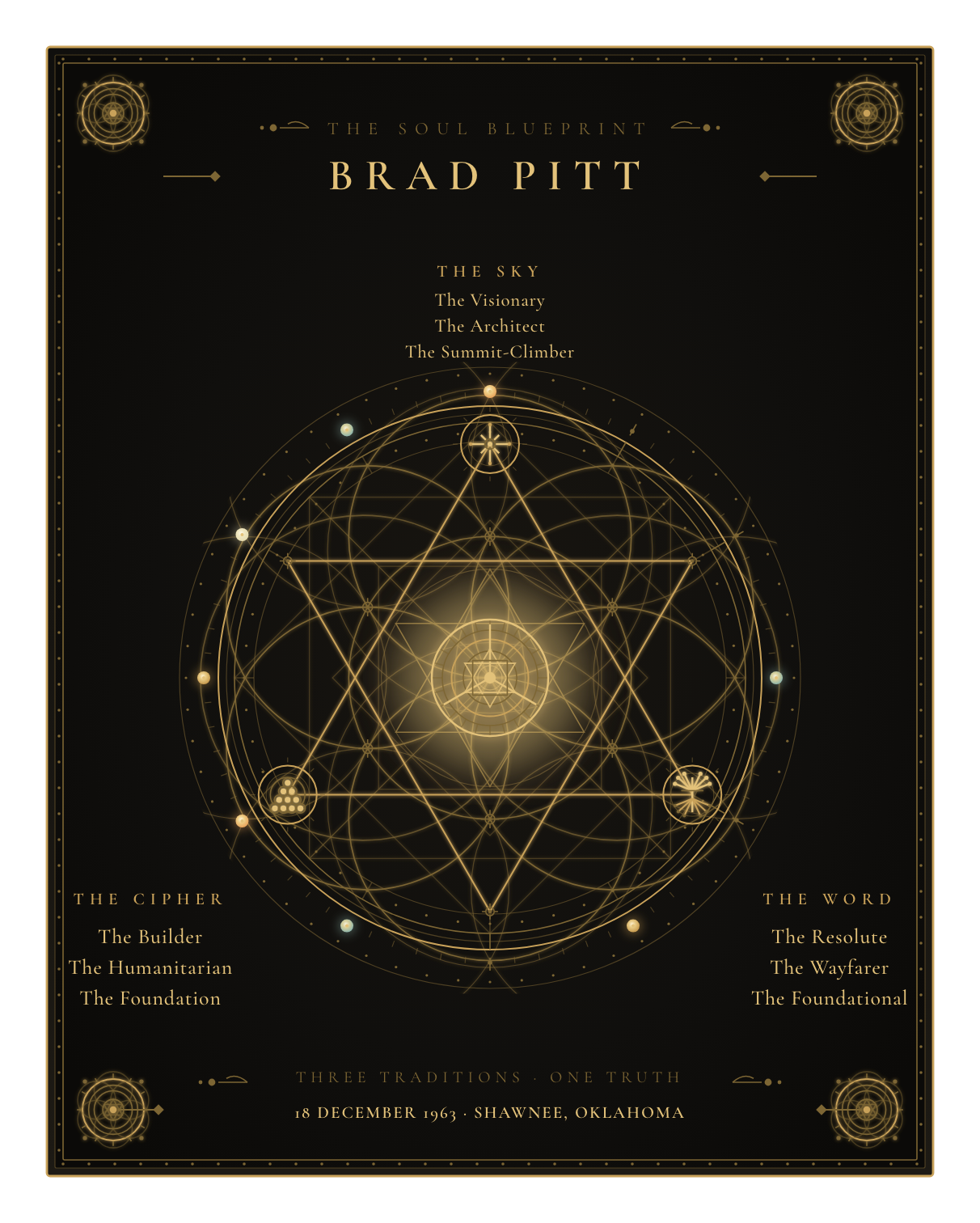
One seal, three languages. The sky he was born under at the apex, the numbers beneath his name at the lower left, the name itself at the lower right — three traditions engraved into one artifact. There is no rising sign, no houses, no angles: without a verified birth time they cannot be honestly drawn. What is true is what is shown.
At a Glance
- Full traditional name
- William Bradley Pitt
- Born
- December 18, 1963 · Shawnee
- Sun
- Sagittarius 26.1° — the essential fire of the life
- Rising
- Birth time unverified — the Ascendant is offered conditionally, never asserted
- Moon
- Date-dependent across the unverified birth day — not fixed without a confirmed time
- Mind · Value · Will
- Mercury Capricorn · Venus Capricorn · Mars Capricorn
- Discipline · Direction
- Saturn Aquarius · North Node Cancer
- Life Path
- 4 — The Builder
- Title-name Destiny
- 9 — The Humanitarian
- Birth-name Destiny
- 4 — The Builder
- Master Numbers
- None preserved at the final layer
- Soul archetype
- The Humanitarian who lives the Builder’s path
It is 1991, and the light in the California desert is pure and unforgiving — the kind of light that shows everything, hides nothing. A young man sits in a car with a woman who will become iconic for a single moment with him, and the camera finds his face in profile: beautiful, yes, but something else moves beneath the symmetry. There is a quality of seeking there, a restlessness that no amount of physical perfection can settle. He is playing a small-time criminal, a drifter, and the role will define him to the world — not because he is playing a criminal, but because something in the character’s hunger rings true to something in him that has not yet found its name.
The fragments the world calls Brad Pitt — the sex symbol, the star, the actor, the producer, the architect of his own image — are what float on the surface of a river. They are real, but they are not the source. Below them moves something older and stranger: a soul that arrived carrying the hunger of the seeker, the builder, the one who must venture into the vast uncharted realms of meaning and structure, asking always What am I for? What can I build that lasts? What belongs to me? The beauty, the fame, the marriages, the films, the production houses, the foundations — all of these are the river’s visible current. This reading descends to the source.
Below the image lies a blueprint that was not chosen but arrived whole: a soul born under the sign of the Sagittarian quest, gifted with the disciplined strategic mind of Saturn and Mars and Mercury all aligned toward Capricornian mastery, yet called — called — toward the very softness and vulnerability that mastery most resists. The architecture of his life is not accidental. Neither is the hunger that built it.
What follows is not biography. It is the soul’s own grammar, written in the language of arrival, inheritance, wound, calling, and the slow saying of Yes to what the blueprint always knew.
The reading moves through the eight chapters of the Soul Blueprint architecture — The Arrival, The Soul’s Inheritance, The Living of It, The Soul’s Calling, The Soul’s Territories, The Name You Carry, The Moment, and The Invitation — and at the end, the same instrument turns gently toward you.
His soul has a blueprint.
So do you.
The same three languages — the sky, the numbers, the name — are waiting in your own.
The Arrival
William Bradley Pitt arrived into the world carrying a paradox that would structure every decade of his life: the soul of the seeker meets the will of the builder. The Sagittarian inheritance gave him the mind that looks toward the horizon, the restlessness that cannot settle for the small or the personal — always the question Is there something larger? Something that means? But the constellation that governs his will and structure — the austere, patient, exalted discipline of Mars and Mercury and Venus all in the sign of the master architect — demands that the seeking be built, materialized, made lasting and real. He did not arrive to dream. He arrived to quest and construct.
This is the soul’s essential contradiction and its genius: the pilgrim who is also the general, the visionary who is also the engineer. The Sagittarian fire seeks meaning in the vast realms — religion, philosophy, the eternal values beyond the self — but the Capricornian machinery says these must be built into form, into consequence, into something that stands. He cannot simply wander. He cannot simply achieve. He must achieve while wandering, build while seeking, construct monuments to a meaning he is still discovering.
The arrival carried both the compass and the stone. And the life that followed would show what happens when a soul refuses to choose between them — when the builder becomes a seeker, and the seeker becomes ruthlessly committed to making things that last. The paradox is not a flaw. It is the entire engine.
The Soul’s Inheritance
He was born into the machinery of postwar American self-making: a father who owned a trucking company, a mother who was a school counselor — the lineage of builders and caretakers, people who made things run and tended to the people inside the system. Shawnee, Oklahoma, then Springfield, Missouri — the Midwest, where efficiency was virtue and discipline was love, where you did not ask if the structure was right, you asked how to master it.
The household was Christian, Southern Baptist, built on the bedrock of principle and propriety. The era was the 1960s becoming the 1970s, the age when American certainty was beginning to fray, when the old structures were being questioned — but not yet in the homes of trucking-company proprietors and school counselors. He inherited the inheritance of coping — the soul-pattern of the one who keeps the machine running, who achieves competence, who does not complain and does not break. The South, the faith, the family business, the expectation of mastery and self-sufficiency: this was the material he was given.
Yet something in him was already different. The hunger for something beyond the machinery was present early — not as rebellion, but as a kind of interior seeking that the structure of his family could not quite contain. He was born into the very competence and control that his soul would eventually have to learn to release. The inheritance was not wrong. But it was the weight he would have to carry in order to understand, eventually, what lay beneath it.
The Living of It
The wound was the beauty itself — or rather, the fact that beauty is a door that opens into expectation, and expectation becomes the cage that contains you. He emerged into the world of cinema in the late 1980s as an uncredited presence, then a television actor, then — suddenly, in one moment in a desert car — as the object of desire. The Thelma & Louise moment was not the beginning of his fame; it was the crystallization of something that had already begun to happen, something that would define him in ways he could not control.
To be desired for beauty is to be misread constantly. The roles that came — the small-time criminal, the seducer, the beautiful young man — began to calcify around the image rather than the soul. And yet he was also genuinely gifted as an actor, hungry to work, driven by something deeper than fame. The wound was the gap between the image the world saw and the seeker underneath. He had been born to build, to quest, to venture into meaning — but the machinery of his own beauty and fame had made him a symbol instead, a surface that reflected back what others wanted to see.
The cost was paid in the 1990s and 2000s: in relationships that the world watched like a gladiatorial sport, in the pressure to remain the image even as the soul was changing, in the slow recognition that he had become trapped inside the very success that was supposed to liberate him. The competence, the mastery, the discipline he had inherited — these became the armor that kept him from feeling what was happening. And the beauty that had opened every door became the door he could not walk through, because the world would not let him.
If this is what was true for him, what might be true for you?
The Soul’s Calling
The voice that arrives in him does not arrive by accident — it comes weighted, deliberate, each word carrying consequence as though it has been tested in some inner forge before it ever reaches the world. His mind moves in straight lines toward what endures: the architecture of thought itself, the way a sentence can be laid down like foundation stone and hold weight for decades. He speaks in a language of structure and economy, as though every utterance must earn its place in the world. This is the calling of the Builder made visible in speech — not the flourish or the improvisation, but the steady accumulation of meaning that refuses waste.
The soul came to this earth to demonstrate that mastery lives in restraint, that power is not loudness but the patience to say exactly what is necessary and nothing more. His Life Path inscribes the same instruction: build something that will outlast the moment of its making. The industry he entered — an industry of image and velocity — required him to move against his own nature: to be seen, to shine, to answer to the hunger of the world for his face. Yet beneath that, the deeper calling has always run: to use the platform not for the perpetuation of the self, but for the structures that serve the many — the foundations rebuilt in New Orleans after disaster, the systems of attention that draw light toward what the powerful wish to ignore.
He was born into a father’s enterprise of moving goods across distance, a mother’s vocation of counsel and care. The inheritance whispers: tend to what is real, what is built to last, what serves the body of the world. His work — whether in the frame or behind the camera, whether in stone or in the careful architecture of story — answers that call without sentimentality, without the need to be thanked.
The Soul’s Territories
The territories that claim him are written into his hands, his eye, and the structure of his longings—and they arrive not as separate rooms but as a continuous pilgrimage inward.
There is the kingdom of craft and structure, where the mind descends into the architecture of a scene—how light falls, where the camera should be placed, what the body does when the soul beneath it breaks. He has spent decades learning the grammar of consequence, the way a single gesture carries weight across time. This is not accident; the will that disciplines itself, that chooses the long view over the immediate sway, commands this territory as a general commands a battlefield. When he spent six months learning to move like a warrior for a single role, when he studies the designs of great architects and works clay with his own hands, he is speaking the language of this realm: intention made visible through sustained effort.
Another territory opens in humanitarian witness—the soul that turns toward suffering and asks what can be built to answer it. After a hurricane left a city broken, he did not look away; he founded something, poured resources into it, made it lasting. He has appeared on lists honoring those who use visibility not as ornament but as a lamp. This is the territory where private fortune meets public consequence, where the competence learned in one realm becomes the muscle for service in another.
And there is the territory of belonging sought through vulnerability—harder to name, less visible in the record, yet written into the texture of his relationships, his struggles with dissolution and recovery, his admission of the face-blindness that makes every stranger a mystery. The soul has been learning, perhaps against its own armor, that to be held is not weakness but the deepest form of strength. This territory calls him toward what he has spent a lifetime protecting himself from: the softness beneath the general, the capacity to receive.
These three are not separate. They form a single geography of becoming.
There are twelve domains in the kingdom of any life: The Mark, The Unfolding, The Unseen, The Long Return, The Inheritance, The Encounter, The Alchemy, The Living Tension, The Sight, The Body’s Knowing, The Crossing, The Calling.
The Name You Carry
The name William carries the weight of will — the Old Germanic root speaks of resolute protector, the one whose will is oriented toward keeping what matters safe. It is the name of builders and kings, of men who are expected to decide and to hold. Bradley, derived from the meadow of broad clearings, speaks to openness, to space, to the wide-seeing perspective — the one who can stand in the clearing and see far. Together they form a paradox of their own: William’s concentrated will, Bradley’s broad vision. The boy was named for containment and expansiveness at once, for decision and perspective. Pitt, whatever its etymology, became the surname that the world would know — solid, brief, architectural in its economy.
But the name he chose for himself, publicly, was Brad — a shortening, a modernizing, a moving toward the accessible and the immediate. Brad Pitt entered the world not as William Bradley, but as a name that was already in motion, already simplified, already oriented toward the future rather than the heritage. And yet the full name — William Bradley Pitt — carries the complete blueprint. The will, the breadth, the solidity. In the early 1990s, when he was still becoming, the shortened name was practical. But the full name holds the person he would have to grow into: the one who could combine the concentrated will with the vast perspective, the architectural precision with the horizon-seeking gaze.
The Moment
The moment arrived in 2005 like a threshold no one had warned him about — not the crossing itself, but the standing still before it. He had built something that appeared solid: a marriage consecrated in private ceremony on a California shore, a name that had become luminous in the world’s eye, the accumulation of roles that had let him taste what it meant to be seen. And then, in the January light, he announced its ending. The divorce would be finalized that October, and the machinery of it — the legal dissolution, the public reckoning — unspooled with a precision that felt almost architectural in its cold geometry.
But the real threshold was not the marriage’s collapse; it was what bloomed in its wreckage. During the filming of Mr. & Mrs. Smith in 2005, while still bound to his previous life, he fell in love on a film set — both parties would later confirm this, speaking it into the light as if confession mattered. The woman he loved was not a blank companion; she was a builder herself, a maker of meaning through her own labor and conviction. By 2012, seven years into this second commitment, he offered an engagement. In August of 2014, in a château in France, he married again — this time not in hiding, but before witnesses, in a ceremony held at a place that suggested permanence, stone, inheritance.
Then, in September of 2016, something fractured. An incident on an airplane — the details disputed, the pain real — opened a chasm. His wife filed for divorce nineteen days later. The legal dissolution would take years. In that same month, confronted with the weight of his own inner collapse, he began to surrender to what he could no longer carry alone. He sought the fellowship of others who understood the particular gravity of addiction, began to attend meetings where anonymity was sacred, began the slow work of being held by a community rather than standing apart in his own sufficiency.
The marriage had shattered so that the soul might learn what it had never known: that strength lives in the admission of need, and that the direction forward lay not in perfecting the fortress, but in opening the door.
The Invitation
Everything in this reading has been moving toward a single point. The doubleness named in the first chapter, the inheritance, the wound, the calling, the territory, the name, the moment. These are not seven separate truths about Brad Pitt. They are one truth, named from seven different angles. And they all converge here.
The invitation that arrived for this soul was not wrapped in gentleness—it came as a collision between the gift of sight and the blindness that fame itself creates. Brad Pitt inherited a will so disciplined, so architecturally precise in its ambition, that it could build empires of image and achievement with the efficiency of a master strategist, yet that very mastery carried a cost: the cost of staying in control, of managing the self as a perfected product, of treating vulnerability as a tactical failure rather than a threshold. The soul was being asked to release the armor of self-sufficiency—the belief that competence alone could hold a life together, that being relied-upon was the same as being loved, that the role was the man. This was the old inheritance, the one that had served him, that had gotten him from Oklahoma to the world stage, that had allowed him to study under the gaze of architects and visionaries and emerge not as a dilettante but as someone who understood structure down to its bones. But the invitation came in the form of collapse.
It arrived first as a question that would not be silenced: What are you actually feeling beneath all that you have built? The question came through relationships that demanded not performance but presence—partners who would not accept the curated self, children who needed a father present not in role but in raw, unguarded feeling. It came through the work of art itself, through scripts and collaborators who asked him to inhabit not heroes or archetypes but broken, wounded, human men: Tyler Durden in his fracture, Jesse James in his paranoia, characters who wore their damage like skin. The invitation was calling him toward softness—not weakness, but the strength that comes from allowing oneself to be held, from admitting need, from leading not from the authority of achievement but from the authority of the heart.
In September of 2016, when the soul entered a season of reckoning—when a crisis forced a confrontation with habits that had been quieting the inner voice, when he stepped into rooms of strangers and spoke the truth of his own unraveling—something began to shift. The public architecture of Brad Pitt, the image that had been so carefully maintained, was no longer the primary currency. What became available instead was permission: permission to be known not as a beautiful thing on a screen but as a man in the slow work of becoming real. The architecture did not disappear—his mind remained strategic, his craft remained disciplined, his will remained stamped with the mark of someone who finishes what he begins—but it was no longer the whole story. What opened was the capacity to let others in, to admit that the journey toward wholeness required vulnerability, that the greatest building was not an empire but a self that could say I don’t know, I need help, I was wrong.
The work of these years has been the work of learning to receive—not accolades, which came easily, but care. To let others be strong where he had insisted on bearing all the weight himself. To understand that a legacy is not measured only in what one accomplishes alone but in what one creates with others, in the embrace of family and community and the messy, inconvenient truth of belonging. The production companies, the foundations, the collaborations with filmmakers who pushed him beyond the beautiful and into the necessary—these were not distractions from the real work. They were the real work: the slow conversion of a will trained in mastery into a will trained in service, of a mind built for strategy into a mind that could also hold tenderness, of a soul that had learned to achieve into a soul learning how to receive.
The invitation is still unfolding. He is still the builder—that will not change, it is written into his very blueprint—but now he builds differently, knowing that the structures that matter most are the ones held together not by ambition alone but by the capacity to be present, to be present to others, to let himself be loved as he is and not as he performs. The Yes that is being spoken now is not to a life of greater control but to a life of greater truth—messier, more uncertain, more alive.
He was not late. He was exactly where the soul-clock said he should be. The mission had been inscribed at the threshold of his first breath. What was being asked of him, he has been walking. The naming has been done.
This Is Not Coincidence
The astrology says: A soul born under the sign of the Sagittarian quest, with the entire power-triad — Mercury, Venus, Mars — gathered in Capricorn’s mastery, and the North Node calling toward Cancer’s vulnerability and belonging; a Saturn in Aquarius demanding that the will serve the collective rather than the self. The numerology independently says: A soul whose Title Destiny is 9 — the humanitarian — and whose Birth and Life Path are both 4, the number of the builder; a consciousness called to create lasting structures in service to something larger than itself. The names say: William speaks the will that protects; Bradley speaks the clearing that sees far; together they name a soul at the intersection of precision and perspective, of decision and openness. Three entirely different languages. One truth: A builder who must learn to feel; a seeker who must learn to come home; a soul called to surrender the mastery in order to master the art of belonging.
Three entirely different languages. One truth.
This is not coincidence. This is what three independent systems do when they are all telling the truth about the same soul.
The Numbers, Decoded
The numbers are computed, not intuited — each letter takes its Pythagorean value, each name reduces, and any Master Number is preserved rather than collapsed.
You have sat with the chart and the numbers and the name of another soul, and watched how a wound becomes a calling, how the place of least belonging becomes the place of greatest gift, how a life too precisely configured to be coincidence reveals itself when three independent languages are read together.
The reading you have just received was, in its outer form, a reading of his soul. But its inner form was a reading written for yours. You did not arrive without a Blueprint either. May this reading be the beginning of the reading you finally receive of yourself. May the light you carry — in whatever particular, irreplaceable form it has taken inside the specific life you were given.
Some lives carry a pattern this clear.
Yours does too.
You’ve read the shape of his soul. The same three languages — the sky, the numbers, the word — are waiting in your own name and birth date. Begin yours, free, below.
Or, when you’re ready, begin your own full Soul Blueprint reading →
Frequently Asked Questions
What is Brad Pitt’s birth chart?
Brad Pitt’s birth chart has the Sun in Sagittarius — the sign of the seeker, the explorer of meaning and eternal values. His Mercury is in Capricorn, giving him a structured, strategic mind. His Venus is also in Capricorn, expressing love through commitment, responsibility, and enduring loyalty. His Mars is in Capricorn as well, meaning his will is disciplined, goal-directed, and exalted through patience and sustained effort. Saturn, the planet of mastery and discipline, is in Aquarius, calling him toward principled contribution to the collective. Because his birth time is unverified, his rising sign cannot be determined with certainty — different times would produce different ascendants. The Moon sign is similarly date-dependent and should not be fixed without verified birth time.
What is Brad Pitt’s numerology?
Brad Pitt’s numerology reveals three distinct archetypal currents. His Title Destiny — derived from the public name Brad Pitt — is 9, the Humanitarian, speaking to a calling toward universal service and the building of a legacy that serves humanity. His Birth Destiny — from his full legal name William Bradley Pitt — is 4, the Builder, anchoring him to the soul’s need to create lasting, concrete structures. His Life Path, calculated from his birth date December 18, 1963, is also 4, reinforcing the builder archetype at the deepest level. This alignment of two 4s — Birth and Life — with the humanitarian reach of the 9 creates a person called to build in service to something larger than the self.
What does the name Brad Pitt mean?
The name William derives from Old Germanic roots meaning ‘resolute protector,’ carrying the weight of will and the responsibility to keep what matters safe. Bradley comes from Old English, referring to a broad clearing or meadow — evoking openness, expansiveness, and the wide perspective. Together, William Bradley speaks to a soul caught between concentrated will and broad vision, between the specific decision and the vast seeing. Pitt, the surname, is brief and architectural — solid, economical, the kind of name that stands firmly in the world. Brad, the shortened version he uses publicly, modernizes and simplifies the formal name, moving it toward accessibility and the present moment.
What is a Soul Blueprint?
A Soul Blueprint integrates three independent traditions — Western natal astrology, Pythagorean numerology, and the etymology of the full birth name — into a single document written as a personal letter to the soul. When you’re ready, you can begin your own.
This reading was prepared in the lineage and methodology of the Soul Blueprint Method — Pythagorean numerology with master numbers preserved, Western archetypal astrology, and a researched etymological reading of the full name. Brad Pitt’s birth date (December 18, 1963) is sourced from the public record; the birth time is unverified, so the rising sign is offered conditionally and never asserted.
A Soul Blueprint reading · Astrology · Numerology · Etymology · shams-tabriz.com