
Marilyn Monroe’s Birth Chart, Numerology, and Name Decoded
Marilyn Monroe’s Birth Chart,
Numerology & Name Decoded
The Soul Blueprint Method — three traditions woven into one personal letter: Western natal astrology, Pythagorean numerology, and the etymology of the soul’s name. Learn the method →
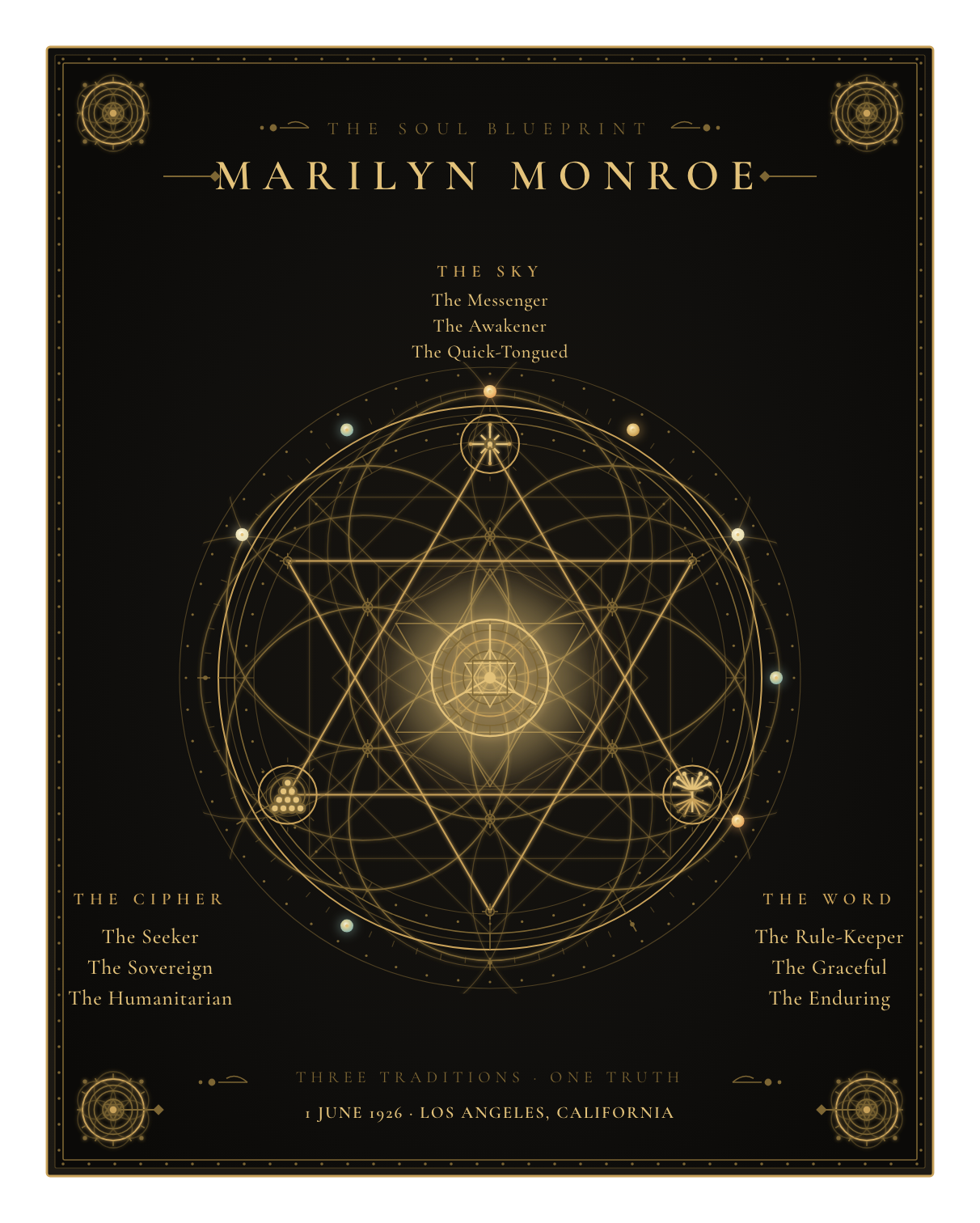
One seal, three languages. The sky she was born under at the apex, the numbers beneath her name at the lower left, the name itself at the lower right — three traditions engraved into one artifact. There is no rising sign, no houses, no angles: without a verified birth time they cannot be honestly drawn. What is true is what is shown.
At a Glance
- Full traditional name
- Norma Jeane Mortenson
- Born
- June 1, 1926 · Los Angeles
- Sun
- Gemini 10.5° — the essential fire of the life
- Rising
- Birth time unverified — the Ascendant is offered conditionally, never asserted
- Moon
- Aquarius 20.6° — the inner life
- Mind · Value · Will
- Mercury Gemini · Venus Aries · Mars Pisces
- Discipline · Direction
- Saturn Scorpio · North Node Cancer
- Life Path
- 7 — The Seeker
- Title-name Destiny
- 1 — The Pioneer
- Birth-name Destiny
- 22 — The Master Builder
- Master Numbers
- 22
- Soul archetype
- The Pioneer who lives the Seeker’s path
It is late 1944, and she is cutting film negatives at the Radioplane Company munitions factory in Burbank—her hands moving through celluloid and light, the spools turning beneath her fingers while the war still burns across oceans she has never crossed. The photographer David Conover arrives one afternoon with his camera, and in that moment something shifts: the factory worker becomes the one being seen, the invisible hand becomes the face. By January 1945, she has left the factory. By August, she has signed with the Blue Book Model Agency. By early 1946, her face has crossed thirty-three magazine covers. The world calls this a rise, a transformation, a stroke of luck—fragments of the story that float on the surface like foam on moving water. But beneath the foam runs the river itself, the source from which all these visible currents emerge. The source does not begin with the camera’s eye or the cover of a magazine. It begins much earlier, in the soul’s own signature, in what she arrived carrying before the world ever knew her name. This reading reaches toward that source—not the story the world tells, but the blueprint underneath it, the truth the soul knew before anyone else did.
The reading moves through the eight chapters of the Soul Blueprint architecture — The Arrival, The Soul’s Inheritance, The Living of It, The Soul’s Calling, The Soul’s Territories, The Name You Carry, The Moment, and The Invitation — and at the end, the same instrument turns gently toward you.
Her soul has a blueprint.
So do you.
The same three languages — the sky, the numbers, the name — are waiting in your own.
The Arrival
She arrived as the one built to connect, to multiply links, to see relationships everywhere—the mind that comes alive through exchange and the constant search for new doors into the world. This is the signature of the self that extends itself through connection: curiosity as identity itself, the many-sided mind as the very shape of being. Yet she carried something more intricate than mere sociability. She arrived as the Pioneer—the one who breaks new ground, who makes the first mark—and also as the Master Builder, the soul tasked with constructing something that will last, that will hold weight and form. These three selves lived inside her together: the connector who learns by relating, the pioneer who ventures into unmapped territory, and the builder whose work must endure. The paradox was this—the soul built for relationship and exchange was also the soul tasked with standing alone, with building something that the world had not yet imagined. She did not arrive to fit into existing structures. She arrived to make new ones, to show that what had never been seen before could be real, could be substantive, could matter.
The Soul’s Inheritance
She was born into fragmentation—into a mother hospitalized, into foster homes and the orphanage, into the evangelical Christian household of Albert and Ida Bolender, into the care of Grace Goddard, a friend of her mother’s. She was born into a California where film ran like water through the soil, where images were the currency of becoming, where you could remake yourself if you had the face and the hunger. She was born into absence—the absence of a father, the absence of a mother who remained present only in her untethered state, committed to a psychiatric hospital in 1934 when the child was eight years old. She was born into the Depression’s tail and into a world at war. She was born into a name—Norma Jeane—that would eventually be erased entirely, replaced by something the world could more easily hold. What she inherited was not stability or bloodline or property. She inherited the necessity of becoming. She inherited the orphan’s knowledge that you must make yourself, must find your place through your own invention, must build a self from the materials the world leaves behind. She inherited a mother’s fractured mind and a father’s absence, and from these she inherited the hunger to be seen, to be held by something other than foster care and institutional walls, to prove that a self built from nothing could still be real, still matter, still shine.
The Living of It
The life was lived at the threshold between two worlds—between the invisible girl who moved through other people’s lives as a servant, a ward, a problem to be housed, and the visible woman whose face became property, whose image was owned and circulated without her consent. She married at sixteen to stay out of the orphanage, then divorced the factory worker James Dougherty in 1946. She began as a model in the same year she was freed from that marriage, and the camera became her new threshold—the place where the invisible could become visible, where the nameless could acquire a name. She worked with photographers, with drama coaches, with agents who saw potential and demanded control. She studied method acting under Lee Strasberg, searching for something beneath the surface that the world called beauty. She refused roles, she negotiated contracts, she founded her own production company with Milton Greene in 1954. She married Joe DiMaggio in 1954, and the marriage fractured under the weight of his jealousy and physical violence after only nine months. She married Arthur Miller in 1956, converting to Judaism for the marriage, then obtained a Mexican divorce in 1961. She performed ‘Happy Birthday, Mr. President’ for John F. Kennedy on May 19, 1962, in a beige rhinestone-covered dress that became myth. The cost was immense: perfectionism that never rested, low self-esteem that no amount of acclaim could soothe, stage fright that sent her toward barbiturates and amphetamines, toward alcohol and the slow addiction that would escalate throughout her career. She was hospitalized at the Payne Whitney Psychiatric Clinic in 1961 and placed, erroneously, on a ward for the psychotic and locked in a padded cell. Joe DiMaggio—the same man who had hurt her—helped her transfer to Columbia University Medical Center. The life was lived as a constant negotiation between the self she was forced to perform and the self she was trying to discover beneath the performance.
If this is what was true for her, what might be true for you?
The Soul’s Calling
She came to demonstrate what it meant to build a self from nothing, to speak through the only language the world had given her—her face, her voice, her presence—and to transform that language into something that demanded to be taken seriously. The gift was Mercury’s own: the agile, curious, connective mind that sees links everywhere, that moves between worlds with ease, that asks the next question, that opens doors. She was built to relate, and her calling was to relate not as a passive object but as an active consciousness—to move from being looked at to being listened to, from being possessed to being respected. Her voice was quick, versatile, interested in everything—the voice of someone who had learned to speak by watching and listening and absorbing the world around her. She came to show that beauty could think, that the image could contain intelligence, that the visible could refuse to be merely decorative. The Seeker was her deeper calling—the soul tasked with finding what is hidden, with asking the questions that others are afraid to ask, with journeying into territories that have not yet been mapped. She sought authenticity in a world built on illusion; she sought feeling in a world built on surfaces; she sought belonging in a world that had always treated her as a guest.
The Soul’s Territories
The first territory was the Screen itself—the cinema, the image, the close-up that made her visible. In this territory, she learned that the face could be a language, that presence could speak louder than words, that what the camera saw could become real to millions. The Asphalt Jungle, All About Eve, Gentlemen Prefer Blondes, Bus Stop, Some Like It Hot, The Misfits—these were not mere roles but territories where she could exist, where the invisible girl could become visible, where she could be held by something larger than herself. The second territory was the Method—the study of acting with Lee Strasberg at the Actors Studio in 1955, the search for authenticity beneath the surface, the demand that she understand the character’s inner life rather than merely perform the surface. In this territory, she sought to prove that she could think, could understand, could access depths that the world did not believe she possessed. The third territory was Independence—the founding of Marilyn Monroe Productions with Milton Greene in 1954, the negotiation of contracts that gave her more control, the refusal of roles that did not serve her calling. In this territory, she became not merely the object of the industry’s gaze but an active agent of her own becoming, a builder constructing something that would outlast the moment. These three territories—the visible, the deep, and the self-directed—were where she lived most fully, where the fragments began to cohere into something whole, where the soul’s signature began to match the life being lived.
There are twelve domains in the kingdom of any life: The Mark, The Unfolding, The Unseen, The Long Return, The Inheritance, The Encounter, The Alchemy, The Living Tension, The Sight, The Body’s Knowing, The Crossing, The Calling.
The Name You Carry
The name Norma carried the weight of the ordinary, the normal, the everyday. It was a name that asked nothing of the world, that promised nothing extraordinary. Jeane was a variation of the form that meant ‘God is gracious,’ a name that pointed toward blessing, toward grace arriving from beyond the self. Together, Norma Jeane was the name of an ordinary girl for whom grace might arrive, a name that contained both the mundane and the numinous, both the everyday and the transcendent. But this name was erased. On February 23, 1956, she legally changed her identity from Norma Jeane to Marilyn Monroe, and in that act she claimed the right to reinvent herself entirely. Marilyn carried echoes of Marilyn Miller, the dancer and performer from an earlier era—a name that promised movement, performance, the body as expression. Monroe was her mother’s maiden name, a name that brought her back to the maternal lineage at the very moment she was severing the maternal connection. Together, Marilyn Monroe was the name of someone who had chosen herself, who had claimed the right to become the person she wished to be rather than the person circumstance had named her. The resonance was precise: the stage name carried both the recovery of her mother’s name and the assertion of her own authority to be called something different from what she had been born as. The name was an act of both inheritance and rebellion—she took back her mother’s name at the moment she took control of her own becoming.
The Moment
The moment was long and complex, beginning in 1952 when she revealed that she had posed for a nude calendar in 1949, a revelation that could have destroyed her but instead created a strange alchemy of sympathy and fascination. The scandal opened rather than closed doors. In 1953, her films Niagara, Gentlemen Prefer Blondes, and How to Marry a Millionaire were released, and she achieved stardom—the industry suddenly saw that the image they had tried to control had become a force they could not contain. By 1954, she was one of Hollywood’s most bankable performers, listed in the Top Ten Money Making Stars Poll. But in January 1954, she married Joe DiMaggio, and in those nine months she encountered a different kind of possession—not the industry’s gaze but a man’s jealousy, his physical abuse, his attempt to own her completely. After the marriage ended, she began to study method acting with Lee Strasberg in 1955, searching for something beneath the surface. She founded her own production company, Marilyn Monroe Productions, in 1954, and negotiated a new contract with 20th Century-Fox that gave her more control and higher salary. In 1956, she married Arthur Miller, the playwright, and converted to Judaism for the marriage—an act of profound belonging and commitment. By 1957, she made The Prince and the Showgirl with Laurence Olivier, receiving a BAFTA nomination. But the moment revealed its darker face: the addiction that had begun as a way to manage anxiety and insomnia was escalating; the marriages were fractured by betrayal and infidelity; the perfectionism was becoming unbearable. The moment showed her what the soul had come to learn—that visibility and invisibility were not opposites, that being seen did not mean being known, that the industry’s love could turn to cruelty in an instant.
The Invitation
Everything in this reading has been moving toward a single point. The doubleness named in the first chapter, the inheritance, the wound, the calling, the territory, the name, the moment. These are not seven separate truths about Marilyn Monroe. They are one truth, named from seven different angles. And they all converge here.
What was being asked of this soul was nothing less than the integration of opposing forces—the visibility and the invisible, the performance and the authenticity, the Pioneer’s need to break new ground and the Master Builder’s need to make something lasting, the connector’s gift for relationship and the lonely soul’s need for genuine belonging. She was being asked to build a self from nothing, to claim authority over her own image and voice at a moment in history when women’s images and voices were property of the industry that controlled them. She was being asked to prove that the beautiful could also be intelligent, that the visible could demand to be taken seriously, that a self constructed from fragments could still be real and substantial and worthy of respect. She was being asked to journey into territories that had never been mapped—to become an independent producer, to study method acting at a moment when the industry expected only surfaces, to negotiate for control at a time when actresses were expected to obey. What was being released was the identity of Norma Jeane—the orphan, the foster child, the invisible girl, the factory worker, the wife married to avoid the orphanage. What was being released was the belief that she had to wait for permission, that she had to accept the roles she was given, that she had to remain grateful for whatever crumbs the industry offered. What was being released was the false self that had been constructed by others’ expectations—the blonde bombshell, the decorative object, the symbol rather than the person. What was being called toward was the authentic self beneath the performance, the thinking mind beneath the beautiful face, the depth beneath the surface. It was a call toward independence, toward the founding of her own production company, toward the study of acting that would allow her to prove her range and intelligence. It was a call toward belonging that was genuine—toward marriages that were not transactions or escapes but real attempts at connection. It was a call toward the vulnerable heart that could be hurt, that could fail, that could be betrayed, and still remain open. What became available because the Yes was said—because she moved forward into the territories she was called toward—was a new kind of visibility, not the visibility of the image but the visibility of the soul itself. She became not merely a symbol but a presence, not merely an object of desire but a conscious agent of her own becoming. Her films earned critical acclaim not because she was beautiful but because she could act, because she could access the depths of human emotion, because she could make the audience feel something real. Some Like It Hot in 1959 became a critical and commercial success, and she received a Golden Globe for Best Actress in a Leading Role—Musical or Comedy. The Misfits in 1961, John Huston’s film, gave her a dramatic role that she had hoped would prove her range and depth. Even as the addiction deepened, even as the marriages fractured, even as the industry continued to try to control her, something shifted: she had proven that a self built from nothing could build something that would last, that the image could contain intelligence, that the visible could demand to be heard. By the time she performed ‘Happy Birthday, Mr. President’ on May 19, 1962, in that beige rhinestone-covered dress, she had claimed authority over her own presence. The Yes that had been said—to independence, to study, to authenticity, to the vulnerable heart—had made her not just a star but a presence that the world would remember as something more than image, something more than symbol, something that spoke to the soul’s own hunger to be seen, truly seen, and still be loved.
She was not late. She was exactly where the soul-clock said she should be. The mission had been inscribed at the threshold of her first breath. What was being asked of her, she has been walking. The naming has been done.
This Is Not Coincidence
The chart speaks: a mind born to connect and multiply links, a will that flows around obstacles and acts through imagination and compassion, a heart that needs freedom and authenticity, a growth-call to vulnerability and belonging. Numerology speaks independently: the Pioneer who breaks new ground, the Master Builder tasked with constructing what will endure, the Seeker who journeys into hidden territories. The names speak: Norma Jeane (the ordinary girl touched by grace), then Marilyn Monroe (the chosen self that reclaims the maternal name and claims the right to reinvent). Three entirely different languages. One truth: the soul was assembled to become visible precisely so that she could teach the world that visibility and authenticity are not opposites.
Three entirely different languages. One truth.
This is not coincidence. This is what three independent systems do when they are all telling the truth about the same soul.
The Numbers, Decoded
The numbers are computed, not intuited — each letter takes its Pythagorean value, each name reduces, and any Master Number is preserved rather than collapsed.
You have sat with the chart and the numbers and the name of another soul, and watched how a wound becomes a calling, how the place of least belonging becomes the place of greatest gift, how a life too precisely configured to be coincidence reveals itself when three independent languages are read together.
The reading you have just received was, in its outer form, a reading of her soul. But its inner form was a reading written for yours. You did not arrive without a Blueprint either. May this reading be the beginning of the reading you finally receive of yourself. May the light you carry — in whatever particular, irreplaceable form it has taken inside the specific life you were given.
Some lives carry a pattern this clear.
Yours does too.
You’ve read the shape of her soul. The same three languages — the sky, the numbers, the word — are waiting in your own name and birth date. Begin yours, free, below.
Or, when you’re ready, begin your own full Soul Blueprint reading →
Frequently Asked Questions
What is Marilyn Monroe’s birth chart?
Marilyn Monroe was born with the Sun in Gemini, the sign of connection and the many-sided mind—identity shaped by curiosity, exchange, and the search for new links to the world. Her Moon is in Aquarius, the emotional nature oriented toward freedom and individuation, the heart that needs authenticity and perspective rather than sentiment. Her Mercury is also in Gemini, the gift of agile, connective thought; her Venus is in Aries, love expressed as direct, ardent desire; her Mars is in Pisces, will that flows through imagination and compassion rather than confrontation; her Saturn is in Scorpio, tasking her with the mastery of power, depth, and the courage to trust. The rising sign cannot be fixed without a verified birth time.
What is Marilyn Monroe’s numerology?
Marilyn Monroe’s Title Destiny is 1, the Pioneer—the soul that breaks new ground and makes the first mark. Her Birth Destiny is 22, the Master Builder—tasking her with constructing something that will endure and hold weight. Her Life Path is 7, the Seeker—the soul called to journey into hidden territories and ask the questions others are afraid to ask. These three numbers together form her numerological signature: the builder who seeks, the pioneer who creates something lasting.
What does the name Marilyn Monroe mean?
Norma Jeane carried the resonance of the ordinary made graceful—a name pointing toward blessing arriving from beyond the self. But Marilyn Monroe, chosen on February 23, 1956, resonates as an act of self-authorship: Marilyn echoes the performer and dancer Marilyn Miller, promising movement and expression, while Monroe returns her to her mother’s maiden name, recovering the maternal lineage at the moment of greatest separation. Together, the chosen name holds both inheritance and rebellion—the assertion of the right to become oneself rather than accepting the identity others have named.
What is a Soul Blueprint?
A Soul Blueprint integrates three independent traditions — Western natal astrology, Pythagorean numerology, and the etymology of the full birth name — into a single document written as a personal letter to the soul. When you’re ready, you can begin your own.
This reading was prepared in the lineage and methodology of the Soul Blueprint Method — Pythagorean numerology with master numbers preserved, Western archetypal astrology, and a researched etymological reading of the full name. Marilyn Monroe’s birth date (June 1, 1926) is sourced from the public record; the birth time is unverified, so the rising sign is offered conditionally and never asserted.
A Soul Blueprint reading · Astrology · Numerology · Etymology · shams-tabriz.com