
Drake’s Birth Chart, Numerology, and Name Decoded
Drake’s Birth Chart,
Numerology & Name Decoded
The Soul Blueprint Method — three traditions woven into one personal letter: Western natal astrology, Pythagorean numerology, and the etymology of the soul’s name. Learn the method →
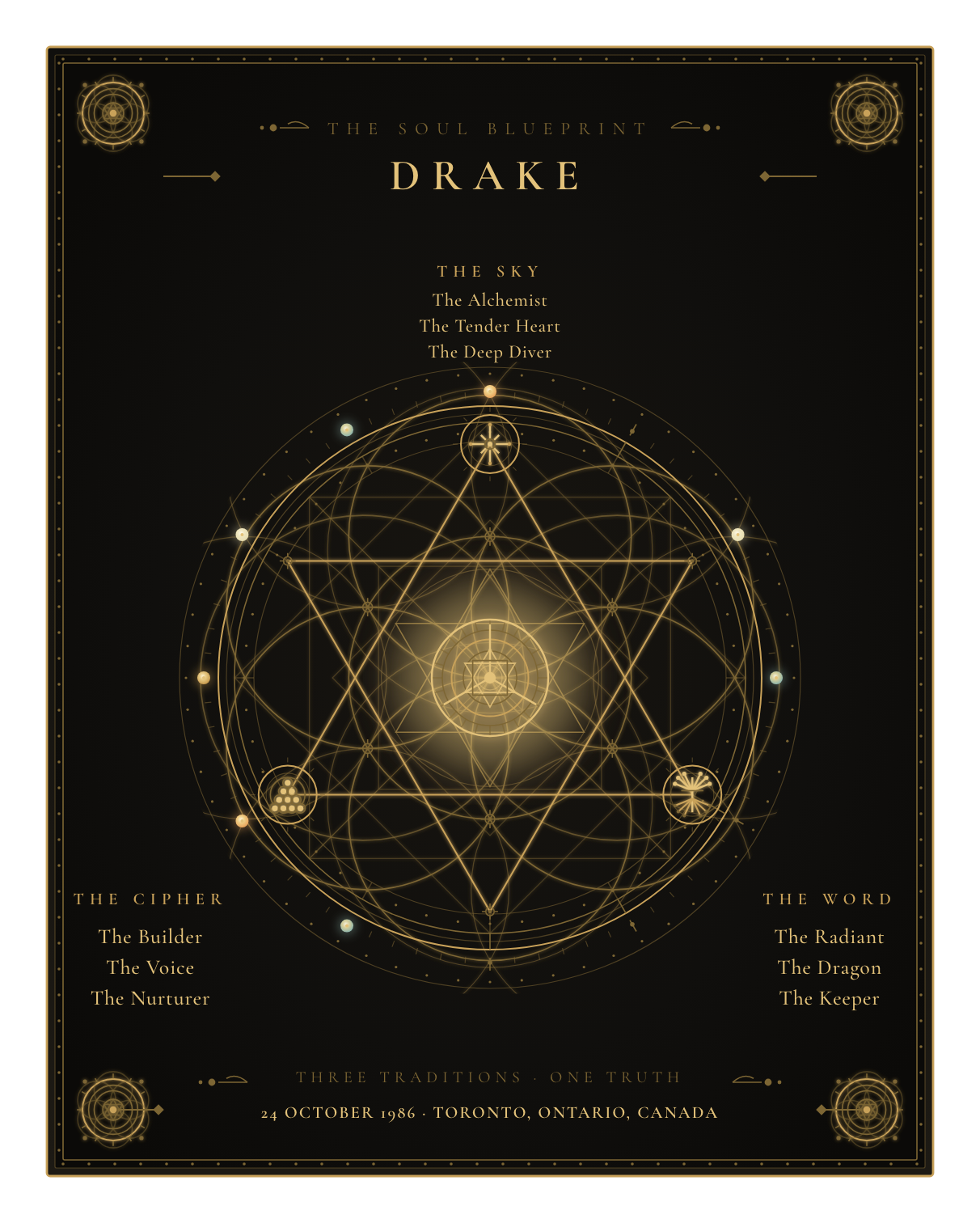
One seal, three languages. The sky he was born under at the apex, the numbers beneath his name at the lower left, the name itself at the lower right — three traditions engraved into one artifact. There is no rising sign, no houses, no angles: without a verified birth time they cannot be honestly drawn. What is true is what is shown.
At a Glance
- Full traditional name
- Aubrey Drake Graham
- Born
- October 24, 1986 · Toronto
- Sun
- Scorpio 0.9° — the essential fire of the life
- Rising
- Birth time unverified — the Ascendant is offered conditionally, never asserted
- Moon
- Cancer 17.0° — the inner life
- Mind · Value · Will
- Mercury Scorpio · Venus Scorpio · Mars Aquarius
- Discipline · Direction
- Saturn Sagittarius · North Node Aries
- Life Path
- 4 — The Builder
- Title-name Destiny
- 3 — The Communicator
- Birth-name Destiny
- 6 — The Nurturer
- Master Numbers
- None preserved at the final layer
- Soul archetype
- The Communicator who lives the Builder’s path
Toronto, October 2013. A young man stands in the Scotiabank Arena, the city’s light falling across his shoulders, and the ceremony begins — the moment the basketball court becomes his witnessing ground. He is wearing the colors of home, the Raptors crimson, and something in the room shifts; the boundary between spectator and participant dissolves. This is not the first time his presence has remade a threshold, but it is the first time a city has claimed him back so publicly, so completely. For years the world has called him a rapper, a producer, a cultural force — the name Drake attached to mixtapes and chart positions and the language of commerce. But beneath that naming, there flows something deeper and more ancient: a soul whose arrival carried a specific kind of fire, one that does not seek to dominate or destroy but to merge, to penetrate, to transform everything it touches through absolute honesty and depth. The fragments the world calls them — the chart positions, the feuds, the business deals, the collaborations — are like stones disturbed in a riverbed, visible only because the current has shifted them. But the river itself, the Source from which all those fragments emerge and toward which they all eventually flow, is something else entirely. This reading descends beneath the public naming. It reads not the stones but the water underneath — the soul’s blueprint, the inheritance it carries, the calling it cannot refuse, and the specific invitation the universe has been extending all along.
The reading moves through the eight chapters of the Soul Blueprint architecture — The Arrival, The Soul’s Inheritance, The Living of It, The Soul’s Calling, The Soul’s Territories, The Name You Carry, The Moment, and The Invitation — and at the end, the same instrument turns gently toward you.
His soul has a blueprint.
So do you.
The same three languages — the sky, the numbers, the name — are waiting in your own.
The Arrival
He arrived carrying a paradox that the world would spend two decades trying to resolve: the self that comes alive through transformative union and depth, whose desire to be a separate individual is being overwhelmed by the need to be more than oneself — yet born under a sky also marked by will-toward-independence, toward standing alone for a principle, toward refusing the conventional. The soul that Scorpio brings is regenerative depth, the urge to go beneath the surface and be remade by merging; it does not caricature itself as vengeance or darkness but as the honest penetration into what lies hidden, and the absolute commitment to truth-telling even when it costs. This is a being born to remake himself through union — with sound, with other artists, with the listener, with the city itself — and to be remade by them in return. Yet simultaneously, there lives in him a force that knows how to stand separate, how to choose his own direction, how to build something new when the old no longer serves. The paradox is not a contradiction; it is the deepest signature of his soul. He is the transformer who must also learn to transform himself, the one who merges while maintaining clarity about his own centre, the communicator whose voice cuts through pretense to name what others avoid saying — and all of this because he arrived carrying both the depths and the independence required to do the work his soul came to do.
The Soul’s Inheritance
He was born into music as inheritance and absence as teacher. His father was a drummer who had played with Jerry Lee Lewis, and his uncles carried the musician’s gift forward — one of them a member of Sly and the Family Stone, the other contributing songs for Al Green — yet the paternal line was marked by distance. His father was in the United States; his father was incarcerated; his father was a presence that moved in and out like a tide, never settling. His mother was an English teacher and a florist, a woman who tends growing things, and from her came the instinct to nurture and to make a felt foundation. His maternal grandfather owned a furniture factory — a man who built structures, who understood how to make something solid and lasting. Toronto itself was the true father, the city that held him when the biological inheritance could not. He attended a Jewish day school and became bar mitzvah, marking his belonging to a people, a lineage of exile and return; he worked in his grandfather’s factory during his teenage years, learning the knowledge of his hands and the price of building something real. He was bullied for his racial and religious background, which meant he grew up understanding what it meant to be the outsider, the one who does not fit the easy categories, the one who must forge an identity from fragments — music and absence, nurture and structure, belonging and otherness — all of it woven together in a city that would become his true country.
The Living of It
The wound was abandonment wrapped in the language of choice; the qualification became the ability to speak the unspeakable and to transform absence into presence through pure creative will. He grew up in a body marked by duality — half African-American, half English, a Canadian with American citizenship, a Jewish boy in a secular world — and learned early that belonging required translation, that to be heard he would have to learn multiple dialects at once. At fifteen, an introduction through a high school friend’s father led him to an acting agent, which led to Degrassi: The Next Generation, and for seven years he lived in the lives of others, learning to embody what was not his own story. Then he stepped into music — self-releasing a mixtape that sold 6,000 copies and earned him $304.04, which is the price of learning that the world does not owe you recognition simply because your gift is real. He tore his anterior cruciate ligament performing ‘Best I Ever Had’ in July 2009, a body split open mid-song, and had to learn to move in music in a new way. He dropped out of high school to pursue his calling and did not receive his diploma until age 25, which meant he carried the weight of that choice — the gamble that art was enough, that his own vision was worth the cost of formal belonging. Every one of these costs became a qualification: he learned how to work in systems not made for him, how to endure pain in public, how to persist when institutions withheld their stamps of approval, how to build something real from nothing. The wound became transparency itself.
If this is what was true for him, what might be true for you?
The Soul’s Calling
The voice that arrived in Drake was not born to repeat what others had already sung — it came to pierce through the surface of what people pretended not to know, to speak the depth-truth that lives beneath charm and agreement. His mind moved like a detective’s, always searching beneath the presented fact for the hidden architecture of feeling and motive. This was not the voice of a crowd-pleaser; it was the voice of one who could see through pretense to the raw thing underneath, and who had the courage — even the compulsion — to name it aloud.
He was called to be a builder, to lay foundation-stones that would last — not the temporary scaffolding of a single song or album, but the architecture of an entire kingdom of sound and symbol. The soul arriving as communicator in the public world did not come merely to entertain; it came to transmit — to move something from the hidden chamber of his own becoming out into the world in a form others could touch, could live inside, could be remade by. That transmission required penetrating honesty: the willingness to speak what polite society keeps locked away, to make art from the most vulnerable and most vengeful chambers of the heart without flinching.
The calling was rooted in a deep need to nurture — not as weakness, but as the intelligence of feeling itself, the knowing that comes from tending to what is broken and making it whole. Every work he brought forth carried the intention to heal something in the listener: the isolated, the doubted, the one who had loved unwisely and survived it. The voice was his way of saying I have been here too. This was his assignment — not to be the loudest, but to be the truest, to build something with his words and rhythms that would shelter those who needed shelter.
The Soul’s Territories
The first territory is Sound as Threshold — the mixtape and the album as a container where the full spectrum of feeling can be held, where Scorpionic depth meets Mercury’s incisive clarity, where a voice can move from singing to rapping to spoken word and all of it feels like the same person being honest in different tones. Every project has been a deliberate architecture of that honesty, a sequence of tracks designed to take the listener deeper, to merge their feeling with his own. The second territory is Collaboration and the Alchemy of Merge — the ceaseless studio work with producers like Noah ’40’ Shebib, the features with other rappers, the signing and nurturing of artists through OVO Sound — because the soul that comes alive through transformative union cannot work alone. He has built his creative life around the principle that the best sound emerges when two or more artists enter the space willing to be remade by the encounter. The third territory is Toronto as Kingdom — not just the city where he was born but a place he has actively claimed and been claimed by, through his ambassadorship with the Raptors, through naming ‘The Six,’ through building The Embassy, through making every album a meditation on what it means to belong to a place that is home. These territories are not separate; they circle each other. The sound comes alive through the collaborations; the collaborations deepen the sound; both of them pour back into the city that made space for him. In each one, he is enacting the soul’s deeper mythology — the story of a being learning what it means to merge without losing his centre, to communicate without flinching from the cost, to build something real and lasting in the city he loves.
There are twelve domains in the kingdom of any life: The Mark, The Unfolding, The Unseen, The Long Return, The Inheritance, The Encounter, The Alchemy, The Living Tension, The Sight, The Body’s Knowing, The Crossing, The Calling.
The Name You Carry
The names he carries are the names of a builder and a communicator bearing the mark of regeneration. Aubrey arrives from lineage — a name that speaks to heritage and inheritance, and through the numbers it carries, it calls forth the Nurturer, the one whose life is about tending and healing, about making a home where others can be safe, about the felt foundation. This is the interior gift, the private inheritance he was born to embody and to offer — the understanding that a space is only alive if the people in it feel genuinely cared for, if there is room for all the complicated feelings, if the work of nurturing is done invisibly so that the creative work can flourish. Drake is the public name, the one the world hears first, and it carries the Communicator — the need to speak, to connect, to bridge the gap between what is hidden and what is known. But the Builder lives underneath both of them, moving through time with the Life Path that knows how to construct something that will last, that understands the necessity of discipline and foundation and the slow accumulation of effort. The full name Aubrey Drake Graham moves through the world like a sentence: the Nurturer who speaks (the Communicator), grounded in the discipline of building something real (the Builder). This is not a name of dominance but of service — the name of someone called to heal through his clarity, to build through his merging, to speak the unspeakable in a way that makes people feel understood rather than exposed. The names together spell out his true work: creating containers of sound and belonging where transformation can happen.
The Moment
June 29, 2009. The bidding war between record labels ended, and he signed with Young Money Entertainment — but the real moment was not the signing but what it represented: the confirmation that his vision had been worth the years of mixtapes nobody bought, the performances for $100, the belief held alone when the world had not yet assembled around him to confirm it. This was the threshold moment when the invisible became visible, when the underground became the mainstream, when the Communicator was finally given the platform to speak. But what came next — what he had to live through in the months after — was the true revelation. He stood on stage in July 2009, performing ‘Best I Ever Had,’ and felt his body split open, his knee shattered mid-song. It is a perfect image of what his soul came to learn: that transformation cannot happen without the body’s breaking, that you cannot merge with others without being willing to be remade, that depth requires sacrifice. He had to learn to move through music differently, had to rebuild not just his physical form but his relationship to the stage itself, to presence, to the vulnerability of standing alone in front of thousands while being fundamentally changed. This moment — the signing and the injury, the confirmation and the breaking, all within weeks of each other — revealed the complete blueprint of his calling. He was not meant to be untouched by success; he was meant to be transformed by it, to use the platform to go deeper, to merge more completely, to speak truths that cost him something to say. Every album released after that moment carries the mark of that breaking — not as trauma but as initiation, the wound that became his voice.
The Invitation
Everything in this reading has been moving toward a single point. The doubleness named in the first chapter, the inheritance, the wound, the calling, the territory, the name, the moment. These are not seven separate truths about Drake. They are one truth, named from seven different angles. And they all converge here.
He is living the extended invitation to become a master of union without losing himself — to build structures of sound and belonging while remaining coherent at his centre, to speak the hidden depths without being consumed by them. The question the universe has been asking him, across two decades of albums and feuds and business decisions and public facing, is this: Can you merge absolutely and still know who you are? Can you collaborate without losing your vision? Can you be the ambassador for your city while also moving freely in the world? Can you speak truth so penetrating that it reaches into the listener’s hidden places — and still be safe, still be whole, still be standing on solid ground? The release required has been constant and specific. He had to release the idea that paternal presence could come in the form he needed it to; he had to release the need for institutional validation (it took until age 25 to get his high school diploma, but he never let the lack of it stop him); he had to release the notion that a chart position or a platinum record would finally make him feel secure. He had to release the belief that being separate and being merged are opposite states — they are not, for a Scorpio learning the Aries medicine of independence. And through each release, something else became available. The call has been toward building what lasts — not just in music but in the ecosystem around the music. The founding of OVO Sound meant he could nurture other voices the way he wished he had been nurtured. The naming of The Six, the ambassadorship with the Raptors, the building of The Embassy — these are not vanities but invitations to the city to see itself differently, to claim its own power and beauty. The collaborations with dozens of other artists, some of them brief and some of them extended across years, have become the primary work — the demonstration that the best sound emerges when two or more people enter the room willing to be remade. Because he said Yes to the invitation to merge, to go deeper, to communicate the unspeakable, to build structures that serve the collective healing, what became available is a form of influence that is not about dominance but about resonance. He has become the voice that people trust to tell them the truth about what is actually happening beneath the surface of their own lives — about love and abandonment, about loyalty and betrayal, about what it costs to build something real in a world that often prefers surfaces. He is the proof, living it in real time, that you can be intensely, Scorpionically honest and also be loved; that you can be a communicator of the deepest truths and also be a builder of lasting institutions; that you can belong absolutely to a place and also move freely beyond it; that the self overwhelmed by the need to be more than itself can also learn to stand on its own two feet. Every album released is an altar he is building, a space where people can come to have their depths witnessed, to feel less alone in the complexity of what they are feeling. The work continues. He is still in the middle of becoming.
He was not late. He was exactly where the soul-clock said he should be. The mission had been inscribed at the threshold of his first breath. What was being asked of him, he has been walking. The naming has been done.
This Is Not Coincidence
The astrology speaks: a being born under Scorpio, whose self comes alive through transformative union and depth, whose entire signature is regenerative and merging, yet also holding Mars in Aquarius — the will toward independence, toward standing alone for principle, toward liberating oneself and others from convention. The numerology speaks independently: the Title Destiny of 3 (the Communicator, the voice that bridges worlds), the Birth Destiny of 6 (the Nurturer, the healer of the heart), and the Life Path of 4 (the Builder, the one who constructs what will endure) — three separate archetypes weaving together a single blueprint of someone called to build structures of sound and belonging while remaining coherent and independent at their centre. The name speaks: Aubrey (the heritage, the inherited gift), Drake (the public voice, the penetrating communication), Graham (the grounding, the foundation, the building). Three entirely different languages. One truth. He arrived to show us what it looks like when you merge absolutely and also know exactly who you are.
Three entirely different languages. One truth.
This is not coincidence. This is what three independent systems do when they are all telling the truth about the same soul.
The Numbers, Decoded
The numbers are computed, not intuited — each letter takes its Pythagorean value, each name reduces, and any Master Number is preserved rather than collapsed.
You have sat with the chart and the numbers and the name of another soul, and watched how a wound becomes a calling, how the place of least belonging becomes the place of greatest gift, how a life too precisely configured to be coincidence reveals itself when three independent languages are read together.
The reading you have just received was, in its outer form, a reading of his soul. But its inner form was a reading written for yours. You did not arrive without a Blueprint either. May this reading be the beginning of the reading you finally receive of yourself. May the light you carry — in whatever particular, irreplaceable form it has taken inside the specific life you were given.
Some lives carry a pattern this clear.
Yours does too.
You’ve read the shape of his soul. The same three languages — the sky, the numbers, the word — are waiting in your own name and birth date. Begin yours, free, below.
Or, when you’re ready, begin your own full Soul Blueprint reading →
Frequently Asked Questions
What is Drake’s birth chart?
Drake’s birth chart is anchored by the Sun in Scorpio — the sign of transformative depth and the drive to merge in absolute union. His Mercury is also in Scorpio, giving him a penetrating, investigative mind that speaks truth incisively and without fear of the taboo. His Venus in Scorpio means his capacity for love is intense, all-or-nothing, and transformative. His Mars in Aquarius brings a will toward independence, reform, and standing alone for principle. His Saturn in Sagittarius marks a hard-earned, tested philosophy — belief that has been examined and made structurally sound. His Moon in Cancer (date-stable) speaks to his emotional nature as nurturing, tending, and healing-oriented. Because his birth time is unverified, his rising sign cannot be fixed with certainty.
What is Drake’s numerology?
Drake’s numerology shows three archetypal layers. His Title Destiny (from Drake) is 3 — the Communicator, whose task is to bridge worlds and speak clearly. His Birth Destiny (from Aubrey Drake Graham) is 6 — the Nurturer, called to heal and tend the heart. His Life Path (from October 24, 1986) is 4 — the Builder, who constructs what endures and brings discipline to vision. Together these three numbers create a single coherent blueprint: a voice that nurtures others by building spaces where transformation can happen.
What does the name Drake mean?
The full name Aubrey Drake Graham carries three separate resonances woven together. Aubrey speaks to heritage and inheritance — the gifts passed down, the lineage carried. Drake names the voice itself, the public presence, the communication — the very word suggests motion, penetration, reaching. Graham grounds it all — a name of solidity and foundation, the building beneath the voice. Together they spell out a single calling: inherited gifts expressed through clear communication, all of it built on ground that will hold.
What is a Soul Blueprint?
A Soul Blueprint integrates three independent traditions — Western natal astrology, Pythagorean numerology, and the etymology of the full birth name — into a single document written as a personal letter to the soul. When you’re ready, you can begin your own.
This reading was prepared in the lineage and methodology of the Soul Blueprint Method — Pythagorean numerology with master numbers preserved, Western archetypal astrology, and a researched etymological reading of the full name. Drake’s birth date (October 24, 1986) is sourced from the public record; the birth time is unverified, so the rising sign is offered conditionally and never asserted.
A Soul Blueprint reading · Astrology · Numerology · Etymology · shams-tabriz.com