
Tyla’s Birth Chart, Numerology, and Name Decoded
Tyla’s Birth Chart,
Numerology & Name Decoded
The Soul Blueprint Method — three traditions woven into one personal letter: Western natal astrology, Pythagorean numerology, and the etymology of the soul’s name. Learn the method →
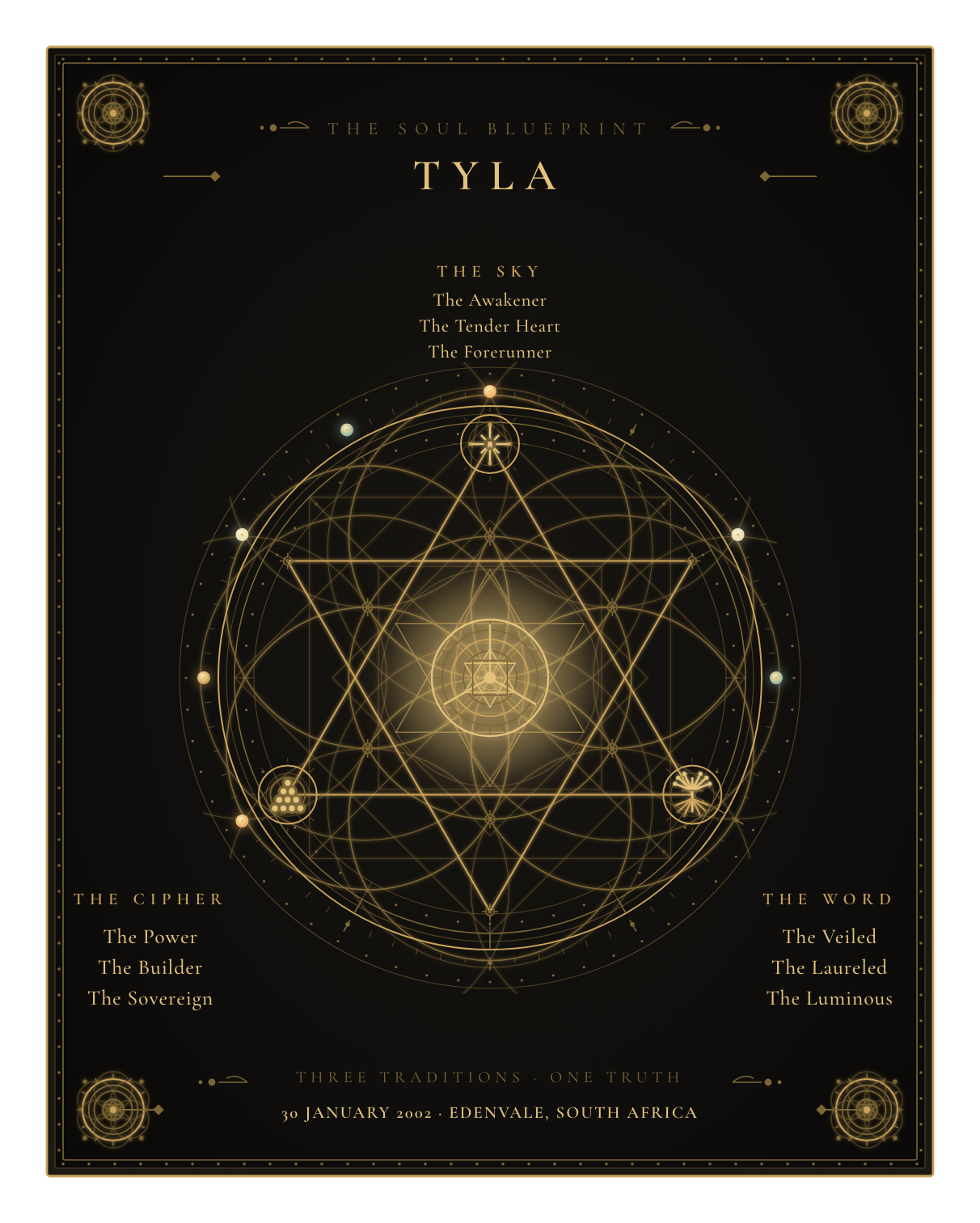
One seal, three languages. The sky she was born under at the apex, the numbers beneath her name at the lower left, the name itself at the lower right — three traditions engraved into one artifact. There is no rising sign, no houses, no angles: without a verified birth time they cannot be honestly drawn. What is true is what is shown.
At a Glance
- Full traditional name
- Tyla Laura Seethal
- Born
- January 30, 2002 · Edenvale
- Sun
- Aquarius 10.3° — the essential fire of the life
- Rising
- Birth time unverified — the Ascendant is offered conditionally, never asserted
- Moon
- Date-dependent across the unverified birth day — not fixed without a confirmed time
- Mind · Value · Will
- Mercury Aquarius · Venus Aquarius · Mars Aries
- Discipline · Direction
- Saturn Gemini · North Node Gemini
- Life Path
- 8 — The Sovereign
- Title-name Destiny
- 4 — The Builder
- Birth-name Destiny
- 1 — The Pioneer
- Master Numbers
- None preserved at the final layer
- Soul archetype
- The Builder who lives the Sovereign’s path
It is October 2023, and a young woman from the East Rand of Johannesburg stands before a camera as water moves across her skin—not rain, but the substance of something else, something that refuses to sit still and demands to be danced with. The song is called ‘Water,’ and it will become the threshold through which the world learns her name. She is twenty-one years old. She has just released the single that will crack open a door no South African artist her age has walked through in fifty-five years. Around her, the machinery of the music industry is beginning to recognize what has been true since birth: that here is a soul who does not arrive with a question mark, but with an assertion—not arrogant, but clean and certain, like the strike of a bell.
The world will see fragments of her: the viral dance, the Grammy, the awards piling up like offerings at a threshold. The industry will call her ‘Queen of Popiano,’ will measure her by charts and streams and the speed of her ascent. But underneath the names the world gives—the accolades, the categories, the comparisons—there is a source. There is a blueprint that arrived before the videos, before the contracts, before the decision to take a year away from studying mining engineering and stand instead in front of a microphone. Like a river, we see only the surface movement: the current, the flow, the undeniable momentum. But a river is not made by its own rushing—it is made by what flows through it from higher ground.
This reading reads the source. It reads not the fragments the industry assembled, but the inheritance and the calling that made a twenty-one-year-old South African girl the youngest African artist ever to win a Grammy Award—twice. It reads what the soul arrived carrying, what it has cost her to live it, and what is still being asked of her as the momentum continues to gather and the world watches to see what an Aquarius revolutionary will do next.
Listen, then, not to the applause, but to what is underneath it—to the blueprint itself.
The reading moves through the eight chapters of the Soul Blueprint architecture — The Arrival, The Soul’s Inheritance, The Living of It, The Soul’s Calling, The Soul’s Territories, The Name You Carry, The Moment, and The Invitation — and at the end, the same instrument turns gently toward you.
Her soul has a blueprint.
So do you.
The same three languages — the sky, the numbers, the name — are waiting in your own.
The Arrival
She arrived carrying a paradox that could not be contained in one room or one genre or one predictable arc: the revolutionary who comes alive through the liberation of others, the inventor who cannot think in isolation but only in the radical meeting of minds, the voice that speaks not from on high but from the principle that all human beings stand equal at the starting line. Her Sun lives in the sign of the reformer and the seer—that fixed, urgent will to expand civilization itself through the power of original vision. Not withdrawn detachment, but something far more dangerous: humanitarian individuality that leans into the world with both hands, that wants to remake the given order not by preaching from a distance but by standing in the marketplace and saying: Look what I have made. Look what we can do together.
This is not the arrival of someone content to follow a path already laid. From her earliest years, there was in her the signature of the inventor—Mercury in that same reforming sign, a mind that does not accept the given structure but steps back to see the whole pattern, that questions everything not because it is rebellious but because genuine objectivity demands it. Her mind comes alive by understanding the system, by seeing how things fit together, and then by reimagining how they might fit together differently.
And what she desires, what she moves toward—Mars in the domicile of initiation itself—arrives with a clarity and a courage that refuses hesitation. She wants. She asserts. She acts. Not after careful deliberation, but in the clean, immediate strike of someone who knows what she came to do.
She arrived as the liberator who would be liberated by her own liberation of others. The paradox was not something to resolve but something to live.
The Soul’s Inheritance
She was born into the East Rand of Johannesburg, into a South African landscape still shaped by its own unfinished reckoning with division and transformation—a country itself in the process of reforming, of asking who gets to speak and who has been silenced, of reimagining what it means to stand equal before the world. Born in 2002, she arrived into the child of a nation twenty-eight years into its own revolution, into a generation that had never known the world the way her parents had known it. The inheritance was not wealth in the material sense, but something richer and more complicated: she came into a culture alive with music, with the amapiano that would later become her native tongue, with the memory of voices that had sung through apartheid itself and come out the other side.
Her ancestry carried India, Indo-Mauritius, the Zulu traditions of the land, the Irish inheritance of her father’s lineage—a bloodline as deliberately mixed and as revolutionary in its own way as the nation she was born into. She grew up in a home where education mattered; her parents both held the lineage of study, of discipline, of the expectation that a child would apply herself rigorously to what mattered. When she began to dream of music, to feel the pull toward something other than the path already mapped (mining engineering, a respectable profession, a clear trajectory), they did not immediately say yes. But the inheritance they had given her—that combination of rigor and that living in a nation remade—meant she would not accept no without fighting for it.
She graduated from Edenglen High School in 2019 as Head of Culture—not a role held by accident. Even before ‘Water,’ even before the contracts, she was someone attuned to what moved through a community, what spoke to the spirit of a place. She had been born into the inheritance of a reforming nation, and she had learned early that culture is not decoration—it is the substance through which a people remembers itself and imagines what it might become.
The Living of It
The living of it began in the margins: during her final year of high school, she was already sharing original songs and covers online, already listening to the voices she would name later as her inheritance—Michael Jackson, Rihanna, Beyoncé, Wizkid—already teaching herself the grammar of what she wanted to say. After she finished high school in 2019, in late that same year, she released a debut single called ‘Getting Late’ with production from Kooldrink, and it achieved something that mattered in South Africa: national success. The door began to open. In May 2021, she signed to Epic Records through the joint venture with Fax Records—the machinery of the industry beginning to recognize what was already true.
But then came the wound that qualified her. She enrolled in a degree in mining engineering. She began to study what was rational, what was respectable, what fit the map her parents could understand. And it was killing something in her. The contradiction between what the soul had come to do and what the world expected became unbearable. She had to come to her parents and ask—after much persuasion, after a lot of crying—if they would let her leave university, let her take a year away from the degree, let her step fully into the calling that would not let her sleep. She had to grieve the path not taken. She had to trust the architect she could not fully see.
That year of asking, of fighting for permission from those who loved her and wanted to protect her from risk, became the year that broke something open. It cost her the certainty that the respectable path offers. It cost her the possibility of remaining half-committed to two futures. By 2023, when ‘Water’ arrived, she was fully herself—no longer divided, no longer holding one foot in mining engineering and one in music. She had paid the price of coherence. And the coherence had set her free.
If this is what was true for her, what might be true for you?
The Soul’s Calling
The calling that arrived through her voice was always about the system: how to speak in a way that could not be ignored, how to invent a language that belonged to no one category and therefore to everyone. Her mind—that Aquarian mind that sees the whole pattern—knew that pop and amapiano were not enemies but partners, that South African and global were not contradictions but invitations to build something new from the collision of both. Mercury in the reformer’s house meant she would not sing what had already been sung. She would remake the grammar itself.
She came to speak in the technological languages of our moment: TikTok became not a burden but a native home, a place where her voice could travel without the gatekeepers having to approve it first. The viral dance around ‘Water’ was not a marketing accident—it was the soul expressing itself in the native tongue of liberation. She understood that to speak to the young, to crack the US Billboard Hot 100 as the first South African soloist in fifty-five years, meant understanding the systems through which sound now travels: not radio playlists alone, but the algorithm itself, the image, the moment of collective movement.
But beneath the tactical intelligence was something deeper: a calling to demonstrate that an African girl from Johannesburg did not have to become a copy of what had already succeeded elsewhere. Her dream—to become the first global pop star from Africa—was not narcissism. It was a blueprint. It was a statement that the structure itself could be reformed. That the distribution of who gets to be heard, who gets to matter, who gets to shape what the world listens to—that structure could be reimagined from the ground up. Her calling was to speak not for herself alone but as a proof that the system could remake itself.
The Soul’s Territories
The territory of Sound and Innovation holds her most alive—this is where her mind and her voice become one. It is not enough to sing what exists; the soul came to invent new syntax, to prove that pop and amapiano could speak to each other, that the language of her childhood (amapiano, the sound of South African townships made global) could meet the international grammar of pop production and create something that had never existed before. This territory is where the system thinker meets the artist—where Mercury’s need to understand the whole pattern becomes the discipline of making something that sounds like nothing else on the radio.
The territory of Youth Leadership and Cultural Authority moves through her with equal force. She was Head of Culture at Edenglen High School; she became the voice that young people worldwide recognized as their own. When she dances to ‘Water,’ she is not performing femininity—she is demonstrating what a woman looks like when she is fully herself, moving without apology or diminishment. The territory is not about being famous; it is about being the kind of presence that tells a generation: You do not have to wait for permission. You do not have to become what they expect. You can make something new. This is what it means to be a revolutionist in real time—not through manifestos, but through the simple fact of living it.
The territory of Equality and Collaboration threads through everything she has done: the features with Ayra Starr, with Summer Walker, with Lisa, with Nile Rodgers and Damiano David—always moving as an equal in the room, never diminishing her own voice to make space for others, but creating space where all voices could be heard at their full volume. This is Venus in the house of the free spirit, love expressed as friendship and genuine equality. She has spent her life surrounded by collaborators, not competitors, because she arrived knowing that the future is built by those who can think as a collective. From these three territories, the deeper mythology emerges: a soul tasked with demonstrating what becomes possible when a young woman refuses to be smaller than her vision.
There are twelve domains in the kingdom of any life: The Mark, The Unfolding, The Unseen, The Long Return, The Inheritance, The Encounter, The Alchemy, The Living Tension, The Sight, The Body’s Knowing, The Crossing, The Calling.
The Name You Carry
The names a soul carries are the first code, the initial language through which the invisible begins to speak. Tyla—though the source of the name remains uncertain, unable to be traced to a single etymological root—carries within it a kind of clean simplicity, a name that does not explain itself, that refuses decoration. It is short, direct, memorable in the way a bell is memorable after it rings—you cannot unhear it. In a world of long, complex naming conventions, Tyla arrives like the strike of something clear. It is the name of someone who does not ask for permission to be noticed.
Laura carries the inheritance of the laurel, of honor, of the ancient victor’s crown—not a crown given by others, but the symbol of achievement earned through discipline and excellence. For a soul born with Saturn in the house of the disciplined mind, there is resonance here: the understanding that mastery is not a gift but a practice, that the authority to speak arrives only after the long work of learning to trust one’s own mind.
Seethal—the family name, the inheritance, the place in the lineage—carries the weight of ancestry, the Indian and Indo-Mauritian traditions, the Zulu earth, the Irish blood. It is a name that cannot be pronounced without acknowledging that she comes from somewhere, that she has been shaped by more than one tradition, that her vision is not individual but inherited.
Together, the three names speak a progression: the clean announcement (Tyla), the earned authority (Laura), the grounded inheritance (Seethal). They are the blueprint written in language. They say: I am clear about who I am. I have done the work. I know where I come from. A soul who arrives without apology, fully named, ready to remake the world from her own sovereignty.
The Moment
October 2023. The music video for ‘Water’ had already been released, had already accumulated three million views on YouTube in three days—a velocity that suggested something was moving through the culture faster than the industry had time to measure. But the defining moment arrived when the song crossed a threshold it had been moving toward since its July release: it entered the top ten in multiple countries, it began its long climb toward the US Billboard Hot 100. For a twenty-one-year-old South African artist, this was not a number on a chart. It was a reformation of the map itself.
What made it a defining moment was not the velocity alone, but what it revealed: that the world had been waiting for exactly this voice, this fusion, this particular girl from Johannesburg. When the chart positions confirmed what the TikTok dance had already suggested—that something had shifted in the distribution of attention, that a young Black African woman was no longer an exception to the rule of global pop dominance but the rule itself—something crystallized. She was twenty-one. She had been born in 2002. She had fought her parents for permission. She had released ‘Getting Late’ from the margins. And now, suddenly, there was no margin left. She was in the center.
Then came February 2024, the 66th Grammy Awards, and the moment became something larger still. She won Best African Music Performance—the inaugural award, which meant she was the first to hold it. And in that moment of being the first, of being the youngest African artist ever to win a Grammy, the defining season became clear: this was the season in which the soul’s entire blueprint moved from private truth to public proof. This was the season in which what she had always known to be true about herself—that she was here to reform the structure—became something the world could no longer deny.
The Invitation
Everything in this reading has been moving toward a single point. The doubleness named in the first chapter, the inheritance, the wound, the calling, the territory, the name, the moment. These are not seven separate truths about Tyla. They are one truth, named from seven different angles. And they all converge here.
What was being asked of Tyla arrived in the form of a question that had no safe answer: Will you trust the vision more than the respectable path? The soul had been born with the inheritance of a reformer, with a mind shaped to see the whole system and to question it, with a will that moved immediately toward what it desired. But the world she was born into offered her a clear map: education, credentials, the mining engineering degree that would place her securely in a knowable future. Her parents—shaped by their own need to protect her, to offer her the stability they had worked for—embodied that map. They did not say no because they did not love her vision. They said no because they loved her too much to let her risk everything on a dream.
What was being released in that year away from university was not her obligation to her parents or her family, but the part of her that was divided. She could not be a whole person and hold two futures. She could not sing with full voice if half of her attention was in a classroom learning thermodynamics. The release was painful—it required crying, persuasion, the kind of negotiation that happens when two people who love each other have to accept that they cannot protect each other from risk. But it was also a liberation. Once she had chosen, once she had said yes to the calling over the safety, the coherence arrived. She was no longer split. She was fully herself.
What was being called toward was the demonstration itself: the proof that a South African girl did not have to leave South Africa or become someone else’s version of a pop star in order to matter globally. ‘Water’ was not a song written to fit a market. It was a song written in the fusion of the languages she carried—amapiano and pop meeting as equals, not as colonizer and colonized. When it became viral, when it climbed the charts, when it won the Grammy, what was being called toward was clarity: the clarity that the structure itself was reformable, that the algorithm and the industry could recognize excellence even when it arrived in an unexpected package, that a young woman with vision was enough.
What became available because she said yes to the calling—what opened up in the season that followed—was the proof that the future she had dreamed was not fantasy. By October 2024, she had won three MTV Europe Music Awards. By the 2024 BET Awards, she had won more awards than any other artist that year, tying with Usher and Victoria Monét—not as a novelty, not as ‘the young African artist’ competing in a special category, but as a legitimate contender in the conversation about who was shaping music itself. She had performed at the Victoria’s Secret Fashion Show. She had been featured on tracks with some of the artists she had named as her influences—Nile Rodgers, whom she sang with on ‘Talk To Me’; Lisa, the Thai rapper whose vision of global collaboration mirrored her own; Damiano David, who saw in her the future of what music could be.
And then came December 2025, and the announcement that HYBE, one of the most powerful management companies in the world, had entered into a global partnership with her. This was not an accident of timing. This was the inevitable next chapter for a soul whose entire blueprint is built around reformation and innovation. The global stage was no longer something she was reaching toward—it was the natural habitat of her gift.
But what matters most about what became available is something quieter and deeper than awards and partnerships. What became available was the knowledge that she had been right about herself all along. That the voice inside her that said You can do this differently. You can remake the structure from inside it. was not the voice of arrogance or delusion, but the voice of truth. She had said yes. The world had said yes back. And now she is living in the territory where the vision and the reality are no longer separate—where the blueprint that arrived at birth is being lived in real time, available to be witnessed by anyone who has ever wondered if their own vision was too big, too strange, too unmarketable to matter.
She was not late. She was exactly where the soul-clock said she should be. The mission had been inscribed at the threshold of her first breath. What was being asked of her, she has been walking. The naming has been done.
This Is Not Coincidence
The astrology speaks: three planets in Aquarius — Sun, Mercury, Venus — all singing the same frequency of liberation, systemic sight, and love that refuses to possess; Mars in Aries adds the will to act without delay, and Saturn in Gemini demands rigorous mastery of the voice and mind itself. The numerology independently testifies: a Life Path 8 carrying sovereign command and material manifestation; a Title Destiny 4 building structures that last; a Birth Destiny 1 pioneering what has never been done before. The names themselves — Tyla, Laura, Seethal — carry the resonance of one who arrives to remake, to build anew, to speak what has not yet been spoken into the world. Three entirely different languages. One truth. The soul came to invent a new form and to speak it with authority. A second convergence: the astrology shows a North Node in Gemini — the soul’s medicine is open curiosity and the gathering of near facts, moving away from the certainty of the big picture toward the humble art of listening. The numerology reflects this same arc: the sovereign who must learn to ask questions, the builder who must remain flexible, the pioneer who must stay teachable. And the name itself — born into a family lineage and a land, a young woman finding her voice in the particular moment of her generation — speaks to a soul learning to balance the visionary with the grounded, the universal with the local, the blueprint with the living breath. Three entirely different languages. One truth. She is learning that revolution lives in the questions we ask together.
Three entirely different languages. One truth.
This is not coincidence. This is what three independent systems do when they are all telling the truth about the same soul.
The Numbers, Decoded
The numbers are computed, not intuited — each letter takes its Pythagorean value, each name reduces, and any Master Number is preserved rather than collapsed.
You have sat with the chart and the numbers and the name of another soul, and watched how a wound becomes a calling, how the place of least belonging becomes the place of greatest gift, how a life too precisely configured to be coincidence reveals itself when three independent languages are read together.
The reading you have just received was, in its outer form, a reading of her soul. But its inner form was a reading written for yours. You did not arrive without a Blueprint either. May this reading be the beginning of the reading you finally receive of yourself. May the light you carry — in whatever particular, irreplaceable form it has taken inside the specific life you were given.
Some lives carry a pattern this clear.
Yours does too.
You’ve read the shape of her soul. The same three languages — the sky, the numbers, the word — are waiting in your own name and birth date. Begin yours, free, below.
Or, when you’re ready, begin your own full Soul Blueprint reading →
Frequently Asked Questions
What is Tyla’s birth chart?
Tyla was born under the Sun in Aquarius — the sign of liberation, systemic vision, and the reformer’s light. Her Mercury is also in Aquarius, granting her an original, architecture-minded intellect that sees patterns and underlying structures; her Venus in Aquarius shapes her love as friendship and equality, drawn to the unique and the free. Mars in Aries provides direct, courageous will — the capacity to act without hesitation — while Saturn in Gemini places her Great Work in the mastery of thought and voice, the discipline of speaking with earned authority. Because her birth time is unverified, her rising sign cannot be fixed and remains circulated rather than settled.
What is Tyla’s numerology?
Tyla’s numerology carries three distinct archetypal signatures. Her Title Destiny is 4 — The Builder, the soul who creates lasting structures and systems. Her Birth Destiny is 1 — The Pioneer, the soul who arrives to initiate what has never been done before. Her Life Path is 8 — The Sovereign, the number of authority, material manifestation, and command. Together, these three numbers describe a young builder-pioneer-sovereign tasked with creating new forms and establishing them in the world with real power.
What does the name Tyla mean?
The names Tyla, Laura, and Seethal form a singular resonance: the entry of a liberator into the world. While the complete etymology of Tyla remains uncertain, the name carries a contemporary lightness and originality — a name that speaks without apology. Laura echoes the Latin laurel, the crown of the victor and the honored one. Seethal anchors the soul in a specific family lineage and a specific land — South African earth, mixed ancestry, the inheritance of a place. Together, the three names compose the signature of one who arrives new but rooted, revolutionary but tethered to a real family and a real place.
What is a Soul Blueprint?
A Soul Blueprint integrates three independent traditions — Western natal astrology, Pythagorean numerology, and the etymology of the full birth name — into a single document written as a personal letter to the soul. When you’re ready, you can begin your own.
This reading was prepared in the lineage and methodology of the Soul Blueprint Method — Pythagorean numerology with master numbers preserved, Western archetypal astrology, and a researched etymological reading of the full name. Tyla’s birth date (January 30, 2002) is sourced from the public record; the birth time is unverified, so the rising sign is offered conditionally and never asserted.
A Soul Blueprint reading · Astrology · Numerology · Etymology · shams-tabriz.com