
Sydney Sweeney’s Birth Chart, Numerology, and Name Decoded
Sydney Sweeney’s Birth Chart,
Numerology & Name Decoded
The Soul Blueprint Method — three traditions woven into one personal letter: Western natal astrology, Pythagorean numerology, and the etymology of the soul’s name. Learn the method →
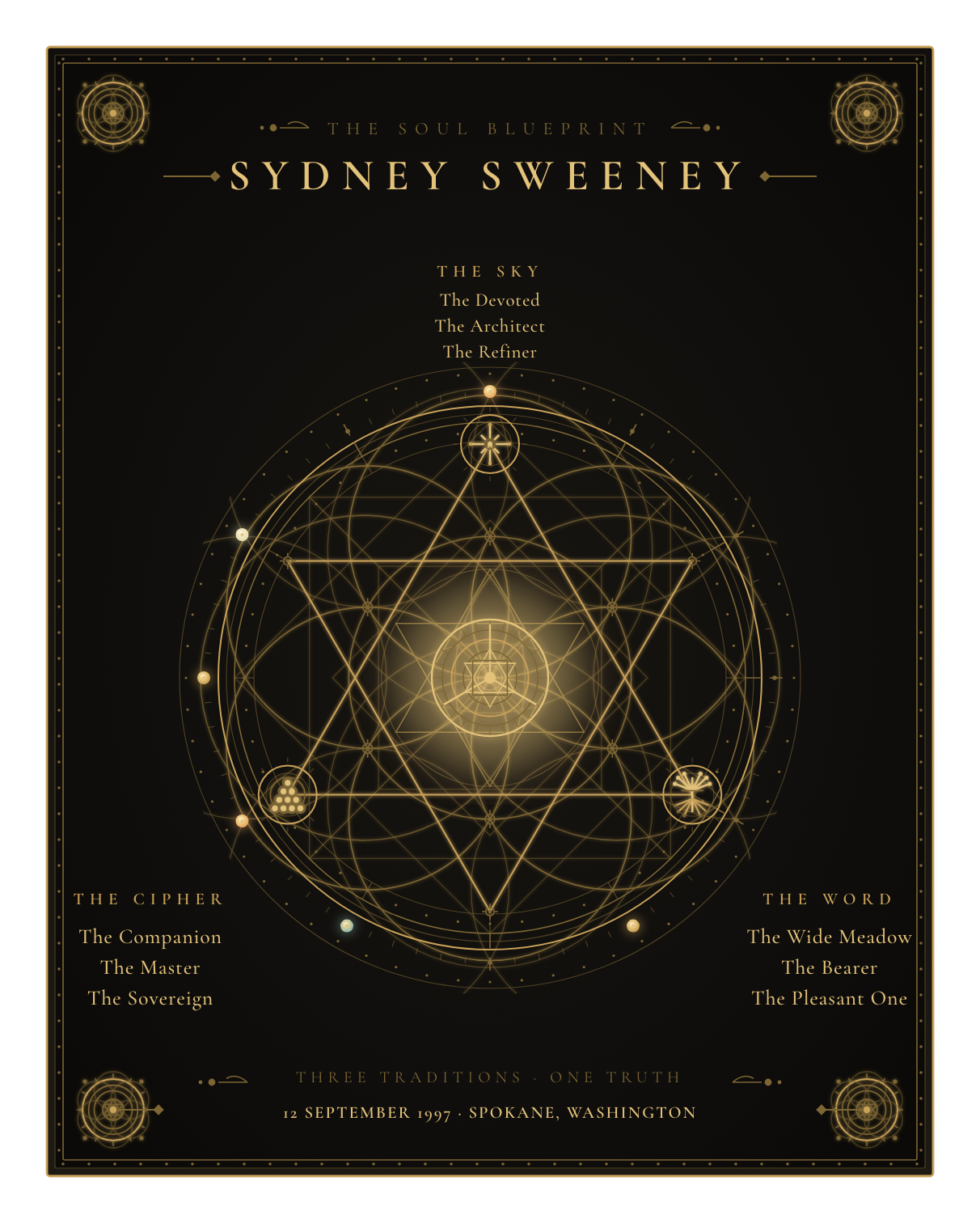
One seal, three languages. The sky she was born under at the apex, the numbers beneath her name at the lower left, the name itself at the lower right — three traditions engraved into one artifact. There is no rising sign, no houses, no angles: without a verified birth time they cannot be honestly drawn. What is true is what is shown.
At a Glance
- Full traditional name
- Sydney Bernice Sweeney
- Born
- September 12, 1997 · Spokane
- Sun
- Virgo 20.0° — the essential fire of the life
- Rising
- Birth time unverified — the Ascendant is offered conditionally, never asserted
- Moon
- Date-dependent across the unverified birth day — not fixed without a confirmed time
- Mind · Value · Will
- Mercury Virgo · Venus Scorpio · Mars Scorpio
- Discipline · Direction
- Saturn Aries · North Node Virgo
- Life Path
- 2 — The Cooperator
- Title-name Destiny
- 44 — The Master Architect
- Birth-name Destiny
- 1 — The Pioneer
- Master Numbers
- 44
- Soul archetype
- The Master Architect who lives the Cooperator’s path
It is January 2026, and there are dozens of bras draped across the Hollywood sign—a cascade of fabric and defiance suspended above the city that demanded her body before it ever asked for her craft. The light is that particular Los Angeles gold that makes everything look temporary and true at once. She stands somewhere below, having orchestrated this small rebellion in service of her lingerie brand, and the gesture carries within it the whole paradox of her inheritance: she is the girl who walked into this kingdom at thirteen with a five-year business plan, who learned early that the only way to own your image is to move faster than the appetite that consumes it.
The world names her by the fragments it sees—the Euphoria actress, the phenomenon, the body that sparked discourse, the girl with the scar beside her eye who somehow became the one they could not stop looking at. But there is a source beneath these refractions, a coherence that moves beneath the scatter of roles and deals and public heat. It is the coherence of a soul that arrived already knowing the difference between craft and exposure, between technical mastery and the noise that surrounds it. This reading moves toward that source—the river beneath the river—and reads not the surface current but the bedrock geology beneath, the blueprint that knew from the beginning how to build, how to discriminate, how to survive by becoming indispensable.
The soul that inhabits Sydney Bernice Sweeney came into form on September 12, 1997, in Spokane, Washington, carrying a signature that would prove both her armor and her medicine: the ability to refine anything toward excellence, to see precisely what needs to be corrected, to move through chaos with the steady hand of the technician. She was born into a religious family with five generations rooted in the Idaho panhandle, a legacy of both constraint and grounding—people who knew how to build, to endure, to say no. And what arrived in her was not the gentle, dreaming soul; what arrived was the one who could look at any fragment and see its potential, who could hold the boundary between what was hers and what was hunger.
The reading moves through the eight chapters of the Soul Blueprint architecture — The Arrival, The Soul’s Inheritance, The Living of It, The Soul’s Calling, The Soul’s Territories, The Name You Carry, The Moment, and The Invitation — and at the end, the same instrument turns gently toward you.
Her soul has a blueprint.
So do you.
The same three languages — the sky, the numbers, the name — are waiting in your own.
The Arrival
She came bearing the fire of discrimination—the self that comes alive only by refining toward mastery, by seeing precisely what is and is not so, by moving through the world as a technician moves through a craft that demands everything. This is not the soul that dissolves into her roles or merges carelessly with the hunger around her; this is the soul whose identity is built on the continual correction of itself, the self-purification that makes the power flow through renewed channels. The paradox she carried from arrival is this: in a kingdom that wanted her to be consumable, she insisted on being useful.
The self that refines is not comfortable; it is not restful. It sees fault where others see surface, and it cannot stop working to make things better. But in this particular soul’s blueprint, that relentless eye toward what needs correcting became not a curse but a gateway—the very mechanism by which she would refuse to be merely looked at, and demand instead to be reckoned with as a builder, a producer, a maker of things. The signature fire arrived in a form that could not sit still, that could not accept the first answer, that was willing to move through exhaustion and exposure and the weight of being seen, because underneath it all was the understanding that technique in service of illumination is not the same as technique in service of ego. She knew this before she had words for it.
The Soul’s Inheritance
She was born into the inheritance of the builder and the believer—a family religious in orientation, rooted for five generations in the rural lakeside country of the Idaho panhandle, people who lived by discipline and the long commitment, who understood constraint as a feature of a meaningful life rather than a punishment. Her father worked in the hospitality industry, her mother had been a criminal defense lawyer, which meant she was born into a legacy of both precision and protection—people who knew how to argue for what mattered, who understood that the world was not automatically kind. Her brother would later join the Air Force, carrying forward the family’s orientation toward service and structure.
This was not an era that made it easy to be young and ambitious; she was born in 1997, into a pre-digital world that would transform into the attention economy just as she came of age. But she came into that world already marked by the inheritance of rural discipline, of people who knew how to say no. And somewhere in her childhood—in fourth grade—she found mathematics, found structure, found the robotics team and the Math is Cool club, the places where precision was celebrated. She was also a child who moved through the world with a visible mark: a wakeboarding accident had left a scar beside her eye, the kind of mark that teaches a young person early that the body can be wounded, that survival requires a particular kind of courage. By the time she was thirteen and ready to pursue acting, she did not ask permission; she built a five-year business plan and presented it to her parents as though it were the only rational option. They could see what she was already, which was not a dreamer but a builder.
The Living of It
The wound became the qualification—the scar beside her eye became the proof that she could not be consumed by her own image, that she was already marked by reality in a way that made her refuse the superficial. She moved to Los Angeles at thirteen, to an industry that was built entirely on the consumption of image, and she did not arrive as an innocent; she arrived with the calculation of the builder. She was a child in that city, but she moved through it with the steadiness of someone who had already decided what she was willing to trade and what she was not.
The living of it cost her the ordinary architecture of childhood and adolescence—she was valedictorian of her graduating class, but the graduation itself was of a school in Burbank, not Spokane. She worked at Universal Studios, briefly, before leaving for the next role. She filmed two shows simultaneously, moving between the weekday work and the weekend work, moving between stories of girls who harmed themselves and stories of connection, never resting, never accepting the first iteration. For her role in Sharp Objects, she did not fake the understanding; she went into hospitals, she studied the territory of mental anguish, she let the material change her. This was not an actress learning lines; this was a craftsperson acquiring the precision necessary to render the interior life of another human being with the exactitude it deserved.
The cost was the constant exposure of her body to critique, to obsession, to the distortion of hunger—the nude scenes in Euphoria became not a moment in her career but a terrain that the culture would not stop excavating. She was objectified relentlessly, and she did not disappear into it; she kept working, kept refining, kept moving toward the roles and the projects that would allow her to demonstrate that she was not the body the culture wanted to consume. The wound of visibility became the qualification for the work—she understood, at a cellular level, that the only way to move through a kingdom built on consumption is to become indispensable to the architecture itself.
If this is what was true for her, what might be true for you?
The Soul’s Calling
The calling that arrived in her was not the call to be seen, though the world made it seem that way; the calling was to make something—to produce, to refine, to build a structure that could hold the complexity of human experience and render it with precision. The voice she carries is the voice of Mercury at its most dignified, the mind that sees exactly what is and is not so, that refuses the approximation, that speaks clearly and usefully. She founded Fifty-Fifty Films in 2020, not as an accessory to her acting but as the primary expression of what she had come to do: make things.
The calling moved her toward the producer’s chair as much as the actor’s, and she began to move through projects not as talent but as architect—she was instrumental in hiring Glen Powell for Anyone but You, contributed to the script, understood at a depth what the story needed to become. She produced Immaculate, auditioned for that project in 2014, and returned to it in 2024 with the authority of the builder who had learned what she needed to learn. She starred as Christy Martin in the biopic carrying her name, but she also produced it, which meant she understood the responsibility of rendering another woman’s life with the exactitude it deserved. The calling is not to be brilliant in the moment; the calling is to hold the vision across time, to refine it, to make sure that the work that comes out the other end is not a approximation but a precision.
The Soul’s Territories
The first territory alive in her is the Craft of Rendering—the space where she enters a character and does not perform but investigates, where she studied the territory of self-harm to inhabit Alice in Sharp Objects, where she moved through the broken sophistication of Cassie Howard in Euphoria with the precision of a surgeon. In this territory, she is not the object; she is the technician, and the body becomes the instrument through which truth can be spoken. The second territory alive in her is the Builder’s Authority—the space where she sits in the producer’s chair and makes decisions about hiring, about script, about the shape the story will take. She moved Glen Powell into Anyone but You because she understood what he could offer; she shaped the vision of Immaculate because she had spent a decade acquiring the knowledge of what the camera needed, what the audience deserved. The third territory alive in her is the Marking of Territory—the space where she has not accepted the consumption but has instead moved to define the terms, where she draped the Hollywood sign in bras, where she built a lingerie brand, where she has accumulated properties and designed cars and moved through the landscape of Los Angeles not as an asset but as a presence that cannot be ignored or diminished.
Each territory holds within it a refusal to be diminished, a commitment to moving the boundary between what is consumed and what is kept. And beneath all three moves the deeper mythology of the one who arrives already whole, already marked, already knowing the difference between craft and hunger, and who cannot be separated from the work of building something that will outlast the appetite that tried to consume her.
There are twelve domains in the kingdom of any life: The Mark, The Unfolding, The Unseen, The Long Return, The Inheritance, The Encounter, The Alchemy, The Living Tension, The Sight, The Body’s Knowing, The Crossing, The Calling.
The Name You Carry
The names she carries are Sydney and Bernice and Sweeney, and they move together like the inheritance and the rupture of a single soul. Sydney arrives as a name of the water—the one who comes from the wide meadow, from the open country—and it carries within it the promise of expansiveness, of the territory that can be seen and inhabited. But Sydney is also the name that became the public name, the one that moved into the industry and became synonymous with the actress, the brand, the presence that could not be ignored. The name itself is almost austere in its directness—it does not ornament, it does not obscure, it names the territory cleanly.
Bernice is the ancient name, the one that means the bringer of victory, and it carries within it the weight of the lineage that came before—the generations in the Idaho panhandle, the religious family, the people who understood that victory is not swift but accumulated through discipline and the refusal to compromise. It is a name that suggests both the warrior and the one who understands the cost of winning, and it is the name that sits beneath the public name, the name that the soul knows itself by in the interior territory. Sweeney is the family name, the one that carries the Irish inheritance, and it is sturdy and direct—it does not require explanation or adornment; it simply names the belonging.
Together, these names move as Sydney Bernice Sweeney—the public name, the ancient name, the family name—and they suggest a soul that is both the refiner and the bringer of victory, the one who comes from the wide meadow but who knows how to hold the boundary, who understands that the sweetness (swee-) comes only through the discipline of the name itself, through the knowing of who you are beneath what the world wants to make you.
The Moment
The moment was the wakeboarding accident when she was a child, the edge of the board propelled backward and slicing the area beside her eye—a moment of velocity and rupture that left its mark permanently on her face. It was a moment that arrived without warning, that transformed the body from a seamless thing into a thing that bore witness, and it was a moment that she could not undo or hide. She could not move through childhood unblemished; she could not arrive at adolescence as the unblemished girl; she had to move through the world already knowing that the body can be interrupted, that visibility is not protection, that the wound is permanent.
This was the defining moment because it taught her at a cellular level that the only answer to visibility is precision, that if you are going to be seen, you must become so indispensable, so competent, so clearly the builder and not the object, that your presence cannot be diminished by the mark it bears. The scar beside her eye became the proof that she could survive being marked, and it became the gateway into the understanding that the girl who could move through the world with a visible wound was the girl who could move through an industry built on the consumption of the body without losing herself to it. It was the moment that made everything that came after possible—the thirteen-year-old girl who presented the five-year business plan, the adolescent who worked two shows simultaneously, the actress who went into hospitals to understand mental anguish, the producer who would not accept the first draft.
The Invitation
Everything in this reading has been moving toward a single point. The doubleness named in the first chapter, the inheritance, the wound, the calling, the territory, the name, the moment. These are not seven separate truths about Sydney Sweeney. They are one truth, named from seven different angles. And they all converge here.
She is being asked to hold the line between the body that is visible and the soul that refines, to continue the work of moving through the machinery of consumption without disappearing into it, to demonstrate that the woman who was marked early can become the woman who cannot be marked at all—not because she is invulnerable, but because she has become so necessary to the architecture itself that to wound her is to wound the structure. The industry arrived at her, and she was young enough to be teachable but old enough to have already decided what she was willing to trade.
What was being released was the possibility of innocence—she could not move through the world as someone untouched, someone who could be confused or consumed without consequence. The wound beside her eye insisted that she see clearly, that she understand early that visibility comes with a cost, and that the only way to survive the cost is to become the one who is not being looked at but rather the one who is building. What was being released was also the inheritance of constraint, the religious family’s understanding that the world is not automatic in its kindness—she took that inheritance and she did not reject it; she transformed it into the discipline of the builder, into the refusal to accept the approximation, into the commitment to the precision that makes something worth making.
What was being called toward was the work of making—the founding of Fifty-Fifty Films, the move into the producer’s chair, the understanding that the actor’s body is not the final product but the instrument through which the product is created. She was called toward the responsibility of hiring, of shaping vision, of rendering other people’s stories with the exactitude they deserved. She was called toward the territory of authority, not the authority of the consumed object but the authority of the one who decides what gets made and how. She was called toward the refusal of the easy answer, the role that required nothing but surface, the project that did not demand the full precision of her craft.
What became available because the Yes was said was the possibility of becoming indispensable—not as an object, but as a maker. When she produced Anyone but You, when she shaped that project and saw it become a phenomenon, she was not the talent anymore; she was the architect. When she returned to Immaculate with the authority of the producer, having auditioned for it a decade before, she was not waiting to be cast; she was deciding what the story would be. When she draped the Hollywood sign in bras, when she built a lingerie brand, when she designed a custom Mustang, when she accumulated the properties and the projects and the authority, she was not negotiating with the hunger anymore; she was defining the terms.
She is still being asked to hold this line—not to disappear into the public face, not to accept that the visible body is the whole story, not to stop refining, not to settle for the approximation. The scar beside her eye is still there, still visible, still a reminder that the body can be marked and still move with authority. She is still moving through a territory that wants to consume her, and she is still refusing it by becoming so necessary to the structure that her presence cannot be diminished. The work continues; the refining continues; the building continues. This is not the soul who rests; this is the soul who cannot stop moving toward the precision that makes something matter.
She was not late. She was exactly where the soul-clock said she should be. The mission had been inscribed at the threshold of her first breath. What was being asked of her, she has been walking. The naming has been done.
This Is Not Coincidence
The astrology speaks: a will that descends into the underworld and does not return until the work is complete—Mars in Scorpio, the warrior-strategist whose power is sustained and transformative, paired with a Sun that refines toward mastery through self-correction and technique. The numerology independently testifies: 44, the Master Architect, and 1, the Pioneer, and 2, the Cooperator—three numbers that together bear the signature of one who builds with precision, acts with original courage, and serves a larger design through devoted collaboration. The name itself—Sydney, ‘wide meadow,’ the expanse; Sweeney, the clan-voice, the heritage carried forward—speaks of territory claimed and lineage stewarded with clarity and intention. Three entirely different languages. One truth. She arrived to refine the raw into the luminous, to move through shadow without flinching, and to build something real that lasts. — The astrology says again: Saturn in Aries, the maturing of the will itself—fear faced, courage disciplined, the act undertaken with timing and patience rather than impulse. The numerology says: Life Path 2 calls the soul toward partnership and the wisdom of knowing when to yield and when to hold firm, the diplomatic precision that makes collaboration possible. The name—Sweeney, the ‘pleasant’ voice, the one who carries the family word—echoes the same teaching: she came not to conquer alone but to refine what was given and pass it forward renewed. Three entirely different languages. One truth. The soul arrived knowing that mastery and service are not opposites but one movement—the hand that perfects the tool is the same hand that gives it away.
Three entirely different languages. One truth.
This is not coincidence. This is what three independent systems do when they are all telling the truth about the same soul.
The Numbers, Decoded
The numbers are computed, not intuited — each letter takes its Pythagorean value, each name reduces, and any Master Number is preserved rather than collapsed.
You have sat with the chart and the numbers and the name of another soul, and watched how a wound becomes a calling, how the place of least belonging becomes the place of greatest gift, how a life too precisely configured to be coincidence reveals itself when three independent languages are read together.
The reading you have just received was, in its outer form, a reading of her soul. But its inner form was a reading written for yours. You did not arrive without a Blueprint either. May this reading be the beginning of the reading you finally receive of yourself. May the light you carry — in whatever particular, irreplaceable form it has taken inside the specific life you were given.
Some lives carry a pattern this clear.
Yours does too.
You’ve read the shape of her soul. The same three languages — the sky, the numbers, the word — are waiting in your own name and birth date. Begin yours, free, below.
Or, when you’re ready, begin your own full Soul Blueprint reading →
Frequently Asked Questions
What is Sydney Sweeney’s birth chart?
Sydney Sweeney was born on September 12, 1997, in Spokane, Washington, with the Sun in Virgo—the self that arrives to refine toward mastery and technical illumination. Her Mercury also inhabits Virgo, amplifying the precise, discriminating mind and the gift of clear, useful speech. Venus resides in Scorpio, bringing intense and transformative depth to her capacity for intimacy and commitment, while Mars also in Scorpio anchors a will that is sustained, strategic, and all-or-nothing. Saturn in Aries disciplines her will itself, asking her to mature courage and act with patience and timing. The birth time remains unverified and circulated without certain documentation, so the rising sign cannot be fixed.
What is Sydney Sweeney’s numerology?
Sydney Sweeney’s numerology unfolds across three governing numbers. Her Title Destiny is 44, the Master Architect—the soul whose task is to build something real and enduring, to create structure and leave a legacy that lasts. Her Birth Destiny is 1, the Pioneer—the signature she carries from her full birth name, speaking of original action and the courage to break new ground. Her Life Path is 2, the Cooperator—a journey asking her to develop partnership, discernment, and the wisdom of knowing how to move with others toward shared purpose. Together, these three numbers paint the image of one who pioneers with precision, builds with others, and leaves something standing.
What does the name Sydney Sweeney mean?
The name Sydney carries the Old English root meaning ‘wide meadow’—a broad, open territory, space claimed and cultivated. Sweeney traces to Irish and Scottish heritage, from ‘Suibhne,’ connoting the pleasant, the harmonious voice or presence—the one whose speech is clear and carries the family name forward. Together, Sydney Sweeney speaks of a soul who arrived to tend a large territory with clarity and care, to hold space and speak truth, and to stewarden a lineage—not to conquer it, but to refine it and pass it forward renewed. The names themselves whisper: expand the meadow, keep the voice true, make the inheritance luminous.
What is a Soul Blueprint?
A Soul Blueprint integrates three independent traditions — Western natal astrology, Pythagorean numerology, and the etymology of the full birth name — into a single document written as a personal letter to the soul. When you’re ready, you can begin your own.
This reading was prepared in the lineage and methodology of the Soul Blueprint Method — Pythagorean numerology with master numbers preserved, Western archetypal astrology, and a researched etymological reading of the full name. Sydney Sweeney’s birth date (September 12, 1997) is sourced from the public record; the birth time is unverified, so the rising sign is offered conditionally and never asserted.
A Soul Blueprint reading · Astrology · Numerology · Etymology · shams-tabriz.com