
Freddie Mercury’s Birth Chart, Numerology, and Name Decoded
Freddie Mercury’s Birth Chart,
Numerology & Name Decoded
The Soul Blueprint Method — three traditions woven into one personal letter: Western natal astrology, Pythagorean numerology, and the etymology of the soul’s name. Learn the method →
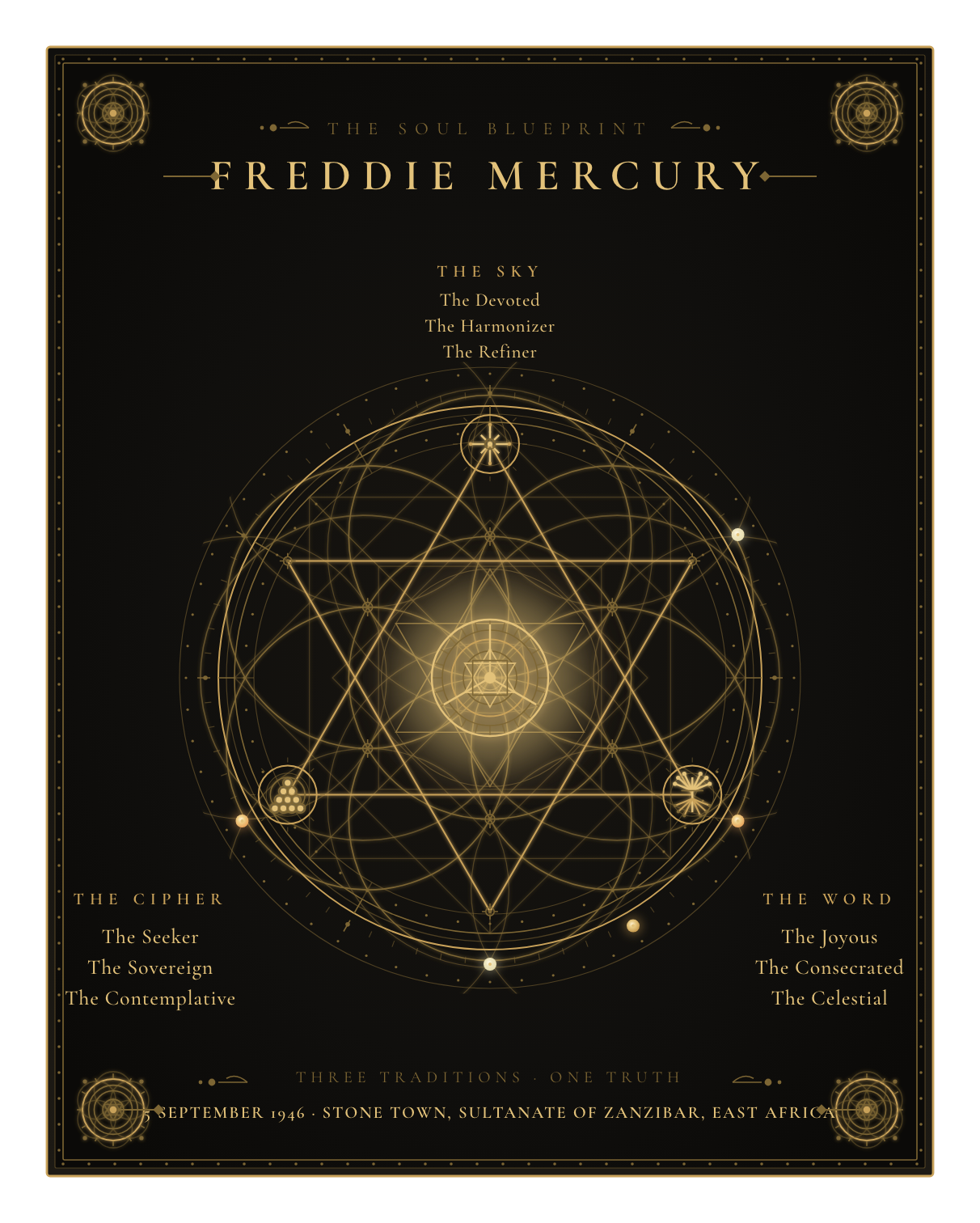
One seal, three languages. The sky he was born under at the apex, the numbers beneath his name at the lower left, the name itself at the lower right — three traditions engraved into one artifact. There is no rising sign, no houses, no angles: without a verified birth time they cannot be honestly drawn. What is true is what is shown.
At a Glance
- Full traditional name
- ફારુખ બલસારા
- Born
- September 5, 1946 · Zanzibar City
- Sun
- Virgo 12.2° — the essential fire of the life
- Rising
- Birth time unverified — the Ascendant is offered conditionally, never asserted
- Moon
- Date-dependent across the unverified birth day — not fixed without a confirmed time
- Mind · Value · Will
- Mercury Virgo · Venus Libra · Mars Libra
- Discipline · Direction
- Saturn Leo · North Node Gemini
- Life Path
- 7 — The Seeker
- Title-name Destiny
- 1 — The Pioneer
- Birth-name Destiny
- 0 —
- Master Numbers
- None preserved at the final layer
- Soul archetype
- The Pioneer who lives the Seeker’s path
It is August 1986, late summer at Knebworth Park, and the light is the gold of endings. Two hundred thousand people have come to watch a man in white satin deliver what will turn out to be his final live performance — though none of them know it yet, and he does not announce it. The stage is enormous, the voice is boundless, the body moving through the songs as though the body itself were a tuning fork struck at exactly the frequency the moment demands. What the world sees in that light is crystalline: the performer, the mastery, the absolute command of a space and a sound. But beneath the visible performance runs another current — the figure that the public calls Freddie Mercury, the legend being constructed in real time, and underneath that figure runs yet another stream: the source from which both the performer and the legend emerge.
This is always the work of reading a soul — to move beneath the fragments the world has gathered and named, the roles and the achievements and the stories told about a life, and to listen instead for the current underneath, the unbroken line that has been flowing through all of it from the beginning. A river has many surfaces, many reflections, many visible currents that appear to be moving in different directions; but a river has only one source, one geometry of descent and flow that determines everything the river will become. This reading returns to that source — not to the legend, but to the soul that the legend was built upon.
What follows is a reading of Farrokh Bulsara, born September 5th, 1946, in Stone Town on the island of Zanzibar, in the moment when the British Empire was still drawing its final map and before the island itself would be torn by revolution. It is a reading of the soul that arrived carrying a specific paradox, inherited a specific wound, and lived a specific calling — and what that arrival, inheritance, and calling were built to demonstrate about the nature of craft, beauty, and the price of being seen.
The reading moves through the eight chapters of the Soul Blueprint architecture — The Arrival, The Soul’s Inheritance, The Living of It, The Soul’s Calling, The Soul’s Territories, The Name You Carry, The Moment, and The Invitation — and at the end, the same instrument turns gently toward you.
His soul has a blueprint.
So do you.
The same three languages — the sky, the numbers, the name — are waiting in your own.
The Arrival
He arrived carrying a paradox that would define everything the life touched: the paradox of the self that becomes most alive precisely when it is most refined, most disciplined, most exacting about every detail — and yet arrives into a body, a voice, a sensibility that is itself excessive, ornate, impossible to contain within any conventional frame. The self that comes alive by refining toward mastery, by analyzing and purifying and doing the work over until the work becomes invisible in its precision — this is the essential signature the soul came in carrying. But this refining impulse did not land in a cautious temperament, a life lived in small spaces, a person content with perfection in private. It landed in a being whose entire nature wanted to explode into sight, into excess, into the most visible and flamboyant expression possible.
The Virgo inheritance — the call to technique, to analysis, to getting it exactly right through meticulous work and self-correction — this became the spine of everything he built. Every song was rewritten. Every performance was controlled down to the smallest gesture. The mind that lived inside him was precise, discriminating, capable of hearing what was not quite true and fixing it until the truth emerged. But this precision was not the prison it sometimes becomes; it was instead the foundation that allowed the excess, the beauty, the four-octave range and the ornamental arrangements and the colors and the costumes to build upward with absolute structural integrity. The refining mind and the extravagant soul were not in conflict — they were in alliance. Mastery was not the denial of abundance; it was the vessel that could hold it.
The Soul’s Inheritance
He was born into a Parsi family — inheritors of a lineage stretching back to the Zoroastrian fire-temples of ancient Persia, a people who had carried their traditions across centuries and continents until they landed in India, in the city of Gujarat, in the practices of merchants and professionals and people deeply committed to their own aesthetic and moral codes. The name Bulsara itself is a place-name, derived from Bulsar, a city in what is now Gujarat, one of the five centers where the Zoroastrian religion held its deepest roots. His father, Bomi Bulsara, worked as a cashier at the British Colonial Office — a man embedded in the structures of Empire, serving in a colonial administration that was itself beginning to fracture. This is the inheritance: a family conscious of lineage, of heritage, of the particular dignity that comes from belonging to a tradition older and more rooted than the modern nations around them.
The family lived in Zanzibar, an island at the intersection of trade routes and cultures, where the British Empire was still drawing its administrative lines but where older powers were also stirring. In the spring of 1964, when Farrokh was seventeen, the island erupted into revolution — violence, upheaval, the structures of colonial order collapsing — and the family fled. They went to England, to Middlesex, to the suburbs of a nation that was itself in the midst of profound transformation. The boy had already been sent away to boarding school in India at age eight, sent to St. Peter’s School in Panchgani, where he began calling himself Freddie — a shortened, anglicized name, a small act of translation and self-fashioning that would become the practice of a lifetime. He arrived in England as a teenager already accustomed to displacement, already trained in the art of becoming someone else while carrying the old name underneath.
The Living of It
He lived as a figure perpetually split between two natures — the extrovert who lived on stage, the performer who could command a room of two hundred thousand people and make them move as though they were a single organism — and the shy, retiring man who existed when the performance ended, who granted almost no interviews, who said of himself that when performing he was an extrovert but inside he was completely different. This split was not a neurosis to be overcome; it was the structural truth of the life, the organizing principle that determined everything.
The calling required him to become a craftsman first. He studied art at Isleworth Polytechnic, then graphic art and design at Ealing Art College, and graduated with a diploma in 1969 carrying the training of technique, proportion, visual composition. He worked as a baggage handler at Heathrow, sold second-hand Edwardian clothes in Kensington Market, joined bands playing blues in the style of Hendrix — and through all of it was learning, refining, analyzing what worked and what did not. When he teamed up with drummer Roger Taylor and guitarist Brian May in April 1970, when bassist John Deacon joined in 1971, the group that became Queen was not built on inspiration alone; it was built on a discipline of composition, arrangement, and exact execution that bordered on obsession. He designed the Queen crest himself — the logo combining the zodiac signs of all four band members, a visual statement of proportion and balance and the refining eye.
But the cost of this split life, of being publicly extravagant while privately guarded, of carrying a love that could not be spoken aloud in the world as it was, of contracting a virus in the early 1980s and keeping that knowledge private for years while rumors accumulated and the press pursued him — this cost accumulated silently. By 1987, when he celebrated his forty-first birthday at Pikes Hotel in Ibiza at what was described as the most incredible example of excess the Mediterranean had ever seen, with seven hundred people in attendance, he knew. He had contracted HIV. The party was not a celebration; it was a threshold.
If this is what was true for him, what might be true for you?
The Soul’s Calling
The soul came to demonstrate the marriage of precision and abundance — what it means to use technique not as a denial of excess but as its vessel, to refine toward mastery not in order to diminish but to amplify. He came to show that a discriminating mind, an exact ear, an almost obsessive attention to detail could be the instrument through which beauty becomes visible, through which a voice can contain four octaves and subharmonics that no human throat should theoretically be able to produce, through which a song can be simultaneously complex and inevitable.
He was a voice in the most literal sense — Mercury, the god of communication, of language, of the precise word that travels and lands and does its work. His voice carried frequencies that seemed to defy the anatomy of the body producing them. His songwriting encompassed rockabilly and progressive rock and heavy metal and gospel and disco — an absolutely catholic range of forms, all held together by a sensibility that could analyze what made each form true and then rebuild it with absolute structural integrity from the inside out. Ten of the seventeen songs on Queen’s Greatest Hits album were his — Bohemian Rhapsody, Killer Queen, We Are the Champions — songs that should not have been commercially viable, that broke every rule, and that became timeless precisely because they were built with such exact attention to what makes a song breathe and move and land in the listener’s body.
He performed an estimated seven hundred concerts around the world. He was not late. He was exactly, precisely, obsessively on time — on time with his voice, on time with his vision, on time with the demand that every detail matter because beauty itself depends on every detail mattering.
The Soul’s Territories
The territory of Composition holds the essential work: the songs written, the arrangements built, the structure that allows a piece to move through multiple movements and genres and moods while remaining coherent. Bohemian Rhapsody is the supreme example — a song that contains opera and ballad and hard rock within a single five-minute arc, a song that should have been unlistenable and instead became eternal. What this territory reveals is that complexity does not require obscurity; precision does not require coldness. A song can be intricate and beloved. A structure can be elaborate and still move the human heart.
The territory of Performance holds a different kind of truth — the translation of precision into presence, the way that all the technical mastery becomes invisible in the moment of delivery, the way that a body moving on a stage in white satin can become a conduit for something larger than itself. The performances were not spontaneous; they were choreographed, controlled, obsessively prepared — and yet in the moment of delivery they felt like pure abandonment, pure generosity, pure offering. This is what precision at this level allows: the freedom to be absolutely free because the foundation is absolutely secure.
The territory of Relationship holds the deepest vulnerability: Mary Austin, whom he called the only friend he had, the common-law wife, the person he lived with in West Kensington, whom he told of his sexuality in December 1976 and who remained his closest lifelong friend; Winfried Kirchberger in Munich, his great love, who gave him a silver wedding band; Jim Hutton, beginning in 1985, described as built on solace and understanding, whom he called his husband, who tested HIV-positive in 1990 and remained with him, nursing him through his final years, present at his deathbed. What these territories reveal together is the architecture of a life that was simultaneously the most visible and the most private, a soul that could command a stadium and still needed the exact, faithful presence of one person who knew him underneath the performance.
There are twelve domains in the kingdom of any life: The Mark, The Unfolding, The Unseen, The Long Return, The Inheritance, The Encounter, The Alchemy, The Living Tension, The Sight, The Body’s Knowing, The Crossing, The Calling.
The Name You Carry
The birth name carries three layers: Farrokh, a Persian name used by the Parsi community, a people defined by their connection to a rooted, ancient tradition stretching back to Zoroastrianism — the fire-temples, the teachings, the sense of belonging to something older and more enduring than any one lifetime. Then Bulsara, the family surname derived from Bulsar, a city in Gujarat, one of the five centers of Zoroastrian fire-temples, making the name itself a statement of religious and cultural inheritance — a reminder of where the family descended from, what they carried, what they refused to forget.
Then Freddie, the anglicized shortening, adopted at age eight during boarding school in India — a small translation, a first gesture toward becoming someone new while keeping the old name underneath. And finally Mercury, the legal name adopted around 1970, the planet and the Roman god, the messenger, the one who travels between worlds, the god of commerce and communication and the precise word. He said the name sounded powerful, and it is — Mercury is not shy, not retiring, not content to stay in one place or one form. Mercury moves. Mercury communicates. Mercury is the mind made visible, the voice given form.
What the three names carry together is the architecture of a soul that knew itself as both rooted and rootless, both traditional and revolutionary, both the heir to a lineage and the creator of something entirely new. The Parsi inheritance, the family name, the adopted childhood name, and finally the chosen adult name — each layer is honest, each represents a truth about who he was becoming, and none of them contradicts the others. He said he would always walk around like a Persian popinjay — ornate, exuberant, impossible to ignore, and unmistakably Eastern in his sensibility even as he became the voice of Western rock and roll.
The Moment
In the spring of 1964, when Farrokh was seventeen years old, the island of Zanzibar erupted into revolution. The structures of colonial order that had held the island together began to collapse. Violence moved through the streets. The family made the decision to flee — to leave behind the place where they had lived, the networks they had built, the life they knew. They went to England, to Middlesex, to the suburbs of a nation they had always admired from a distance but had never lived in. It was the defining rupture of his youth — the moment when the boy understood that home could be taken away, that the structures that seemed permanent could dissolve overnight, that one had to be prepared to become someone else and live in a new language and a new climate and a new way of being seen.
But this moment of displacement was also, paradoxically, the moment of arrival. He came to England carrying a Parsi heritage, a boarding-school education, a voice that was already remarkable, an eye for visual composition and design, and an absolute hunger to learn British culture, British fashion, British music — the music of the Beatles and the Rolling Stones and everything that had been broadcasting from England into the world. He had always felt connected to Britain before arriving; now he was inside it, and the intensity of that arrival, that immersion, that hunger to become fluent in a new world while carrying the old world inside, this became the fuel for everything that followed.
The moment revealed a central truth about his nature: he could hold multiple identities simultaneously without needing them to cohere into a single, unified self. He could be Farrokh Bulsara and Freddie Mercury. He could be the shy, retiring person and the extroverted performer. He could be the precise craftsman and the flamboyant artist. The revolution in Zanzibar had taught him early that identity was not fixed, that one could be translated and still be oneself, that the deepest self was portable and could survive displacement. This became his greatest strength and his greatest struggle.
The Invitation
Everything in this reading has been moving toward a single point. The doubleness named in the first chapter, the inheritance, the wound, the calling, the territory, the name, the moment. These are not seven separate truths about Freddie Mercury. They are one truth, named from seven different angles. And they all converge here.
The invitation arrived not as a single moment but as a tearing open—a demand that the self who had learned to refine, to master technique until it became invisible, until craft itself was a kind of prayer, would have to stand exposed in the light he had spent so long earning the right to claim. The soul born into the work of self-purification through meticulous discipline was being asked to do the one thing that terrified it most: to be seen. Not admired from a distance. Not praised for the perfection of the instrument. Seen—in the rawness of desire, in the particularity of his own heart, in the unconventional shape of love as he actually lived it, not as the world’s categories permitted.
For decades, he had obeyed the law of the refiner: he studied the masters, he practiced until his voice held frequencies that seemed to exist outside the normal human spectrum, he composed with such intricate architecture that musicians still struggle to decode what he somehow knew without reading a note. He had built a kingdom of technical mastery so complete that it became a kind of armor. When I’m performing I’m an extrovert, yet inside I’m a completely different man—these words were not confession but statement of fact, the division between the self that could be seen and the self that must remain hidden. The invitation was to collapse that division, to stop performing the extrovert and become, instead, the man who performs truth.
What was being released was the assumption that visibility required perfection, that to be seen was to be judged, that his worth depended on the purity of his output rather than the authenticity of his presence. The soul who had inherited his father’s precision, his meticulous eye for detail, his devotion to getting things exactly right, had to learn that the greatest refinement is not the removal of imperfection but the acceptance of what cannot be polished away—his own longing, his own need for partnership, his own refusal to hide the shape of his desire beneath borrowed names or acceptable fictions.
The direction the soul was travelling toward was radical particularity: the gift was in learning to speak not in abstractions but in the intimate details of his own life, not in pronouncements about universal truth but in curiosity about the textures of the immediate and real. He began to ask questions instead of declaring answers. He began to listen—to Mary Austin, to the four musicians around him, to Jim Hutton, to the people he encountered who showed him that love wore many faces and that honesty about one’s own face was worth more than a thousand performances of someone else’s. The medicine was in the gathering of near facts, the particular loves, the specific friendships, the real names of the people who mattered.
What became available because the Yes was said—because he allowed himself to be visible as he actually was—was the paradox that the more truly he showed himself, the more he became universal. The technical mastery did not disappear; it became the vehicle for something deeper. He could compose a song for his cat and have it become an immortal prayer. He could sing at a benefit concert with a throat already declining and have it called the greatest live performance in history because what came through was not the perfection of technique but the generosity of presence. He could stand in front of 200,000 people and feel that he was standing in front of one person, and in that meeting of singular souls the whole world was illuminated.
The invitation was also to claim his own creative authority—not as something earned through years of penance and self-correction, but as something inherent, something that could be expressed precisely because he had done the work. The fear of being seen, of being judged unworthy, of being found insufficient—that fear matured into its opposite: the absolute certainty that his way of loving, his way of making beauty, his way of refusing to be ordinary was not a flaw to be hidden but a gift to be offered. He became the Pioneer not because he rejected the work of refinement but because he used that discipline to say the thing that had never been said in quite that way before. He became the Seeker not by abandoning certainty but by holding his certainties lightly enough to remain genuinely curious about the person in front of him. And he became the self-purified vessel through which power could flow—not because he had removed all traces of humanity but because he had finally allowed his humanity to be the very thing that made him luminous.
He was not late. He was exactly where the soul-clock said he should be. The mission had been inscribed at the threshold of his first breath. What was being asked of him, he has been walking. The naming has been done.
This Is Not Coincidence
The astrology speaks clearly: a Virgo Sun demands refining toward mastery, technique in service of Illumination, the devotion to doing the work truly well — and this Sun is supported by a Mercury equally in Virgo, the precise discriminating mind, the voice that is clear and accurate and useful, and a Venus in Libra that loves relationship itself, harmony, beauty, grace, the art of making things lovely and fair. The numerology speaks independently: a Life Path 7 is the Seeker, the soul who questions and refines and searches for deeper truth, and a Title Destiny of 1, the Pioneer, who arrives to show the world something that has not been shown before, something that breaks the pattern and opens a new way of seeing. The names speak their own language: Farrokh carries the ancient Persian inheritance, Bulsara the rooted place-name, Freddie the childhood translation, and Mercury the chosen planetary identity — four layers of naming that say: I am traditional and revolutionary, rooted and mobile, private and visible, all at once. Three entirely different languages — planetary positions in the heavens, the numerology of birth and naming, the etymology of identity — and they are singing exactly the same song: A soul arrived carrying the paradox of precision and excess, asking to build something so beautifully exact that it would outlast the body that made it.
Three entirely different languages. One truth.
This is not coincidence. This is what three independent systems do when they are all telling the truth about the same soul.
The Numbers, Decoded
The numbers are computed, not intuited — each letter takes its Pythagorean value, each name reduces, and any Master Number is preserved rather than collapsed.
You have sat with the chart and the numbers and the name of another soul, and watched how a wound becomes a calling, how the place of least belonging becomes the place of greatest gift, how a life too precisely configured to be coincidence reveals itself when three independent languages are read together.
The reading you have just received was, in its outer form, a reading of his soul. But its inner form was a reading written for yours. You did not arrive without a Blueprint either. May this reading be the beginning of the reading you finally receive of yourself. May the light you carry — in whatever particular, irreplaceable form it has taken inside the specific life you were given.
Some lives carry a pattern this clear.
Yours does too.
You’ve read the shape of his soul. The same three languages — the sky, the numbers, the word — are waiting in your own name and birth date. Begin yours, free, below.
Or, when you’re ready, begin your own full Soul Blueprint reading →
Frequently Asked Questions
What is Freddie Mercury’s birth chart?
Freddie Mercury was born with his Sun in Virgo, the sign of refining toward mastery and technical precision in service of illumination. His Mercury is also in Virgo — a mind that thinks clearly, accurately, and discriminatingly, with a voice that cuts through to essential truth. His Venus in Libra gives him a gift for relationship, harmony, and beauty, while his Mars in Libra channels his will through diplomacy and the fight for fairness. Saturn in Leo places his great work in the earning of creative authority and the courage to be seen. Because his birth time is unverified, the rising sign cannot be determined with certainty, though various times have been circulated; the chart elements that matter most are the Sun, Mercury, Venus, Mars, and Saturn placements.
What is Freddie Mercury’s numerology?
Freddie Mercury’s numerology carries three essential numbers: his Title Destiny is 1, the Pioneer — the soul who arrives to show the world something unprecedented and to break the old patterns; his Birth Destiny is 0, the circle complete, the soul who contains all potential; and his Life Path is 7, the Seeker — the soul who questions, analyzes, and searches for the deeper truth beneath the surface. Together these numbers suggest a soul who came to refine understanding itself, to pioneer a new way of seeing precision and excess as compatible rather than contradictory, and to demonstrate that the deepest seeking happens through exact technical mastery.
What does the name Freddie Mercury mean?
The birth name Farrokh is Persian, used by the Parsi community of India and carrying connection to the ancient Zoroastrian tradition. Bulsara is the family surname, derived from Bulsar (now Valsad), a city in Gujarat that was one of five centers of Zoroastrian fire-temples — making the name itself a statement of religious and cultural inheritance. Freddie was the anglicized shortening adopted during boarding school in India at age eight, a first gesture toward translation and self-creation. Mercury, the legal surname adopted around 1970, names the Roman god and planet associated with communication, precision, travel, and the voice — the messenger who moves between worlds. Together the names trace a soul’s movement from ancient rooted tradition through displacement and reinvention into a chosen identity that honors both the inheritance and the revolution.
What is a Soul Blueprint?
A Soul Blueprint integrates three independent traditions — Western natal astrology, Pythagorean numerology, and the etymology of the full birth name — into a single document written as a personal letter to the soul. When you’re ready, you can begin your own.
This reading was prepared in the lineage and methodology of the Soul Blueprint Method — Pythagorean numerology with master numbers preserved, Western archetypal astrology, and a researched etymological reading of the full name. Freddie Mercury’s birth date (September 5, 1946) is sourced from the public record; the birth time is unverified, so the rising sign is offered conditionally and never asserted.
A Soul Blueprint reading · Astrology · Numerology · Etymology · shams-tabriz.com