
Robert Pattinson’s Birth Chart, Numerology, and Name Decoded
Robert Pattinson’s Birth Chart,
Numerology & Name Decoded
The Soul Blueprint Method — three traditions woven into one personal letter: Western natal astrology, Pythagorean numerology, and the etymology of the soul’s name. Learn the method →
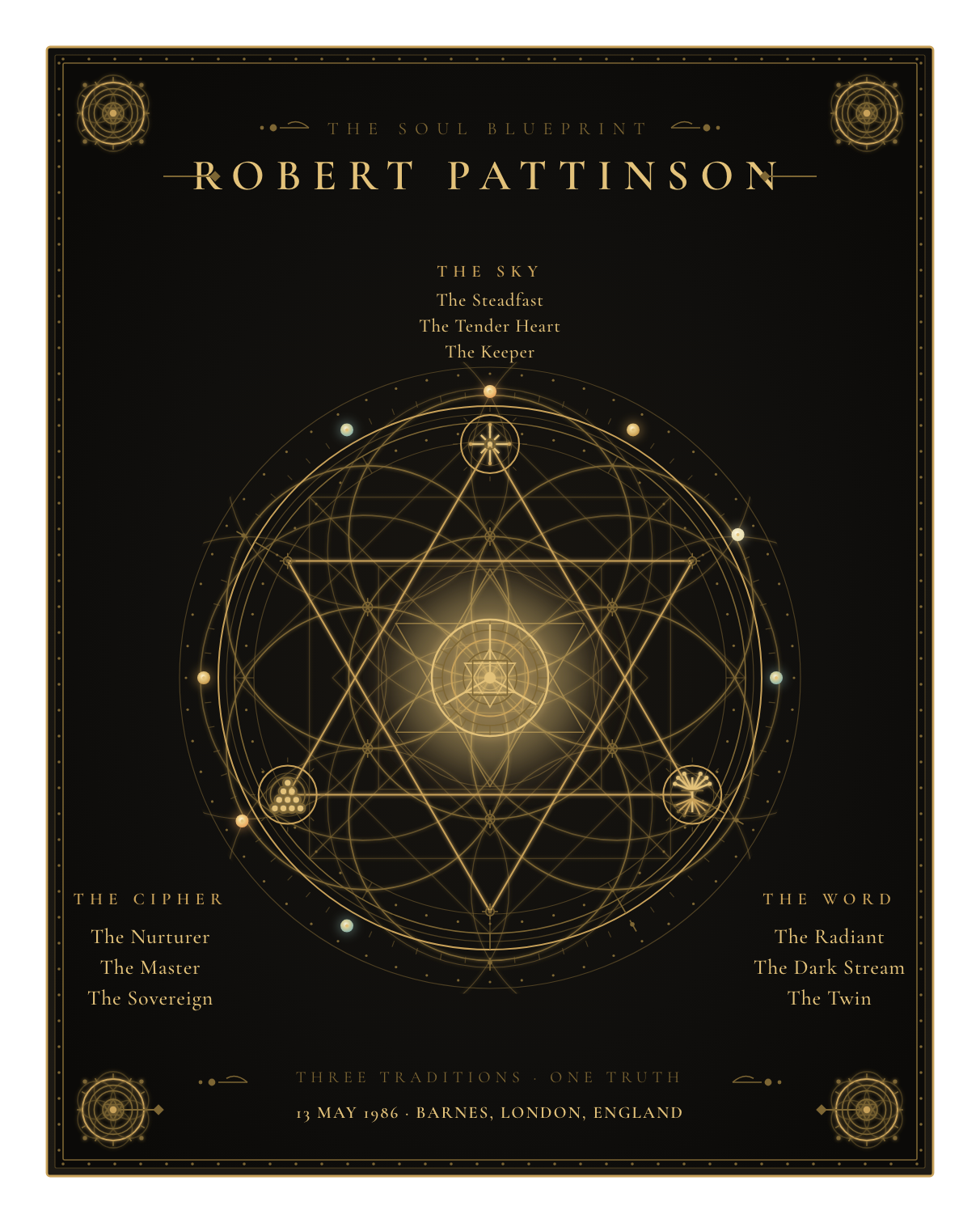
One seal, three languages. The sky he was born under at the apex, the numbers beneath his name at the lower left, the name itself at the lower right — three traditions engraved into one artifact. There is no rising sign, no houses, no angles: without a verified birth time they cannot be honestly drawn. What is true is what is shown.
At a Glance
- Full traditional name
- Robert Douglas Thomas Pattinson
- Born
- May 13, 1986 · London
- Sun
- Taurus 22.4° — the essential fire of the life
- Rising
- Birth time unverified — the Ascendant is offered conditionally, never asserted
- Moon
- Cancer 11.8° — the inner life
- Mind · Value · Will
- Mercury Taurus · Venus Gemini · Mars Capricorn
- Discipline · Direction
- Saturn Sagittarius · North Node Aries
- Life Path
- 6 — The Nurturer
- Title-name Destiny
- 44 — The Master Architect
- Birth-name Destiny
- 1 — The Pioneer
- Master Numbers
- 44
- Soul archetype
- The Master Architect who lives the Nurturer’s path
Light falls through the Gothic arches of a film set in 2022, and in the shadows between takes, a man sits alone with a guitar he has carried since childhood—fingers moving through chords without thought, the body remembering what the mind sometimes cannot hold. The city outside is London again, as it always is underneath, even when the screen shows Gotham. He was born here in 1986, in the quiet streets of Barnes, and something in him never left—a rootedness, a returning. The world has called him many things: the face of the Twilight era, the actor who broke free, the method practitioner who collaborates with auteur visionaries, the reluctant icon. But these are the fragments the world assembles from the surface—names attached to a body moving through cinema, a voice lending itself to stories not his own. Beneath the public arc lies something the fragments cannot contain: a steady, self-sustaining intelligence that arrived in human form already knowing how to endure, how to anchor itself in what is true and tactile and real, how to nurture both the art and the person beneath the work. The river that sources all these names flows from a single spring—the soul that came not to be known, but to know itself through the discipline of becoming. This reading traces that river backward to its source.
The reading moves through the eight chapters of the Soul Blueprint architecture — The Arrival, The Soul’s Inheritance, The Living of It, The Soul’s Calling, The Soul’s Territories, The Name You Carry, The Moment, and The Invitation — and at the end, the same instrument turns gently toward you.
His soul has a blueprint.
So do you.
The same three languages — the sky, the numbers, the name — are waiting in your own.
The Arrival
Robert Pattinson arrived carrying a paradox that would shape every choosing he would make: a self-sufficient, embodied presence yoked to an emotional nature that craves sanctuary and the solace of those who truly see him. The personality that greets the world is steady, patient, and imbued with a quiet confidence rooted not in external validation but in an inner knowing of value—a river that flows because it knows its own depth, not because the world affirms its current. Yet beneath this grounded self lives a tender, protective instinct, a soul who feels his way forward and whose intelligence is always calibrated toward healing and restoration. He arrived as someone who could endure the unbearable weight of being watched, precisely because he was born with the capacity to sustain himself from within. This is not the signature of a performer who needs the stage to feel real; it is the signature of a man who can hold stillness at the center even as the world demands motion all around him. The gift is also the burden: a nature that nurtures others while protecting its own inner refuge—a sanctuary within the sanctuary—has always had to learn when to open the door.
The Soul’s Inheritance
He was born into the London of 1986, in a household where visual sophistication and material substance were woven into the daily air: a father who imported vehicles from across the Atlantic, a mother who worked within the world of modelling and its exacting eye for form and presence. This was not wealth that announced itself loudly, but rather the kind of security that allows a child to move through the world without the terror of instability—a foundation from which one can afford to be curious, to play, to take risks. At twelve, he began modelling himself, carrying the family’s aesthetic inheritance in his own face and body for a season before the call turned inward toward acting. The era into which he arrived—the late 1980s, the 1990s, the early digital turn—was one where a young man could still move between intimate theatre work and the enormous machinery of cinema without the two cancelling each other out. He had sisters, siblings who occupied the household with him. By thirteen, he was already in the local theatre company in Barnes, already learning that the body could be an instrument of truth-telling, already discovering that discipline applied to the art of becoming someone else is a form of self-knowledge. This inheritance—not of wealth alone, but of permission to know oneself through craft—shaped the trajectory before the world ever knew his name.
The Living of It
The cost of arrival is the cost of visibility, and Robert Pattinson learned this early. At twelve, in an act that seems in retrospect almost a threshold crossing, he was expelled from his preparatory school—a rupture, a falling away from the expected path that may have freed something in him, or fractured something, or both. What matters is that he did not break. Instead, he turned toward the disciplines that made sense to him: music, which he had carried since age four in his hands; acting, which began as a local art and became, by his early twenties, a global phenomenon he could never have fully anticipated. The wound that came with the Twilight years—the massive, unprecedented attention, the reduction of a complex intelligence to a single image, the anxiety that required him to name therapy as a lifeline without which he does not know how he would have survived—this was not a wound he could refuse. It arrived as the price of visibility itself. Yet the living of it, the actual daily endurance of it, taught him something neither fame nor rejection could have taught: that the self survives not through approval or through distance from approval, but through the stubborn, quiet assertion of one’s own complexity. By the time he moved toward independent cinema—toward directors like Cronenberg, Denis, Eggers—he was not escaping the wound; he was transmuting it into a qualification. The cost had been paid. The knowledge it purchased was durable.
If this is what was true for him, what might be true for you?
The Soul’s Calling
The soul came to demonstrate something precise about the nature of presence itself: that a human being can inhabit a form—whether that form is a character in a film or a public persona—without losing the integrity of the self underneath. The calling is not toward greatness or recognition, though these have come; it is toward a kind of disciplined truthfulness, a slow and measured voice that speaks only when something of weight has settled enough to be carried into words. Mercury, the planet of thought and communication, moves in him with the heaviness of stone—not slow in the sense of dull, but slow in the sense of sure, each word weighted, each idea tested before it is released into the world. This is the voice of a man who listens more than he speaks, who gathers information about the terrain before he moves, who knows that silence is a form of integrity. The Life Path asks him to nurture, to tend, to see the heart of what is broken and to know how to touch it toward wholeness. In his work, he does this: he enters a character not to display himself but to understand that character’s wound, its hidden tenderness, its capacity to endure. In his collaborations with visionary directors—the long conversations, the trust required, the willingness to be surprised by what emerges—he demonstrates that the highest calling is to serve the work, not to be served by it.
The Soul’s Territories
Three territories come most alive in his presence and work: the first is the territory of Cinema itself, where he has learned to move between the monumental spectacle—the global machinery of Twilight, the architectural ambition of Nolan—and the intimate, almost invisible work of independent cinema, where the camera sees into the actor’s face and asks him to contain multitudes in stillness. The second is Music, carried in his hands since childhood, a language more direct than words, where he can speak what cannot be said—contributing to albums, playing on his own terms, letting the instrument connect him to something beneath the thinking mind. The third is the territory of Endurance itself, the capacity to remain true to a discipline over time, to say no to what does not serve the soul’s integrity, to collaborate only with visionaries who ask something of him that stretches him toward his own edges. Each of these territories is not separate from the others but woven together—the discipline of music informs how he approaches a scene; the integrity learned in independent cinema teaches him how to move within the machinery of spectacle without losing himself; the relentless cultivation of presence across all three feeds a mythology that is entirely his own, a story he is still writing about what it means to be human, to be watched, and to choose, again and again, to remain true.
There are twelve domains in the kingdom of any life: The Mark, The Unfolding, The Unseen, The Long Return, The Inheritance, The Encounter, The Alchemy, The Living Tension, The Sight, The Body’s Knowing, The Crossing, The Calling.
The Name You Carry
The name Robert carries within it a resonance of brightness, of fame-bringing luminosity—and yet the man who carries it has spent a life learning how to hold that brightness without being consumed by it, how to let it illuminate the work rather than the self. Douglas speaks of darkness, the dark waters, the underworld beneath the surface—a counterweight, a depth-knowledge, a refusal of pure light. Thomas anchors all of this in the twin-natured soil of the earth itself, the disciple who doubts, who needs to see and touch before he believes. Pattinson, the family name, holds within it the old English resonance of a path-finder, one who makes passage—and indeed, the life has been a passage, a continuous movement between territories, between selves, between the public and the sacred. The full name, held together, is a kind of prayer: brightness held by darkness, doubt held by presence, passage made real through the steady embodiment of one who refuses easy answers. That the world came to know him through a single name—Pattinson, the surname alone—is itself a kind of destiny: they called him by his passage-making, and in doing so, they asked him to teach them what it means to move with integrity through a world that does not understand the difference between the actor and the role. The names he carries are not ornamental; they are instructions.
The Moment
The moment arrived quietly, not with the fanfare the world would later attach to it: in 2005, at nineteen years old, he played Cedric Diggory in a film that would gross nearly $900 million worldwide, and the world noticed him in a way that would not let go. But this was not the defining moment—this was merely the announcement that a moment was coming. The defining moment came in the years that followed, in the Twilight phenomenon, when his image was everywhere and his private self had nowhere to hide, when the anxiety that had lived in him found a name and a shape and became a crisis he could not manage alone without the structure of therapy. The soul was being asked to choose: to let the external noise dissolve the internal knowing, or to hold steady, to remain in the river of his own source even as the world tried to divert him into channels of its own making. The turning point, the true defining moment, came when he began to say no—when he left the franchise and moved toward the work that asked something different of him, when he collaborated with Cronenberg and understood that the wound he carried could become the instrument through which he could see more clearly. By 2017, when he earned his first Independent Spirit Award nomination for a film called Good Time, something had shifted. He was no longer the boy being remade by the world’s attention; he was becoming the man who could remake himself through the discipline of his craft. The moment defined him not because it brought him fame, but because it taught him how to survive fame without surrendering the self.
The Invitation
Everything in this reading has been moving toward a single point. The doubleness named in the first chapter, the inheritance, the wound, the calling, the territory, the name, the moment. These are not seven separate truths about Robert Pattinson. They are one truth, named from seven different angles. And they all converge here.
What is being asked of Robert Pattinson, across the arc of his life, is a profound and double-edged invitation: to become a student of presence itself, to learn that visibility can be a vehicle for truth-telling rather than a prison, and to demonstrate—through the actual living of his days—that a human being can be seen by millions without being known by millions, can be public without being exposed, can remain a mystery even when his face has become a kind of currency in the global imagination. The soul arrived already equipped with the tools for this task: a self-sufficiency rooted so deep that it cannot be shaken by external judgment, a mind that thinks in images and substance rather than abstractions, a will that is strategic and patient enough to wait for the right work, the right collaborator, the right moment to say yes. Yet the asking comes wrapped in a particular kind of suffering—the anxiety that bloomed in the years of overwhelming attention, the necessity of learning that one’s own inner sanctuary is not a luxury but a survival mechanism, the hard knowledge that the world will not give you permission to be complex; you must claim it. What was being released, across those years, was the fantasy that approval from the outside world could ever be enough—that accumulating roles, achieving recognition, becoming a household name at an impossibly young age could substitute for the deeper work of knowing and trusting oneself. What was being called toward, instead, was a radical commitment to the intelligence of the soul itself: to collaborate only with those who see you, to choose projects that stretch rather than diminish, to let the wound become a qualification, to understand that the camera can be a mirror if you bring truth to it. And what became available because he said yes—because he endured the years of anxiety and did not break, because he chose therapy and self-knowledge over the seduction of fame’s false completeness—is this: he is now free to move between all the territories of his calling with integrity. He can work with the largest machinery of cinema (as in Tenet, as in The Batman, which Matt Reeves wrote with him in mind after witnessing what he could do in smaller, fiercer work) without losing the intimacy and truthfulness that independent cinema demands. He can let the world watch him, and he can remain, fundamentally, unwatched. He can be photographed, interviewed, discussed, dissected, and none of it touches the river that flows beneath—the source that sustains him. This is not invulnerability; it is something more delicate and more real: the capacity to be available to the world without being absorbed by it, to give his gifts through his work without giving away the self that generates those gifts. The invitation is ongoing, still being lived, still being answered. He is demonstrating, through the actual shape of his choices, that you can say yes to visibility and no to violation, that you can be famous and complex, that the soul’s integrity is not a luxury—it is the only real inheritance worth protecting.
He was not late. He was exactly where the soul-clock said he should be. The mission had been inscribed at the threshold of his first breath. What was being asked of him, he has been walking. The naming has been done.
This Is Not Coincidence
The astrology speaks: a Taurus self that arrives complete in its own sufficiency, a steady flowing river giving embodied life-force an enduring channel; the emotional nature at home in Cancer, the instinct to tend and heal, to make sanctuary. The numerology speaks in its own tongue: the Title Destiny of 44, the Master Architect who builds what lasts; the Birth Destiny of 1, the Pioneer who must stand alone; the Life Path of 6, the Nurturer whose medicine is restoration and love. The names speak a third language: Robert’s brightness held by Douglas’s darkness, both anchored in Thomas’s doubt and Pattinson’s passage-making. Three entirely different languages. One truth: A soul who came to teach the world that you can be watched without being dissolved, can be public without being exposed, can remain a mystery even when your face belongs to the world.
Three entirely different languages. One truth.
This is not coincidence. This is what three independent systems do when they are all telling the truth about the same soul.
The Numbers, Decoded
The numbers are computed, not intuited — each letter takes its Pythagorean value, each name reduces, and any Master Number is preserved rather than collapsed.
You have sat with the chart and the numbers and the name of another soul, and watched how a wound becomes a calling, how the place of least belonging becomes the place of greatest gift, how a life too precisely configured to be coincidence reveals itself when three independent languages are read together.
The reading you have just received was, in its outer form, a reading of his soul. But its inner form was a reading written for yours. You did not arrive without a Blueprint either. May this reading be the beginning of the reading you finally receive of yourself. May the light you carry — in whatever particular, irreplaceable form it has taken inside the specific life you were given.
Some lives carry a pattern this clear.
Yours does too.
You’ve read the shape of his soul. The same three languages — the sky, the numbers, the word — are waiting in your own name and birth date. Begin yours, free, below.
Or, when you’re ready, begin your own full Soul Blueprint reading →
Frequently Asked Questions
What is Robert Pattinson’s birth chart?
Robert Pattinson was born on May 13, 1986, in London with the Sun in Taurus—a signature of self-sufficiency and inner-sourced value, the steady embodied presence that cannot be shaken. The birth time is unverified, so the rising sign cannot be reliably determined. His Moon is in Cancer, the emotional nature at home in its own sign, instinctively protective and nurturing. Mercury is in Taurus (a deliberate, grounded mind that speaks slowly and only when sure), Venus is in Gemini (affection expressed through wit and conversation), Mars is in Capricorn (disciplined, strategic will), and Saturn is in Sagittarius (the hard-won philosophy, the tested belief).
What is Robert Pattinson’s numerology?
Robert Pattinson’s numerology shows three governing numbers: Title Destiny 44 (The Master Architect—the soul who builds what endures), Birth Destiny 1 (The Pioneer—the capacity to stand alone and initiate), and Life Path 6 (The Nurturer—the calling to heal, restore, and see the heart of what is broken). The Master Number 44 is preserved, not reduced, holding the blueprint of someone who is meant to construct something lasting.
What does the name Robert Pattinson mean?
Robert carries the resonance of brightness and renown, while Douglas speaks of darkness and depth—a name built from contrast. Thomas anchors the combination in the earth, the disciple who doubts and requires proof. Pattinson, the family name, derives from path-making and passage—and the life has been precisely that, a continuous movement through territories, between selves, between public and sacred. Together, the names hold a prayer: brightness tempered by depth, doubt grounded in presence, passage made real.
What is a Soul Blueprint?
A Soul Blueprint integrates three independent traditions — Western natal astrology, Pythagorean numerology, and the etymology of the full birth name — into a single document written as a personal letter to the soul. When you’re ready, you can begin your own.
This reading was prepared in the lineage and methodology of the Soul Blueprint Method — Pythagorean numerology with master numbers preserved, Western archetypal astrology, and a researched etymological reading of the full name. Robert Pattinson’s birth date (May 13, 1986) is sourced from the public record; the birth time is unverified, so the rising sign is offered conditionally and never asserted.
A Soul Blueprint reading · Astrology · Numerology · Etymology · shams-tabriz.com