
Harry Styles’s Birth Chart, Numerology, and Name Decoded
Harry Styles’s Birth Chart,
Numerology & Name Decoded
The Soul Blueprint Method — three traditions woven into one personal letter: Western natal astrology, Pythagorean numerology, and the etymology of the soul’s name. Learn the method →
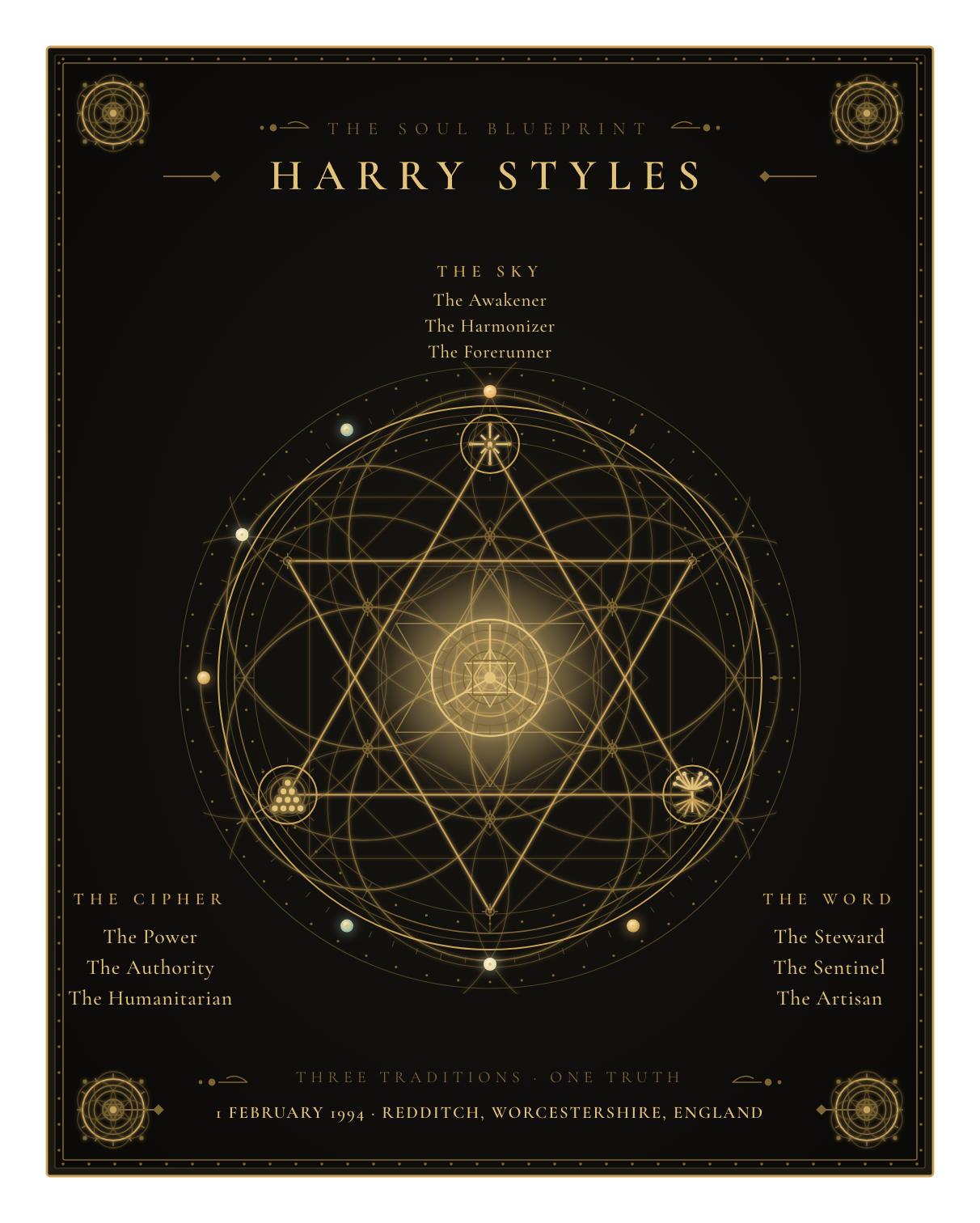
One seal, three languages. The sky he was born under at the apex, the numbers beneath his name at the lower left, the name itself at the lower right — three traditions engraved into one artifact. There is no rising sign, no houses, no angles: without a verified birth time they cannot be honestly drawn. What is true is what is shown.
At a Glance
- Full traditional name
- Harry Edward Styles
- Born
- February 1, 1994 · Redditch
- Sun
- Aquarius 12.4° — the essential fire of the life
- Rising
- Birth time unverified — the Ascendant is offered conditionally, never asserted
- Moon
- Libra 18.2° — the inner life
- Mind · Value · Will
- Mercury Pisces · Venus Aquarius · Mars Aquarius
- Discipline · Direction
- Saturn Pisces · North Node Scorpio
- Life Path
- 8 — The Sovereign
- Title-name Destiny
- 8 — The Sovereign
- Birth-name Destiny
- 9 — The Humanitarian
- Master Numbers
- None preserved at the final layer
- Soul archetype
- The Sovereign who lives the Sovereign’s path
It is April 2022, Coachella, the desert at dusk—one hundred thousand souls pressed into the space where the stage dissolves into the violet sky, and Harry Styles stands at the threshold between the light and what comes after, singing into a crowd that has waited years to hear him alone, not folded into the constellation of four other voices. The air carries the weight of becoming: this moment is the proof that the boy who auditioned as a solo contestant in 2010, who failed to advance, who was bundled into a group by stranger’s grace, has arrived at a threshold the world did not predict. The festival grounds shimmer with the particular electricity of a life that has been remade more than once.
There are two ways to read a human being. The first is how the world collects the fragments—the chart of hits, the tour receipts, the controversies, the relationships, the fashion statements, the records broken, the gender norms questioned. The second is deeper: it is the river before the rivers, the Source that gave rise to every tributary, every apparent contradiction, every paradox. The world sees the tributaries and calls them the whole thing. But a soul reads differently. It sees the spring.
This reading is written for the Source. It does not read Harry Styles as the world packages him—the ‘soft rock icon,’ the ‘genre-shifting solo artist,’ the ‘gender-fluidity advocate’ as headline. Rather, it reads the singular organizing principle that arrived in Redditch on February 1, 1994, the coherence beneath every fragment, the spiritual architecture that has held every choice—the ones celebrated and the ones that cost him deeply—in one long arc of becoming.
What follows is an act of remembrance. Not of facts the world already knows. But of the blueprint.
The reading moves through the eight chapters of the Soul Blueprint architecture — The Arrival, The Soul’s Inheritance, The Living of It, The Soul’s Calling, The Soul’s Territories, The Name You Carry, The Moment, and The Invitation — and at the end, the same instrument turns gently toward you.
His soul has a blueprint.
So do you.
The same three languages — the sky, the numbers, the name — are waiting in your own.
The Arrival
Harry Styles arrived carrying a paradox that would remake his entire life: the soul who came to liberate and reform, to invent what has never been seen, yet arrived also with a heart that hungers for harmony, for the meeting of equals, for beauty and trust and peace between two souls. This is not a contradiction—it is the signature of a reformer whose revolution lives in intimacy, not isolation. The visionary fire arrived in a form that could not sit still, that insisted on expanding what was thought possible, what was permitted, what was allowed—but only in the name of drawing closer, of meeting the other as equal, of refusing the false walls between self and beloved, between convention and genuine connection.
He came, in other words, as a liberator whose liberation looks like love. Not love as possession, but love as the refusal to own or diminish. His is a will that reforms through the courage to stand alone, yet does so not from withdrawal but from an almost reckless commitment to the collective good—to the idea that what benefits the one who is free benefits everyone. The self that came alive by reforming what was given would spend his adolescence in the suffocation of constraint, his adulthood in the work of undoing those constraints—first internally, then publicly, then in the very fabric of how the world permits souls to be themselves.
The arrival carried also a third quality: the capacity to give form to the boundless. To take the imaginal, the symbolic, the poetic whisper and build it into structure that endures. This is the architecture underneath—the one who dreams in image and symbol, yet disciplines that dream into songs that survive centuries of listening.
The Soul’s Inheritance
He was born into the England of the mid-1990s, into a Worcestershire working geography, into a family whose stability was rooted in the tangible—a parent in finance, a parent in the business of hospitality, the pub as the family’s terrain. He knew early the texture of work, the rhythm of labor: he was sixteen when he delivered newspapers, when he worked at the bakery in Holmes Chapel, when he moved through a stable and learned the weight of care through animals and their needs. These were not the apprenticeships of a chosen child or a groomed prodigy. These were the ordinary inheritances of a boy who would have become what his parents were—a guardian of the practical, the stable, the known.
But inheritance is never only material. The era itself was his inheritance: he came of age in the age of social media’s first bloom, of The X Factor and its democratic violence, of YouTube and the flattening of distance between the bedroom and the world stage. He inherited a world where fame was suddenly accessible, suddenly possible for the ordinary boy, and where that accessibility came with a cost nobody fully understood yet.
He inherited also, invisibly, a wound that would become his qualification: to be seen in the particular way adolescents are seen in an age of total surveillance is to be remade by the gaze of strangers before you have finished making yourself. The world he was born into did not yet understand privacy. He would spend his entire adult life learning to live inside that wound—and from that wound, to build his art.
The Living of It
The living of it began not with a triumph but with a failure. He auditioned for The X Factor in April 2010 as a solo contestant, singing ‘Hey, Soul Sister’ and ‘Isn’t She Lovely’—ordinary choices for an ordinary sixteen-year-old with an ordinary dream—and he did not advance. He was released. But in that release lay the architecture of everything that followed: he was gathered with four other released souls and given a second chance as something he had never imagined becoming. One Direction was not his vision. It was an accident that contained a gift.
The next six years were the education of a soul in constraint masquerading as freedom. The band achieved what had never been achieved in the history of the Billboard 200: four consecutive albums debuting at number one. The records were staggering. The visibility was total. But visibility at that scale, for an adolescent, is not primarily a gift—it is an archive. Every moment is recorded, interpreted, theorized about, turned into conspiracy and obsession and invasive speculation. He lived those years inside an attention so total that it began to blur the boundary between the self and the public image of the self.
It cost him. The media scrutiny was relentless. The online theorizing about his life, his body, his identity became a form of possession. His relationships were dissected, his choices were questioned, his very presence in the world was contested by crowds of strangers who believed they owned a stake in him. And yet—from inside that pressure, he was also learning something essential: how to live as a public being without being consumed by it, how to maintain a private self even when the world insists on total access, how to say no to the narratives offered and write his own instead.
If this is what was true for him, what might be true for you?
The Soul’s Calling
His calling arrived in two languages: the voice that speaks and the voice that sings. Mercury, the messenger, arrived in him not as logic or linear argument but as image, symbol, intuition—the voice of the poet, not the philosopher. He thinks in pictures. He knows truth by resonance, not reason. And this quality, refined through discipline and the long apprenticeship of craft, became his weapon and his medicine: the ability to say in song what cannot be said in words, to move a hundred thousand hearts at once through the precision of feeling rather than the clarity of statement.
But there was a second calling underneath: the calling to liberate and reform, to refuse the false constraints, to stand alone if necessary in the name of what is right. This calling arrived as a responsibility: he would eventually become a public figure large enough that his choices—his dress, his relationships, his refusals to label himself, his gender nonconformity—would ripple outward, would give permission to others to refuse the same constraints. The calling was not to be a spokesperson or an advocate in the conventional sense. The calling was to live his own freedom so visibly, so publicly, with such grace and such refusal of apology, that others would recognize their own freedom became possible in the space his freedom created.
The soul came to demonstrate that reform and intimacy are not opposed. That the heart can be both loyal and free. That the voice that liberates is also the voice that builds beauty.
The Soul’s Territories
His first territory was the territory of reinvention through sound—the albums that came after One Direction’s hiatus were not returns to a previous self, but arrivals into new selves. ‘Harry Styles’ in 2017 was the first breath of independence, the sound of a soul discovering what it could make when it was not accountable to four other voices. ‘Fine Line’ in 2019 was an entirely different creature: introspective, vulnerable, sexual, experimental—a map of emotional territory that had never been sung before. ‘Harry’s House’ in 2022 broke records and won the recognition of the highest honors because it had something the culture was hungry for: the sound of genuine transformation, of a person who had moved through something and arrived changed. Each album was a threshold, a leaving-behind, a becoming-new. This territory holds the truth that the soul who reforms must also reform itself perpetually.
The second was the territory of visual expression and the refusal of false boundaries. When he appeared on the cover of Vogue in December 2020 wearing a blue Gucci dress, and when he responded to the controversy by refusing to apologize, by speaking instead about ‘shutting out a whole world of great clothes,’ he was not primarily making a fashion statement. He was enacting a teaching: the boundary between masculine and feminine is an invention, not a law. The power to remake those boundaries is available to anyone willing to stand in the conversation. This territory holds the truth that liberation happens in the body first, in the choices you make about how you move through the world.
The third was the territory of labor and gift-giving. The Love On Tour that circled the world from 2021 to 2023 was a gift economy: the tour itself earned vast revenue, yes, but he channeled millions toward causes—reproductive rights, Black voter registration, displaced persons—and he did this not as a celebrity performing charity but as a soul honoring a responsibility. The fans, whom he has always called ‘Harries,’ were not treated as consumers but as a collective he was accountable to. This territory holds the truth that what moves through you is meant to be given, that abundance is not hoarded but distributed, that the platform is a trust.
There are twelve domains in the kingdom of any life: The Mark, The Unfolding, The Unseen, The Long Return, The Inheritance, The Encounter, The Alchemy, The Living Tension, The Sight, The Body’s Knowing, The Crossing, The Calling.
The Name You Carry
His name arrived in English as the sound of what rules the home—’Harry’ carries within it the echo of the ancient ‘heim,’ the dwelling place, and ‘ric,’ the ruler, the one who tends what is within the threshold. It is the name of one who gathers, who creates sanctuary, who holds the center. Yet ‘Edward,’ his middle name, carries a different resonance: it speaks of wealth—not merely in money but in resources, in abundance—and of guardianship, of the one who protects what is valuable and precious. The surname ‘Styles’ itself is an occupation: one who works with style, who creates form and distinction, who knows that the way something is presented is inseparable from what it is.
When you place these names together—Harry Edward Styles—you hear the resonance of a guardian of home who is also wealthy in imagination, abundant in resource, and devoted to the craft of making beautiful form. The names carry the blueprint: this is one who was born to hold space, to create sanctuary for others, to give form to the formless. His entire life has been a living out of these promises embedded in his name.
There is a numerological convergence here as well. The names he carries produce a frequency that speaks to sovereignty—the ability to rule oneself, to make choices that are his own, to build a kingdom that is organized around truth rather than fear. This is not the sovereignty of domination but of self-mastery: the one who has learned to govern the impulses toward compliance, toward people-pleasing, toward the performance of being what others need him to be. The names insist: you were born to create the home you want to live in, to be the guardian of your own threshold.
The Moment
There is a moment in 2016 that contains all moments. The band One Direction announced an indefinite hiatus after a tour that had sustained six years of intensity—six years of four boys learning to live inside a shared container, to make five albums that broke records, to be watched by a global audience that was both devoted and invasive. In that moment of ending, the threshold opened. He joined new management, signed with new companies, and for the first time since he was sixteen years old, stood alone.
But this is not a moment of triumph dressed as a transition. It was a moment of absolute terror and absolute freedom arriving simultaneously. He had spent his adolescence and early adulthood in a structure that was suffocating—the cleanliness clauses in his contract, the control over his image, the constant surveillance—but it was also a structure that held him, that gave him a role, that provided an identity already built. The hiatus meant he had to discover who ‘Harry Styles’ was when ‘Harry Styles’ was not a member of One Direction. He had to rebuild himself from the silence.
What unfolded in the aftermath of that moment is a reckoning: he released a solo album that announced his independence in every choice—the sound, the production, the subject matter, the visual presentation. He said no to the narratives that had been written about him. He began, slowly, to live his own freedom instead of managing his own captivity. The moment revealed that the soul who had arrived to liberate and reform had first to liberate and reform himself. The threshold was the crucible. And he did not retreat from it.
The Invitation
Everything in this reading has been moving toward a single point. The doubleness named in the first chapter, the inheritance, the wound, the calling, the territory, the name, the moment. These are not seven separate truths about Harry Styles. They are one truth, named from seven different angles. And they all converge here.
What is being asked of Harry Styles, in this moment of his becoming, is nothing less than the full expression of the liberated life. He is being asked to refuse, again and again and without apology, every false constraint—the constraint that a musician must stay in one genre, the constraint that a man’s body is a fixed thing, the constraint that a public person must have a clear and labeled identity, the constraint that freedom and loyalty are opposed, the constraint that the pursuit of beauty is frivolous or that the creation of sanctuary is anything less than spiritual work.
He is being asked to live this refusal not as a political stance but as a daily practice. To wear what he wants to wear. To love whom he loves without narration. To make the art that calls to him, even if it surprises the people who think they know what he is supposed to make. To use the platform he has built—at extraordinary cost—to create spaces where others can practice their own freedom. To refuse the comfort of staying the same, the comfort of being what people already expect, the comfort of the role that has been written for him.
What was being released in this summons is the identity that was constructed for him by others—the ‘One Direction member,’ the ‘heartthrob,’ the ‘soft rock icon,’ the ‘gender-neutral fashion icon’ as simple label. These were the masks that kept him safe and also kept him imprisoned. The invitation asks him to release the need for those masks to explain who he is.
What was being called toward is something far more alive: the full authority of his own becoming. The permission to make albums that are entirely unlike what came before—to release ‘Kiss All the Time. Disco, Occasionally’ in 2026 and not apologize for the shift. To continue the work of building businesses (Erskine Records, Pleasing) that are extensions of his vision rather than additions to his resume. To star in films that interest him, not films that are expected of him. To allow his life to be lived as the unfolding creative project it fundamentally is.
What has become available because he said yes to this calling is nothing less than the permission to be fully human in a time when the world insists on fixing souls into categories. The love he gives now is not constrained by the narratives of romantic convention—he knows how to love freely, how to remain loyal to the people who matter while also refusing to be possessed by possession. The voice he sings with now is his own, not the voice the industry taught him to use. The beauty he creates—in clothes, in music, in the spaces he builds—comes from a person who no longer needs to ask permission to make beautiful things.
And perhaps most importantly: what has become available is the capacity to show others that freedom is not something you inherit or are granted. It is something you build, daily, through the refusal to comply with false constraints, through the willingness to stand alone if necessary, through the commitment to tell the truth about yourself even when the truth is inconvenient to the people who have invested in your performance. Every time he refuses to label himself, every time he wears something that breaks a boundary, every time he makes a choice that surprises the people who thought they knew him—he is not making a personal statement. He is demonstrating to thousands of other souls that their own freedom is possible, is permitted, is available right now, without waiting for permission from any authority outside themselves.
He was not late. He was exactly where the soul-clock said he should be. The mission had been inscribed at the threshold of his first breath. What was being asked of him, he has been walking. The naming has been done.
This Is Not Coincidence
The astrology speaks: a Sun in Aquarius that liberates and reforms, that invents what has never been seen, that stands alone in the name of what is right—and alongside it, a Moon that needs harmony, beauty, trust, and the serenity of genuine intimacy with equals. A Mars that fights for a principle larger than itself, a Venus that refuses to possess, a Mercury that speaks in image and symbol, a Saturn that disciplines the boundless into enduring form. Together they compose a coherence: the revolutionary whose revolution is intimate, the liberator whose liberation is built on love. The numerology speaks independently: a Title Destiny of 8, the Sovereign—the one who rules the kingdom of themselves; a Birth Destiny of 9, the Humanitarian—the one whose gift is to the collective; and a Life Path of 8, the Sovereign again—the architecture of self-mastery woven through every day. Three numbers that insist: you were born to liberate through the example of your own free life, to give form to what is boundless, to show others that the kingdom they seek is not outside them. The names speak: Harry the home-ruler, Edward the guardian of abundance, Styles the one who works with form and beauty—three entirely different languages saying the same thing. One truth: This soul arrived to show the world what becomes possible when someone refuses the false walls and builds freedom from the inside out.
Three entirely different languages. One truth.
This is not coincidence. This is what three independent systems do when they are all telling the truth about the same soul.
The Numbers, Decoded
The numbers are computed, not intuited — each letter takes its Pythagorean value, each name reduces, and any Master Number is preserved rather than collapsed.
You have sat with the chart and the numbers and the name of another soul, and watched how a wound becomes a calling, how the place of least belonging becomes the place of greatest gift, how a life too precisely configured to be coincidence reveals itself when three independent languages are read together.
The reading you have just received was, in its outer form, a reading of his soul. But its inner form was a reading written for yours. You did not arrive without a Blueprint either. May this reading be the beginning of the reading you finally receive of yourself. May the light you carry — in whatever particular, irreplaceable form it has taken inside the specific life you were given.
Some lives carry a pattern this clear.
Yours does too.
You’ve read the shape of his soul. The same three languages — the sky, the numbers, the word — are waiting in your own name and birth date. Begin yours, free, below.
Or, when you’re ready, begin your own full Soul Blueprint reading →
Frequently Asked Questions
What is Harry Styles’s birth chart?
Harry Styles was born February 1, 1994, with his Sun in Aquarius—the sign of liberation, invention, and reform—and his Moon in Libra, the sign of harmony, beauty, and authentic equality in intimate relationship. His Mercury is in Pisces, an imaginative and symbolic intelligence that speaks in image rather than argument; his Venus is in Aquarius, love founded on freedom and equality rather than possession; and his Mars is also in Aquarius, a will directed toward principled reform and the collective good. His Saturn in Pisces disciplines the boundless imagination into enduring structure and form. The birth time is unverified, so the rising sign cannot be determined.
What is Harry Styles’s numerology?
Harry Styles carries three primary numerological destinies. His Title Destiny is 8, the Sovereign—the archetype of self-mastery and the rule of one’s own kingdom. His Birth Destiny is 9, the Humanitarian—the archetype of giving one’s gifts to the whole. His Life Path is 8, the Sovereign, woven through every day of his existence. These three numbers compose a coherence: sovereignty in service of the collective, the kingdom built on the foundation of transformation and gift.
What does the name Harry Styles mean?
The name Harry derives from the Old Germanic elements meaning ‘home’ and ‘ruler’—the guardian of the threshold. Edward means ‘wealthy guardian’ or ‘prosperous protector,’ and Styles as a surname indicates one who works with form, distinction, and beauty. Together they compose the resonance of a soul born to create sanctuary, to give form to the formless, and to hold the center through the practice of making beautiful things.
What is a Soul Blueprint?
A Soul Blueprint integrates three independent traditions — Western natal astrology, Pythagorean numerology, and the etymology of the full birth name — into a single document written as a personal letter to the soul. When you’re ready, you can begin your own.
This reading was prepared in the lineage and methodology of the Soul Blueprint Method — Pythagorean numerology with master numbers preserved, Western archetypal astrology, and a researched etymological reading of the full name. Harry Styles’s birth date (February 1, 1994) is sourced from the public record; the birth time is unverified, so the rising sign is offered conditionally and never asserted.
A Soul Blueprint reading · Astrology · Numerology · Etymology · shams-tabriz.com