
Teyana Taylor’s Birth Chart, Numerology, and Name Decoded
Teyana Taylor’s Birth Chart,
Numerology & Name Decoded
The Soul Blueprint Method — three traditions woven into one personal letter: Western natal astrology, Pythagorean numerology, and the etymology of the soul’s name. Learn the method →
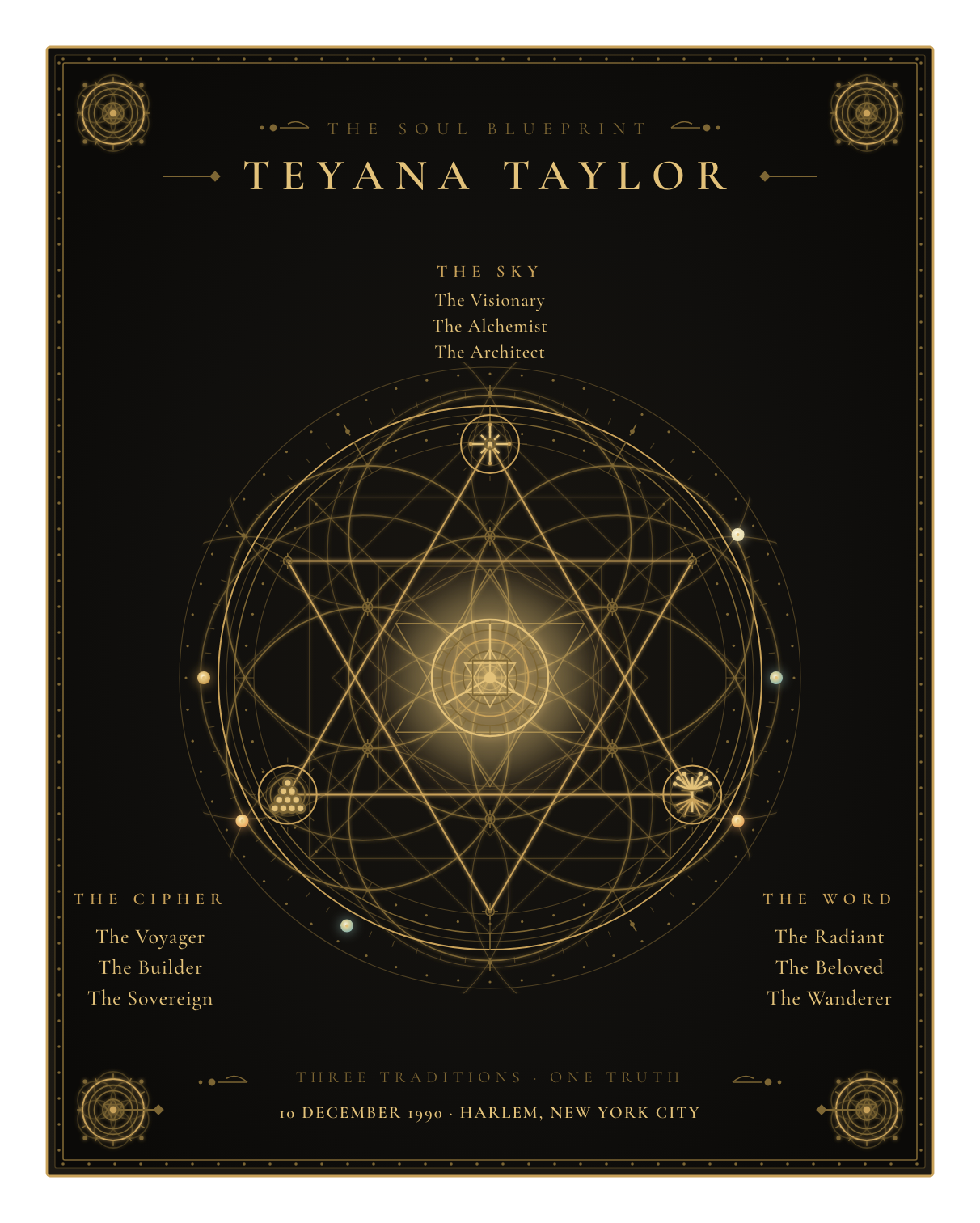
One seal, three languages. The sky she was born under at the apex, the numbers beneath her name at the lower left, the name itself at the lower right — three traditions engraved into one artifact. There is no rising sign, no houses, no angles: without a verified birth time they cannot be honestly drawn. What is true is what is shown.
At a Glance
- Full traditional name
- Teyana Me Shay Jacqueline Taylor
- Born
- December 10, 1990 · Q189074
- Sun
- Sagittarius 18.4° — the essential fire of the life
- Rising
- Birth time unverified — the Ascendant is offered conditionally, never asserted
- Moon
- Libra 7.3° — the inner life
- Mind · Value · Will
- Mercury Capricorn · Venus Sagittarius · Mars Gemini
- Discipline · Direction
- Saturn Capricorn · North Node Capricorn
- Life Path
- 5 — The Free Soul
- Title-name Destiny
- 4 — The Builder
- Birth-name Destiny
- 1 — The Pioneer
- Master Numbers
- None preserved at the final layer
- Soul archetype
- The Builder who lives the Free Soul’s path
It is September 2006, and Teyana Taylor is fifteen years old in a choreographer’s body that knows something the world does not yet know—standing in a music video set, moving through the space of Beyoncé’s ‘Ring the Alarm,’ her hands translating fire into gesture, her spine fluent with a language older than ambition. The light on her shoulders is the light of beginning, though she does not know it yet as beginning; she knows it only as the thing her body must do, the meaning her movement must carry, the way her limbs become the bridge between a vision in someone else’s mind and the world’s first sight of what that vision was. This is how the soul arrives sometimes—not announced, not heralded, but already fluent in its own dialect, already speaking what it came to say.
The world will name her by what it sees: a singer, a dancer, a choreographer, a video director, an actress, a woman who moves between territories as though they were rooms in a house she was always meant to inherit. But beneath these fragments—these names the market gives her—runs a deeper current, a source that has nothing to do with career or category. It is the current of a soul that came to seek, to quest, to move toward horizons that do not yet exist on any map; a soul that was born knowing that meaning and beauty and freedom are worth the long pilgrimage, worth the cost of reinvention, worth standing alone when standing alone is what the hour demands. Like a river that seems to change form as it passes through different lands but carries the same essential water from the same essential spring, she moves through the territories of her life—music, movement, image, story—but the source beneath all of them is singular and true.
This reading reads the source. Not the fragments the world sees, not the categories it assigns, but the blueprint—the original instruction, the soul’s signature inheritance, the place where paradox resolves into purpose. The chart speaks it in the language of the stars; the numbers speak it in the language of destiny; the names speak it in the language of sound and resonance. And all three languages converge on a single truth about who came into this world on the tenth of December, 1990, and what she was sent to demonstrate.
The reading moves through the eight chapters of the Soul Blueprint architecture — The Arrival, The Soul’s Inheritance, The Living of It, The Soul’s Calling, The Soul’s Territories, The Name You Carry, The Moment, and The Invitation — and at the end, the same instrument turns gently toward you.
Her soul has a blueprint.
So do you.
The same three languages — the sky, the numbers, the name — are waiting in your own.
The Arrival
The self that arrives in her is a seeker, a pilgrim animated by the need to expand toward the vast uncharted—the mind that reaches for meaning beyond the personal, that cannot rest in safety or smallness, that is always oriented toward the horizon where eternal values call. This is the Sagittarian fire, the quest made flesh, the heart that measures itself against the infinite. But this fire does not arrive naive or untethered; it arrives partnered with a will that thinks strategically, that builds through patience and sequence, that knows the long view and the load-bearing word. The builder and the seeker live in her simultaneously—the builder who must construct something real and enduring, and the seeker who must be free to roam, to experiment, to venture into territories unmapped.
The paradox she carries is this: she is called to create structures that hold truth, while remaining constitutionally unable to be contained by structures that bind.
This is not a contradiction in her soul; it is her signature frequency. She is the pioneer who builds, the one who leaves safety to establish something new, who takes full responsibility for what she creates while maintaining the restless hunger that will not let her settle into any single form. The emotional nature that steadies her seeks harmony and beauty, the aesthetics that prove that truth can also be gentle, that growth need not be crude. She arrives with the equipment to move through many territories—the hands of a dancer, the voice of a singer, the eye of a director, the mind of a strategist—but underneath all of it is this singular current: the soul that seeks, that builds, that will not be diminished, that understands that freedom and genuine authority are not opposites but partners in the creation of something that lasts.
The Soul’s Inheritance
She arrived into Harlem in December of 1990—that particular geography and moment held her from the beginning, a place where the creative pulse had never ceased to run, where music and movement lived in the streets themselves. Her mother, Nikki Taylor, was a manager—a woman trained in the language of vision and navigation, the kind of parent who could see talent not as accident but as something to be stewarded, shaped, protected. The household itself carried the inheritance of oversight, of someone learning early that the world required not just artistry but architecture, not just impulse but strategy.
Her father’s presence in the fact-sheet is uncertain, a gap that speaks its own truth: she was raised in a particular kind of solitude, one that may have taught her the self-reliance that would later become her signature. There is a geometry in growing up without that particular anchor—the child learns that survival and thriving belong to her own hands, that she cannot wait for permission or guidance from quarters that are absent.
Harlem itself was her inheritance—a lineage of creative risk-taking, of artists who had built from nothing, of dancers and musicians who understood that the body was a language older than words. She was born into a place where visibility came not from bloodline or wealth but from what you could make, what you could offer, what fire you carried in your limbs.
The soul arrived already knowing she would have to build her own foundation, already inheriting the demand to stand on her own authority. Her mother’s watchful management and the absence of other anchors combined to teach her this early: the world would require not softness but structure, not accident but intention. She was born already carrying the blueprint of someone who would have to earn everything—her place, her voice, her right to be seen.
The Living of It
The soul arrived in New York at the threshold where family safety meets the world’s demand—and she felt the collision early. Her mother stood as guide and keeper, the voice that said you can, while the outer realm whispered back: prove it. This is the classic inheritance of the mature soul—to be held close in one nest while being called to build something that belongs to no one family, no single refuge. The wound is the simultaneous pulling: the need to be safe AND the need to be sovereign; the ache of loyalty to origin AND the hunger to outgrow it.
She began at fifteen, choreographing for the cathedral of contemporary voice—Beyoncé’s vision made physical. The body already knew what the heart had not yet named: I can author something larger than myself. But the early labeling came swiftly and it trapped her. Star Trak held the contract; she held the ambition. For six years she existed in the cage of other people’s schedules, her voice measured out in features and fragments, her talent held back like a secret that would not be released. The signature struggle was real—she could not sing from her own depths, could not prove what lived in her. This is the specific pain of the builder who is not allowed to build: the competence locked behind permission, the authority waiting for someone else’s signature.
What cost this season? The deferral of self. The swallowing of readiness. The knowledge that she possessed more than she was permitted to show. But from this restraint came its inverse medicine: when she finally demanded release in 2012, she did not ask softly. She did not beg. She requested—a word of sovereign clarity. The wound had taught her its opposite number: that independence is not rebellion, but maturity. That standing alone is not abandonment of family, but the true honoring of what the soul came here to build. The price was paid in patience; the qualification was earned in the furnace of constraint.
If this is what was true for her, what might be true for you?
The Soul’s Calling
The calling that animates her is the call to demonstrate—through every territory, through every form she touches—that meaning and beauty are not separate from power, that freedom and responsibility are partners, that the world can be served by someone who refuses to be diminished or contained. Her will is the will that acts through words, through argument, through quick maneuvering on multiple fronts at once; she is the warrior who fights with wit and vision rather than force, who can move between territories—music, dance, video, acting—because the underlying instrument is the same: the mind that is strategic, agile, alert to consequence and structure. She came to show what the voice can do when it is finally released to speak its truth—not just sound, but meaning; not just performance, but witness.
This calling manifests in her signature choice: to build something enduring. The albums that came after her independence—’VII’ in 2014, topping the R&B/Hip-Hop chart; ‘K.T.S.E.’ in 2018; ‘The Album’ in 2020—are not accidents or gifts of fortune. They are the work of someone who claimed authority over her own sound, who could collaborate with Missy Elliott and Lauryn Hill not as a supplicant but as a peer, who understood that real power in art is not about being famous but about being true. And the breakthrough into acting—’A Thousand and One’ in 2023, the Golden Globe for ‘One Battle After Another’ in 2025—is not a pivot away from her calling but a deepening of it: the same soul, still seeking, still building, still translating internal truth into external form where it can move the world.
The Soul’s Territories
The territory of Music—where her voice learned to speak after years of waiting, where the albums that came after her independence became proof that she had been right to ask for release, where she could finally command the space between intention and sound. This is the territory where the seeker became the sovereign, where she could collaborate with giants not as an apprentice but as an equal partner carrying her own vision. Here, in the recordings and the performances, the world learned what those early choreographers had always known: that her gift was not confined to the body but lived in something deeper—the capacity to translate soul into sound.
The territory of Movement and Vision—where she began, where the choreography for ‘Ring the Alarm’ at fifteen launched the arc, where the direction and design of music videos became another language for the same truths she was learning to speak in every other form. The MTV Video Music Award for Best Choreography for ‘Fade,’ the BET Awards for Video Director of the Year, the design of sneakers and the creation of ‘Fade 2 Fit’—all of these are expressions of a soul that understands the body as a primary text, as the place where philosophy becomes visible, where the abstract becomes concrete.
The territory of Acting and Story—the newest opening, the most recent threshold, where she stepped into the role of Inez in ‘A Thousand and One’ and discovered that this too was a form of the same calling: the translation of internal life into external truth, the body and voice in service of a narrative that asks the viewer to witness, to feel, to recognize something true. The Golden Globe, the Academy Award nomination, the recognition that she is an actress of depth and power—these are not departures from who she has always been but expansions of it, the seeker and builder finding new territories in which to plant her flag and prove that meaning matters. Beneath all three territories runs the deeper mythology: a soul that refuses to be singular, that insists on moving across territories because the breadth of the quest itself is the point—the pilgrim who builds many temples because the search for truth is infinite.
There are twelve domains in the kingdom of any life: The Mark, The Unfolding, The Unseen, The Long Return, The Inheritance, The Encounter, The Alchemy, The Living Tension, The Sight, The Body’s Knowing, The Crossing, The Calling.
The Name You Carry
The names carry a frequency that belongs to her: Teyana itself arrives as a sound that does not resolve into easy etymology, a name that contains something unfinished, something reaching—the very sound of seeking, of a voice that has not yet found its final form. Me—the second name, the essential self, the ‘I am’—speaks to a soul oriented toward presence, toward the primary fact of existence itself, toward the refusal to be defined by external measure. Shay adds a lightness, a fluency, the name that moves easily, that does not demand gravity. And Jacqueline carries the weight of history, the classical form, the name that grounds her in lineage even as the other names push her toward the unknown.
Taylor—the public name that the world calls her—means one who cuts, one who tailors, one who shapes material into form. This is the builder’s name, the name of the architect of her own life, the one who refuses to accept what arrives unfinished and instead takes up the scissors and the needle and remakes it. It is the name of precision, of consequence, of work done with intention. When the names are taken together, they speak the whole arc: the reaching sound (Teyana), the foundational self (Me), the easy movement (Shay), the historical weight (Jacqueline), and the public authority (Taylor)—a single consciousness that knows how to build, how to move, how to seek, how to refuse what diminishes her and claim what amplifies her.
The name Teyana Taylor resonates at the frequency of the pioneer and the builder—the one who arrives with a question that has no answer in the present, who must therefore create the answer, who must move across territories because the answer lives not in one place but in the accumulated testimony of a life lived with intention. The names say what the chart has already spoken: this is a soul that came to seek truth across many territories and to build structures that last.
The Moment
The autumn of 2020 arrived with a silence that had been gathering for years—a quiet accumulation of constraint, of being held in a shape not her own. She stood at the threshold of a choice that would remake her, though she could not yet see its full contour. For six years she had carried the weight of a contract that promised much and delivered a kind of creative suffocation; the label that had signed her did not know how to hold what she was, and she had spent those seasons watching her voice go unheard in the rooms where decisions were made. The soul that seeks freedom cannot remain in a cage, even a gilded one.
On December 4, 2020, she announced her retirement from music—not in anger, but in clarity. The act was itself a kind of mastery: she named the truth aloud, took full responsibility for her own trajectory, and stepped away from what no longer served the deepest reaching of her gift. This was not collapse; it was sovereignty. She had learned, through years of being diminished, what it meant to be undervalued, and in that learning she discovered something harder and more precious than any recording contract—the capacity to choose herself.
What this moment revealed was the architecture of her own becoming. The years that followed would show her that the gift she carried was not confined to song alone—that her hands could direct vision, that her body could embody story, that she could move through the world as a maker in multiple languages. The retirement was not an ending but a translation, a deliberate stepping sideways so that every dimension of her genius could unfold. She had spent her early season proving she could meet the external world’s demands; now she would prove something far more difficult—that she could build from her own authority, on her own terms, answerable to no master but the Source itself. The silence she chose became a gestation, and from it would emerge a woman who understood, finally, that freedom was not something to be granted but something to be claimed and lived.
The Invitation
Everything in this reading has been moving toward a single point. The doubleness named in the first chapter, the inheritance, the wound, the calling, the territory, the name, the moment. These are not seven separate truths about Teyana Taylor. They are one truth, named from seven different angles. And they all converge here.
What is being asked of this soul is a particular and relentless refusal: the refusal to accept diminishment, the refusal to settle for being known in one territory when she came equipped for many, the refusal to believe that the industry’s categories are the same as her own categories. She is being asked to demonstrate what becomes possible when a soul insists on its own wholeness—when it will not accept the reduction that says you are a singer or you are a dancer or you are an actress, but instead insists I am all of these and more, and my wholeness is not a liability but a gift. This asking began early, in that moment at fifteen when she choreographed ‘Ring the Alarm’ and discovered that her body could translate vision into form; it intensified in the years of constraint with Star Trak, when she was held in a single category while the other gifts pressed against the walls of the cage; it became urgent in January 2012 when she claimed the authority to walk away from what was killing her.
The asking continues now—particularly in the threshold she crossed between 2023 and 2025, when she moved from being recognized primarily as a musician and visual artist into being recognized as an actress of depth and power. This was not a reinvention; it was the logical next movement of a soul that had always understood that the same work—the translation of internal truth into external form, the commitment to meaning and beauty over mere visibility—could happen in any territory. The soul that can choreograph can direct; the soul that can direct can act; the soul that can act can sing. It is all the same work, all the same pilgrimage toward the horizon where truth lives.
What was being released in these moments was the world’s permission. She released the need for the industry to tell her who she was allowed to be. She released the belief that safety lay in specialization, in accepting the role the market had assigned her and making peace with it. She released the voice that said be grateful for what you have been given, and she claimed instead the voice that said I know what I came here to do, and I will do it however long it takes, in whatever territory requires me. The cost of this release was loneliness—the loneliness of standing alone, of asking for the freedom that no one wanted to grant her, of building the life she envisioned rather than accepting the life others envisioned for her.
What she was called toward was sovereignty—not fame, not approval, not the confirmation of the industry, but the unshakeable knowledge that her vision was worth trusting, that her refusal to be contained was not selfishness but fidelity to her own soul. She was called toward the building of something that lasted: albums that topped charts not because she had been packaged correctly but because she had finally been freed to be herself; directing work that won awards because it came from a visionary who understood the body and the story and the meaning all at once; acting that moved audiences because it came from someone who had learned through decades of translation that authenticity is the only power that matters. She was called toward the territories themselves—music, movement, vision, story—not as separate careers but as chapters in a single arc of testimony.
What became available because she said yes to this calling is the life she is living now. She is an artist who is recognized not in one territory but across multiple territories, a woman who refused the reduction and lived long enough to be proven right. She is someone who can move between music and acting, between direction and performance, between building institutions (the sneaker line, the ‘Fade 2 Fit’ program, the growing body of work) and surrendering into story—because all of it is the same soul, asking the same question, seeking the same truth. She became available to herself. She became available to the visionaries who could recognize her—Kanye West, Paul Thomas Anderson—because she was no longer trying to fit into a shape that was not hers. She became available to an audience that had been waiting for someone who would refuse the categories, who would insist on her own wholeness, who would show that it is possible to be more than one thing, to move across territories, to seek the horizon without losing the ground beneath your feet.
The divorce that finalized in 2024—after separating in September 2023—was another threshold, another release of what no longer served the pilgrimage. The marriage had been real, the family real (two daughters born in 2015 and 2020), but the path required her to release the structure that had held her for eight years and to continue the journey alone, as she had learned to do. The enrollment in Auguste Escoffier School of Culinary Arts in July 2025 is not a departure but a continuation—another territory, another language for the same conversation: how to transform raw material into nourishment, how to create beauty that serves others, how to be more than the world has taught you to expect.
Even the throat surgery in August 2025—the removal of a noncancerous growth from her vocal cords—speaks the pattern: the voice that had learned to speak after years of silence, being protected, being healed, being readied for what comes next. She is not settling into any single form. She is not closing any doors. She is continuing to seek, continuing to build, continuing to expand toward the horizon where meaning calls. This is what it looks like when a soul insists on its own wholeness and refuses to be diminished: it looks like a life that moves across territories, that refuses the categories, that keeps seeking, that keeps building, that will not rest until the world can see what has always been true.
She was not late. She was exactly where the soul-clock said she should be. The mission had been inscribed at the threshold of her first breath. What was being asked of her, she has been walking. The naming has been done.
This Is Not Coincidence
The astrology speaks of a seeker oriented toward the infinite, toward the quest for meaning and the far horizon—a mind that moves within the greater sphere of society, that refuses containment, that is animated by the need to expand. The numerology speaks independently of the pioneer who builds, the free soul who cannot be constrained, the builder who arrives to demonstrate that structures can hold truth. The names speak of reaching sound and public authority—Teyana as the seeking voice, Taylor as the one who cuts and tailors, who shapes material into intentional form. Three entirely different languages. One truth: A soul arrived to quest across many territories and to build what lasts.
Three entirely different languages. One truth.
This is not coincidence. This is what three independent systems do when they are all telling the truth about the same soul.
The Numbers, Decoded
The numbers are computed, not intuited — each letter takes its Pythagorean value, each name reduces, and any Master Number is preserved rather than collapsed.
You have sat with the chart and the numbers and the name of another soul, and watched how a wound becomes a calling, how the place of least belonging becomes the place of greatest gift, how a life too precisely configured to be coincidence reveals itself when three independent languages are read together.
The reading you have just received was, in its outer form, a reading of her soul. But its inner form was a reading written for yours. You did not arrive without a Blueprint either. May this reading be the beginning of the reading you finally receive of yourself. May the light you carry — in whatever particular, irreplaceable form it has taken inside the specific life you were given.
Some lives carry a pattern this clear.
Yours does too.
You’ve read the shape of her soul. The same three languages — the sky, the numbers, the word — are waiting in your own name and birth date. Begin yours, free, below.
Or, when you’re ready, begin your own full Soul Blueprint reading →
Frequently Asked Questions
What is Teyana Taylor’s birth chart?
Teyana Taylor was born on December 10, 1990, with the Sun in Sagittarius—the sign of the seeker, the pilgrim oriented toward meaning and the far horizon. Because the birth time is unverified, the rising sign cannot be fixed. Her Moon is in Libra, the emotional nature that seeks harmony, beauty, and connection. She carries Mercury in Capricorn (the structured, strategic mind), Venus in Sagittarius (love as shared adventure and growth), Mars in Gemini (will expressed through words and versatile action), and Saturn in Capricorn (the great work of earning real authority through integrity).
What is Teyana Taylor’s numerology?
In numerology, the name Teyana Taylor (her public name) carries the Title Destiny 4—The Builder. Her full birth name, Teyana Me Shay Jacqueline Taylor, carries the Birth Destiny 1—The Pioneer. Her Life Path, derived from her birth date, is 5—The Free Soul. Together, these three numbers narrate a soul called to build something enduring while refusing to be confined by any single structure or category.
What does the name Teyana Taylor mean?
The names Teyana Taylor carry resonance without easily resolved etymology. Teyana itself arrives as a reaching sound, a name that seems to be seeking something—the very frequency of a soul in quest. Taylor is the name of one who cuts and shapes, the builder and architect, the one who takes raw material and makes it into intentional form. Together, they speak the signature of a soul that moves across territories, that refuses reduction, that insists on building what lasts.
What is a Soul Blueprint?
A Soul Blueprint integrates three independent traditions — Western natal astrology, Pythagorean numerology, and the etymology of the full birth name — into a single document written as a personal letter to the soul. When you’re ready, you can begin your own.
This reading was prepared in the lineage and methodology of the Soul Blueprint Method — Pythagorean numerology with master numbers preserved, Western archetypal astrology, and a researched etymological reading of the full name. Teyana Taylor’s birth date (December 10, 1990) is sourced from the public record; the birth time is unverified, so the rising sign is offered conditionally and never asserted.
A Soul Blueprint reading · Astrology · Numerology · Etymology · shams-tabriz.com