
Jim Carrey’s Birth Chart, Numerology, and Name Decoded
Jim Carrey’s Birth Chart,
Numerology & Name Decoded
The Soul Blueprint Method — three traditions woven into one personal letter: Western natal astrology, Pythagorean numerology, and the etymology of the soul’s name. Learn the method →
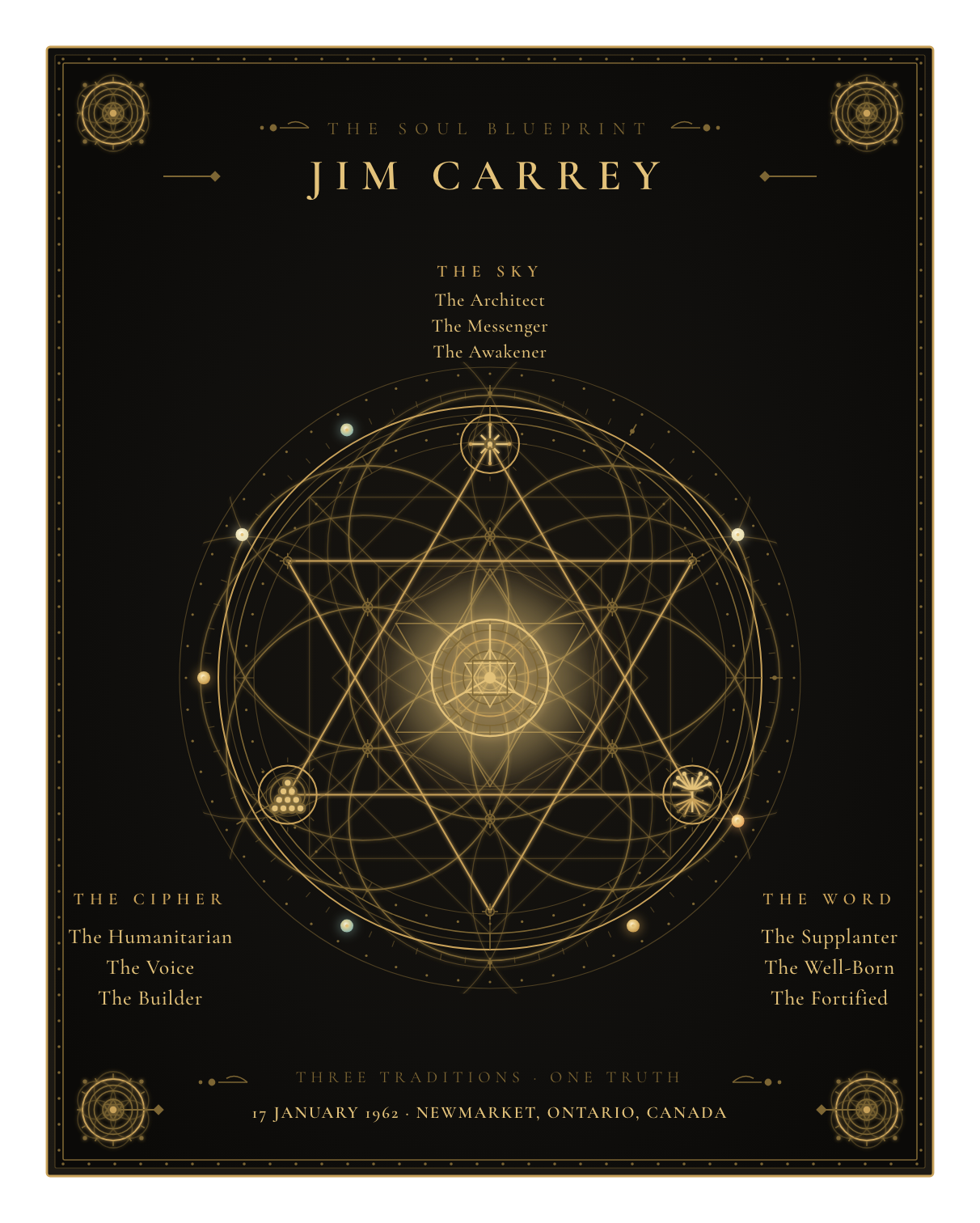
One seal, three languages. The sky he was born under at the apex, the numbers beneath his name at the lower left, the name itself at the lower right — three traditions engraved into one artifact. There is no rising sign, no houses, no angles: without a verified birth time they cannot be honestly drawn. What is true is what is shown.
At a Glance
- Full traditional name
- James Eugene Carrey
- Born
- January 17, 1962 · Newmarket
- Sun
- Capricorn 27.1° — the essential fire of the life
- Rising
- Birth time unverified — the Ascendant is offered conditionally, never asserted
- Moon
- Gemini 22.3° — the inner life
- Mind · Value · Will
- Mercury Aquarius · Venus Capricorn · Mars Capricorn
- Discipline · Direction
- Saturn Aquarius · North Node Leo
- Life Path
- 9 — The Humanitarian
- Title-name Destiny
- 3 — The Communicator
- Birth-name Destiny
- 4 — The Builder
- Master Numbers
- None preserved at the final layer
- Soul archetype
- The Communicator who lives the Humanitarian’s path
It is 1977 in Downtown Toronto, and the air smells of beer and cigarette smoke and the particular electricity of a room full of strangers who have paid to be made to laugh. A fifteen-year-old boy steps onto the stage of Yuk Yuk’s comedy club—not famous yet, not even accomplished, not even certain—and the moment opens its mouth and swallows him whole. His father watches from somewhere in that crowd, a musician and accountant carrying his own inheritance of practical skill and creative yearning. The boy has already spent years before a mirror, sculpting his face into every shape it could hold—Carol Burnett’s face, other people’s faces, the infinity of expressions the human body can make when it stops hiding. He is about to discover that what the world will call him—the comedian, the rubber-faced one, the man who makes his body speak in a language that bypasses language itself—is only the fragment, the surface current. Underneath runs a deeper source: a soul built for structure and endurance, for consequence and weight, for building what lasts—a Capricorn arriving in a body designed to make others laugh, yet carrying within him the architect’s blueprint, the general’s patience, the weight-carrier’s discipline. This letter reads the source beneath the fragment. It reads the soul whose task was never simply to amuse, but to demonstrate something about the human will—its capacity to transform pain into vision, to build empires from nothing, to carry authority earned through the real price of struggle. The journey from that smoke-filled room in Toronto to whatever comes next is not a story about entertainment. It is a story about a soul learning to speak itself into being—learning to stand in the personal light it was born to carry, learning that the masks were always meant to fall away and reveal the architecture underneath.
The reading moves through the eight chapters of the Soul Blueprint architecture — The Arrival, The Soul’s Inheritance, The Living of It, The Soul’s Calling, The Soul’s Territories, The Name You Carry, The Moment, and The Invitation — and at the end, the same instrument turns gently toward you.
His soul has a blueprint.
So do you.
The same three languages — the sky, the numbers, the name — are waiting in your own.
The Arrival
The paradox arrived in the body of a boy whose face could become anyone’s face—but whose essential nature was built to command, to structure, to bear weight and endure. This is the signature the soul carried into its arrival: a Capricorn mastery expressed through the language of transformation and appearance, a will disciplined and strategic wearing the costume of the fool. The self that comes alive by building enduring structure found its first expression not through stone or strategy, but through the liquid, shape-shifting medium of physical comedy—the body as architecture, the face as a system of infinite expressions. Yet even in this, the architectural truth held: every expression was calculated, controlled, precise. The boy who made faces before a mirror was not improvising; he was building a system, mastering the mechanics of transformation, approaching comedy with the discipline of a craftsman learning the structure of his trade. This is the paradox the soul carried—the capacity for structure and command, the will that is exalted in its patience and control, arriving in a form that appears to be pure play, pure spontaneity, pure the-moment-made-flesh. Yet underneath the fluidity lived the engineer: the one who builds what lasts, who carries real weight, who knows that nothing permanent is made without discipline and long effort. The soul did not arrive to be entertained or to entertain lightly. It arrived to demonstrate that even joy, even laughter, even the liberation of the human face, can be built—can be mastered, can be made to serve something larger than the moment.
The Soul’s Inheritance
He was born into the inheritance of structure in the midst of precarity—the inheritance of Canadian working skill, of a father who was both musician and accountant (the dreamer and the counter, held in one man), of a mother who kept the household together through whatever came. The family itself carried a French-Canadian name, Carré, later anglicized to Carrey, a small emigration in the spelling that marked the passage from one language-world to another. He was the youngest of four, arriving into a household that was already formed, already structured, already moving through its patterns. The era was postwar North America, a world being rebuilt, a continent of people learning to build again after the great breaking. His inheritance was not wealth or advantage, but something more fundamental: the inheritance of people who knew how to make something from the materials at hand. His father’s music was not his profession; his father’s skill was in accounting, in making numbers add up, in the discipline of understanding systems. Yet the music lived in him—alive, yearning, present in the home. The boy inherited both: the accountant’s respect for structure and consequence, the musician’s understanding that beauty must be made through patient practice, that skill comes from repetition and discipline. This inheritance would become the foundation of everything—the understanding that comedy is not spontaneous, but learned; that the face is a system to be mastered like an instrument; that there is no freedom without the discipline that comes first. The family knew struggle; they would know deeper struggle still. But the basic inheritance was clear: you are built to make something. You are built to use your hands and your mind and your will. You are built to work.
The Living of It
The signature wound arrived when he was a child, and it took the shape of homelessness. His family became homeless and lived together in a Volkswagen van—the four of them, the youngest boy and his three older siblings and their parents, squeezed into a space that was not designed for human life. Then, in a further compression of that wound, the teenage Jim and his brother lived in a tent in Charles Daley Park on the shore of Lake Ontario in Lincoln, Ontario, while the parents carried the weight of finding their way back. The boy dropped out of school on his sixteenth birthday—not from rebellion but from necessity, from the understanding that his labor was needed to help his family survive. He worked as a janitor and security guard at Titan Wheels tire factory in Scarborough, working eight-hour shifts from six in the evening into the next morning, in return for family housing. The qualification that emerged from this wound was radical: he learned that his will could be used, that his body and his time had value measured in money and survival, that he was capable of bearing weight. He learned that there was no separation between dignity and labor, that a person could work through the night in a factory and still be a human being with worth. The wound became the engine of his calling—because he had lived in a tent and worked in a factory, he would understand something about the human will that the comfortable never grasp. He would carry, his whole life, the memory of what it cost to build something from nothing. He would understand that any achievement was not luck or talent alone, but discipline and endurance and the willingness to show up night after night after night. The cost was loneliness, displacement, the loss of childhood ease. The qualification was the knowledge that he was built to survive, built to work, built to endure.
If this is what was true for him, what might be true for you?
The Soul’s Calling
The soul came to demonstrate the power of voice—not the voice of speaking, at first, but the voice of the body made language, the face made utterance, the physical form transformed into a system of meaning and expression. Yet the deeper calling was always to speak the unspeakable, to name what others could not name, to use the instrument of his mind and his body to reach into the collective consciousness and articulate what lay underneath the surface. This is the calling of the communicator born under an Aquarius mind—the mind that sees the whole pattern, that steps back to understand the underlying structure, that speaks with genuine objectivity about what is true. The calling was never to amuse for amusement’s sake, but to use amusement as a gateway to truth. To use the mask to reveal what the mask usually conceals. To use comedy to access the sacred. The soul was called to demonstrate that the human being is capable of complete transformation—that the will can reshape not just circumstance but consciousness itself. He was called to show that discipline and structure can serve freedom, that the one who builds with patience and care can reach furthest into the human heart. The calling was to use his voice, his face, his body, his will—all of it—to show others that they were not trapped, that transformation was possible, that the human will was more powerful than circumstance.
The Soul’s Territories
The first and most visible territory is Comedy itself—the live stage, the face, the body as instrument, the mastery of expression and timing. Here he learned the fundamental truth: that there is no freedom without discipline, no spontaneity without thousands of hours of practice, no laughter without structure underneath. The second territory is The Architecture of Performance—the films that required him to hold a character across time, to build a world and live inside it, to demonstrate that he was not only a reactor to the moment but a builder of sustained imaginative structures. The Truman Show, Eternal Sunshine of the Spotless Mind, Man on the Moon—these were not comedies in the service of laughter alone, but films in which he had to construct a complete human being and remain inside that construction for the duration. The third territory is The Visionary Frame—the space where he encountered teachings about consciousness itself, where he sat with the law of attraction and visualization, where he studied the masters who spoke about the nature of the human will and its capacity to shape reality. He appeared alongside Eckhart Tolle, he spoke of Transcendental Meditation, he described the moment when he understood that he was not a fragment of the universe but the universe itself. Each territory held different knowledge, different medicine, different aspects of the same fundamental truth: that the human being is capable of building, of becoming, of transcending the limitations of circumstance through discipline and vision and the stubborn application of will over time. As the territories expanded, a deeper mythology began to emerge—not the mythology of the entertainer, but the mythology of the one who uses every available tool—comedy, film, visual art, political speech, spiritual practice—to point toward the liberation of human consciousness itself.
There are twelve domains in the kingdom of any life: The Mark, The Unfolding, The Unseen, The Long Return, The Inheritance, The Encounter, The Alchemy, The Living Tension, The Sight, The Body’s Knowing, The Crossing, The Calling.
The Name You Carry
The names he carries hold within them a complete blueprint. Jim—the shortened form of James, itself derived from the Hebrew meaning ‘one who supplants,’ the one who takes the place of what came before, who arrives to transform what was. There is a directness in Jim, a casualness, a accessibility—the shortened name speaks to someone who is present, ordinary, unadorned, yet carrying within him the power to overtake and remake. Carrey, the anglicized form of Carré, the French surname meaning ‘square’—a pure geometric shape, a fundamental structure, the building block itself. The square is the shape of the founded world, the shape of the house, the shape of the town square where the community gathers. His surname carries within it the inheritance of building, of geometry, of the fundamental structures upon which human life is laid. James Eugene Carrey—the full form speaks differently. Eugene, the Greek root meaning ‘well-born,’ ‘of noble birth,’ carries an inheritance claim that seems to contradict his actual material beginning. Yet the contradiction is precisely the point: a soul well-born into struggle, arriving with the imprint of nobility not through bloodline but through destiny, through the particular quality of the soul’s architecture. The names together speak to a soul whose task is to take the place of what came before (the supplanter), to carry the structure of the foundational world (the square), to arrive as one who is well-born into the necessity of transformation. The briefer form—Jim Carrey, the Communicator—speaks to the public voice, the accessible one, the one who speaks to everyone. The deeper form holds the full inheritance: the one whose noble task is to transform the foundational structures themselves.
The Moment
The defining moment arrived in stages, but the crisis came in 1981, when the young comedian was struggling, when he had already bombed—described by Mark Breslin, the owner of Yuk Yuk’s, as ‘bad Rich Little,’ doing only impressions, trapped in the shape of other people’s voices and other people’s faces. The path ahead looked closed. He had tried Saturday Night Live three times and been rejected three times; the third rejection came when Dana Carvey and Phil Hartman were hired and he was not. The wound of that rejection opened a question: What if impressions alone were not enough? What if there was something in him that could not be accessed by copying other people? What if the only way forward was to become himself? Then, in February 1981, a Toronto Star review by Bruce Blackadar described him with a phrase that changed everything: ‘a genuine star coming to life.’ The review created nationwide demand for his act. The moment was not one single thing; it was the accumulation—the bombed performances, the rejections, the doubts, and then the sudden recognition. What the moment revealed was that the soul’s real power did not lie in its capacity to become other people, but in its capacity to become itself, to find the voice that was uniquely his own, the expression that could not be copied because it was not imitation. The crisis was the teacher: it pushed him past the territory of safe impressions into the unknown country of originality. It forced him to develop the observational humor, the character work, the physical comedy that was not mirroring but inventing. The moment taught him that transformation was the goal, but transformation of the self, not escape into other people. The real power was in the willingness to stand in his own voice, to be seen, to be vulnerable enough to fail as himself rather than succeed as someone else.
The Invitation
Everything in this reading has been moving toward a single point. The doubleness named in the first chapter, the inheritance, the wound, the calling, the territory, the name, the moment. These are not seven separate truths about Jim Carrey. They are one truth, named from seven different angles. And they all converge here.
The soul of Jim Carrey is being asked to demonstrate, across the entire arc of his life, that the human will can reshape the conditions of its own existence—not through magical thinking or denial of real circumstance, but through the disciplined, patient, strategic application of vision and effort over time. He is being asked to do this in a public space, witnessed by millions, in a form that appears to be entertainment but is something far more ancient: the shamanic art of transformation through the body, the face, the voice—the human instrument used as a tool for collective awakening. What was being released in him—through the homelessness, through the factory work, through the early rejections—was the illusion that he needed to be anyone other than himself. The comfort had to be removed. The path had to close behind him. The old escape routes—the copying of other people’s faces, the safety of doing what worked—had to become impossible, so that there was nowhere to go but into the unknown territory of his own voice. What was being called toward was the full majesty of his own will, disciplined and strategic and exalted, but also warm, personal, willing to be vulnerable, willing to let himself be seen, willing to fail publicly if that was what truth required. He was being called toward the integration of the architect and the artist, the builder and the dreamer, the accountant’s precision and the musician’s yearning. He was being called to understand that his task was not entertainment alone but the demonstration of human possibility—that a soul born into struggle could build an empire; that the one who had lived in a tent could shape consciousness itself; that the face that learned to hold every expression could learn to hold the human heart. What became available because the Yes was said—the willingness to answer the call—was the full territory of his own genius. The films began to demand more of him: The Truman Show, where he had to carry the weight of a character awakening to the nature of his own reality; Man on the Moon, where he had to become Andy Kaufman and access not just comedy but the vulnerability and loneliness underneath; Eternal Sunshine of the Spotless Mind, where he had to work with one of the most penetrating directors of the time and offer his face and his instrument to the service of a story about memory, loss, and the persistence of love. Each role deepened his capacity. Each role required him to build something that would last, something that had weight and consequence, something that could be entered by the viewer and actually change the viewer’s consciousness. The territory of his own vision opened. He began to paint, to draw, to work in mediums where there was no audience applause, where the only measure of success was the integrity of the work itself. He began to speak about consciousness and spirituality, not from the outside looking in, but from the lived experience of someone who had been broken and remade, who had worked through depression and medication and come out the other side into a different understanding of what it meant to be alive. He began to understand that his gifts—the flexibility of his face, the discipline of his will, the depth of his mind, his capacity to see patterns and systems and the underlying structures of things—were not meant to serve entertainment alone but to serve the awakening of human consciousness itself. The soil that had been broken and worked through the factory years, through the tent on the shore of Lake Ontario, through the rejections and the struggles—that soil became capable of growing something far larger than he could have imagined at fifteen, standing on the stage of Yuk Yuk’s. He is still in the process of becoming. He is still learning what the Yes means. He is still discovering what the will can do when it is married to vision and then to the courage to speak the vision aloud, to make it visible, to offer it to the world not as entertainment but as a gift, as an offering, as a demonstration of what becomes possible when a human being decides to use everything they have been given in service to something larger than themselves.
He was not late. He was exactly where the soul-clock said he should be. The mission had been inscribed at the threshold of his first breath. What was being asked of him, he has been walking. The naming has been done.
This Is Not Coincidence
The astrology says: a Capricorn sun—the self that comes alive by building enduring structure and taking real responsibility, the will exalted in its patience and strategic discipline—arrives in a human form designed to speak through transformation and appearance. The numerology says independently: a Title Destiny of 3, The Communicator, married to a Birth Destiny of 4, The Builder, married to a Life Path of 9, The Humanitarian—three numbers that together speak to a soul whose task is to build structures of meaning and to speak them aloud in service to the collective. The name says: James, the supplanter, arriving to take the place of what was before; Carrey, the square, the foundational structure itself; well-born into struggle, called to transform. Three entirely different languages. One truth: The architect arrives in the body of the communicator, speaking the liberation of human will through the disciplined transformation of the human form.
Three entirely different languages. One truth.
This is not coincidence. This is what three independent systems do when they are all telling the truth about the same soul.
The Numbers, Decoded
The numbers are computed, not intuited — each letter takes its Pythagorean value, each name reduces, and any Master Number is preserved rather than collapsed.
You have sat with the chart and the numbers and the name of another soul, and watched how a wound becomes a calling, how the place of least belonging becomes the place of greatest gift, how a life too precisely configured to be coincidence reveals itself when three independent languages are read together.
The reading you have just received was, in its outer form, a reading of his soul. But its inner form was a reading written for yours. You did not arrive without a Blueprint either. May this reading be the beginning of the reading you finally receive of yourself. May the light you carry — in whatever particular, irreplaceable form it has taken inside the specific life you were given.
Some lives carry a pattern this clear.
Yours does too.
You’ve read the shape of his soul. The same three languages — the sky, the numbers, the word — are waiting in your own name and birth date. Begin yours, free, below.
Or, when you’re ready, begin your own full Soul Blueprint reading →
Frequently Asked Questions
What is Jim Carrey’s birth chart?
Jim Carrey was born January 17, 1962, in Newmarket, Ontario, with the Sun in Capricorn—the self that builds enduring structure and carries real responsibility. The birth time is unverified, so the rising sign cannot be fixed. His Mercury is in Aquarius, an original and systems-oriented mind that sees the whole pattern. Venus and Mars are both in Capricorn, expressing committed, enduring love and disciplined, strategic will. Saturn is in Aquarius, the great work of principled contribution and earned belonging.
What is Jim Carrey’s numerology?
Jim Carrey’s Title Destiny (from Jim Carrey) is 3, The Communicator—the voice that speaks and builds connection. His Birth Destiny (from James Eugene Carrey) is 4, The Builder—the soul that constructs what endures. His Life Path (from the birth date 1-17-1962) is 9, The Humanitarian—the soul whose gifts are meant to serve the collective awakening. Together, these three numbers describe a communicator-builder called to serve humanity.
What does the name Jim Carrey mean?
James means ‘one who supplants’—the one who arrives to take the place of what came before and transform it. Eugene carries the Greek root meaning ‘well-born,’ suggesting nobility of soul regardless of material circumstance. Carrey is the anglicized form of the French surname Carré, meaning ‘square,’ the fundamental geometric structure of the foundational world. The full name holds the blueprint: the one well-born into struggle, called to transform the foundational structures themselves, and to speak that transformation aloud.
What is a Soul Blueprint?
A Soul Blueprint integrates three independent traditions — Western natal astrology, Pythagorean numerology, and the etymology of the full birth name — into a single document written as a personal letter to the soul. When you’re ready, you can begin your own.
This reading was prepared in the lineage and methodology of the Soul Blueprint Method — Pythagorean numerology with master numbers preserved, Western archetypal astrology, and a researched etymological reading of the full name. Jim Carrey’s birth date (January 17, 1962) is sourced from the public record; the birth time is unverified, so the rising sign is offered conditionally and never asserted.
A Soul Blueprint reading · Astrology · Numerology · Etymology · shams-tabriz.com