
David Bowie’s Birth Chart, Numerology, and Name Decoded
David Bowie’s Birth Chart,
Numerology & Name Decoded
The Soul Blueprint Method — three traditions woven into one personal letter: Western natal astrology, Pythagorean numerology, and the etymology of the soul’s name. Learn the method →
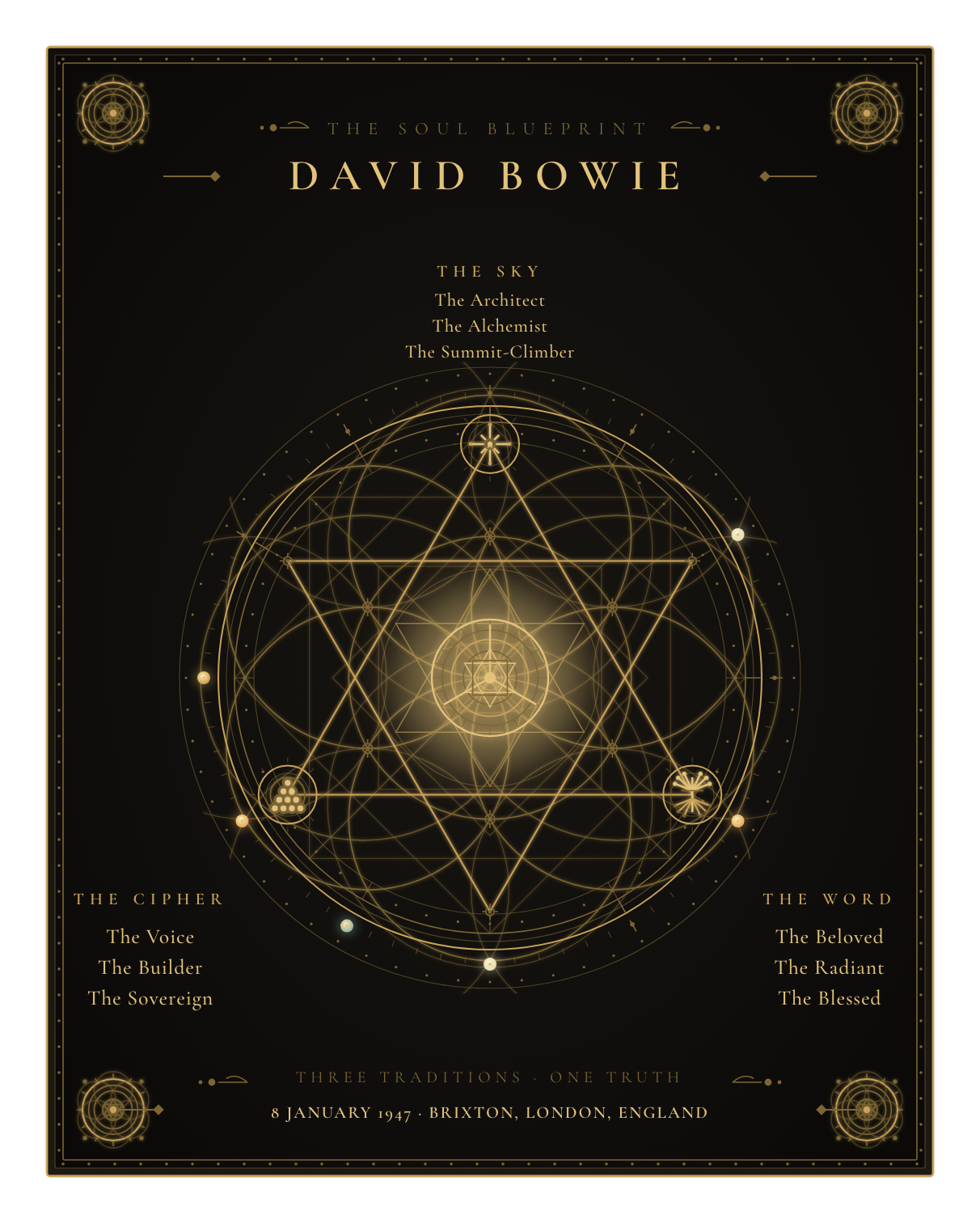
One seal, three languages. The sky he was born under at the apex, the numbers beneath his name at the lower left, the name itself at the lower right — three traditions engraved into one artifact. There is no rising sign, no houses, no angles: without a verified birth time they cannot be honestly drawn. What is true is what is shown.
At a Glance
- Full traditional name
- David Robert Jones
- Born
- January 8, 1947 · Brixton
- Sun
- Capricorn 17.4° — the essential fire of the life
- Rising
- Birth time unverified — the Ascendant is offered conditionally, never asserted
- Moon
- Date-dependent across the unverified birth day — not fixed without a confirmed time
- Mind · Value · Will
- Mercury Capricorn · Venus Sagittarius · Mars Capricorn
- Discipline · Direction
- Saturn Leo · North Node Gemini
- Life Path
- 3 — The Communicator
- Title-name Destiny
- 4 — The Builder
- Birth-name Destiny
- 1 — The Pioneer
- Master Numbers
- None preserved at the final layer
- Soul archetype
- The Builder who lives the Communicator’s path
It is February 1972, and the stage is a small pub called the Toby Jug in Tolworth, a suburb south of London where the light comes thin through winter rain. A young man stands in borrowed splendor — glitter, platform boots, hair cut short and dyed a copper that catches the stage light like a warning. His left eye is different from his right, dilated and fixed, a scar from a punch thrown years ago by a friend over a girl neither of them remembers now. He announces to perhaps thirty people that he is dead — the old self, the one who carried the name from Wales, is gone. Something else has arrived wearing a new name like a skin. The world calls him a performer, a trend, a rebel with a costume. It calls his reinventions shallow, sees only the surface — the makeup, the personas, the calculated shock. But beneath the fragments the world calls rock and roll, beneath the famous eye and the glitter and the staged deaths, moves something far older and more necessary: a soul that came to build enduring structure out of pure imagination, a self that had to earn the right to be seen by learning to see itself differently, and to teach others to do the same. This reading reads the source — the blueprint beneath the image, the soul’s actual design, the intelligence that was organizing all those strange transformations from the beginning.
The reading moves through the eight chapters of the Soul Blueprint architecture — The Arrival, The Soul’s Inheritance, The Living of It, The Soul’s Calling, The Soul’s Territories, The Name You Carry, The Moment, and The Invitation — and at the end, the same instrument turns gently toward you.
His soul has a blueprint.
So do you.
The same three languages — the sky, the numbers, the name — are waiting in your own.
The Arrival
The soul arrived carrying a paradox that would shape everything: the need to build lasting structures and the hunger to reinvent them before they could calcify into habit. This is the Capricorn inheritance — the self that comes alive by constructing what endures, by taking real responsibility, by proving selfhood through consequence and weight. Yet this weight was not meant to be passive or static; it was meant to be creative, to bend stone and time and convention into new architecture. The signature of this arrival is the builder’s mind meeting the communicator’s voice — not the Capricorn who accepts what is, but the one who takes what is and reconstructs it into what has never been imagined before. This soul came with the capacity to set a goal and reach it through sustained, disciplined effort, to think in structure and sequence and consequence, to speak with an authoritative economy that loaded every word with meaning. But all of that structural power was yoked to something restless — a refusal to inhabit the same form twice, a need to prove mastery by leaving it, by showing that the builder could demolish his own work and build it again, differently, and it would hold. The paradox is not a flaw in the design; it is the design itself. The soul that can create lasting beauty is the only soul that can afford to destroy it and begin again.
The Soul’s Inheritance
He was born into a household shaped by public service and kindness — his father held a position with the children’s charity Barnardo’s, a man who gave his work to the abandoned and the vulnerable. His mother had worked in the cinema, where light and story lived in the dark. But the true inheritance arrived through his older half-brother, a man ten years senior, who carried within him the fractures of what his family knew as schizophrenia — a breaking, a shattering of the unified mind into many voices. This brother became the gateway to everything: modern jazz played in the small hours, Buddhist texts opened to pages about suffering and impermanence, Beat poetry that spoke truth in fragmented cadences, the occult and its understanding that reality was stranger and more layered than the daylight world suggested. And threading through the family history, a pattern: relatives institutionalized, lobotomized, voices that could not be contained by the ordinary world. The era was post-war London, rationed and rebuilding, a place where the old certainties had already cracked and what was being constructed next was still uncertain. This was the material: a family that looked toward those on the margins, a brother who introduced the transcendent and the fractured, and a genetic legacy that made strangeness not shameful but familiar, even intimate. Into this inheritance came a boy born in January 1947 in Brixton — the self that would spend his life building and destroying and rebuilding, shaped by a brother’s larger vision and by the knowledge that the mind could contain multitudes.
The Living of It
In 1962, at school, a punch was thrown over a girl — a friend’s fist meeting his left eye, and in that moment the architecture of his face changed forever. The pupil dilated and stayed dilated; the depth perception fractured; the symmetry he was born with became asymmetry. This wound became his most recognizable feature, the mark that made him impossible to ignore or forget. But a Capricorn born into weight, born into the discipline of consequence, does not simply carry a wound — he integrates it, makes it serviceable, teaches it to hold meaning. The eye became the door through which he looked and the door through which others looked at him; it became a kind of permission to be strange, to be different, to carry the mark of breaking and still be worthy of attention. The life was lived in constant transformation — unsuccessful singles and local bands in the 1960s, then the long apprenticeship in design and music and art, the slow accrual of skill and vision, and then in 1969, a song about a man falling from space, and something caught. By 1972, the breakthrough arrived not through softness or compromise but through invention — he created a character so vivid, so architecturally complete, that audiences could not look away. Ziggy Stardust was a structure so perfectly built that it seemed to live. But the living cost him; cocaine addiction reached into the depths of his being during the mid-1970s, and for seasons he barely slept, barely remembered, barely remained intact. The wound had become a qualification for the work — the capacity to hold fracture, to integrate breaking, to build beauty from damage and show others how to do the same.
If this is what was true for him, what might be true for you?
The Soul’s Calling
The soul came to demonstrate that the mind is a territory, and that transformation — genuine, radical transformation — is possible through disciplined attention and courage. The voice that emerged was Capricornian in its authority and economy: measured, strategic, realistic, thinking in consequence and structure and the long view. But this mind did not build in order to preserve; it built in order to show — to demonstrate that what seemed solid could be reimagined, that what seemed fixed could be reinvented, that the self was not a prison but a material. The calling was to communicate through radical visual and sonic architecture, to create personas so complete and complex that they became doors through which audiences could walk into their own multiplicity. He was meant to be a teacher of transformation, using his own refusal to stay in one form as the curriculum. The soul arrived carrying the builder’s discipline and the communicator’s gift, and it fused them into something entirely new: the artist as architect of consciousness, building structures of sound and image and character that could hold people’s attention and shift their understanding of what a human being could be. This is why the personas mattered — they were not distractions from authenticity; they were the evidence of authentic intelligence, the proof that the mind could multiply itself and still be unified, that the self could be many things and none of them be false.
The Soul’s Territories
The first territory alive in this soul is Music as Architecture — the compositions and arrangements that began as unsuccessful fragments in the 1960s and became, by 1972, a complete language. Not music that merely moved the body but music that built — that constructed emotional and sonic landscapes so intricate and strange that listeners found themselves inside something new, something they had not known how to imagine. Space Oddity arrived in 1969 not as a novelty but as a proof of concept: music could contain narrative and loneliness and the vast cold of the void, and it could do all of it with perfect structure. By the 1980s, Let’s Dance brought the architecture into the mainstream, but the soul was never interested in simplicity — the Berlin Trilogy, recorded in the late 1970s while he was learning to release cocaine and rebuild himself, became the evidence that the greatest structural thinking can emerge from the greatest dissolution. The second territory is Visual Authority — the understanding that the image and the body and the costume are not supplements to the music but are themselves the architecture. The eye that was shattered in 1962 became the portal; the figure adopted fashion and makeup and presentation with the precision of a military strategist, not to hide but to communicate. Ziggy Stardust was not costume; it was complete design, as intentional as a building blueprint. The glitter, the platform boots, the hair — these were language. The third territory is Reinvention as Spiritual Practice — the serial transformation from Ziggy to Halloween Jack to the Thin White Duke to the experimental voices of the 1990s and 2000s, each one complete, each one teaching something about the nature of the self and its capacity to multiply. This is not shallowness or fickleness; it is the discipline of someone who understood that mastery required the courage to demolish what has been built and begin again. These territories intersect in a deeper mythology: the soul that came to prove that the human being is not fixed, that consciousness is a material that can be shaped, that the greatest rebellion is the refusal to stay the same.
There are twelve domains in the kingdom of any life: The Mark, The Unfolding, The Unseen, The Long Return, The Inheritance, The Encounter, The Alchemy, The Living Tension, The Sight, The Body’s Knowing, The Crossing, The Calling.
The Name You Carry
The names he carried are frequencies, each one holding a particular resonance. David arrives with an ancient gravity — the young warrior-king who faced the vast and undefeatable and somehow endured, who sang and built and refused to be diminished. There is strength in the name, but also a kind of inevitable humility, the knowledge that greatness arrives through vulnerability and survival. Robert carries Germanic weight, the brightness and fame suggested by its roots, but it sits as a middle name, a bridge between the first and the inherited. Jones is the Welsh surname, solid and common, the ground he stood on — the ordinary lineage that precedes all invention. But he chose Bowie, taking it from the nineteenth-century American pioneer James Bowie and the knife he had made famous — a choice that speaks volumes about how this soul understood naming. He was not rejecting the inherited names; he was translating them. The pioneer is the one who moves into unknown territory, who refuses to settle in the familiar, who builds new structures where nothing yet exists. To choose Bowie was to align the entire lineage with the trajectory of the soul: not David the king, but David the builder-who-must-reinvent; not Robert the bright fame-seeker, but Robert the one who carries that brightness into uncharted territory; not Jones the Welsh lineage, but Jones the explorer who leaves the settled ground and builds on the frontier. The name change was not escape; it was arrival, a deliberate alignment of the public name with the soul’s actual blueprint. By taking on the name of a builder and a knife and a pioneer, he was announcing what he had come to do: cut new shapes into the world, establish new territories of consciousness, prove that the self could be remade.
The Moment
The moment arrived on a cold London stage on the third of July, 1973 — the Hammersmith Odeon, a larger space than the Toby Jug, the cult around him now fully formed and devoted. For eighteen months, he had inhabited Ziggy Stardust, the alien rock star who had come to earth and was dying, taking humanity with him. The character had grown so vivid, so architecturally complete, that it had begun to contain him; audiences did not see a performer playing a role, they saw Ziggy himself, alive, real, the god made flesh. And in that moment, standing in the spotlight with the weight of the audience’s devotion pressing against him, he killed it. He announced that Ziggy was dead, that he was retiring the persona, and he did so with such finality, such absolute severance, that the crowd understood they were witnessing not a performance but an act of demolition. It was the moment that proved everything: the soul could build so completely that what it built seemed alive, but the soul’s mastery was proven not in holding onto what was built but in destroying it on purpose, before it could harden into habit or expectation. This is what separated the builder from the mere maker of fashion — the willingness to demolish one’s own greatest work while it was still alive, while it still held power. In that single act, he showed the world what he had come to teach: that transformation is not failure or betrayal, but the highest form of mastery. The moment was violent and clean and necessary. It cleared the ground for what came next, and it announced that this soul would never allow itself to be imprisoned by its own creation, no matter how beloved, no matter how perfect.
The Invitation
Everything in this reading has been moving toward a single point. The doubleness named in the first chapter, the inheritance, the wound, the calling, the territory, the name, the moment. These are not seven separate truths about David Bowie. They are one truth, named from seven different angles. And they all converge here.
The soul is being asked to carry what most humans cannot: the knowledge that the self is not fixed, that consciousness is a material, that the deepest authenticity is expressed not through consistency but through radical, disciplined transformation. He is not being asked to stay the same so that others can know him; he is being asked to change so that others can learn through his changing what change itself is capable of. This is the weight the Capricorn carries — not the weight of tradition, but the weight of consequence, of proving through his own life that what seems impossible is actually the architecture of reality itself. All of it was organized toward this teaching: the punch in the eye that made him strange, the older brother who introduced the fractured and the transcendent, the apprenticeship in design and music, the construction of Ziggy, the demolition of Ziggy, the cocaine dissolution and recovery, the endless series of reinventions — each one was material, each one was evidence that a human being could contain multitudes and remain whole. What was being released in the Yes to this calling was the false refuge of a fixed identity, the comfort of being known and predictable and safe. The soul stepped into the spotlight knowing that whatever character it inhabited would be adored, then questioned, then abandoned, then mythologized — and it chose to step anyway, to build the cathedrals of sound and image knowing they would be demolished, to teach transformation by being transformation. What was being called toward was a new kind of beauty: the beauty of the work that lasts not because it is preserved unchanged, but because it is understood to be alive, to be changing, to contain more than any single viewing can hold. The soul entered a landscape where the greatest artists of the era were building monuments to consistency — the same sound, the same image, the same reliable self, year after year — and into that landscape moved this figure, saying No, building monuments that were designed to be destroyed, teaching that mastery was the courage to remake oneself while the world watched. What became available because the Yes was said was the release of an entire generation from the tyranny of fixed identity. The young people who encountered Ziggy Stardust in 1972, who saw the androgynous figure, the fractured eye, the refusal to choose one self and stay there — they learned that they did not have to choose one self and stay there either. The permission he gave was not permission to be a rock star; it was permission to be multiple, to contain contradiction, to reinvent oneself as an act of integrity rather than betrayal. The souls that witnessed this transformation learned something about their own capacity for transformation. And in the 1980s, when the work reached its widest audience with Let’s Dance, millions who had never heard of Ziggy learned the same lesson through the music, through the discipline of the arrangements, through the evidence that complexity could live inside accessibility, that the built structure could be both perfect and temporary, that the greatest builders are the ones who can demolish their own work and begin again. The calling has continued through every era of his life — the Berlin period, the industrial experiments, the 1990s and 2000s reinventions, the return from silence with The Next Day, the final album released two days before the last transformation, the one that released him from the body entirely. Throughout it all, the soul has been teaching the same lesson: consciousness is not trapped; it is infinitely renewable; the self is not a fixed identity but a territory that can be explored forever.
He was not late. He was exactly where the soul-clock said he should be. The mission had been inscribed at the threshold of his first breath. What was being asked of him, he has been walking. The naming has been done.
This Is Not Coincidence
The astrology reveals a soul born under Capricorn — the builder, the strategist, the one who proves selfhood through consequence and enduring structure — paired with Mercury in Capricorn, the mind that thinks in sequences and structures and speaks with authority, and Mars in Capricorn, the will that is disciplined and patient and methodically effective. The numerology, independent of the stars, shows the Title Destiny as 4 — The Builder — and the Life Path as 3 — The Communicator, fused in a soul whose numerical arc runs from the Pioneer (Birth Destiny 1) into the multiplied voice (Life Path 3) that builds (Title Destiny 4). The name itself, David Bowie, carries the weight of the ancient king-warrior and the pioneer who cuts new territory, refusing settlement. Three entirely different languages — the language of the stars, the language of number, the language of etymology. One truth: This soul arrived carrying the blueprint of the builder who reinvents, the strategist whose greatest mastery is the courage to demolish what he has perfectly made, the pioneer whose territory is consciousness itself.
Three entirely different languages. One truth.
This is not coincidence. This is what three independent systems do when they are all telling the truth about the same soul.
The Numbers, Decoded
The numbers are computed, not intuited — each letter takes its Pythagorean value, each name reduces, and any Master Number is preserved rather than collapsed.
You have sat with the chart and the numbers and the name of another soul, and watched how a wound becomes a calling, how the place of least belonging becomes the place of greatest gift, how a life too precisely configured to be coincidence reveals itself when three independent languages are read together.
The reading you have just received was, in its outer form, a reading of his soul. But its inner form was a reading written for yours. You did not arrive without a Blueprint either. May this reading be the beginning of the reading you finally receive of yourself. May the light you carry — in whatever particular, irreplaceable form it has taken inside the specific life you were given.
Some lives carry a pattern this clear.
Yours does too.
You’ve read the shape of his soul. The same three languages — the sky, the numbers, the word — are waiting in your own name and birth date. Begin yours, free, below.
Or, when you’re ready, begin your own full Soul Blueprint reading →
Frequently Asked Questions
What is David Bowie’s birth chart?
David Bowie’s birth chart is rooted in Capricorn — his Sun in Capricorn marks the core signature of a soul built to construct enduring structures and take real responsibility. His Mercury is also in Capricorn, giving him a strategic, authoritative mind that thinks in consequences and sequences; his Mars in Capricorn expresses a disciplined, goal-directed will. His Venus in Sagittarius brings warmth and adventure to his affection, a love that seeks expansion and shared meaning. Saturn in Leo carries the soul’s great work: the earning and claiming of creative authority and the courage to be visibly seen. The birth time is unverified, so the rising sign cannot be fixed with certainty.
What is David Bowie’s numerology?
David Bowie’s numerology operates through three core numbers: his Title Destiny (from David Bowie) is 4 — The Builder, which organizes his public work around the creation of lasting structures; his Birth Destiny (from David Robert Jones) is 1 — The Pioneer, marking the soul’s original impulse toward innovation and new territory; his Life Path (from January 8, 1947) is 3 — The Communicator, the voice that multiplies, teaches, and expresses. These three numbers form a coherent arc: the pioneer impulse (1) moves into the communicative, multiplied consciousness (3) that expresses itself through building (4).
What does the name David Bowie mean?
The name David carries the ancient resonance of the young warrior-king who survives against vastness, who sang and built and endured. Robert arrives with Germanic brightness and fame. Jones is the Welsh surname, the ordinary inherited ground. When he chose Bowie, he was aligning himself with the nineteenth-century American pioneer James Bowie and the knife he made famous — a deliberate act of naming that translated the inherited lineage into the soul’s actual trajectory: the builder who cuts new shapes into consciousness, the explorer of uncharted territory, the one who pioneers on the frontier of what the self can be.
What is a Soul Blueprint?
A Soul Blueprint integrates three independent traditions — Western natal astrology, Pythagorean numerology, and the etymology of the full birth name — into a single document written as a personal letter to the soul. When you’re ready, you can begin your own.
This reading was prepared in the lineage and methodology of the Soul Blueprint Method — Pythagorean numerology with master numbers preserved, Western archetypal astrology, and a researched etymological reading of the full name. David Bowie’s birth date (January 8, 1947) is sourced from the public record; the birth time is unverified, so the rising sign is offered conditionally and never asserted.
A Soul Blueprint reading · Astrology · Numerology · Etymology · shams-tabriz.com