
Cillian Murphy’s Birth Chart, Numerology, and Name Decoded
Cillian Murphy’s Birth Chart,
Numerology & Name Decoded
The Soul Blueprint Method — three traditions woven into one personal letter: Western natal astrology, Pythagorean numerology, and the etymology of the soul’s name. Learn the method →
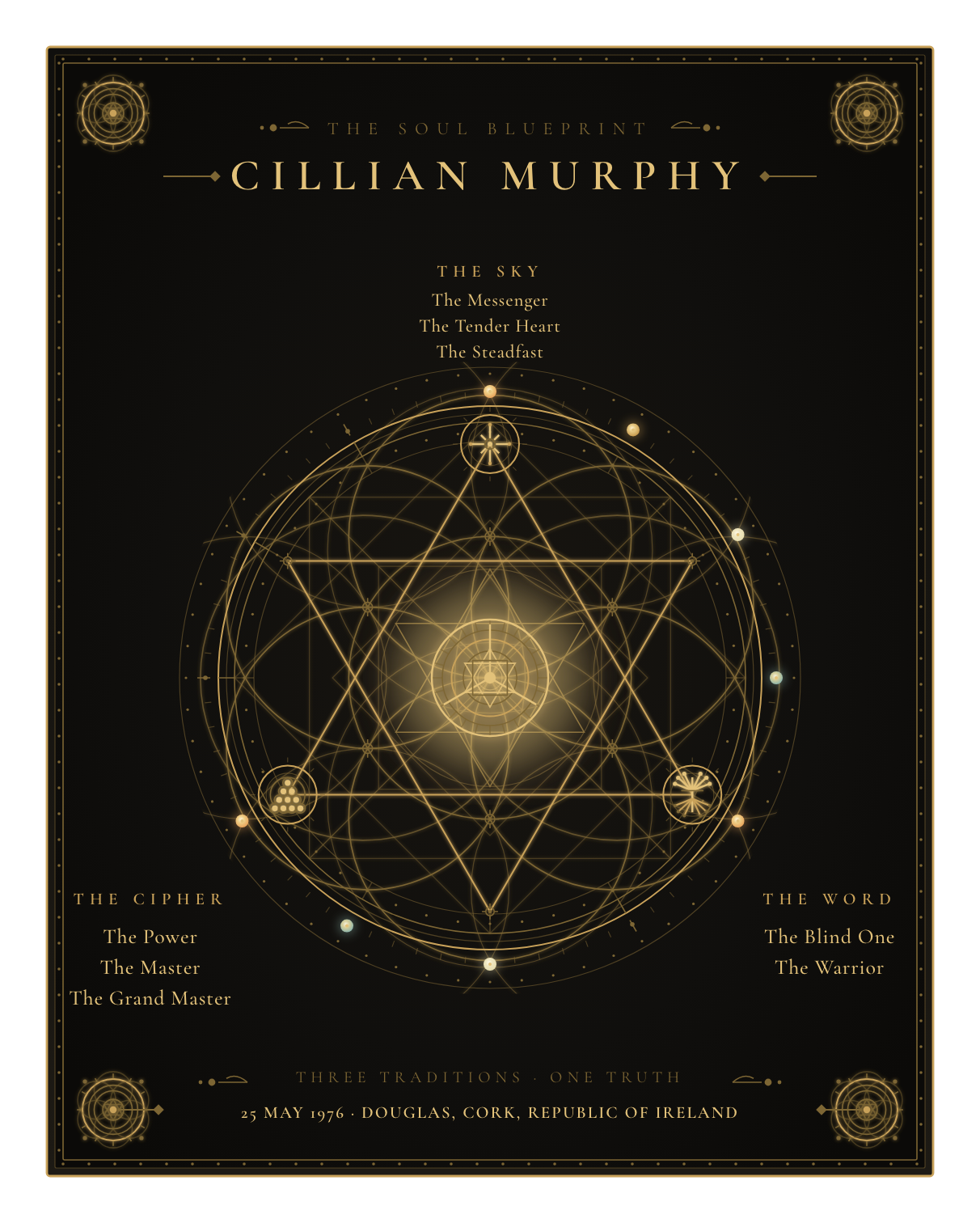
One seal, three languages. The sky he was born under at the apex, the numbers beneath his name at the lower left, the name itself at the lower right — three traditions engraved into one artifact. There is no rising sign, no houses, no angles: without a verified birth time they cannot be honestly drawn. What is true is what is shown.
At a Glance
- Full traditional name
- Cillian Murphy
- Born
- May 25, 1976 · Cork
- Sun
- Gemini 4.4° — the essential fire of the life
- Rising
- Birth time unverified — the Ascendant is offered conditionally, never asserted
- Moon
- Date-dependent across the unverified birth day — not fixed without a confirmed time
- Mind · Value · Will
- Mercury Taurus · Venus Taurus · Mars Leo
- Discipline · Direction
- Saturn Cancer · North Node Scorpio
- Life Path
- 8 — The Sovereign
- Title-name Destiny
- 44 — The Master Architect
- Birth-name Destiny
- 44 — The Master Architect
- Master Numbers
- 44
- Soul archetype
- The Master Architect who lives the Sovereign’s path
It is 1996 in Cork, late summer—the light the color of old brass through tall windows, and in that window sits a young man who has just failed his law exams with the clarity of someone who knew before he began that the law would never be his kingdom. Within thirty days, three invitations arrived at once: a record deal for his band, a role in a small theater production called Disco Pigs, and a woman named Yvonne at one of his rock shows—a convergence so precise it could seem like accident to those who mistake the world’s surface for its machinery.
But there is a difference between the fragments the world calls a life—the failures, the offers, the meetings, the turns—and the singular current that moved beneath them all, the source from which these separate streams emerged. A river does not flow backward into its many tributaries to understand itself; it flows forward, and the tributaries reveal themselves only by what they pour into the greater flow. To read a soul is not to catalog its events but to trace the source—to ask what came to express itself through Cork, through failure and acceptance, through the meeting with an artist in that particular moment, and what it was that needed to arrive in the world wearing that particular configuration.
This reading reads the source. It moves beneath the biography to the blueprint—the pattern of consciousness and desire that made this life not random but inevitable, that took a young man who could have become a lawyer and instead made him an instrument through which certain truths could be witnessed and embodied. The world sees the awards, the films, the collaborations. This letter sees the soul underneath—the architecture that was present before the first role was offered, the inheritance that was waiting to be claimed.
The reading moves through the eight chapters of the Soul Blueprint architecture — The Arrival, The Soul’s Inheritance, The Living of It, The Soul’s Calling, The Soul’s Territories, The Name You Carry, The Moment, and The Invitation — and at the end, the same instrument turns gently toward you.
His soul has a blueprint.
So do you.
The same three languages — the sky, the numbers, the name — are waiting in your own.
The Arrival
He arrived carrying a paradox that would structure everything that followed: a mind made to move, to connect, to speak across thresholds and into new territories—and yet a voice that would only deepen by growing slower, more deliberate, more tethered to what is solid and real. The self that comes alive by connection carries within it the constant search for new relationships, new territories of thought, the many-sided mind that learns by wandering. Yet beneath that wandering sat a fundamental grounding—a deliberate, concrete sensibility that would not let the connections scatter into mere chatter but would settle them into something durable, something that could be returned to.
This is the signature of the soul who arrives as both questioner and keeper: the consciousness that must move to know itself, and the consciousness that must rest to hold what it has learned. The governing image is architectural—the Master Builder who constructs not by imposing a blueprint from outside but by allowing the design to emerge from the relationships between parts, each connection bearing weight, each new link to the world tested for its solidity before it becomes part of the structure. He was born to build by connecting, and to connect only what could endure. This dual inheritance—the extroversion of the many-sided mind and the introversion of the slow, measured voice—would become not a conflict but the very mechanism of his art: the ability to move through many characters, many territories, and to speak each one as if from the deepest rest.
The Soul’s Inheritance
He was born into a lineage of teachers—his father worked in the machinery of education, his grandfather before him stood in classrooms, and his mother taught the language of France, which is to say she taught the architecture of connection itself through grammar and speech. The inheritance was intellectual and linguistic: a family that believed in the power of knowledge to shape lives, in the voice as an instrument of transmission. He grew up in Cork, in a fee-paying Catholic school where he performed well but often found himself in trouble—the signature of a mind too alive, too curious, too unwilling to accept the boundaries offered by simple compliance.
He had a younger brother, Páidi, and younger sisters, and in his late teens and early twenties he and Páidi made music together in several bands, the most successful called The Sons of Mr. Green Genes—an inheritance of making, of creating together within the lineage. The family turned down a record deal because the compensation for musical composition did not honor the work. This refusal—this insistence on the integrity of the exchange—became part of his own signature: the unwillingness to accept surface arrangements, to settle for what did not hold true weight. The era was the late twentieth century, when the old certainties were dissolving, when a young Irish Catholic could inherit faith and also question it, could be raised in tradition and also move toward his own truth. He inherited a kingdom built on language, education, integrity, and the courage to say no to what did not align with deeper principle.
The Living of It
The wound arrived disguised as a clear path: he enrolled in law school because that is what came next, because the family valued education, because it was the sensible architecture. And for days—only days—he knew that the law would never be his. The law demands a certain alignment of will and ambition, a belief in the structure itself. He had no such belief. The failure of his first-year exams was not failure at all but clarity, the soul’s quiet refusal to spend itself on a kingdom that was not its own. And in that same month, within thirty days, he received the role that would become his real education: the invitation into Disco Pigs, a small theatrical production that would send him across Europe and Canada and Australia for two years, touring the territories of the story, learning the character not from books but from repetition, from the live body’s knowledge, from the audience’s hunger night after night.
The cost of this clarity was the severing of one expected path and the entry into a kingdom far less certain, far less lucrative, far more demanding of faith. Yet it was in this seeming sacrifice—the refusal of law, the acceptance of theater, the two years of touring—that the real architecture began to build itself. He learned on his body and voice what no classroom could teach: the weight of a line spoken truly, the difference between performing and embodying, the reciprocal power between the actor and those who witness. The wound was the premature end of one identity. The qualification was the deepening into another: a soul that had learned, through refusal and through years of repetition, that the slow, deliberate voice carries more truth than hurried ambition ever could.
If this is what was true for him, what might be true for you?
The Soul’s Calling
The soul came to demonstrate a particular alchemy: the capacity to move through territories of consciousness without losing the ground beneath one’s feet. The voice it was given—slow, measured, grounded in the sensory real—would become the instrument through which characters are inhabited not as costumes but as territories of being that the actor has genuinely entered. This is the calling of the Master Architect: to build meaning through the careful assembly of parts, each one tested for its integrity, each relationship between parts necessary and true. The Life Path carries the signature of the Sovereign—the authority that comes not from external titles but from having mastered oneself, from the disciplined building of an inner kingdom so solid that it can afford to move freely in the outer world without seeking validation.
Yet the calling is not primarily to be seen—it is to witness, to embody, to make visible what is true about human consciousness and suffering and transformation. Each role becomes a territory entered not for the sake of fame but for the sake of knowing what it means to be human in that particular configuration. The voice is the instrument: slow enough to be trusted, deliberate enough to carry weight, concrete enough that when it speaks, the listener feels the presence of something real. The soul came to build cathedrals of meaning in the space between the speaker and the one who listens—architecture made visible through the body and voice.
The Soul’s Territories
His most alive territories unfold in three directions, each revealing a different aspect of the blueprint. The first is the territory of Character—the inhabited soul of another being, explored from the inside through years of performance, collaboration, and embodiment. Whether the figure is the Scarecrow in a trilogy of films, a transgender Irish woman in a story of transformation, a revolutionary in a film about the cost of violence, or a patriarch in a series that became a global phenomenon, each character becomes a threshold into consciousness itself. He does not inhabit them as costumes but as lived territories, territories he has genuinely entered and understood. The second territory is the territory of Collaboration—the long, sustained relationships with artists and directors who themselves move into deep waters: the filmmaker who makes films about time and consciousness and the structure of meaning, the playwright who refuses easy sentiment and demands the soul show itself in its rawness. These are not professional relationships but lineages—the choice to return again and again to those who have proven they can build something real. The third territory is the territory of Making—the expansion into directorial vision, the launching of a production company, the hosting of a radio series where he selects music and guests, the slow architectural work of building something that lasts. Each territory is grounded in sensory reality, each one demands integrity, each one serves something beyond the self. These territories converge in a deeper personal mythology—the myth of the Builder who moves through many lands but carries home within himself, who connects not to be seen but to understand, who speaks in order that others might remember what is true.
There are twelve domains in the kingdom of any life: The Mark, The Unfolding, The Unseen, The Long Return, The Inheritance, The Encounter, The Alchemy, The Living Tension, The Sight, The Body’s Knowing, The Crossing, The Calling.
The Name You Carry
The name Cillian carries within it an Irish resonance—a specificity of place and lineage, a rooting in a particular cultural inheritance. To be named Cillian is to be named with a name that moves beneath the surface of English-language culture, a name that holds its own language, its own history. Murphy is the Irish surname, the patronymic that anchors him to a family line and to the Irish earth itself. Together, the names carry the signature of belonging to a particular place, a particular people—yet they also carry something that moves across borders. A name that is specifically Irish can travel. It does not erase its origin; it carries it into new territories.
The resonance of the full name—Cillian Murphy—holds a peculiar alchemy: the specific rooted in the universal, the particular at home in the world. When he was named, he was given a name that could not be assimilated into the anonymous machinery of global culture, a name that insists on its own particularity, its own language. Yet this same name has moved across the world, carried the soul across continents and into the consciousness of millions—not by erasing what it is but by being exactly what it is. The names together carry the architecture of his soul’s work: to be rooted in something true and particular, to refuse the generic, to speak from that specificity as if it were the deepest universal truth. The name is not a brand; it is a threshold. To speak the name is to enter a territory.
The Moment
It was August 1996, late summer in Cork, and in the space of thirty days the architecture of the life was drawn. He had received an offer to join a band, to pursue the making of music—the inheritance from his brother, the years of songs written and performed, the collaboration that had almost become a path. He had failed his law exams, but the failure was not shame; it was clarity. And he had received the role in Disco Pigs, the small theatrical production that would send him into the world as an actor, a territory entirely new, entirely unproven. Three doors opened at once: the music, the theater, the law—and he had to choose. The band would be turned down, later, when a record deal came with terms that did not honor the work. The law had already been refused in the clarity of knowing it was not his. The theater remained: the role, the small stage, the two years of touring that would teach him what acting was, what it meant to live a character night after night, to let the character live through him.
And at one of those band shows, in that same month, he met Yvonne—an artist, someone who would understand the making of beautiful things, someone who had studied at the Royal College of Art, someone whose own hand and eye knew how to construct meaning. They would marry eight years later, in 2004, and have two sons, born in 2005 and 2007. But in the moment of meeting, in 1996, it was the convergence itself that held the truth: the moment when the three doors opened, when the path became visible not as a single clear road but as a configuration, a pattern emerging all at once. He chose theater, and he chose Yvonne—not knowing, yet somehow knowing, that these two choices would become the architecture of the life that followed. The moment revealed what he was: someone who would refuse the false path, who would say yes to what was real, and who would build the kingdom not alone but in partnership with another soul who knew how to make.
The Invitation
Everything in this reading has been moving toward a single point. The doubleness named in the first chapter, the inheritance, the wound, the calling, the territory, the name, the moment. These are not seven separate truths about Cillian Murphy. They are one truth, named from seven different angles. And they all converge here.
He is being asked to live out a particular truth: that depth and intimacy are not the opposite of professional mastery but its very foundation. The growth-medicine his soul carries is the journey from the settled, self-sufficient security of the merely familiar—the comfort of what one already knows—into the territories of genuine merger, of transformation through what one faces and allows to change oneself. This is not abstract; it is lived through every choice to return to a character, to deepen the collaboration, to allow the soul to be remade in the presence of another’s vision.
What was being released through the decades of his work was the illusion that one can master the world by keeping distance from it, by remaining safe within the boundaries of what is known. Each role became an invitation into vulnerability—not the vulnerability of exposure to judgment, but the vulnerability of genuine encounter with another consciousness, another way of being human. The Scarecrow in the darkness, the transgender woman finding her own truth, the revolutionary facing the cost of violence, the patriarch building an empire through fear and loyalty, the physicist who unleashes the power that cannot be contained—each character required him to move into territory where he did not know what he would find, where he had to let himself be changed by what he discovered there.
What was being called toward was intimacy with the work itself, and through the work, intimacy with the nature of consciousness. The collaborations with the filmmaker—the six films made together, each one exploring time and meaning and the architecture of reality—became a lineage of deepening. The marriage to an artist, the building of a family, the launching of the production company, the broadcasting of a radio series where he selected voices and music, the patronage of research into child and family—all of these are expressions of the same movement: the soul moving deeper, not outward but inward, finding that the deepest inward journey is the one shared with others.
What became available was a particular kind of authority—not the authority of fame or of being seen, but the authority that comes from having genuinely inhabited the territories one speaks about. When he speaks a line, it carries weight because he has lived that line from the inside. When he receives honors and recognition, they are received with the quiet gravity of someone who understands that the honors are not about him but about the work, the territory, the character, the collaboration. The Academy Award for portraying the physicist—the soul who built the thing that could not be contained—was not a personal victory but a recognition of the deepest work: the capacity to move into the consciousness of another and to make visible what is true there.
He is living in the present-continuous the resolution of the soul’s paradox: the mind that moves through many territories and the voice that becomes slower, more deliberate, more grounded the deeper it goes. The independent production company launched in 2024 is not a turn away from collaboration but a deepening of it—the architecture of his own vision becoming visible, the Builder now explicitly building. The radio series, the patronage of research, the deliberate choices about what to speak about and what to keep private—all of these are expressions of a soul that has chosen depth over breadth, intimacy over exposure, the building of meaning over the accumulation of fame. He continues to move into territories of consciousness precisely by anchoring himself deeper in what is real—the voice, the body, the presence, the marriage, the family, the work itself.
He was not late. He was exactly where the soul-clock said he should be. The mission had been inscribed at the threshold of his first breath. What was being asked of him, he has been walking. The naming has been done.
This Is Not Coincidence
The chart reads as a soul built for movement through connection—a mind made to wander, to link, to learn through the multiplying of relationships—yet grounded by a voice and presence so deliberate and concrete that every connection becomes durable, every word carries weight. The numerology reads as a Master Architect (both name and birth inheritance) whose Life Path is the Sovereign—the authority built from within, from mastery of the self, from the disciplined construction of an inner kingdom. The names Cillian and Murphy together carry the resonance of a consciousness that is specifically rooted—Irish, particular, refusing the generic—and yet capable of moving into any territory, any character, any consciousness, because it is so deeply anchored in what is real and particular that it becomes universal. Three entirely different languages. One truth: A soul that builds by moving, and moves by building—the architect who constructs meaning through connection, the builder who refuses to construct anything that is not true.
Three entirely different languages. One truth.
This is not coincidence. This is what three independent systems do when they are all telling the truth about the same soul.
The Numbers, Decoded
The numbers are computed, not intuited — each letter takes its Pythagorean value, each name reduces, and any Master Number is preserved rather than collapsed.
You have sat with the chart and the numbers and the name of another soul, and watched how a wound becomes a calling, how the place of least belonging becomes the place of greatest gift, how a life too precisely configured to be coincidence reveals itself when three independent languages are read together.
The reading you have just received was, in its outer form, a reading of his soul. But its inner form was a reading written for yours. You did not arrive without a Blueprint either. May this reading be the beginning of the reading you finally receive of yourself. May the light you carry — in whatever particular, irreplaceable form it has taken inside the specific life you were given.
Some lives carry a pattern this clear.
Yours does too.
You’ve read the shape of his soul. The same three languages — the sky, the numbers, the word — are waiting in your own name and birth date. Begin yours, free, below.
Or, when you’re ready, begin your own full Soul Blueprint reading →
Frequently Asked Questions
What is Cillian Murphy’s birth chart?
Cillian Murphy was born on May 25, 1976, in Cork, Ireland, with the Sun in Gemini—the sign of the mind made alive through connection and the constant search for new relationships. His Mercury is in Taurus, giving him a deliberate, grounded voice and a mind that settles into what is concrete and real; his Venus is also in Taurus, expressing love through steadfast loyalty and sensory presence; and his Mars is in Leo, a will that acts with warmth, courage, and generous heart. His Saturn is in Cancer, suggesting the Great Work of building emotional security from within. The birth time is unverified, so a precise rising sign cannot be established.
What is Cillian Murphy’s numerology?
Cillian Murphy’s numerology carries the number 44 twice—once from his full name (Title Destiny) and once from his birth date (Birth Destiny), the Master Architect appearing in both dimensions. His Life Path is 8, the Sovereign—the number of authority built from within, of mastery, of power directed toward meaningful creation. Together, these three numbers (44, 44, and 8) form the signature of a soul whose calling is to build structures of meaning and to do so with the authority that comes from having genuinely mastered the self.
What does the name Cillian Murphy mean?
Cillian is an Irish name carrying the resonance of a specific cultural inheritance and lineage. Murphy is the Irish surname, the patronymic that anchors him to a family line. Together, Cillian Murphy is a name that refuses assimilation into the generic machinery of global culture—it insists on its own particularity, its own language—yet it has traveled across the world, carried by the soul who bears it. The name holds the architecture of his soul’s work: to be rooted in something true and particular, to refuse the generic, and to speak from that specificity as if it were the deepest universal truth.
What is a Soul Blueprint?
A Soul Blueprint integrates three independent traditions — Western natal astrology, Pythagorean numerology, and the etymology of the full birth name — into a single document written as a personal letter to the soul. When you’re ready, you can begin your own.
This reading was prepared in the lineage and methodology of the Soul Blueprint Method — Pythagorean numerology with master numbers preserved, Western archetypal astrology, and a researched etymological reading of the full name. Cillian Murphy’s birth date (May 25, 1976) is sourced from the public record; the birth time is unverified, so the rising sign is offered conditionally and never asserted.
A Soul Blueprint reading · Astrology · Numerology · Etymology · shams-tabriz.com