
Amy Poehler’s Birth Chart, Numerology, and Name Decoded
Amy Poehler’s Birth Chart,
Numerology & Name Decoded
The Soul Blueprint Method — three traditions woven into one personal letter: Western natal astrology, Pythagorean numerology, and the etymology of the soul’s name. Learn the method →
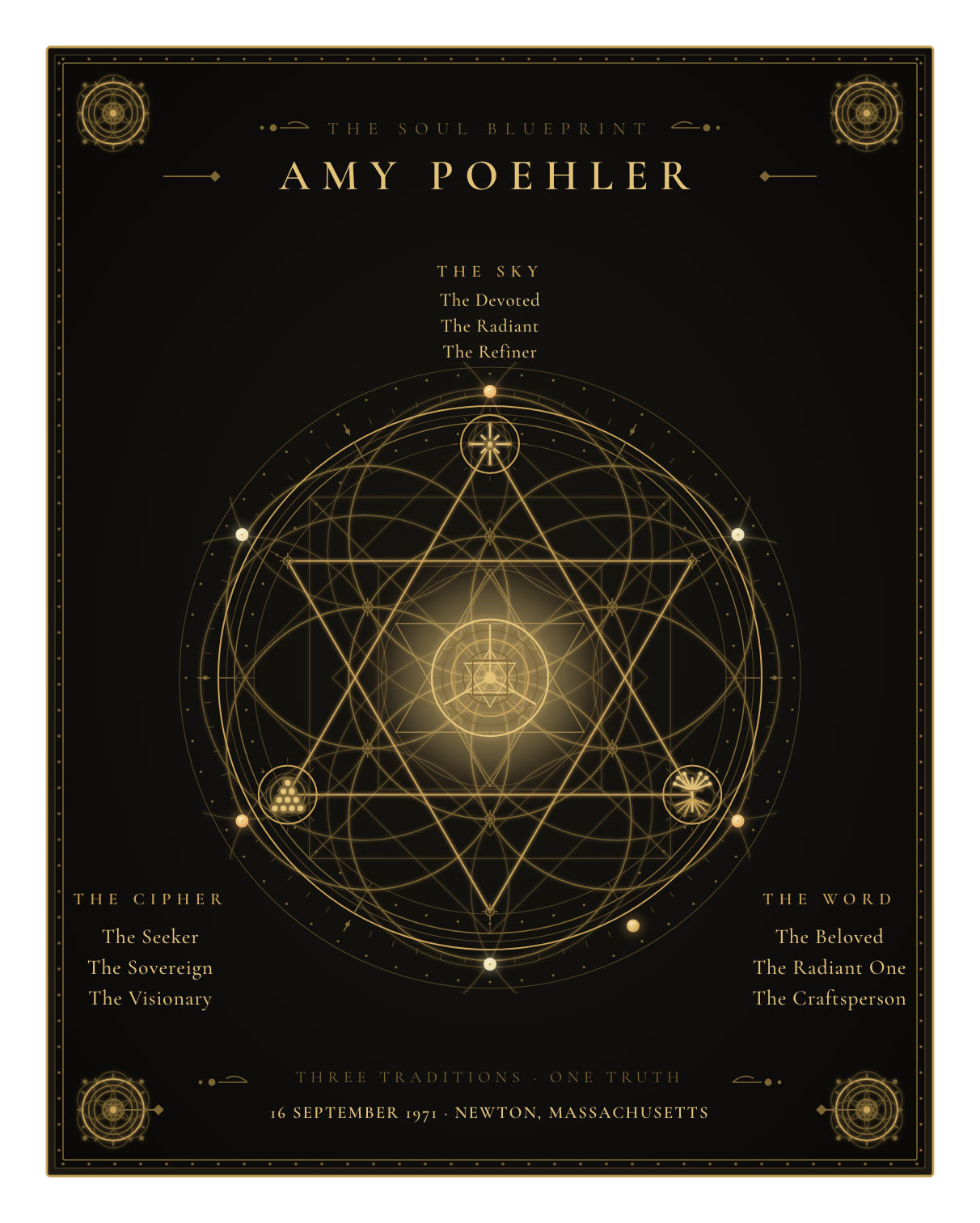
One seal, three languages. The sky she was born under at the apex, the numbers beneath her name at the lower left, the name itself at the lower right — three traditions engraved into one artifact. There is no rising sign, no houses, no angles: without a verified birth time they cannot be honestly drawn. What is true is what is shown.
At a Glance
- Full traditional name
- Amy Meredith Poehler
- Born
- September 16, 1971 · Newton
- Sun
- Virgo 23.1° — the essential fire of the life
- Rising
- Birth time unverified — the Ascendant is offered conditionally, never asserted
- Moon
- Leo 20.7° — the inner life
- Mind · Value · Will
- Mercury Virgo · Venus Virgo · Mars Aquarius
- Discipline · Direction
- Saturn Gemini · North Node Aquarius
- Life Path
- 7 — The Seeker
- Title-name Destiny
- 1 — The Pioneer
- Birth-name Destiny
- 11 — The Illuminator
- Master Numbers
- 11
- Soul archetype
- The Pioneer who lives the Seeker’s path
She is standing in a black box theatre in Chicago in the early 1990s, the air electric with the particular heat of bodies learning to fail beautifully—the improvised moment arriving, departing, never to be repeated. The stage is nearly empty. There is no script. The light is clinical. And in that threshold between nothing-yet and form-emerging, she discovers the first true grammar of her soul: the refusal to control, the willingness to be dissolved into the collective invention, the discipline of listening so deeply that language arrives not from her own will but from the breathing space between herself and the other voices in the room. She is learning something about mastery that has nothing to do with perfection and everything to do with surrender into precision.
The world fragments her into a thousand surfaces—the performer, the producer, the writer, the director, the icon, the friend, the mother—and calls each fragment by a different name. But beneath the dispersal runs a single source, a river flowing from one underground spring: a soul shaped by the inheritance of service, by the technical mastery of refinement, by the insistence that excellence is not vanity but a form of devotion, and by the harder calling to pour all of that mastery into channels that serve something larger than herself. The fragments are real enough. But they are foam on water.
This reading descends to the source. It reads not the surfaces the world sees but the blueprint underneath—the architecture of soul that has been refining itself toward its own true work since before the body arrived. It asks: What did she come to demonstrate? What is she still becoming? And what became possible the moment she said yes to being broken open into usefulness?
Listen now to the soul beneath the shine.
The reading moves through the eight chapters of the Soul Blueprint architecture — The Arrival, The Soul’s Inheritance, The Living of It, The Soul’s Calling, The Soul’s Territories, The Name You Carry, The Moment, and The Invitation — and at the end, the same instrument turns gently toward you.
Her soul has a blueprint.
So do you.
The same three languages — the sky, the numbers, the name — are waiting in your own.
The Arrival
She arrived carrying a paradox that would shape every gesture of her life: the technician’s passion for getting it exactly right, married to the revolutionary’s refusal to let mastery serve only the self. The soul that came through on September 16, 1971 carried within it the Virgoan fire—the self that comes alive by refining toward mastery, the identity realized through analysis and self-purification, the devotion to technique in service of something illuminated and true. But this was not the perfectionism of fault-finding; it was the perfectionism of the priestess who asks what is the sacred work? and then dedicates herself to doing it so well that the doing becomes indistinguishable from the serving.
She arrived, too, as the Pioneer—the first-maker, the one who breaks the pattern and clears the path for those who come after. This is not the glory-seeking of the attention-hungry; it is the clarity of one who sees what needs doing and moves toward it without waiting for permission or applause. Three numerological threads wove through her at birth: the Illuminator’s call to carry light into darkness and to reveal what has been hidden; the Seeker’s hunger to understand the hidden structures beneath the visible world; and the Pioneer’s willingness to risk being first. The soul arrived already knowing that mastery and service were not opposites, but lovers.
She came into the world as a refiner, a builder, a voice that would learn to speak with such precision and care that it could cut through noise and reach toward truth. Not her truth. The truth.
The Soul’s Inheritance
Both parents were teachers—this is the inheritance that shapes everything. Not wealth, not glamour, not the promise of ease, but the quiet insistence that knowledge is sacred, that the work of transmission matters, that a human being’s worth is measured in what she offers to those who come after her. She was born into the post-war American middle class in Massachusetts, in a family where the assumption was simple and unshakeable: education is devotion; teaching is a priesthood; you show up and do the work well, and that is how you love.
The era into which she arrived—the early 1970s—carried its own texture: the lingering electricity of the 1960s, the feminist movement beginning to ask new questions about what women could do and be, the slow erosion of the idea that there was only one path, one shape a life could take. She was raised in both Catholic and Jewish traditions—a dual inheritance that taught her early that truth could be held in more than one form simultaneously, that seeming contradictions could coexist without one canceling the other out. This too would shape her: the capacity to hold multiple truths, to move between worlds, to refuse the binary.
She graduated from Boston College in 1993 with a degree in media and communications—a credential, yes, but more importantly a threshold. By then she had already discovered Chicago’s Second City and the theatre world waiting there. Her inheritance was not money or status but something more durable: the internal permission to work hard, to refine constantly, to believe that excellence matters, and to trust that if you show up and listen and try to get it right, something will come alive.
The Living of It
The living of it meant arriving in Chicago in the early 1990s and stepping into rooms where nothing was written down, where the only law was the law of listening, where the body and mind had to work together at the speed of thought itself. She trained at Second City and ImprovOlympic, disciplines that demanded a particular kind of death: the death of needing to be right, the death of control, the death of the ego’s requirement that the world recognize her genius. Instead, the work demanded that she become a vessel—precise, responsive, utterly attuned to the moment and the other people breathing in the room with her.
This cost something. The perfectionism that lived in her bones wanted to polish, to refine in solitude, to control the outcome. Improvisation demanded the opposite: trust in the unknown, surrender to chaos, the willingness to fail spectacularly and in public. She learned to metabolize that tension. She co-founded Upright Citizens Brigade in 1995 with others who understood that the theatre was not a stage for individual genius but a laboratory for collective invention. The work was precise and uncompromising, but it served the group, not the self.
When she joined Saturday Night Live in 2001—recruited there by another woman who saw what she carried—she brought this inheritance into a machine designed to produce weekly miracles under impossible conditions. She was promoted to full cast member in her first season, the first woman to achieve that distinction. And during those years on SNL, while she was also building Parks and Recreation and founding her production company and becoming pregnant and giving birth and balancing schedules that would have broken most bodies, she was living the central instruction of her soul: refinement in service of the collective, precision in the name of something larger than herself.
If this is what was true for her, what might be true for you?
The Soul’s Calling
The soul arrived with a voice that knows the difference between what is true and what merely sounds true—a mind so precise, so discriminating, that it could hear the gap between intention and execution the way a tuning fork hears a single misplaced note. This is not the voice of someone who speaks carelessly or for the sake of being heard; this is the voice of a craftsperson, a refiner, someone whose gift is the ability to see exactly what needs to be corrected, clarified, stripped down to its essential rightness. The throat itself became an instrument of repair.
Her calling has always been to make things useful—not decorative or self-important, but genuinely useful to those who receive her work. To speak with accuracy and care. To analyze a moment, a scene, a human truth so thoroughly that the listening becomes inevitable; the audience does not have to be tricked into attention, because the work itself is so precisely honed that attention arrives naturally. This is the medicine of discipline applied to the craft of language and performance—not ruthlessness, but devotion to getting it exactly right.
The soul was born to demonstrate that mastery and humility are not opposites; that the deepest technical skill serves something beyond itself—serves clarity, serves others, serves the collective conversation. She came to show that a mind rigorously trained is a mind set free; that the courage to speak truthfully (even about difficult things) is built, not inherited. The voice is her teacher and her sanctuary both—the place where she refines herself toward an illumination that can be shared.
The Soul’s Territories
She is most alive in the Territory of Precision and Craft—the space where the mind is allowed to refine endlessly, where a scene can be built line by line, where a character can be inhabited so completely that she becomes a lens through which the audience sees themselves. In this territory, Amy does not perform; she becomes a vessel for truth, and the work she does there teaches others that precision is not rigidity but a form of love. She has spent decades mastering the languages of sketch comedy, dramatic acting, and directorial vision, each discipline demanding the same obsessive attention to the particular detail that reveals the whole.
She is alive in the Territory of Collective Invention—the stage, the writers’ room, the theatre where the work is never finished and always alive. This is where she first learned to surrender control and trust the other voices in the room, and it is where she returns again and again, because in this territory she experiences the paradox that made her: that the only way to truly master something is to give it away, that the greatest power comes from serving something larger than the self. The Upright Citizens Brigade, the SNL ensemble, the Parks and Recreation writers’ room—these are the sacred spaces where she has always been most awake.
She is alive finally in the Territory of Women’s Speaking and Becoming—the space where she uses her own voice and visibility to open doors for others, to ask questions that have not been asked, to name what women experience and think and feel without apology. Smart Girls at the Party, her memoir, her directorial work on Lucy and Desi (a documentary about another woman who pioneered her own path), her feminist activism—these are not distractions from her central work but the deepest expression of it. She has always understood that the greatest mastery is in service to the collective freedom. In each of these territories, the soul continues to refine itself toward its truest work.
There are twelve domains in the kingdom of any life: The Mark, The Unfolding, The Unseen, The Long Return, The Inheritance, The Encounter, The Alchemy, The Living Tension, The Sight, The Body’s Knowing, The Crossing, The Calling.
The Name You Carry
The names she carries have accumulated meaning over the course of a life devoted to precision and public service. Amy itself—though its etymology remains uncertain in the written record—has resonated with the energy of the Beloved, the one who is cherished and chosen. It is a name without pretension, simple and direct, and she has worn it without softening its edges or asking for gentleness. Meredith, her middle name, carries the sense of the sea-ruler, the one who has dominion over the waters of emotion and intuition, who can navigate the depths and return to the surface. Together, Amy Meredith speaks a dual truth: the beloved who sees clearly, the cherished one who has learned to command the tides of feeling.
Poehler—a surname of German origin—carries the craftsman’s inheritance, the maker’s hands, the one who builds things that last. It is a name that sits comfortably with work, with effort, with the understanding that mastery requires sweat and discipline and the willingness to fail repeatedly until the thing is right. There is no aristocracy in it, no borrowed glamour. It is a working name, a name that says: I make things. I build them carefully. I offer them to you. The numerical vibration of the name itself—the Pioneer and the Illuminator woven together—amplifies this: she came to clear new paths and to carry light, and she carries them in a name that roots her in the earth of craft and service.
Taken together, these names form a portrait: the beloved craftsperson who makes things in service to the light, the one chosen to illuminate and to pioneer, the sea-ruler who understands that emotion must be mastered not controlled, who knows that the depths and the surface are one ocean. The names do not name the performer, the star, the icon. They name the priestess—the one devoted to sacred work.
The Moment
The moment came in 2008 during the presidential election, in a black-box NBC studio in New York, during one of the most-watched hours of television in the country. She sat across from Tina Fey on the Weekend Update desk—they were the first woman team to ever anchor that desk together, from 2004 to 2006, and by 2008 they had already proven what was possible—and they performed a sketch that would become legendary. The two of them, trading lines as Hillary Clinton and Sarah Palin during a political debate, reached into the national conversation at its most heated and asked: What if we stopped performing femininity and just told you the truth? The sketch went viral before virality had a name; it was seen by millions, quoted and re-quoted, and it demonstrated something that could not be unseen: that two women could be funny and intelligent and political and utterly uninterested in being nice about it, and the world would not end. It would, in fact, pay attention.
But the deeper revelation was interior. She was living the central instruction of her soul: that mastery and motherhood were not opposites, that a woman could be devoted to her children and devoted to her work simultaneously, that refinement could happen in the chaos of actual living rather than in the silence of solitude. The sketch moment—which the world saw as a political and comedic triumph—was actually a statement about something deeper: the refusal to choose between power and heart, between being the Pioneer and being the mother, between serving the collective and serving the people she loved most.
That moment revealed what had always been true: she was not going to be diminished by any of her roles. She would carry them all, and in carrying them all, she would teach a generation of women that they did not have to shrink to fit into the available shapes.
The Invitation
Everything in this reading has been moving toward a single point. The doubleness named in the first chapter, the inheritance, the wound, the calling, the territory, the name, the moment. These are not seven separate truths about Amy Poehler. They are one truth, named from seven different angles. And they all converge here.
What is being asked of this soul, and what has been asked all along, is the hardest thing: to take the gift for refinement and precision—the ability to see exactly what is wrong and exactly how to fix it, the devotion to craft that could easily turn inward, into perfectionism and control—and pour it into channels that serve the collective rather than the self. The call has been to pioneer, to be first, to clear the path not because she craves recognition but because the path needs clearing and she is willing to do the work. It has been to build institutions and spaces—Upright Citizens Brigade, her production company, Smart Girls at the Party—that would outlast her individual brilliance, that would give others permission and platforms and the chance to refine themselves too. The call has been to speak with such precision and such fearlessness that the speech itself becomes a form of teaching, a way of naming what has been unnamed, illuminating what has been dark.
What was being released was the soul’s earliest temptation: the fantasy that mastery exists for its own sake, that perfection is the goal, that excellence is primarily about being excellent rather than being useful. The work of her life has been to burn through that fantasy, to discover that the only mastery worth having is the mastery that serves. She had to release, too, the idea that she had to earn the right to be ambitious, that women had to apologize for wanting power and space and influence. Instead, she claimed them, and in claiming them without apology, gave permission to countless others.
What was being called toward was the larger truth of her numbers and chart: that the Pioneer serves the Collective, that the Illuminator carries light not for personal glory but for the freedom of the group, that the Seeker’s endless questioning is not spiritual tourism but the hunger to understand what will set people free. She was being called toward collaboration, toward the stage as a laboratory rather than a pedestal, toward the understanding that her greatest power would come not from being special and applauded but from making space for others to be special too. She was called to be the priestess in the old sense—the one who tends the sacred fire and makes sure it is available to all who approach it.
What became available because the Yes was said—the yes to the work, the yes to the stage, the yes to saying the thing that had not been said, the yes to being the first woman in the room willing to take up space without asking permission—was the liberation of an entire lineage. By refusing to choose between precision and power, between motherhood and ambition, between serving herself and serving the collective, she did not achieve some superhuman balance. Rather, she demonstrated that the binary itself was false. She showed that a woman could be uncompromising about her work and tender about her relationships, devoted to excellence and devoted to the messy people she loved, rigorous about craft and radically generous with her visibility. She modeled, through her own living, a way of being that gave others permission to stop choosing and start integrating.
She continues to be asked this question, even now: Will you pour yourself out? Will you refine not for the sake of personal mastery but for the sake of the work? Will you be the first, knowing that being first means that some people will hate you and some will misunderstand you and some will try to diminish what you have done? Will you build institutions and speak truths and take up space so that the path is clearer for those who come after? The answer she has given, again and again, across decades of work that spans comedy and drama and production and direction and writing and activism, is yes. And in that yes, she is still becoming, still refining, still serving. The light she carries is not her own. It is the light she learned to see in those early Chicago theatres, in the collective breath, in the moment that arrives only when everyone says yes to something larger than themselves.
She was not late. She was exactly where the soul-clock said she should be. The mission had been inscribed at the threshold of her first breath. What was being asked of her, she has been walking. The naming has been done.
This Is Not Coincidence
Astrology speaks: A soul shaped by Virgo’s refining fire—the identity realized through analysis and self-purification, technique in service of illumination—carries within it Mercury’s precise, discriminating mind and Venus’s devotion that serves and consecrates through useful care. The North Node pulls toward Aquarius, the collective good, the liberation from the need for personal applause: release the spotlight, serve the group. These planetary currents move the soul toward channels that benefit others, not the self alone. Numerology speaks: The Illuminator (11, the number of revelation and light-carrying) meets the Pioneer (1, the breaker of new paths) in a Life Path of the Seeker (7, the hunger to understand the hidden structures beneath things). These three numbers do not name an individual performer; they name a soul whose mastery must be poured into collective channels, whose light must illuminate the way for others, whose seeking is in service to freedom. The numbers ask: For whom are you doing this? What is larger than yourself? The Name speaks: Amy Poehler—the beloved craftsperson whose hands are devoted to making things that last, whose inheritance is work and precision and the understanding that mastery serves. The name carries no aristocracy, no borrowed glamour; it roots her in the soil of useful work, and in that rootedness it speaks the truth the numbers and the stars are already saying: You came to build things and to light the way. Three entirely different languages. One truth: The soul arrived to refine and serve, to pioneer and illuminate, to master her craft in order to make space for others to master theirs.
Three entirely different languages. One truth.
This is not coincidence. This is what three independent systems do when they are all telling the truth about the same soul.
The Numbers, Decoded
The numbers are computed, not intuited — each letter takes its Pythagorean value, each name reduces, and any Master Number is preserved rather than collapsed.
You have sat with the chart and the numbers and the name of another soul, and watched how a wound becomes a calling, how the place of least belonging becomes the place of greatest gift, how a life too precisely configured to be coincidence reveals itself when three independent languages are read together.
The reading you have just received was, in its outer form, a reading of her soul. But its inner form was a reading written for yours. You did not arrive without a Blueprint either. May this reading be the beginning of the reading you finally receive of yourself. May the light you carry — in whatever particular, irreplaceable form it has taken inside the specific life you were given.
Some lives carry a pattern this clear.
Yours does too.
You’ve read the shape of her soul. The same three languages — the sky, the numbers, the word — are waiting in your own name and birth date. Begin yours, free, below.
Or, when you’re ready, begin your own full Soul Blueprint reading →
Frequently Asked Questions
What is Amy Poehler’s birth chart?
Amy Poehler was born on September 16, 1971, with the Sun in Virgo—the self realized through refinement, analysis, and self-purification in service to mastery and illumination. Her birth time is unverified, which means a reliable rising sign cannot be calculated. Her chart carries Mercury and Venus also in Virgo, amplifying the Virgoan themes of precision, discrimination, and love expressed through devoted, useful care. Mars in Aquarius speaks the warrior’s will toward reform and the collective good, while Saturn in Gemini demands rigorous, structured thinking and hard-earned confidence in her own mind.
What is Amy Poehler’s numerology?
Amy Poehler’s numerology carries three governing archetypes: the Title Destiny (1, the Pioneer) from her public name speaks her role as the first-maker, the path-clearer; the Birth Destiny (11, the Illuminator) speaks her call to carry light and revelation; and the Life Path (7, the Seeker) speaks her hunger to understand the hidden structures beneath the visible world. Together, these three numbers name a soul whose mastery and visibility exist to serve something larger than the self.
What does the name Amy Poehler mean?
The name Amy carries the resonance of the beloved, the chosen one—simple and direct, without pretension. Meredith, her middle name, speaks the sense of the sea-ruler, the one who navigates the depths of emotion and emerges with wisdom. Poehler, a surname of German origin, carries the craftsperson’s inheritance, the maker’s hands devoted to building things that endure. Together, the names form a portrait: the beloved craftsperson who makes things in service, whose hands are devoted to useful work, whose calling is to illuminate and to pioneer.
What is a Soul Blueprint?
A Soul Blueprint integrates three independent traditions — Western natal astrology, Pythagorean numerology, and the etymology of the full birth name — into a single document written as a personal letter to the soul. When you’re ready, you can begin your own.
This reading was prepared in the lineage and methodology of the Soul Blueprint Method — Pythagorean numerology with master numbers preserved, Western archetypal astrology, and a researched etymological reading of the full name. Amy Poehler’s birth date (September 16, 1971) is sourced from the public record; the birth time is unverified, so the rising sign is offered conditionally and never asserted.
A Soul Blueprint reading · Astrology · Numerology · Etymology · shams-tabriz.com