
Kendrick Lamar’s Birth Chart, Numerology, and Name Decoded
Kendrick Lamar’s Birth Chart,
Numerology & Name Decoded
The Soul Blueprint Method — three traditions woven into one personal letter: Western natal astrology, Pythagorean numerology, and the etymology of the soul’s name. Learn the method →
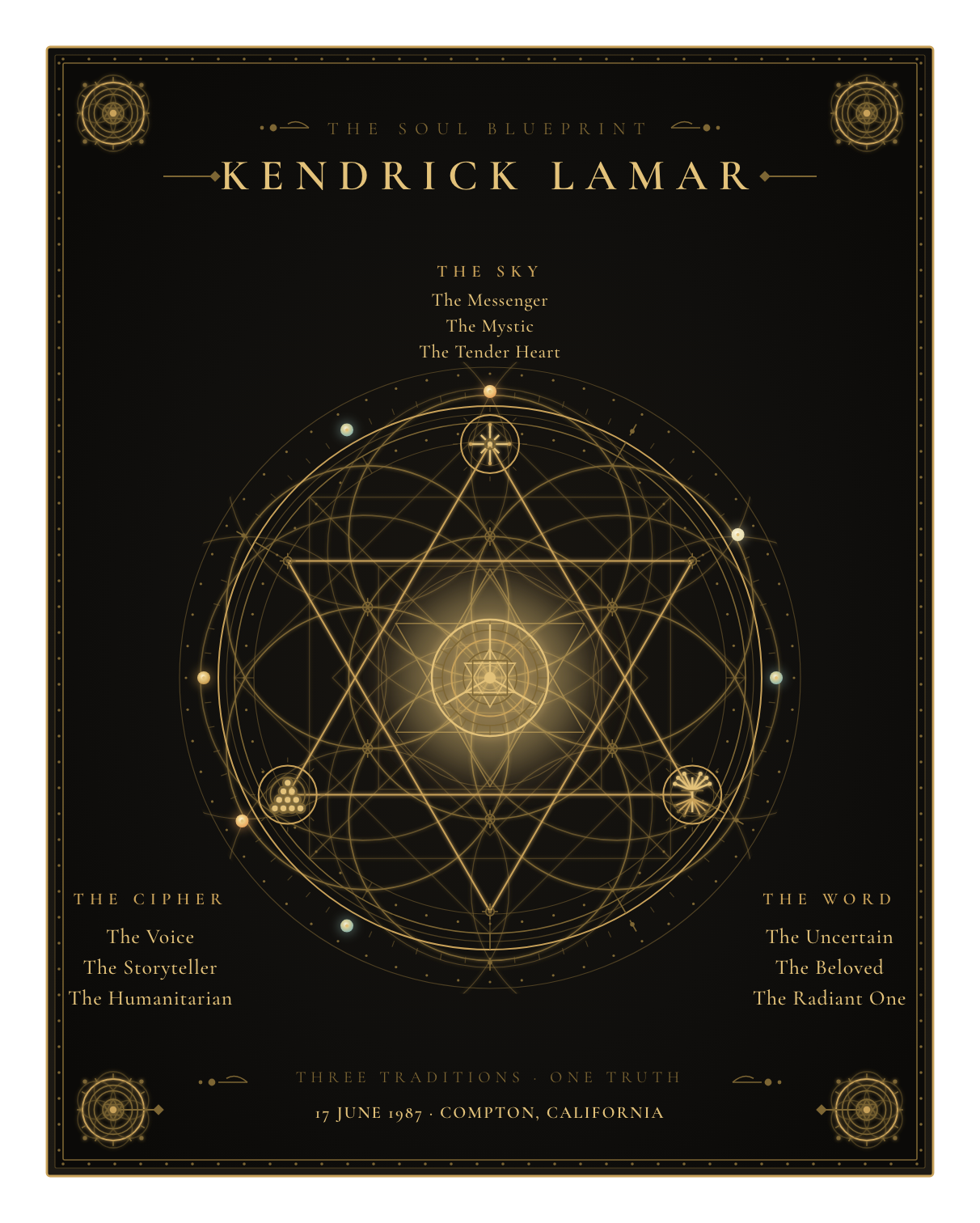
One seal, three languages. The sky he was born under at the apex, the numbers beneath his name at the lower left, the name itself at the lower right — three traditions engraved into one artifact. There is no rising sign, no houses, no angles: without a verified birth time they cannot be honestly drawn. What is true is what is shown.
At a Glance
- Full traditional name
- Kendrick Lamar Duckworth
- Born
- June 17, 1987 · Compton
- Sun
- Gemini 26.1° — the essential fire of the life
- Rising
- Birth time unverified — the Ascendant is offered conditionally, never asserted
- Moon
- Pisces 17.6° — the inner life
- Mind · Value · Will
- Mercury Cancer · Venus Gemini · Mars Cancer
- Discipline · Direction
- Saturn Sagittarius · North Node Aries
- Life Path
- 3 — The Communicator
- Title-name Destiny
- 3 — The Communicator
- Birth-name Destiny
- 9 — The Humanitarian
- Master Numbers
- None preserved at the final layer
- Soul archetype
- The Communicator who lives the Communicator’s path
It is February 2025, and the light over the Los Angeles Memorial Coliseum falls in that particular February way—thin, clear, without the weight of summer—and a man stands at the center of a stage before 133.5 million eyes, the Super Bowl halftime held in his hands like a river. The music moves through him, and through the screen into living rooms across a continent, and what the world sees is a performer, a titan of hip-hop, a chart-maker, a Pulitzer laureate. What the world hears is the voice—layered, tender, precise, carrying the weight of twenty years of testimony. But there is a difference between the fragments the world collects and names (the accolades, the tours, the albums numbered and dated) and the source from which they flow—a deeper current that cannot be reduced to any single track or trophy. The world calls them his achievements. The source is something else: a soul built to speak the unspeakable, to make connection where none seemed possible, to stand in the wreckage of a life and ask what does this mean? This reading reads the source. It traces not the visible current but the spring from which it rises—the inherited blueprint, the paradox he arrived carrying, the threshold he crossed, and what becomes available when a soul says yes to its own deepest calling.
The reading moves through the eight chapters of the Soul Blueprint architecture — The Arrival, The Soul’s Inheritance, The Living of It, The Soul’s Calling, The Soul’s Territories, The Name You Carry, The Moment, and The Invitation — and at the end, the same instrument turns gently toward you.
His soul has a blueprint.
So do you.
The same three languages — the sky, the numbers, the name — are waiting in your own.
The Arrival
He arrived carrying a paradox so precise it could have been written in the body itself: the capacity to connect, to link, to build bridges through language and curiosity—all the facets of a self that comes alive through vivid relationship with the world—married to an emotional depth that asks to belong to something larger than the self, to dissolve the boundary between inner and other, to know the boundless. This is the signature of a soul built to be a translator between worlds. His self is not fixed or singular; it multiplies through encounter, through the constant search for new connection, yet each connection is filtered through a heart that has learned—or is learning—to identify itself with the larger framework of consciousness itself. The many-sided mind arrives not to accumulate or dominate, but to serve. Every link he makes is an invitation to depth, to feeling, to the contemplative recognition that what separates us is an illusion. He came to build the bridges that help others cross from isolation into the knowing that they are part of something whole. This is not a gift for the surface; it is a gift for the soul.
The Soul’s Inheritance
He was born into a particular inheritance, both material and spiritual. His parents—both from the South Side of Chicago—carried the legacy of displacement and survival; they came to Compton in 1984, seeking escape and a different story, though the conditions they found were severe: Section 8 housing, welfare, food stamps, the constant pressure of scarcity. His father had been bound to gangster affiliations; his mother worked to hold the household. The neighborhood itself was a teaching, not an academic one—a landscape of violence woven so deeply into the daily air that a five-year-old could witness murder as casually as someone else might witness rain. He grew up in the shadow of the Westside Pirus gang, not as a member but as someone living in their proximity, breathing their reality. Yet his mother saw something else in him—a precocious child, watchful and interior, a boy who observed more than he spoke. The 1992 riots arrived during his first-grade year, introducing him not to abstract injustice but to the embodied presence of police brutality. He was already learning what it meant to be young, Black, and watched. A teacher at Ronald E. McNair Elementary recognized something in him when he spoke the word audacity correctly in class—recognized the precision, the reach. This too was inheritance: the first adult mirror that said you have a voice.
The Living of It
The signature wound was silence, and the life was built—against great pressure—into speech. He was a loner, described by his mother as withdrawn, and the world noted that he carried a stutter, a place where the voice would catch. Yet the teachers kept seeing him: at Vanguard Learning Center, a seventh-grade English teacher named Regis Inge introduced him to poetry, and something in that form—the precision, the compression, the way feeling could be held in careful language—opened him. He began to write, to rap, to use the constraints of rhyme and meter as a container for what could not be said plainly. By high school, he was K.Dot, building a reputation for technical mastery and depth of content. He graduated straight-A in 2005 from Centennial High School, carrying the contradiction of being both a studious honor student and a young artist building an underground reputation. But the cost was also spiritual: by 2013, as the industry had begun to recognize him, three close friends died, and he descended into depression, survivor’s guilt, suicidal ideation. The nervous breakdown came near the end of a tour, a rupture so severe it fractured the surface he had built. What emerged from that fracture was the refusal to make shallow music. The cost of depth is that you feel everything.
If this is what was true for him, what might be true for you?
The Soul’s Calling
He came to say what the culture was forbidden to say clearly—to demonstrate that hip-hop was not merely a commercial vehicle but a vessel for the soul’s reckoning with itself. His calling was to speak directly to the young, to the forgotten, to those living in the same apartments where he had seen blood on the pavement, and to say: your life is not disposable. Your pain means something. Your story is scripture. The voice he developed was not the voice of aggression but of protection—a fierce, tender care woven into every word. His Mercury operates in the language of the heart; his words move through atmosphere and emotional undertow, and they shelter the listener. This is why his albums function as testimonies rather than entertainments—Good Kid, M.A.A.D City reads like a fever dream of South Los Angeles; To Pimp a Butterfly interrogates power and complicity; Damn asks what it means to live in proximity to grace; Mr. Morale & the Big Steppers confesses the violation within, the ways he has harmed even as he has been harmed. He came to demonstrate that a man could be brilliant, accomplished, adored—and still be broken, still be learning, still be accountable. The calling is radical honesty.
The Soul’s Territories
He is most alive in the Territory of Witness and Testimony—the space where he transforms what he has seen into language that others can hold and recognize themselves within. Here he does not perform; he reports. He does not inspire; he illuminates. A second territory is the Music-as-Architecture of Consciousness—the way he builds albums not as collections of songs but as contained worlds, journeys through states of being, each production choice a deliberate gesture toward deepening the listener’s perception. The third is the Territory of Lineage and Inheritance—his ongoing work to honor Compton, to represent the evolution of his city, to donate 200,000 dollars to twenty Los Angeles charities and community initiatives, to say that the blessing that came through him belongs to the collective from which he emerged. In each of these territories he is not performing a role; he is being faithful to something larger than his own advancement. These territories point toward a deeper personal mythology: the figure of the Griotte, the witness who carries the story of his people and speaks it back to them so that they may see themselves as sacred.
There are twelve domains in the kingdom of any life: The Mark, The Unfolding, The Unseen, The Long Return, The Inheritance, The Encounter, The Alchemy, The Living Tension, The Sight, The Body’s Knowing, The Crossing, The Calling.
The Name You Carry
The name carries resonance rather than accident. He was named after Eddie Kendricks of The Temptations—the voice of spiritual yearning, the tenor who could make vulnerability sound like strength. Kendrick itself resonates with the kingdom—the spiritual order, the inherited realm into which one enters. Lamar holds its own vibration; it carries a quality of reaching, of extension. Together—Kendrick Lamar—the names form an invocation: one who enters the kingdom and reaches toward the larger whole. When he retired the stage name K.Dot after his 2009 EP and chose to move into his given names, it was not a simple rebrand but a spiritual maturation, a decision to be known by the names his parents gave him, to claim that lineage directly. Duckworth, the family name, grounds him in the specificity of place and blood—the worthiness of the duck, perhaps, the resilience of the common creature that survives in difficult waters. The full name—Kendrick Lamar Duckworth—holds a paradox: the sacred aspiration, the reach toward the kingdom, held in the body of a man named for survival, for the humble endurance of those who persist in hard conditions. The names speak his inheritance and his calling in a single breath.
The Moment
The moment came in 2013, a season rather than a single date, though its center is precise. He was touring behind Good Kid, M.A.A.D City, the album he had built with meticulous care, the one that had taught him his own voice. The industry had begun to recognize him—Eminem, Dr. Dre, the gatekeepers had opened doors. And then, in the midst of this arrival, three close friends died. The grief moved through him like a tremor through water, and it did not stop. He experienced depression so deep that the word becomes inadequate; he descended into suicidal ideation, survivor’s guilt so severe it became a kind of spiritual sickness. The nervous breakdown came near the end of a tour, a moment when the carefully maintained architecture of his functioning simply collapsed. What that moment revealed was this: that he could not build his life on the foundation of personal acclaim or industry recognition. That the calling was not to become famous but to be honest. That the only way forward was through the acknowledgment of his own brokenness, his own complicity, his own wounds. The moment cracked him open, and what came through was the insistence that his music could no longer be surface; it had to be testimony, had to be reckoning, had to matter in the way that prayer matters—as a speaking to something larger than himself.
The Invitation
Everything in this reading has been moving toward a single point. The doubleness named in the first chapter, the inheritance, the wound, the calling, the territory, the name, the moment. These are not seven separate truths about Kendrick Lamar. They are one truth, named from seven different angles. And they all converge here.
He is being asked to do something that the culture has made nearly impossible: to maintain integrity while commanding immense visibility, to speak truth while knowing that the amplification of that truth will be used, misused, commodified, and consumed as product. He is being asked to build a philosophy of meaning so grounded that it cannot be shaken by the contradictions inherent in being a beloved artist, a wealthy man, a figure of enormous influence, while remaining accountable to the young people in Compton who still live in the conditions that shaped him. He is being asked to hold the tension between personal reckoning—his own sexual addiction, his own failures as a partner, his own capacity to harm—and public witness, to confess the private wound on the scale of millions of listeners without dissociating from either the confession or the scale. What was being released was the need to be heroic, to be unbroken, to be the savior of the culture. The albums since 2013 have been a long Yes to vulnerability, to the possibility that a man could be brilliant and damaged, accomplished and still learning, beloved and still failing. What was being called toward was a new form of masculinity—not the fortress, but the man who names what he has done, who says I harmed you, I harmed myself, I am still becoming. The work of the past decade has been to demonstrate that this confession, this constant reckoning, is not a weakness but a form of radical strength. What became available because the Yes was said is that others could believe in their own becoming. When he stood on the Super Bowl stage in 2025, at the center of the largest viewership in television history, and performed the songs that came from the breaking open, he was saying to 133.5 million people: you do not have to be whole to be worthy. You do not have to be finished to be seen. Your pain is not a disqualification from love. The PGLang entity he co-founded with Dave Free has become a demonstration of what it looks like to build cultural infrastructure that serves artists rather than extracting from them, to say that the blessing belongs to the community. He is being asked, continuously, to prove that it is possible to be both successful and real, both powerful and accountable, both a voice for millions and a man sitting alone in a room, trying to figure out what he has done and what he owes. The fact that he continues to say yes to this—to make albums that deepen rather than consolidate his power, to give money back to Compton, to co-headline tours with other visionaries like SZA, to push the form of hip-hop toward ever greater emotional and spiritual nuance—means he is not late, not lost, not finished becoming.
He was not late. He was exactly where the soul-clock said he should be. The mission had been inscribed at the threshold of his first breath. What was being asked of him, he has been walking. The naming has been done.
This Is Not Coincidence
The astrology of Gemini Sun, Mercury in Cancer, and Mars in Cancer speaks a soul built to connect through feeling—to carry the tender voice into the world, to speak what shelters, to defend the vulnerable through words and witness. The numerology reads independently: a Life Path 3 (the Communicator), a Title Destiny 3 (the Communicator again), and a Birth Destiny 9 (the Humanitarian)—the soul compressed into the arithmetic of speaking, sharing, and serving the whole. Three entirely different languages. One truth. The messenger who heals through testimony. The second passage: Astrology names a North Node in Aries, the soul’s medicine being the hard-won courage to speak from his own center, to assert what he knows even when it breaks communion—the growth from Libra’s deference into Aries’s fierce self-advocacy. Numerology holds the same fracture and redemption in its own tongue: the 3 demands to be heard, the 9 demands to be of service, and the tension between them is the soul’s actual curriculum—learning to speak truth even when it costs approval. The names themselves—Kendrick Lamar Duckworth—carry an ordinary American inheritance, a grounding in the real world, a refusal of pretense. Three entirely different languages. One truth. The boy from Compton learning that his own voice matters to the world.
Three entirely different languages. One truth.
This is not coincidence. This is what three independent systems do when they are all telling the truth about the same soul.
The Numbers, Decoded
The numbers are computed, not intuited — each letter takes its Pythagorean value, each name reduces, and any Master Number is preserved rather than collapsed.
You have sat with the chart and the numbers and the name of another soul, and watched how a wound becomes a calling, how the place of least belonging becomes the place of greatest gift, how a life too precisely configured to be coincidence reveals itself when three independent languages are read together.
The reading you have just received was, in its outer form, a reading of his soul. But its inner form was a reading written for yours. You did not arrive without a Blueprint either. May this reading be the beginning of the reading you finally receive of yourself. May the light you carry — in whatever particular, irreplaceable form it has taken inside the specific life you were given.
Some lives carry a pattern this clear.
Yours does too.
You’ve read the shape of his soul. The same three languages — the sky, the numbers, the word — are waiting in your own name and birth date. Begin yours, free, below.
Or, when you’re ready, begin your own full Soul Blueprint reading →
Frequently Asked Questions
What is Kendrick Lamar’s birth chart?
Kendrick Lamar was born on June 17, 1987 in Compton, California, making him a Gemini Sun—the self that comes alive through connection, exchange, and the restless architecture of many-sided understanding. His birth time is unverified, which means the rising sign cannot be confidently assigned. His chart carries Mercury in Cancer (an intuitive, feeling-toned mind that thinks through emotional resonance and shelters through words), Venus in Gemini (love expressed as wit, playful discovery, and verbal affection), Mars in Cancer (a will that protects and provides, fierce in defense of the vulnerable), and Saturn in Sagittarius (the hard-earned, tested philosophy—belief that has been examined and lived). His Moon is in Pisces, the emotional nature drawn toward contemplation and belonging to a larger consciousness.
What is Kendrick Lamar’s numerology?
Kendrick Lamar’s numerology is framed by three primary numbers. His Life Path is 3, the Communicator—the soul coded to speak, to share, to bridge worlds through language and story. His Title Destiny (from Kendrick Lamar) is also 3, reinforcing that destiny itself calls him to voice and testimony. His Birth Destiny (from Kendrick Lamar Duckworth, his full legal name) is 9, the Humanitarian—a deeper coding toward service to the whole, toward witnessing and healing on behalf of communities. The interplay of the two 3s and the 9 creates a soul whose calling is to communicate not for personal gain but as an instrument of something larger.
What does the name Kendrick Lamar mean?
The name Kendrick carries the resonance of a patronymic shape—a marker of lineage and inheritance, a name that grounds in family and history. Lamar, his middle name, adds a lyrical quality, a softness to the more structured first name. Together they form a rhythm: the solid with the flowing, the rooted with the musical. Duckworth, his family name, is American, ordinary, unfancy—it speaks to the soil he grew from, the working people and the struggle, the refusal to perform a false elevation. The full name Kendrick Lamar Duckworth carries the arithmetic of the humanitarian (9), the grounded communicator tasked with speaking for those who cannot be heard.
What is a Soul Blueprint?
A Soul Blueprint integrates three independent traditions — Western natal astrology, Pythagorean numerology, and the etymology of the full birth name — into a single document written as a personal letter to the soul. When you’re ready, you can begin your own.
This reading was prepared in the lineage and methodology of the Soul Blueprint Method — Pythagorean numerology with master numbers preserved, Western archetypal astrology, and a researched etymological reading of the full name. Kendrick Lamar’s birth date (June 17, 1987) is sourced from the public record; the birth time is unverified, so the rising sign is offered conditionally and never asserted.
A Soul Blueprint reading · Astrology · Numerology · Etymology · shams-tabriz.com