
Yungblud’s Birth Chart, Numerology, and Name Decoded
Yungblud’s Birth Chart,
Numerology & Name Decoded
The Soul Blueprint Method — three traditions woven into one personal letter: Western natal astrology, Pythagorean numerology, and the etymology of the soul’s name. Learn the method →
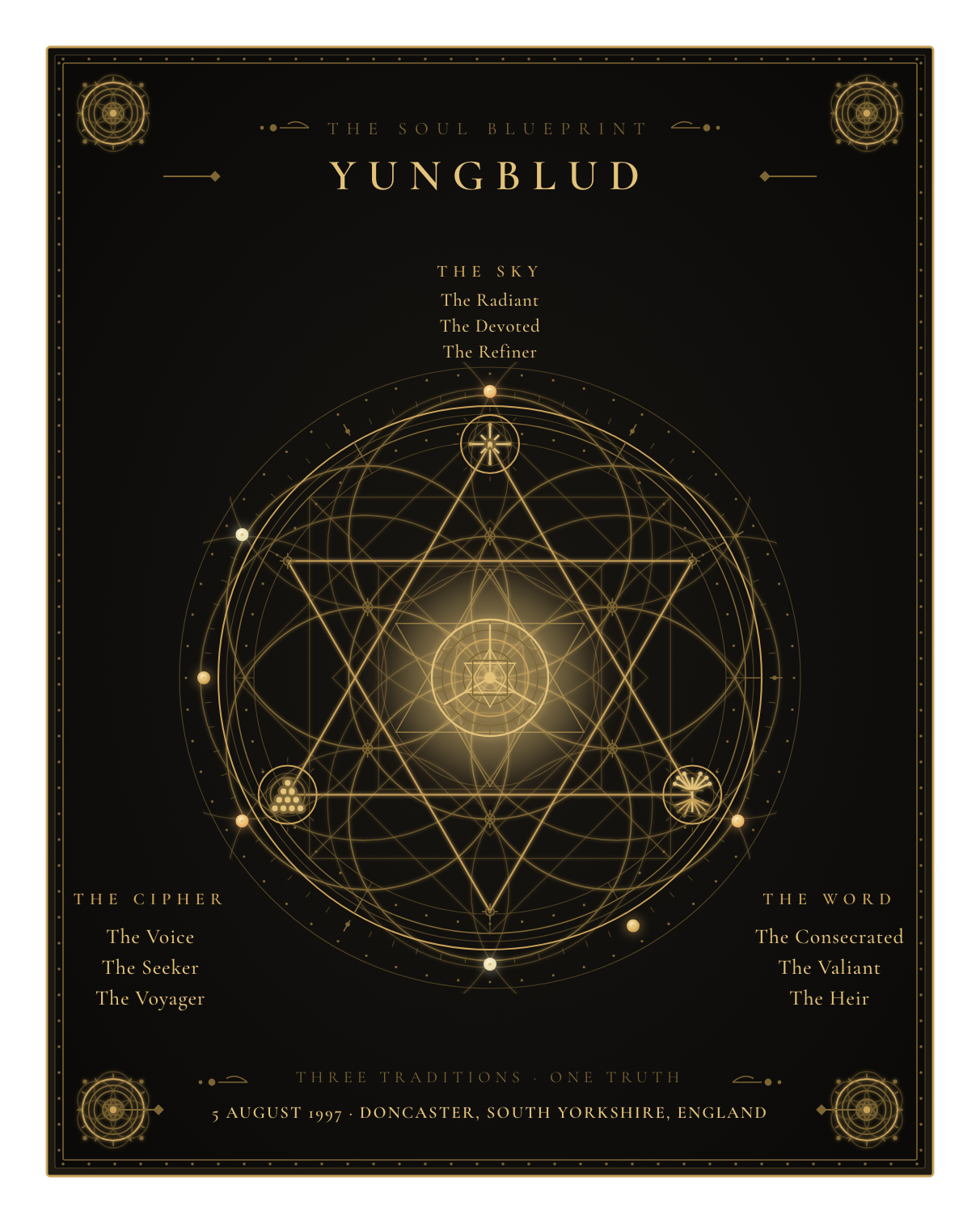
One seal, three languages. The sky he was born under at the apex, the numbers beneath his name at the lower left, the name itself at the lower right — three traditions engraved into one artifact. There is no rising sign, no houses, no angles: without a verified birth time they cannot be honestly drawn. What is true is what is shown.
At a Glance
- Full traditional name
- Dominic Richard Harrison
- Born
- August 5, 1997 · Doncaster
- Sun
- Leo 13.1° — the essential fire of the life
- Rising
- Birth time unverified — the Ascendant is offered conditionally, never asserted
- Moon
- Virgo 6.3° — the inner life
- Mind · Value · Will
- Mercury Virgo · Venus Virgo · Mars Libra
- Discipline · Direction
- Saturn Aries · North Node Virgo
- Life Path
- 3 — The Communicator
- Title-name Destiny
- 7 — The Seeker
- Birth-name Destiny
- 5 — The Free Soul
- Master Numbers
- None preserved at the final layer
- Soul archetype
- The Seeker who lives the Communicator’s path
In the spring of 2018, on a stage in Washington, D.C., a young man stood holding a microphone in the bright March light, his face turned toward thousands of other young faces, and he chose to broadcast live into the world what he was seeing—the grief, the anger, the refusal to accept that children should die while adults debated. The camera caught him there, trembling slightly, not performing but testifying, and what moved through that moment was not a rehearsed gesture but something raw: a soul determined that his voice, however new and unproven, would not remain silent when the world needed it to speak.
The world calls him Yungblud, sees the provocative name and the incandescent stage presence and reads him as a brand, a generation’s voice, a musician. But beneath that reading—beneath the carefully assembled public figure—runs a deeper current: a soul who came alive precisely because something in him refuses the boundary between art and witness, between song and service, between who he is in the hidden room and who he is in the burning light of the world’s gaze. The fragments the world calls them are always a river’s surface; what we read here is the source.
This reading turns toward that source—not the chronology of releases and accolades, but the blueprint itself, the arrangement of forces that made him arrive as he did, the inheritance he walked into, the wounds that became his qualifications, the calling that pulled him forward through the dark seasons. It reads not the persona but the soul underneath, the one who learned early that clarity was a kind of mercy and that his voice had work to do.
What follows is a reading of his essence—the architecture of his becoming.
The reading moves through the eight chapters of the Soul Blueprint architecture — The Arrival, The Soul’s Inheritance, The Living of It, The Soul’s Calling, The Soul’s Territories, The Name You Carry, The Moment, and The Invitation — and at the end, the same instrument turns gently toward you.
His soul has a blueprint.
So do you.
The same three languages — the sky, the numbers, the name — are waiting in your own.
The Arrival
He arrived as a soul whose nature is to become luminous by the act of bringing something to life—a Leo Sun in its own domicile, the self that comes alive through creative expression, through the outward projection of the ‘I am,’ through the drive to make something that did not exist before and to be recognized in that making. But this was not the Leo of ego alone; the chart arranged itself around a different kind of fire: a Virgo Moon and Mercury and Venus all concentrated in the same sign—a clustering of planets in the domain of precision, clarity, and truth-telling. So he arrived as a paradox: a soul built for radiance and recognition, but ordered internally by an exacting need for what is true. The dramatic exteriorization of his personality came with a reigning need for clarity and for saying the exact right thing, in the exact right way, to the exact right person. His generosity—the Leo warmth that gives life to others—expressed itself through service and discrimination, never through flattery or fakeness. This is a soul who came alive both by shining and by getting it exactly right, both by creating beauty and by refusing the false note. The paradox itself is the signature: a fire that burns clean, a performer who is also a truth-seeker, an artist whose gift includes the capacity to see precisely what is and is not so, and to say it.
The Soul’s Inheritance
He was born into the late twentieth century at a hinge point in culture—into 1997, into a moment when the boundaries between image and reality, between public and private, were beginning to dissolve before anyone had language for what was happening. Doncaster, South Yorkshire, gave him a particular kind of English inheritance: industrial roots, working-class earth, a place that had seen its own transformation and carries in its stones the memory of labor and survival. He came into a family with both parents present and younger sisters—a household that contained him, held him, asked things of him. Very early, something in his nervous system registered as different: the diagnosis came of ADHD, a mind that did not fit the standard containers, a body that could not sit still for the prescribed rhythms of the classroom. This was not a crisis—it was a signature, a sign that he was wired differently, that the regular methods would not teach him, that he would have to find his own way through. The education system he encountered treated this as a problem to be solved, a troublemaker to be corrected, rather than a different kind of mind to be understood. So he inherited, early, a double knowledge: that he was built for something other than what was being offered, and that the world would require him to prove that what was different in him was not less, but more.
The Living of It
The living of it meant carrying the weight of a mind that moved too fast and too many directions at once, in institutions designed for stillness and compliance. He moved through performance—acting came before music, a way of channeling the fire into a form that had permission to be dynamic, to move, to create. But the real education came when he broke the frame: suspended from school after refusing the invisible contract that demanded he shrink himself. That moment—mooning the mathematics teacher, a gesture of pure refusal—cost him something: the official path, the approved trajectory, the reassurance that he was on the right track. What it gave him was clarity about what he was not, and therefore the beginning of knowledge about what he was. The diagnosis of ADHD, the diagnosis of depression, the attempted suicides that came later—these were not separate from his genius but part of the same architecture, the same nervous system learning to metabolize a world that was too loud, too fast, too contradictory. The Virgo planets all demanded order, demanded that he understand his own mind with precision, that he develop the discrimination to know which invitations were true and which were noise. The cost was the internal work of clarity—learning not to escape into the boundlessness his soul had inherited as a shadow, but to build steady structures that could hold him. The qualification it gave him was this: the capacity to speak to others who also did not fit, who also moved differently, who also refused the false note.
If this is what was true for him, what might be true for you?
The Soul’s Calling
He arrived with a voice that needed precision—not the precision of a technician hiding behind coolness, but the precision of someone who had learned, through the rigour of his own discernment, to say exactly what was true and nothing else. The mind that lives by clarity and exactitude, that refuses the fuzzy and the decorative, finds its purpose in speaking the thing as it is. This was not oratory for its own sake, nor the theatrical projection of a self who simply wished to be seen; this was the voice of one who had been schooled—by temperament, by inheritance, by the soul’s own direction—in the art of getting the word right, of making language do the work it was meant to do.
The calling that moved through him was the calling of the Communicator—the one born to translate the interior into the shareable, to build bridges between what cannot yet be said and what must be said. Not a preacher, but a precise witness. Not a performer performing, but a truth-teller whose medium happened to be sound, image, the stage. He was born into a lineage of three—the Seeker (the public self, forever questioning), the Free Soul (the birth-name self, restless and untamed), and the Communicator (the life-long direction)—and these three met in the same demand: say what matters, say it clearly, say it so that the one who hears knows they are not alone in the knowing.
His voice was his inheritance and his work. To speak the unspeakable with such precision that it becomes, suddenly, utterly speakable—that was the labour assigned to him, the gift he carried into every threshold he crossed. The word, wielded as a weapon of truth and as a balm.
The Soul’s Territories
Music became the first territory—not as a career destination, but as a language, a way of making the internal audible, of translating the fire and the precision into sound. In this territory he learned that a song could hold multiple truths at once: it could rage and whisper, break and repair, speak to the masses and address the solitary listener in their room at three in the morning when they could not sleep. The album became his form, the sustained work that required him to return again and again to the question of what was true. Witness became the second territory—the capacity to be present at moments of collective suffering or demand, to show up with his body and his attention, not just his words. At the March for Our Lives rally, at the George Floyd protests, standing with Halsey and offering first aid—this was not performance but presence, the Leo warmth expressed as devotion to what was actual and breaking. This territory asked him to leave the insulation of the stage and step into the uncontrolled immediacy of the street. Vulnerability became the third territory—his own and others’. By naming his ADHD, his depression, his attempts at suicide, by speaking about being pansexual and polyamorous when the culture offered no easy language for those truths, he created a space where others could speak what they had been forced to hide. This was not confession for its own sake but permission-giving, the use of his own exposure to crack open the sealed rooms where people carried their solitude. Each territory revealed something: that his fire was not self-directed but service-directed, that his precision was not coldness but a way of honoring what was real, that his voice had more power when it was broken open by encounter with actual pain.
There are twelve domains in the kingdom of any life: The Mark, The Unfolding, The Unseen, The Long Return, The Inheritance, The Encounter, The Alchemy, The Living Tension, The Sight, The Body’s Knowing, The Crossing, The Calling.
The Name You Carry
Dominic Richard Harrison—the birth name carries its own weight, each word a kind of threshold. Dominic holds the root of dominion, of the sovereign will, but it is a name that has been worn by saints, by men who walked toward what terrified them and stood firm. Richard carries the strength and the counsel—the hard rule, the one who advises—but it is also a royal name, a name that expects something of its bearer. Harrison is the patronymic, the inheritance, the father’s line made into identity. Three names stacked like shelves of expectation. The public name, Yungblud, is a reversal and a claiming: young and blood, the vitality and the ancestry both present, both alive, neither separated from the other. It is a name that refuses the false split between innocence and knowledge, between the brightness of youth and the knowing that comes through wound. The name itself performs the integration that the chart demands—the Leo fire burning clean through the Virgo precision. Where the birth name speaks obligation and inheritance, the chosen name speaks alive-ness, the refusal to be merely dutiful, the insistence on being felt and vivid and real. To choose one’s own name is to assert: I am not only what I was given; I am what I have remade myself into. That assertion is the core of his architecture.
The Moment
In the winter of 2020, in the space between one album and the next, while the world was closing down and isolation became universal, Yungblud moved through a season of breakthrough and dissolution simultaneously. The ‘Weird!’ album had reached the pinnacle of the UK charts—the thing he had made had arrived at the place the culture measures as success. But success in a pandemic, success in a locked room, success in a moment when performance itself became impossible, is a strange and hollow thing. It was in that season that he spoke the truth he had been carrying: that he had attempted suicide, not once but twice, and that those attempts had come in the midst of what the world might have read as triumph. The moment of revelation was not strategic; it was a breaking-open, a refusal to let the false narrative stand that success equals safety, that being seen equals being whole. This was the threshold moment: the Leo fire that had driven him to shine encountered the Virgo clarity that demanded he speak the truth underneath the shine. The moment held no redemption arc, no neat resolution—it simply named what was so, the contradiction that one soul could create beauty for thousands while also carrying the weight of wanting to disappear. What it revealed was that his art was not separate from his struggle but woven through it, that the voice that could speak to others’ pain because it had lived that pain at the edge of ending. The season did not cure anything, but it opened a door: the permission to be broken and alive at the same time, to say the beautiful thing and the terrible thing in the same breath.
The Invitation
Everything in this reading has been moving toward a single point. The doubleness named in the first chapter, the inheritance, the wound, the calling, the territory, the name, the moment. These are not seven separate truths about Yungblud. They are one truth, named from seven different angles. And they all converge here.
The invitation arrived not as whisper but as rupture—a breaking open of the self that had learned, from childhood onward, to move too fast, to escape into the next thing, the next stage, the next borrowed identity. The soul born into the restlessness of the Free Soul archetype—the five that speaks in tongues of liberation and refusal—had been given a particular assignment: to learn the difference between freedom and flight, between the breaking of chains and the dissolution of form itself.
What was being asked of Dominic Richard Harrison in his earliest years was almost impossibly precise, though no one named it so: to develop the capacity to discriminate—to look unflinchingly at what was true and what was performance, what served and what merely entertained, what was his own voice and what was an echo borrowed from the stage or the screen or the cultural machinery that had raised him. The mind arrived crystalline and exact, built for analysis and the surgical removal of lies; the emotional nature came wired for clarity and usefulness, for the steadied heart that feels most alive when it is seeing truly. Yet the outer world—the creative industries, the escape routes, the permission structures—kept offering him the opposite: the glamour of the unexamined role, the safety of the persona that looked like freedom because it could change costumes nightly.
So the invitation took the form of a calling toward something he had to build, not merely perform. The actor’s life—the shedding of identities as though they were costumes—began to feel like a form of drowning. And then came the music, the voice, the raw exposure of singing his own words rather than embodying someone else’s script. The invitation was make something that is unmistakably yours; speak it clearly; let the world hear the discrimination in you. Not the pretty version. Not the version designed to please. The version that had learned to see what others could not yet see and had the courage to name it.
What was being released was the permission to stay small, to hide the exactness behind charm, to use the diplomatic gift—the will that moves through fairness and argument rather than force—as a way to make himself acceptable rather than as a weapon for change. He carried a warrior’s spirit dressed in a peacemaker’s hands, and the invitation demanded that he stop apologizing for the fight itself. The battles he was being called to—the rallies for lives and freedoms, the speaking of truths about systems that had failed him and millions like him, the refusal to let the algorithm or the industry dictate what his art could say—these were not distractions from his music. They were his music. The invitation was asking him to stop compartmentalizing.
What was being called toward was the development of boundaries—not walls, but sacred thresholds. The soul traveling toward grounded discernment and useful service was being invited to recognize that showing up meant more than presence; it meant presence with clarity. The insomnia, the restlessness, the twice-faced brush with the void—these were not failures of his constitution but invitations to build the inner architecture that would hold him. The ADHD that had made him troublesome, unconventional, impossible to contain—this was not a defect to be medicated into compliance but a transmission to be channeled. The invitation was asking him to learn the discipline of his own will: to act with precision and timing rather than impulse, to direct the creative fire toward what actually mattered, to say no to what scattered him.
And what became available when he said yes—when he began to build the music, to name the truths, to show up for the people and the causes that demanded his particular gifts—was the discovery that sovereignty is not the same as solitude. Love, in his case, was never going to arrive as possession or merger; it was going to arrive as recognition—you know what your sacred work is—and as the companionship of those who were also building, also refusing, also speaking truly. The relationships that held, the friendships that deepened, the collaborations that mattered were all built on this foundation: I see you clearly, and I am showing you clearly what I am.
The invitation remains open. The soul is still in the becoming—still learning that the freedom he was born to carry is most alive not when he is dissolving but when he is building with exactness, when he is serving something larger than the stage, when he is willing to be precise and vulnerable in the same breath.
He was not late. He was exactly where the soul-clock said he should be. The mission had been inscribed at the threshold of his first breath. What was being asked of him, he has been walking. The naming has been done.
This Is Not Coincidence
The astrology says: Venus sits on the North Node in Virgo, the placement of love itself as the soul’s forward direction, devotion and useful service as the path of growth, the Virgin Priestess who knows her own sacred work. The numerology says: a Title Destiny of 7, The Seeker, a soul oriented toward truth and the questioning of false authority; paired with a Life Path of 3, The Communicator, the voice that must be expressed; and a Birth Destiny of 5, The Free Soul, the one who refuses captivity and conventional form. The name says: Dominic Richard Harrison, the inheritance and the obligation, layered with Yungblud, the alive blood, the refusal of separation between youth and knowledge, innocence and wound. Three entirely different languages. One truth: A soul who came to speak what others feel but cannot name, and to speak it from the ground of his own truth, his own breaking, his own refusal to be less than fully alive.
Three entirely different languages. One truth.
This is not coincidence. This is what three independent systems do when they are all telling the truth about the same soul.
The Numbers, Decoded
The numbers are computed, not intuited — each letter takes its Pythagorean value, each name reduces, and any Master Number is preserved rather than collapsed.
You have sat with the chart and the numbers and the name of another soul, and watched how a wound becomes a calling, how the place of least belonging becomes the place of greatest gift, how a life too precisely configured to be coincidence reveals itself when three independent languages are read together.
The reading you have just received was, in its outer form, a reading of his soul. But its inner form was a reading written for yours. You did not arrive without a Blueprint either. May this reading be the beginning of the reading you finally receive of yourself. May the light you carry — in whatever particular, irreplaceable form it has taken inside the specific life you were given.
Some lives carry a pattern this clear.
Yours does too.
You’ve read the shape of his soul. The same three languages — the sky, the numbers, the word — are waiting in your own name and birth date. Begin yours, free, below.
Or, when you’re ready, begin your own full Soul Blueprint reading →
Frequently Asked Questions
What is Yungblud’s birth chart?
Yungblud’s birth chart is anchored by a Leo Sun—the self that comes alive through creative expression and radiant personality. His Mercury, Venus, and Moon are all in Virgo, creating a strong emphasis on precision, clarity, and truth in his thinking, his values, and his emotional nature. Mars in Libra gives him a warrior’s will expressed through fairness and diplomacy; Saturn in Aries asks him to master the courage to act with intention rather than impulse. Because his birth time is unverified, his rising sign cannot be reliably determined, though his Sun and the strong Virgo clustering are the defining features of his chart.
What is Yungblud’s numerology?
Yungblud’s numerology shows three primary numbers: his Title Destiny is 7, The Seeker—a soul oriented toward truth and the questioning of false authority and empty forms. His Life Path is 3, The Communicator, which gives him the gift and the calling to express what is internal and make it audible and visible to others. His Birth Destiny is 5, The Free Soul, indicating a life oriented toward freedom, refusing captivity, and breaking through conventional boundaries. Together, these three archetypes describe a soul who seeks truth, speaks it, and will not be confined by false forms.
What does the name Yungblud mean?
The birth name, Dominic Richard Harrison, carries the weight of inheritance and obligation—the patronymic line, the expectation. Dominic holds roots in dominion and sovereignty; Richard suggests counsel and strength; Harrison is the father’s name made into identity. The chosen name, Yungblud, is a reclamation and an assertion: young and blood, the vitality and the ancestry both alive, neither separated from the other. It is a name that performs integration, refusing the false split between innocence and knowledge, between brightness and wounding. To choose one’s own name is an act of self-determination—a claim that one is not only what one was given, but what one has remade oneself to be.
What is a Soul Blueprint?
A Soul Blueprint integrates three independent traditions — Western natal astrology, Pythagorean numerology, and the etymology of the full birth name — into a single document written as a personal letter to the soul. When you’re ready, you can begin your own.
This reading was prepared in the lineage and methodology of the Soul Blueprint Method — Pythagorean numerology with master numbers preserved, Western archetypal astrology, and a researched etymological reading of the full name. Yungblud’s birth date (August 5, 1997) is sourced from the public record; the birth time is unverified, so the rising sign is offered conditionally and never asserted.
A Soul Blueprint reading · Astrology · Numerology · Etymology · shams-tabriz.com