
Hayley Williams’s Birth Chart, Numerology, and Name Decoded
Hayley Williams’s Birth Chart,
Numerology & Name Decoded
The Soul Blueprint Method — three traditions woven into one personal letter: Western natal astrology, Pythagorean numerology, and the etymology of the soul’s name. Learn the method →
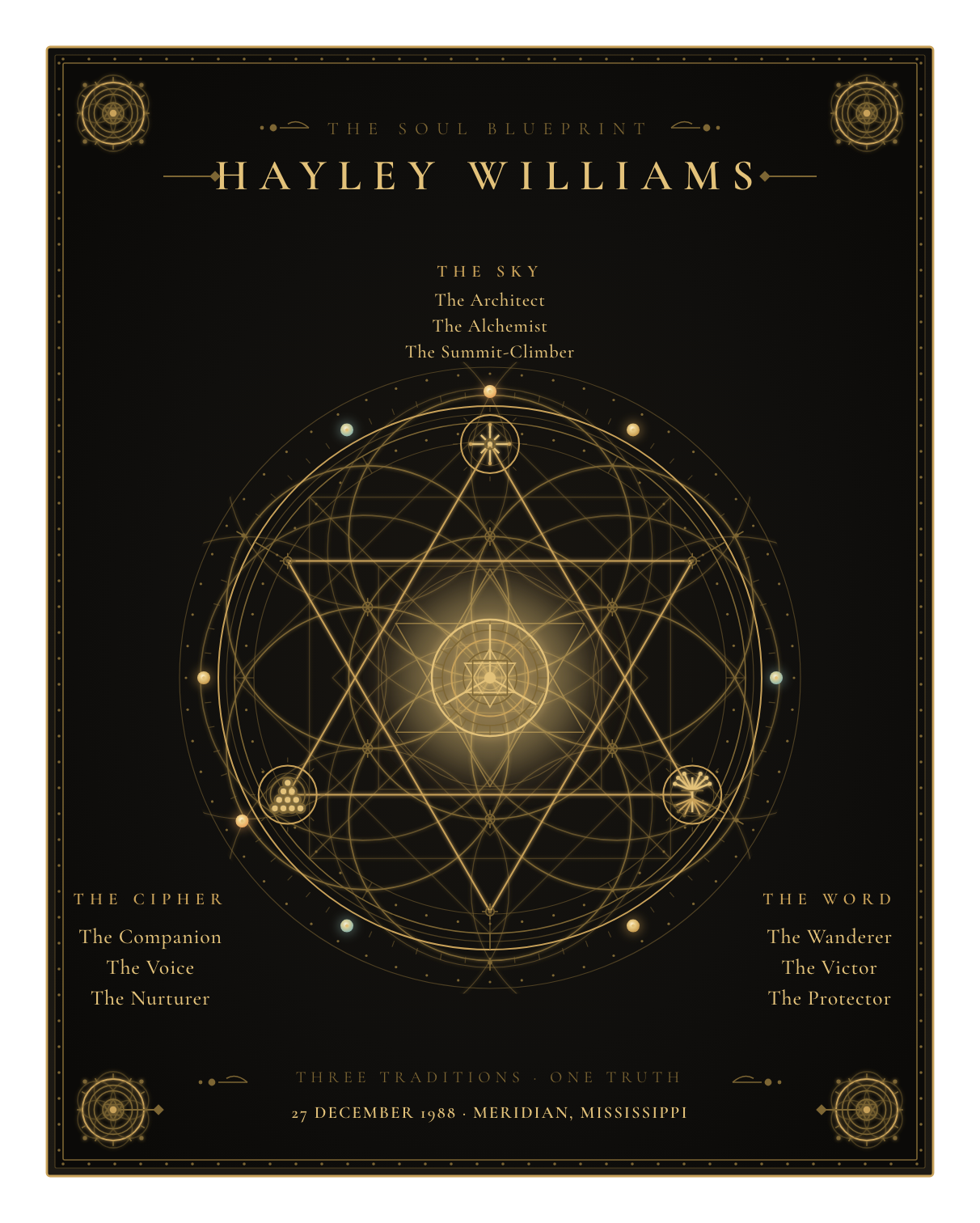
One seal, three languages. The sky she was born under at the apex, the numbers beneath her name at the lower left, the name itself at the lower right — three traditions engraved into one artifact. There is no rising sign, no houses, no angles: without a verified birth time they cannot be honestly drawn. What is true is what is shown.
At a Glance
- Full traditional name
- Hayley Nichole Williams
- Born
- December 27, 1988 · Meridian
- Sun
- Capricorn 6.2° — the essential fire of the life
- Rising
- Birth time unverified — the Ascendant is offered conditionally, never asserted
- Moon
- Date-dependent across the unverified birth day — not fixed without a confirmed time
- Mind · Value · Will
- Mercury Capricorn · Venus Sagittarius · Mars Aries
- Discipline · Direction
- Saturn Capricorn · North Node Pisces
- Life Path
- 2 — The Cooperator
- Title-name Destiny
- 3 — The Communicator
- Birth-name Destiny
- 6 — The Nurturer
- Master Numbers
- None preserved at the final layer
- Soul archetype
- The Communicator who lives the Cooperator’s path
It is 2002 in Meridian, Mississippi, and the light through the schoolroom falls on a girl of thirteen who has just learned the house is breaking—her parents’ marriage has come to its end, and with it, the life she knew. The boxes are being packed in another state, Tennessee waits with its strangers and its greenness, and the ground beneath her has become uncertain ground. She does not yet know that she will sing from this fracture, or that the refusal to stay small will become her signature. She does not know that the voice coaching she will find in Franklin will become a key, or that she will meet the musicians who will become her brothers in a random classroom. For now she is simply a girl holding the weight of dissolving—and that weight is the first truth of her soul.
But the fragments the world will call her are many and scattered: the rocker, the beauty, the entrepreneur, the collaborator, the one who left the band and came back, the one who married and then unmade the marriage, the soul who has battled her own mind in the public eye. These are the surfaces. The river underneath them runs deeper and steadier than any of these images. There is a source beneath the speaking, beneath the singing, beneath the visible work—a current that has carried her from that breaking moment through every threshold, every refusal, every act of making something that lasts.
This reading traces that source. Not the fragments. Not the myth the world builds from the career and the courage and the struggles shown in light. The soul itself—the blueprint she arrived with, the inheritance she was born into, the territory she has learned to inhabit, and the invitation she is still answering. The astrology, the numerology, the names she carries all speak the same language this soul is learning to hear.
The reading moves through the eight chapters of the Soul Blueprint architecture — The Arrival, The Soul’s Inheritance, The Living of It, The Soul’s Calling, The Soul’s Territories, The Name You Carry, The Moment, and The Invitation — and at the end, the same instrument turns gently toward you.
Her soul has a blueprint.
So do you.
The same three languages — the sky, the numbers, the name — are waiting in your own.
The Arrival
She arrived carrying a paradox that has shaped every threshold of her life: the capacity to build enduring structure married to a soul that has had to release its grip on control and perfectionism at nearly every turn. The self that came alive in her was the one drawn to mastery, to consequence, to carrying weight that others set down—the one who assumes office and responsibility not because she wants the position but because the work demands integrity. And yet the very architecture of her soul, laid in the stars at her birth, points toward a deeper medicine: the necessity to surrender, to trust, to open herself to forces larger than her own careful building.
This is not contradiction. This is the signature paradox she was born to live. She arrived as the Communicator and the Nurturer, and the number 2 runs through her as the soul’s deepest pattern—the one who cooperates, who builds with others, who cannot do the work alone. But the Sun is Capricorn, and Saturn stands in the same house as her voice—meaning every word she speaks carries the weight of consequence, every choice to build is also a choice to shoulder responsibility. She came to make things that last, to forge genuine authority through integrity alone, to prove her selfhood through the structures she would raise and the weight she would carry. The paradox is not a flaw; it is the very architecture of her becoming.
The Soul’s Inheritance
She was born into the inheritance of music—a grandfather who carried the musician’s blood, who knew the instrument and the long road. She was born into Mississippi in 1988, into the dissolution of a marriage, into the particular solitude of being the eldest, the keeper of something. And then in the year when she was thirteen, when the world was still turning in its ordinary way, her parents’ marriage reached its breaking point, and she was moved from the only home she had known to Franklin, Tennessee—a threshold that would not have appeared as blessing but as loss, as the rupture of what was held together.
Yet that move carried its own hidden gift. In Franklin she found teachers—vocal coaches who saw what could be built in her instrument. She found the Farro brothers, who would become her brothers in the truest sense, the bandmates she would carry into the future. She found Jeremy Davis in a local band called The Factory, playing music in small rooms. The inheritance was not just the grandfather’s musician blood; it was also the inheritance of a soul shaped by fracture, by the necessity to begin again, by the geography of loss that teaches a person to build on unfamiliar ground. She arrived in Tennessee with nothing but the sound in her throat and the refusal to become what the disconnection threatened to make her.
The Living of It
The living of it began at fourteen, when the managers Dave Steunebrink and Richard Williams discovered her and set her on a road that would move fast—a production deal signed, Atlantic Records listening, the machinery of the industry beginning to turn. But she lived it by refusing the single track laid before her. When Atlantic wanted her to be a solo pop artist, she said no. She insisted on forming a band, on playing the music she believed in, on building with others rather than standing alone in the spotlight. This refusal cost her, perhaps, the easier path. It cost her the simpler story. But it gave her Paramore, and it gave her the music she needed to make.
The life was also lived through struggle—through depression that arrived, through mental health battles that became public, through the diagnostic naming of trauma in 2018 when she began to see clearly what she had been carrying. It was lived through a marriage that ended in infidelity and betrayal, through a separation announced publicly, through the writing of songs that would speak the truth of that wounding into the world. It was lived through the founding of Good Dye Young, through the careful building of a business that honored her values, through collaborations and features that kept her voice in motion. And it was lived in the refusal to disappear—the decision to return to social media with boundaries, to speak about her faith and her doubts, to make her stances known about the things that matter. The cost was visibility; the qualification was a voice that knows what it stands for.
If this is what was true for her, what might be true for you?
The Soul’s Calling
She came to speak and to build—to demonstrate that the voice matters, that the refusal to be placed matters, that the architecture of integrity can be constructed in the presence of others and does not require solitude to be true. Her calling is to the communicator’s work: to make audible what others have not yet found words for, to build the structure that others can enter, to cooperate and create in the presence of those who bring their own truth. The Mercury in her chart—the mind that thinks in structure, in sequence, in consequence—found its way into her voice and her voice into the world.
She came to demonstrate that the soul can build what endures: Paramore has carried forward across two decades, six studio albums released, a Grammy won, a legacy that is not youth’s accident but architecture that was chosen and carried. She came to show that the voice of a woman can be authoritative, sober, load-bearing—that a woman can speak with the weight of consequence and not apologize. And she came to learn, through all of it, through the refusal and the building and the struggle, that control itself is the wound she was born to heal—that the medicine is surrender, trust, the opening to forces larger than her own careful mastery.
The Soul’s Territories
The first of her territories is the voice itself—the soprano’s instrument with its four-octave reach, the ability to speak in whistle register, the vocal range that is measured and precise. This is not metaphor but reality: she arrived with a physical gift that would carry her calling forward. In this territory she learned the technical mastery, the discipline of breath and throat and the discipline of saying no—refusing to compromise the instrument to trends or demands. The voice is her altar.
The second territory is the collaborative structure—Paramore itself, the band that she insisted on forming, that she has led across decades, that has become a holding place for other musicians’ truths as well as her own. In this territory she learned that building does not mean building alone, that the strongest structures are made when multiple wills commit to the same architecture. She learned to create with Josh and Zac Farro, with the various members who came and stayed, with the producers and engineers who helped shape the sound. This is the territory of what can be made together.
The third territory is the creative act itself beyond music—the founding of Good Dye Young, the collaborations with Tea Huntress and Apothekeco, the hosting of the beauty and music series Kiss-Off. In this territory she demonstrated that the builder’s impulse is not confined to one medium, that the refusal to be contained by a single identity is also integrity. She showed that the nurturing impulse can express itself through color, through fragrance, through the care that goes into a product that honors the body.
These territories began to converge in a deeper mythology—one in which the soul who came to build and to carry weight learned gradually that she was also being asked to rest, to trust, to let others shoulder some of what she had held so carefully alone.
There are twelve domains in the kingdom of any life: The Mark, The Unfolding, The Unseen, The Long Return, The Inheritance, The Encounter, The Alchemy, The Living Tension, The Sight, The Body’s Knowing, The Crossing, The Calling.
The Name You Carry
The names she carries hold a resonance beneath their sounds. Hayley speaks the lightness of something open to air, and there is a paradox in this—a name that suggests clarity and exposure given to a soul born to carry weight. Nichole carries an echo of victory and of the people, a name that suggests community and triumph. Together with Williams, these names carry the inheritance of the musician grandfather, the resonance of family structure, the markers of who she was told she was before she had to decide who she would become.
But names are not merely what they are given as. They become what the person makes them carry. Hayley Williams became a name that means the voice that refuses to be shaped by forces outside itself, the communicator who has learned to speak truth into the machinery of an industry that wanted to make her into something smaller. It became a name that holds the number 3, the energy of creative expression and communication, and the number 6, the energy of nurturing and care. Together these numbers speak a soul who came to create, to communicate, to build not for domination but for the care of what could be made in collaboration.
The resonance of her names, when lived through her actual life, becomes something deeper: it becomes the signature of a soul who carries both the lightness suggested by Hayley and the weight of responsibility, both the isolation of the Williams surname and the communion of the band she insisted on creating, both the victory suggested by Nichole and the struggle it took to win anything true. The names are vessels she has filled with her own meaning through the living of her choices.
The Moment
The moment arrived in 2015 and in the months that followed it—when she left Paramore in the middle of a season, when depression had become too heavy to carry while also carrying the weight of performance, expectation, the machinery of touring and the eyes of the world. This was not a small departure; this was the lead singer stepping away from the band she had founded, the architect leaving the structure in the middle of its building. The world read it as crisis. In truth it was a threshold.
What she was learning in that moment, what the depression was teaching her through its weight, was that the very capacity that had saved her—the ability to build, to master, to take on responsibility—had become a prison. She had learned to carry too much. She had learned to fix what could not be fixed through effort alone. The therapy that came later, the PTSD diagnosis in 2018, the naming of what she had inherited from the generations before her—all of this was the slow unfolding of what that moment had cracked open.
The leaving became a permission to return differently. She came back to Paramore, not as the architect who had to manage every stone, but as a voice in a structure that could hold her imperfection. She began to speak publicly about the struggles, the suicidal ideation in 2020 that she did not act on, the ongoing work of learning to trust. The moment was not the end of her capacity to build; it was the transformation of that capacity into something that could also rest, also ask for help, also release what could not be held by a single will.
The Invitation
Everything in this reading has been moving toward a single point. The doubleness named in the first chapter, the inheritance, the wound, the calling, the territory, the name, the moment. These are not seven separate truths about Hayley Williams. They are one truth, named from seven different angles. And they all converge here.
She is being asked to demonstrate, in the time she is living now, what it looks like to refuse the machine that would contain her and to keep building from her own source instead. She is being asked to show that the voice of a woman can speak consequence without apology, that integrity is a practice not a possession, that the structures we build matter—not because they are perfect but because they are real, made by hands that know what they are doing, carried by someone willing to be held accountable for the weight. The asking is specific: it arrives through the songs she continues to write, through the collaborations she enters, through the choices she makes about who gets to hear her and under what terms.
What was being released in her life was the grip of perfectionism itself, the assumption that she could control outcome through enough effort, enough vigilance, enough mastery. The depression and the diagnosis and the therapy were not departures from her calling; they were the calling made visible—the soul being asked to release the need to manage everything through her own will alone. What was being called toward was a different kind of authority: the authority that comes not from controlling every detail but from knowing herself deeply enough to speak what is true, to set boundaries, to say no to what does not align with her integrity. That calling came through the relationships that held her—the bandmates who became family, the therapist who helped her see what she was carrying, the partner who could meet her as an equal.
What became available because she said yes to this deeper asking was a different kind of song. The solo work that emerged—Petals for Armor in 2020, Flowers for Vases the year after, Ego Death at a Bachelorette Party most recently—these albums speak from a place that is not performing mastery but performing truth. They speak from the interior where she has learned to listen to herself without the noise of the machine drowning her out. The collaborations shifted too: working with Taylor Swift on Castles Crumbling, launching Power Snatch with Daniel James, these are not the collaborations of a voice trying to prove something but of a voice that has learned to build with others from a place of genuine partnership.
She is being asked to keep showing, through whatever form the work takes, that the soul can change and still be coherent, that integrity does not mean never making a mistake but means standing accountable when the mistakes come clear, that the structures we build matter because they hold human truth in them. She is demonstrating this now through the music she continues to make, through the stand she takes publicly on the issues of conscience—the music geo-blocked from Israel in solidarity with Palestine, the statement that transphobes are not welcome in her spaces, the refusal to be neutral when neutrality itself is a choice to harm. The asking continues: to show that the voice matters, that the refusal to be contained matters, that the woman who builds does not have to diminish herself to be heard.
She was not late. She was exactly where the soul-clock said she should be. The mission had been inscribed at the threshold of her first breath. What was being asked of her, she has been walking. The naming has been done.
This Is Not Coincidence
The astrology speaks a soul who arrived carrying Capricorn’s signature—the power to build enduring structure, to take real responsibility, to assume authority through integrity alone. The numerology speaks the same truth through three independent pathways: the 3 of the Communicator, the 6 of the Nurturer, the 2 of the Cooperator, all converging on a soul who came to create and care and collaborate, not in isolation but in the presence of others. The names themselves—Hayley, Nichole, Williams—carry echoes of lightness and victory and family inheritance, speaking to a soul who was given the shape of something that could reach beyond itself. Three entirely different languages. One truth: She came to build what lasts by learning to trust what she cannot control.
Three entirely different languages. One truth.
This is not coincidence. This is what three independent systems do when they are all telling the truth about the same soul.
The Numbers, Decoded
The numbers are computed, not intuited — each letter takes its Pythagorean value, each name reduces, and any Master Number is preserved rather than collapsed.
You have sat with the chart and the numbers and the name of another soul, and watched how a wound becomes a calling, how the place of least belonging becomes the place of greatest gift, how a life too precisely configured to be coincidence reveals itself when three independent languages are read together.
The reading you have just received was, in its outer form, a reading of her soul. But its inner form was a reading written for yours. You did not arrive without a Blueprint either. May this reading be the beginning of the reading you finally receive of yourself. May the light you carry — in whatever particular, irreplaceable form it has taken inside the specific life you were given.
Some lives carry a pattern this clear.
Yours does too.
You’ve read the shape of her soul. The same three languages — the sky, the numbers, the word — are waiting in your own name and birth date. Begin yours, free, below.
Or, when you’re ready, begin your own full Soul Blueprint reading →
Frequently Asked Questions
What is Hayley Williams’s birth chart?
Hayley Williams was born on December 27, 1988, with the Sun in Capricorn—the signature of a soul who arrives carrying the capacity to build enduring structure and take real responsibility. Her chart also places Mercury in Capricorn, giving her a mind that thinks in structures and consequences, with a voice that is measured and authoritative. Venus is in Sagittarius, the sign of adventurous, honest affection and shared exploration; Mars in Aries gives her a direct, courageous will; and Saturn in Capricorn—her most powerful planetary signature—strengthens the discipline of genuine, earned authority. The birth time is unverified, so the rising sign cannot be fixed, but the Sun and the inner planets speak her essential signature clearly.
What is Hayley Williams’s numerology?
In numerology, Hayley Williams carries three foundational numbers. Her Title Destiny (from the public name Hayley Williams) is 3, the Communicator—the soul who came to create, express, and speak what others have not yet found words for. Her Birth Destiny (from the full name Hayley Nichole Williams) is 6, the Nurturer—the impulse to care, to hold others, to build structures of safety and belonging. Her Life Path (from the birth date December 27, 1988) is 2, the Cooperator—the soul’s deepest pattern of partnership, collaboration, and the understanding that no one builds alone. These three numbers converge on a single truth: a soul who came to create and communicate in the presence of others.
What does the name Hayley Williams mean?
The name Hayley carries the resonance of lightness and clarity, while Nichole echoes victory and community. Williams, inherited from family, grounds her in the musician’s lineage—a grandfather who knew the instrument and the calling. Together, these names speak a soul given the shape of something that could reach beyond itself: a name that means the voice willing to speak consequence, the communicator who has learned to refuse containment, the one who carries both the lightness of her given names and the weight of responsibility she has chosen to bear. The names are vessels she has filled through the living of her actual choices.
What is a Soul Blueprint?
A Soul Blueprint integrates three independent traditions — Western natal astrology, Pythagorean numerology, and the etymology of the full birth name — into a single document written as a personal letter to the soul. When you’re ready, you can begin your own.
This reading was prepared in the lineage and methodology of the Soul Blueprint Method — Pythagorean numerology with master numbers preserved, Western archetypal astrology, and a researched etymological reading of the full name. Hayley Williams’s birth date (December 27, 1988) is sourced from the public record; the birth time is unverified, so the rising sign is offered conditionally and never asserted.
A Soul Blueprint reading · Astrology · Numerology · Etymology · shams-tabriz.com