
Jenna Ortega’s Birth Chart, Numerology, and Name Decoded
Jenna Ortega’s Birth Chart,
Numerology & Name Decoded
The Soul Blueprint Method — three traditions woven into one personal letter: Western natal astrology, Pythagorean numerology, and the etymology of the soul’s name. Learn the method →
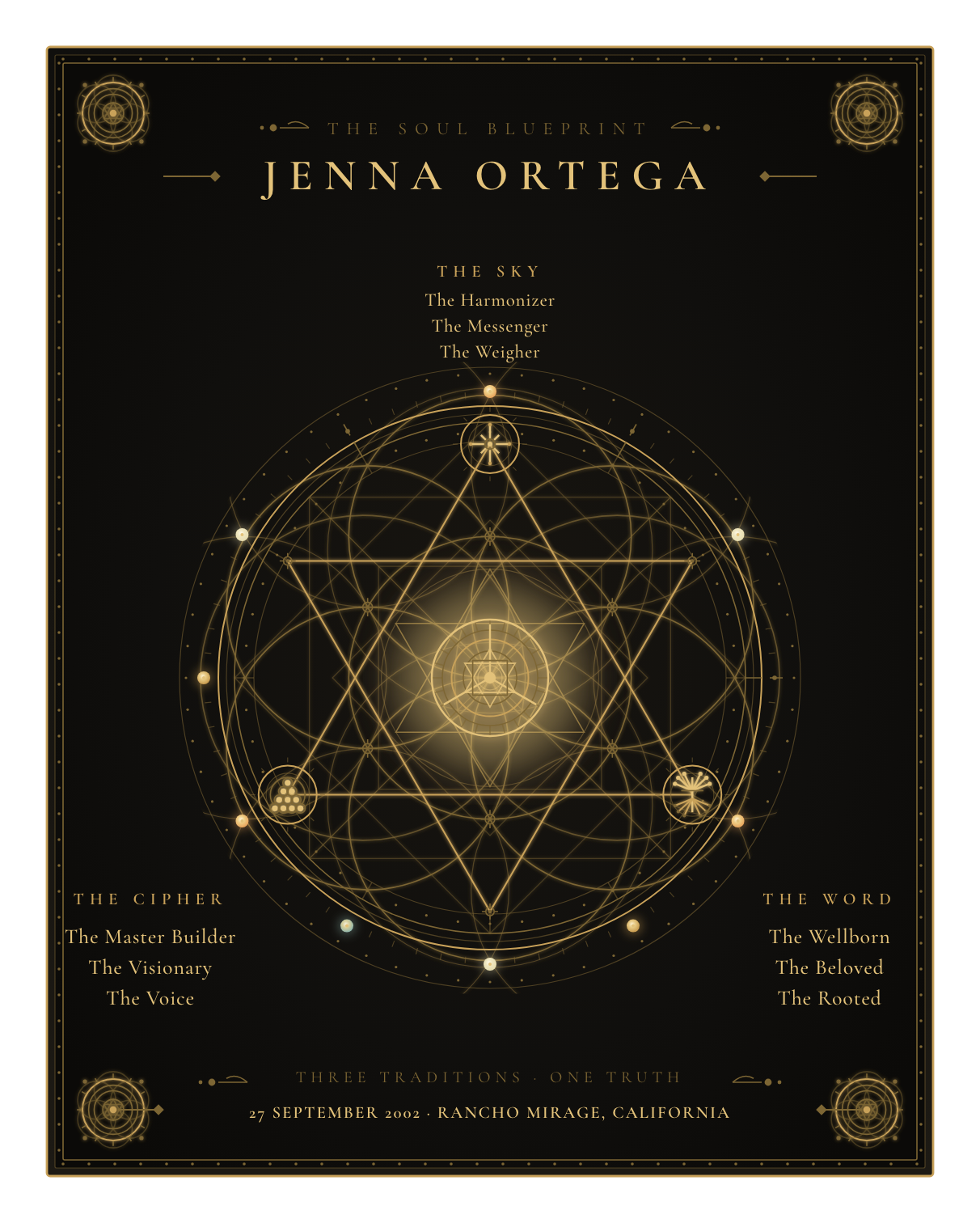
One seal, three languages. The sky she was born under at the apex, the numbers beneath her name at the lower left, the name itself at the lower right — three traditions engraved into one artifact. There is no rising sign, no houses, no angles: without a verified birth time they cannot be honestly drawn. What is true is what is shown.
At a Glance
- Full traditional name
- Jenna Marie Ortega
- Born
- September 27, 2002 · Palm Desert
- Sun
- Libra 4.5° — the essential fire of the life
- Rising
- Birth time unverified — the Ascendant is offered conditionally, never asserted
- Moon
- Gemini 12.4° — the inner life
- Mind · Value · Will
- Mercury Libra · Venus Scorpio · Mars Virgo
- Discipline · Direction
- Saturn Gemini · North Node Gemini
- Life Path
- 22 — The Master Builder
- Title-name Destiny
- 11 — The Illuminator
- Birth-name Destiny
- 3 — The Communicator
- Master Numbers
- 11, 22
- Soul archetype
- The Illuminator who lives the Master Builder’s path
She sits in a Los Angeles apartment that is not quite hers yet — a place she moved into after booking the role that would change everything, a room still arranged in the temporary style of someone who arrived at nine years old with a monologue book and a mother’s faith. The light comes through windows that face west, the California light that flattens time, and in that room she reads script pages and becomes other people — becomes the younger version, the girl who survives, the scream that comes from a place the body knows before the mind catches up. She has learned to live in the space between her own breath and the character’s breath, a skill that would cost her more than she knew.
The world sees fragments: the scream queen, the girl who wore Wednesday’s uniform, the young actress who rose too fast and spoke too clearly about the camera’s demand. These fragments are the river’s surface — the light breaking across current, the foam and splash that catches the eye. What the world calls her and what moves beneath are not the same. Beneath is a soul that arrived knowing something the industry would try to erase: that the self is not a fixed thing but a meeting-place, that identity lives in the reciprocal act of touching the other and being touched in return, that the gift is not to be yourself but to become yourself through relationship, through stepping fully into the Other’s kingdom and discovering there is no border.
This reading reads the source. Not the fragments, not the public record, not even the roles that made her name recognizable — but the blueprint she was born carrying, the inheritance she could not refuse, the territories her soul came to live inside. The bones beneath the light.
We are reading the soul that came to meet the world, not the world’s reading of that soul.
The reading moves through the eight chapters of the Soul Blueprint architecture — The Arrival, The Soul’s Inheritance, The Living of It, The Soul’s Calling, The Soul’s Territories, The Name You Carry, The Moment, and The Invitation — and at the end, the same instrument turns gently toward you.
Her soul has a blueprint.
So do you.
The same three languages — the sky, the numbers, the name — are waiting in your own.
The Arrival
She arrived at the threshold carrying a paradox the industry would spend years trying to flatten: the self that knows itself only by meeting the other fully, completely, without reservation — a soul built for relationship as the primary act of being alive, yet handed a profession that demands she disappear into relationship after relationship and still maintain the integrity of her own center. The Sun in her chart speaks a truth that contradicts the usual shape of celebrity: identity is the birth of the individual unit into the Greater Whole, that the self becomes recognizable not through assertion but through meeting, through the conscious act of taking one’s place as a necessary part of something vastly larger.
This is the gift and the wound she was born carrying. She did not come here to be a star burning alone in an orbit of her own light. She came here to demonstrate what it means to merge — into situation, into character, into the emotional texture of a scene — and still be held upright by something in her that knows the difference between disappearing and surrendering.
The paradox arrived as an invitation dressed as a problem: how to be the one who enters every room ready to meet what is there, without losing the quiet intelligence that knows herself? How to give everything and still know where she ends? This is the essential shape of her arrival — not the question of whether she could act, but whether she could survive the peculiar loneliness of a gift built for merging in a world that demands you merge for an audience that will never truly know you.
The Soul’s Inheritance
She was born into the Coachella Valley of California in a family of borders and crossings — a father who works the law, a mother who tends the wounded in emergency rooms, and behind them a maternal lineage that crossed continents and made new language from survival. Her maternal great-grandmother arrived without documentation, carrying what could not be written down, and her maternal grandfather relocated from Puerto Rico through the Bronx before settling in the Western United States, moving the entire spine of American geography through one family’s bodies.
This is the inheritance: people who know how to show up when it matters, who do not retreat from the difficult thing. Her mother demonstrated this when she bought her daughter a monologue book and posted a video online when she was only a child — an act of faith so quiet it barely registered as risk. Her mother drove six hours round-trip from home to Los Angeles as often as five days each week so her daughter could pursue roles in an industry that would not make space for her face.
She was born into a world where her appearance — her dark hair, her inheritance — was coded as the wrong shape for the parts that existed. She was born into an era beginning to shift, but not yet shifted enough. She was born into a family that did not ask her to diminish herself to fit, even as the entire machinery around her suggested that was the only path available. The family held her upright when the industry tried to convince her to erase what she was. This is what she inherited: not permission, but insistence. Not ease, but a mother’s willingness to drive impossible distances. Not certainty of success, but the bones of people who would not break when they bent.
The Living of It
The living of it began at six years old when she watched another girl move through a film and knew — knew — that she wanted to be what that girl was, a performer who could carry a story and transform space. She begged for three years before her mother believed her, before anything shifted. Three years is a long time in a child’s determination.
What it cost was the ordinary arc — she stopped attending public school during eighth grade, traded the unmapped country of adolescence for the precise, supervised environment of set work and Los Angeles apartments and a career that was always, always being evaluated. The wound was precise: in the early years, she struggled to land roles because few existed for Latinas, and the ones that did required a specific shape of body and face that was not her shape. She was told, without words and in words, that she was the wrong version of herself. She considered dyeing her hair blonde. She considered, more than once, that quitting was the more honest response to an industry that did not want what she was.
What the wound became was qualification — a precise, unsentimental understanding of what it means to refuse erasure, to be told repeatedly that you are not enough and to keep showing up as yourself anyway. The wound taught her to watch closely, to notice when she fit and when she did not, to develop an eye that could read a room with clarity. Most of all, it taught her the particular loneliness of knowing your own gift is real while the world systematically suggests otherwise. By the time she was old enough to be considered for the roles that would change everything, she had already survived the hardest part: the interior conviction that she belonged, despite having been told she did not.
If this is what was true for her, what might be true for you?
The Soul’s Calling
Her calling arrived not as a single voice but as a recognition that moved through her early work like a signature — the capacity to understand what a character needs to communicate and to find the precise, economical gesture that carries it. Her intelligence is relational and fair-minded, built to hold multiple perspectives in balance and find the true middle ground between extremes — she does not assert her way into a scene, she enters it and allows the scene to teach her what shape to take. Mercury in her chart moves as a diplomat and mediator, a Hermes who knows how to make connections visible and name them clearly.
She was called to demonstrate what it means to communicate not through volume but through precision, through the exact right word or gesture offered at exactly the right moment. Her director Tim Burton saw this when he watched her read a four-page monologue via Zoom — he noted that her acting resembles silent film acting, that she expresses entire emotional narratives through her eyes, without needing words to carry the meaning. This is the calling: to make visible what usually stays hidden, to give language or gesture or presence to the interior life that most of us carry in silence.
Her voice in the world is one that speaks most powerfully when it is measured, when it refuses to inflate what is happening, when it simply names the fact: I would like to be a private person. I find this concept of celebrity absolutely ridiculous. This is not withdrawal. This is clarity. This is the calling of the soul who came here to demonstrate that identity lives in the quality of attention you bring to what is in front of you, not in how loudly you announce yourself.
The Soul’s Territories
The territories where Jenna comes alive are not abstractions, but places where the soul remembers itself through action and presence.
The first is Precision and Mastery. Her will arrives not as impulse but as exact, efficient motion—a craftsperson’s hand that knows where every gesture belongs. She enters a scene and understands, immediately, what the work demands: the specific tone, the bodily truth, the line that separates performance from authenticity. This is not natural ease, but disciplined competence earned through repetition and refusal to settle for approximate effort. Her power lives in getting it right, in the quiet certainty that comes from having done the work truly well. When she moves through a character, she does not search; she executes. The body becomes a precision instrument.
The second is Communication and the Threshold Between Solitude and Contact. She holds a reigning need for genuine exchange—not surface pleasantry, but the willingness to name what is actually felt and to hear what the other person is actually saying. Her mind seeks stimulus and connection; her heart is steadied by understanding. Yet there is a discipline here too, a rigor applied to speech itself. She chooses what she speaks and what she holds back with the careful attention of someone who knows the weight of words. This territory includes her written reflections, her public voice refined through deliberation, the boundary she maintains between her inner self and the persona the world receives.
The third is Transformation Through Depth. She does not love lightly or in halves. When she commits—to a role, to a creative vision, to the people she trusts—she goes all the way into the darker chambers, unafraid of what requires complete honesty. This is where she becomes most alive: in the work that asks her to merge with something true, to strip away pretense and meet the character’s soul directly. Horror, in particular, has become her threshold into this territory—not because she chases fear, but because fear is the doorway to authenticity, and authenticity is where she finds herself most real.
These three territories weave together toward the deeper pattern: a soul called to build something that lasts, to speak truth that matters, and to refuse the half-measure in any direction.
There are twelve domains in the kingdom of any life: The Mark, The Unfolding, The Unseen, The Long Return, The Inheritance, The Encounter, The Alchemy, The Living Tension, The Sight, The Body’s Knowing, The Crossing, The Calling.
The Name You Carry
The names she carries hold frequencies that the numerology translates into recognition: Jenna, a name that arrives with the resonance of illumination — a light that breaks through, that makes visible what was obscured; Marie, carrying the root-wisdom of the sea, the mother-ocean, the source of all becoming; Ortega, a Spanish surname rooted in place-logic, in the person who lived near nettles or brambles, near the wild edge where cultivation stops and the untended world begins — speaking of someone born at a threshold, not quite inside the garden and not quite outside it.
These names together speak what the numerology confirms: a soul called to illuminate (the 11 in her Title Destiny), to communicate and express the interior truth (the 3 in her Birth Destiny), to master the foundational work and build something that lasts (the 22 in her Life Path). The names are not arbitrary — they carry the exact frequency the soul needed to arrive in this particular moment, to this particular family, to this particular work. Jenna arrives with the task of making visible; Marie arrives holding the connection to source, to mother-wisdom, to the ocean that feeds everything; Ortega arrives at the threshold, at the wild edge, the place where transformation happens because the cultivated rules no longer apply.
When she moves through the world bearing these names, she carries their full weight — not burden, but inheritance. The names are not decoration. They are the soul’s own spelling of itself, the way the Source marked her as she arrived, saying: You are here to illuminate, to communicate, to build, to live at the threshold where the wild world and the human world meet. The names are the blueprint written in language.
The Moment
The moment arrived when she was invited to audition for Wednesday Addams — the role that would remake her career and nearly undo her in the same gesture. She was hesitant. She wanted to focus on film acting, believed that a television series would trap her, that it would typecast her into the shape of a single character and lock away all the other versions of herself she had not yet been allowed to become. The fear was not irrational: the industry had already taught her that visibility narrows choice, that once you are known for one thing, the doors to other things close.
But something in the role called to her beneath the fear — not the fame that would follow, but the character itself, the challenge of taking a girl who exists in two dimensions on the page and finding the truth inside her, making her both familiar and uncanny, both deadpan and deeply feeling. She read a four-page monologue via Zoom with director Tim Burton and found something in herself she had not known was there — a capacity to express entire emotional landscapes through silence, through the exact placement of her eyes.
What followed was described by her as the most overwhelming job — constant confusion, stress, the sense of never quite understanding what was being asked of her. She changed lines because she believed the writing made no sense; she underwent a physical transformation so complete she barely recognized herself in the mirror — hair cut and dyed black, mannerisms remade, the entire architecture of her presence shifted. She became the character so thoroughly that the boundary between Jenna and Wednesday blurred, and when the show became one of Netflix’s most-watched productions in the world, when the role made her name recognizable across generations and continents, she discovered that the fear she had carried was justified: she could no longer move through the world as an ordinary person. The visibility was complete, and it was not what she had chosen. It had chosen her, and she had said yes, and the yes had erased something precious — the version of her life that could still be private, still be unmapped, still belong only to her.
The Invitation
Everything in this reading has been moving toward a single point. The doubleness named in the first chapter, the inheritance, the wound, the calling, the territory, the name, the moment. These are not seven separate truths about Jenna Ortega. They are one truth, named from seven different angles. And they all converge here.
She was being asked to carry something she did not choose and could not refuse: the weight of being seen by millions, of having her image and her face and her voice distributed across screens in homes she would never enter, generating reactions she would never witness, being interpreted by people who had access to her through film but no actual access to her, the real person living in her body. The question posed to her was absolute: Can you be remade and still be yourself? Can you become a symbol without becoming only a symbol?
What was being released in her saying yes was the ordinary life — the life where she could go unrecognized, where her choices were made in private, where she could stumble and fail and change her mind without an audience narrating the arc. She released the possibility of being unknown. She released the freedom to move through the world as an unmapped person. She released the luxury of mistakes that were hers alone to know about. This release was not gentle — she has spoken openly about the discomfort of the Wednesday experience, the creatively unpleasant elements of filming it, the sense of being overwhelmed by what was being asked of her, the violation of having AI-generated explicit images of herself circulated without consent. The yes extracted a cost that cannot be undone.
What was being called toward her was a deeper task: the opportunity to demonstrate what it means to refuse to perform yourself, to resist the industry’s demand that you turn your private self into a legible product, to say clearly and repeatedly that I would like to be a private person in a world structured around the opposite principle. She was being called toward the mastery of boundaries, toward the development of a voice that could speak her own truth without needing to explain it, justify it, or make it palatable. She was being called to become a kind of model for the refusal of transparency, the insistence on interiority, the claim that not everything about you belongs to the world.
What became available because the yes was said — and continues to become available — is a platform from which to speak about what matters to her without needing permission from the industry to speak: she has used her visibility to advocate for gun control, to support immigrant and refugee communities, to speak about her own experience of anxiety and obsessive-compulsive disorder, to refuse to stay silent about ceasefire and collective suffering, to name clearly what she believes rather than performing what she thinks she is supposed to believe. The paradox of her arriving as someone built for relationship is that she is learning, in real time, how to be in relationship with millions without losing the private core of herself. She is learning to illuminate without being consumed by the light she creates.
She is learning, through each role, through each appearance, through each moment of being asked who are you? by cameras and interviewers and strangers — she is learning that the answer cannot come from outside, that no amount of being seen will settle the question. The answer lives only in her capacity to keep returning to herself, to the quiet intelligence that knows the difference between being known and being seen, to the refusal to let the visibility dictate who she is allowed to become. This is the ongoing work: to hold the light and the darkness in balance, to illuminate without dissolving, to be seen without being consumed by sight.
She was not late. She was exactly where the soul-clock said she should be. The mission had been inscribed at the threshold of her first breath. What was being asked of her, she has been walking. The naming has been done.
This Is Not Coincidence
The Sun in Libra speaks the archetype of the self that comes alive through relationship, identity born at the moment of meeting the Other and taking one’s place as a necessary part of something larger — the soul whose gift is reciprocal, whose boundaries are found not in assertion but in the consciousness of where she ends and another begins. The numerology independently arrives at the same truth: the Life Path 22 is the Master Builder, called to construct something that lasts beyond the self, the Title Destiny 11 is the Illuminator who brings light to what is hidden, and the Birth Destiny 3 is the Communicator whose work is to name and share what would otherwise stay silent — three entirely different languages speaking the same governance: a soul built to merge and illuminate without losing the center that cannot be merged away. The name Ortega carries the threshold-logic, the wild edge where the person was born to live; Jenna speaks illumination, Marie speaks source and mother-wisdom — three entirely different languages. One truth: She came here to demonstrate what it means to let the light pass through you without letting it burn you away.
Three entirely different languages. One truth.
This is not coincidence. This is what three independent systems do when they are all telling the truth about the same soul.
The Numbers, Decoded
The numbers are computed, not intuited — each letter takes its Pythagorean value, each name reduces, and any Master Number is preserved rather than collapsed.
You have sat with the chart and the numbers and the name of another soul, and watched how a wound becomes a calling, how the place of least belonging becomes the place of greatest gift, how a life too precisely configured to be coincidence reveals itself when three independent languages are read together.
The reading you have just received was, in its outer form, a reading of her soul. But its inner form was a reading written for yours. You did not arrive without a Blueprint either. May this reading be the beginning of the reading you finally receive of yourself. May the light you carry — in whatever particular, irreplaceable form it has taken inside the specific life you were given.
Some lives carry a pattern this clear.
Yours does too.
You’ve read the shape of her soul. The same three languages — the sky, the numbers, the word — are waiting in your own name and birth date. Begin yours, free, below.
Or, when you’re ready, begin your own full Soul Blueprint reading →
Frequently Asked Questions
What is Jenna Ortega’s birth chart?
Jenna Ortega was born September 27, 2002, with the Sun in Libra — the self that discovers itself through meeting and merging with the Other as a conscious part of something larger. Her Moon is in Gemini, an emotionally curious and communicative inner nature that processes feeling through conversation, naming, and the perpetual need for understanding. Her Mercury is also in Libra, giving her a balanced, fair-minded intelligence that weighs multiple perspectives and speaks with diplomacy and grace. Her Venus is in Scorpio, expressing love and value through profound emotional depth and transformative intimacy; her Mars is in Virgo, will expressed as precise, skillful, efficient action; and her Saturn is in Gemini, the Great Work being the disciplining of mind and voice. Because her birth time is unverified, the rising sign cannot be reliably determined.
What is Jenna Ortega’s numerology?
Jenna Ortega’s numerology carries three foundational numbers: her Title Destiny is 11, the Illuminator — a Master Number calling her to bring light and visibility to what is hidden or unseen. Her Birth Destiny is 3, the Communicator — the soul whose work is to express, name, and share the interior truth that lives in feeling and relationship. Her Life Path is 22, the Master Builder — another Master Number calling her to construct something foundational and lasting, to build on a scale that extends beyond the individual life. Together, these three numbers compose a soul signature dedicated to illumination, communication, and the creation of something that endures.
What does the name Jenna Ortega mean?
The name Jenna carries the resonance of illumination — light that breaks through obscurity and makes visible what was hidden. Marie roots the soul in source-logic, in mother-wisdom, in the oceanic foundation from which all becoming flows. Ortega, a Spanish surname, speaks of the person who lived at the threshold, at the wild edge where nettles and brambles grow — the uncultivated boundary between human order and the wild world. Together, the names form a complete frequency: Illumination arising from source-wisdom and rooted at the threshold where transformation becomes possible.
What is a Soul Blueprint?
A Soul Blueprint integrates three independent traditions — Western natal astrology, Pythagorean numerology, and the etymology of the full birth name — into a single document written as a personal letter to the soul. When you’re ready, you can begin your own.
This reading was prepared in the lineage and methodology of the Soul Blueprint Method — Pythagorean numerology with master numbers preserved, Western archetypal astrology, and a researched etymological reading of the full name. Jenna Ortega’s birth date (September 27, 2002) is sourced from the public record; the birth time is unverified, so the rising sign is offered conditionally and never asserted.
A Soul Blueprint reading · Astrology · Numerology · Etymology · shams-tabriz.com