
Dolly Parton’s Birth Chart, Numerology, and Name Decoded
Dolly Parton’s Birth Chart,
Numerology & Name Decoded
The Soul Blueprint Method — three traditions woven into one personal letter: Western natal astrology, Pythagorean numerology, and the etymology of the soul’s name. Learn the method →
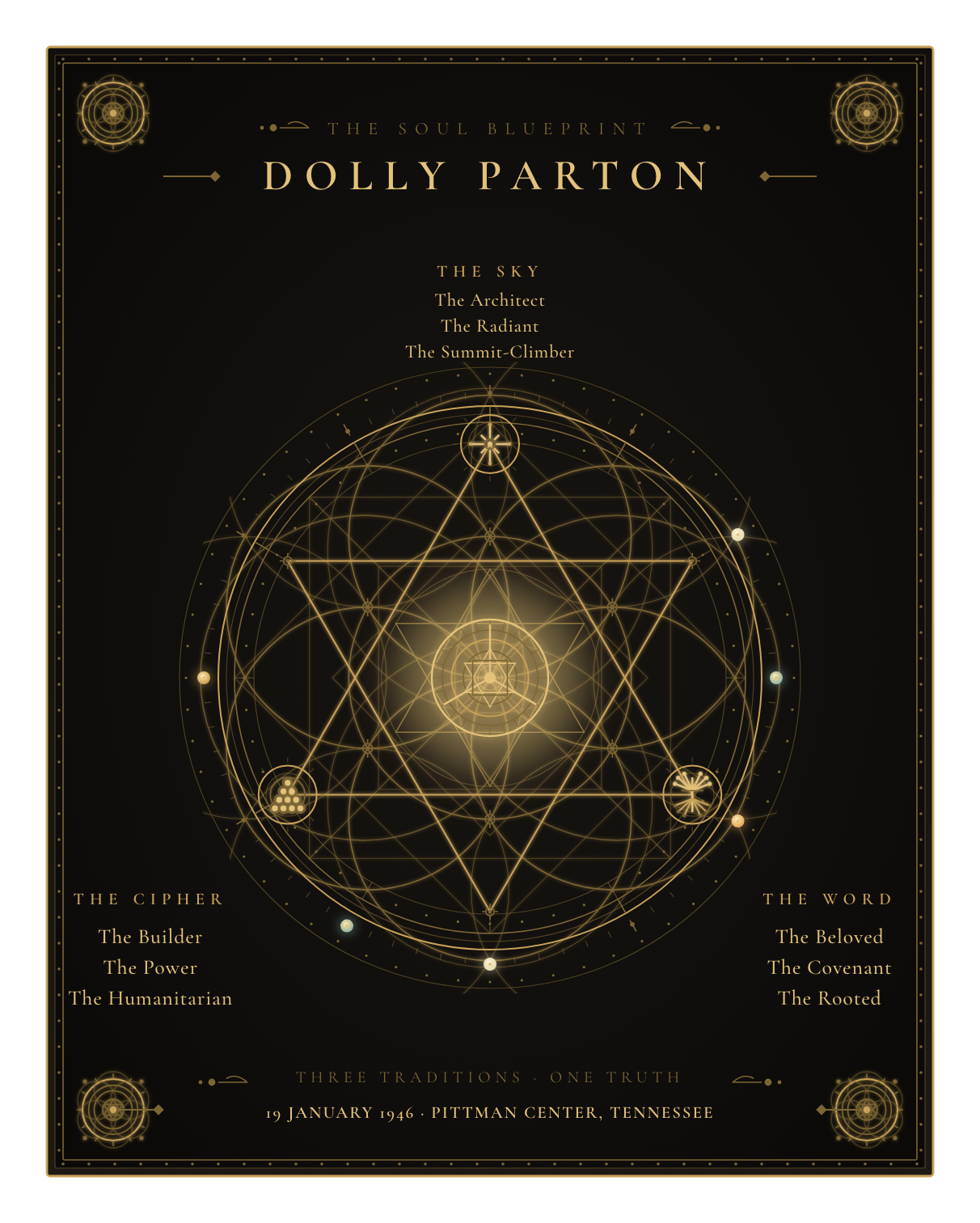
One seal, three languages. The sky she was born under at the apex, the numbers beneath her name at the lower left, the name itself at the lower right — three traditions engraved into one artifact. There is no rising sign, no houses, no angles: without a verified birth time they cannot be honestly drawn. What is true is what is shown.
At a Glance
- Full traditional name
- Dolly Rebecca Parton
- Born
- January 19, 1946 · Pittman Center
- Sun
- Capricorn 29.0° — the essential fire of the life
- Rising
- Birth time unverified — the Ascendant is offered conditionally, never asserted
- Moon
- Date-dependent across the unverified birth day — not fixed without a confirmed time
- Mind · Value · Will
- Mercury Capricorn · Venus Capricorn · Mars Cancer
- Discipline · Direction
- Saturn Cancer · North Node Gemini
- Life Path
- 4 — The Builder
- Title-name Destiny
- 8 — The Sovereign
- Birth-name Destiny
- 9 — The Humanitarian
- Master Numbers
- None preserved at the final layer
- Soul archetype
- The Sovereign who lives the Builder’s path
On a Saturday morning in Nashville, the day after she had walked out of Sevier County High School for the last time, she stood outside a Wishy Washy Laundromat and met the man who would hold her life steady for nearly fifty-nine years. The light was ordinary. The moment was not. She was eighteen, newly arrived, carrying the whole weight of twelve children’s voices in her chest and the memory of a one-room cabin where her father had taught her that profit and survival were the same argument. The world will say she is a singer, a businesswoman, a philanthropist, a theme-park operator, an actress, a songwriter who composed over three thousand songs. The world will catalogue her chart-toppers and her Grammy Awards and the hundred million records sold across the globe. But beneath those fragments—beneath the glittering persona and the carefully constructed public face—there runs a source, a single current of intention that has never stopped flowing since that morning outside the laundry. This letter reads that source. It asks: What soul arrived in that cabin in 1946, and what has it been building all this time? The eight chapters that follow turn from the surface to the underground river, from the name the culture gave her to the blueprint she came to live.
The reading moves through the eight chapters of the Soul Blueprint architecture — The Arrival, The Soul’s Inheritance, The Living of It, The Soul’s Calling, The Soul’s Territories, The Name You Carry, The Moment, and The Invitation — and at the end, the same instrument turns gently toward you.
Her soul has a blueprint.
So do you.
The same three languages — the sky, the numbers, the name — are waiting in your own.
The Arrival
The soul that arrived on January 19, 1946, came carrying the paradox of the builder under weight—the self that proves itself by taking on consequence, by standing under the load that breaks smaller people, and by transmuting that pressure into enduring form. There was no softness in this arrival. The Sun had positioned itself in a sign that knows only one language: the language of structure, of office, of responsibility so absolute it becomes a kind of grace. She did not come to be celebrated. She came to build. The signature she carried was this: the capacity to face the heaviest facts of the material world—poverty, illiteracy in her bloodline, the raw arithmetic of twelve mouths to feed—and to convert them into something that lasts. Not escape. Not transcendence. Building. The self that comes alive by taking authority over consequence and time. From the beginning, she understood that the world does not reward softness; it rewards the one who can carry weight without collapsing, who can make decisions others avoid, who can look at what is broken and ask not what it means but how to fix it. This is the paradox at her center: tender in feeling, but ruthless in structure. Capable of deep loyalty and commitment, but incapable of being moved by sentiment alone. The soul had arrived to demonstrate that the individual human personality proves itself not through charm or luck, but through office—through the assumption of real responsibility and the willingness to be held accountable for what is built.
The Soul’s Inheritance
She was born into a Smoky Mountain landscape of scarcity and song—a lineage where music and faith and the ancient ballads arrived as inheritance before any other language, and where the mathematics of survival was taught as gospel truth. Her father, a sharecropper and tobacco farmer who never learned to read, possessed an intelligence for profit and business that her mind would inherit and transform; her mother tended the voices of twelve children and kept alive the old songs, the folklore, the Pentecostal hymns that would become the bedrock of everything she would write. The maternal line carried preachers and musicians—her grandfather a Pentecostal minister, her uncle a songwriter, her aunt Dorothy Jo an evangelist who played banjo and guitar and wrote. She arrived as the fourth of twelve children in a one-room cabin on the banks of the Little Pigeon River, carrying in her blood the name of her maternal great-great-grandmother Rebecca, a lineage-keeper’s anchor. The era into which she was born—postwar America, rural Tennessee, the tail end of the Depression’s shadow—shaped her with clarity: there was no room for waste, no tolerance for those who did not contribute, no comfort in circumstance. Everything had to be made by hand or it would not exist. Her father taught her the grammar of business and consequence; her mother’s family taught her that the invisible world—the world of story and song and spiritual hunger—was as real as dirt. She inherited a world where music was not a luxury but a tool for survival, where a song could feed the soul when the body had nothing else, where the voice was proof that you existed and mattered.
The Living of It
The wound that formed her was the wound of watching her father—intelligent, shrewd, capable—broken by the fact that he could not read or write, could not claim the authority that his mind deserved, could not preserve his own stories or teachings in any form that would outlast him. She watched this and learned: the greatest cruelty is to be made powerless by circumstance, to have capacity but no means to express it. By age six she was performing in church. By age seven she was playing a homemade guitar. By age eight she held in her hands a real guitar, a gift from her uncle, and with it came the knowledge that this—this—was the instrument of escape and power. She sang on local radio by age ten. She recorded her first single at thirteen. She graduated high school in 1964 and moved to Nashville the next day. No hesitation. No looking back. The life was lived at a velocity that made others dizzy. She wrote songs with her uncle, founded a publishing company, signed record deals, joined The Porter Wagoner Show, and within a decade had begun building the infrastructure of her own empire—not asking permission, not waiting for opportunity to knock, but making decisions as if authority over her own work was hers by right. The cost was the cost of all rapid ascension: the loneliness of being the only one in the room making decisions at that scale, the burden of carrying the ambitions of a whole family’s worth of untold stories, the knowledge that softness and the luxury of doubt were luxuries she could not afford. She built the structure. The structure held her.
If this is what was true for her, what might be true for you?
The Soul’s Calling
The calling that arrived through her was the calling to speak and sing and compose with a voice so strategic, so economical, so weighted with consequence that every word became a tool—not decoration, not expression for its own sake, but architecture. Her mind understood language as structure. A song was not a feeling that happened to her; it was a blueprint she could engineer, a sequence of consequence and time laid out so precisely that it would move through the world and change it. She came to demonstrate that the voice—the Mercury voice, the strategic voice, the voice that thinks in sequences and consequences—could be a weapon and a medicine at once. She wrote ‘Jolene’ and understood that a song could strip a woman’s jealousy down to its essence and still be forgiving. She wrote ‘Coat of Many Colors’ and understood that poverty and dignity were not opposites. She wrote ‘I Will Always Love You’ and understood that a love song could be both a goodbye and a gift, both private and eternal. The calling was to prove that the mind that thinks in structure and time could speak to the deepest places in the human heart—that you did not have to choose between building and feeling, between power and tenderness. She came to teach through action that the composed word, the measured thought, the song engineered with absolute precision, could contain more truth than a thousand unexamined emotions.
The Soul’s Territories
Three territories held her alive across the decades: The Territory of Songwriting, where she proved that the strategic mind and the feeling body could speak in the same language—where ‘Jolene’ and ‘I Will Always Love You’ and ‘Coat of Many Colors’ became proof that the song could be a vessel for the whole of human longing if the architect understood how to build it. She composed over three thousand songs in a lifetime, which is to say she never stopped adding to the structure, never rested in what had been built, but kept building as if the foundation was never quite complete. The Territory of Crossover, where she refused the narrowness of category and demanded that her voice be heard across every threshold—country, pop, rock, bluegrass—because the truth she carried was not a country truth but a human truth, and it would not be contained by genre or expectation. The Territory of Giving, where she converted her wealth and authority into what the Imagination Library became—the monthly book mailed to nearly 850,000 children across five continents, a structure of generosity that addressed the wound of her father’s illiteracy by ensuring that no child born into poverty would ever be denied the gateway that reading opens. These territories were not separate. Each one was an expression of the same underlying blueprint: the builder who understands that what you build must serve not only yourself but the generations who come after, the community that held you, the wound that shaped you into the instrument of healing.
There are twelve domains in the kingdom of any life: The Mark, The Unfolding, The Unseen, The Long Return, The Inheritance, The Encounter, The Alchemy, The Living Tension, The Sight, The Body’s Knowing, The Crossing, The Calling.
The Name You Carry
The name Dolly carries in it the echo of something handmade and cherished—a doll, a beloved object, the diminutive form of endearment that suggests both smallness and the intensity of care. Yet the woman who carried this intimate, child-sized name across the world stage was anything but small. Rebecca, her middle name, the name of her maternal great-great-grandmother, means to bind and to join—to tie together what had been scattered. Her father never read his own name. Her mother’s mother carried it through generations. The name anchored her to a lineage of women who had kept things whole when the world worked to break them apart. Parton, the surname, comes from a place name—a farmstead, a settlement, a territory that belongs to no one dynasty but exists as common ground. She was born into a name that said from a place, not to a place, a name that rooted her in the soil of Appalachia as deeply as any anchor could. The three names together—Dolly, Rebecca, Parton—tell a story of smallness and tenderness bound together with generational purpose and grounded in the earth. She would become a builder, a sovereign, a woman whose authority reshaped the landscape of popular music. But the names she carried from birth spoke a different vocabulary: I am beloved. I am bound to those who came before. I am of this place. The person the world would know learned to reconcile those truths—to be both the intimate diminutive Dolly and the architect who builds empires, to honor Rebecca’s binding work while expanding far beyond it, to carry Parton’s rootedness into territories no farmer from that settlement could have imagined.
The Moment
The defining moment arrived over the span of 1973 and 1974, when she stood at the threshold between two selves and chose the one that cost more. By then she had achieved what many would call success: she was a regular on The Porter Wagoner Show, a recognized duet partner, a woman with several hit songs already recorded under a male mentor’s watchful eye. Porter Wagoner had signed her, produced her, elevated her into the spotlight. The structure was secure. But the structure was not hers. In 1974 she released ‘Jolene,’ and it moved into the country charts like a whisper that became a roar. Then ‘I Will Always Love You’—written, by some accounts, as a farewell to Wagoner, a song about letting go of what you love because you must be free. And then ‘Love Is Like a Butterfly.’ Three number-one singles in a single year. The world shifted. She had been invited to stay inside someone else’s castle, and she chose instead to build her own. By mid-1974 she was no longer appearing on Wagoner’s show. The break was professional but it was also a breaking—a refusal to remain in the position of the woman who sang the duets, the woman whose career was an appendage to someone else’s story. What the moment revealed was that she understood, with perfect clarity, that authority over her own work was not a gift to be granted by a powerful man but a right to be claimed. The cost was the severing of a relationship that had been profitable and protective. The gain was everything that came after—the crossover campaign, the movie roles, the transformation of Dolly Parton from a country singer into a force of nature that the world could not contain.
The Invitation
Everything in this reading has been moving toward a single point. The doubleness named in the first chapter, the inheritance, the wound, the calling, the territory, the name, the moment. These are not seven separate truths about Dolly Parton. They are one truth, named from seven different angles. And they all converge here.
What was being asked of this soul, from the very beginning, was whether she would build the structure that could hold both her own ambition and the ambitions of everyone who had come before her—whether she could take the untold stories of her father’s thwarted intelligence and her mother’s kept songs and her great-great-grandmother’s binding work and transform them into something enduring, something visible, something that would prove to the world that the worth of a human life cannot be measured in the circumstances of its birth. She was being asked to do the work that ordinary builders do—the masonry of a career, the architecture of a public self, the calculated decisions of a business mind. But she was also being asked to do something that only certain souls can bear: to prove, with every decision, that the person from the one-room cabin could stand in rooms with presidents and philanthropists and Hollywood luminaries and not diminish, not apologize, not shrink. What was being released was the idea that her voice belonged to anyone but herself—that she owed loyalty to a mentor over loyalty to her own becoming, that gratitude meant obligation, that a woman born into poverty was obliged to express eternal humility. By 1974, with three number-one singles in a single year and the break from Wagoner complete, she had released the story that she was someone’s duet partner. She had become her own song. What was being called toward was the discovery that she could crossover—not by diluting what she was, but by claiming it so fully that there was no resistance left, no apology, no holding back. The world had expected her to choose: country or pop, roots or ambition, loyalty or freedom. She chose all of it. She released an album in 1967. By 1981, ‘9 to 5’ was number one on country, pop, and adult-contemporary charts simultaneously—proof that the boundary between categories was not fixed, that a woman who understood structure could move through any door. What became available because the Yes was said—because she said yes to leaving, yes to building her own thing, yes to the work of becoming sovereign in her own right—was the possibility of giving at a scale that matched her capacity. The Imagination Library was founded because she had the authority and the wealth and the unwavering focus required to build it. The theme parks, the charitable giving, the Kennedy Center Honors and the Grammy Lifetime Achievement Award and the Rock and Roll Hall of Fame induction—none of these would have been possible if she had remained in the position of the woman who sang the duets. She would have been comfortable. She would have been secure. She would have been half-alive. Instead, she chose the path that required her to assume authority over her own work, to trust that her instincts—honed by a father who understood profit and a mother’s family who understood music—were sound, and to build structures that would outlast her. She is seventy-eight years old and still releasing albums. The latest arrived in 2023, a rock album featuring Paul McCartney and Elton John, proof that the builder never stops, never rests, never assumes that the work is finished. She is building still. The structure holds her still. And through her, it holds everyone who comes after.
She was not late. She was exactly where the soul-clock said she should be. The mission had been inscribed at the threshold of her first breath. What was being asked of her, she has been walking. The naming has been done.
This Is Not Coincidence
First passage: The astrology states that the Sun arrived in a sign that seeks to build enduring structures and to take real responsibility—that the self proves itself through office and consequence, through the weight it can bear. The numerology of her public name (Dolly Parton) arrives at 8, the Sovereign, the number that rules over empires and authority and the translation of human will into lasting form. The name itself—Dolly, diminutive and beloved, rooted in Parton, the farmstead—carries the paradox: smallness bound to place, yet holding the energy of the builder. Three entirely different languages. One truth: She came to prove that the person born into nothing could become the architect of empires, not by transcending her origins but by building from them. Second passage: The numerology of her birth name (Dolly Rebecca Parton) arrives at 9, the Humanitarian—the soul called to serve the many, to translate personal success into collective healing. The astrology shows Mars in Cancer, the will that protects and provides for the vulnerable, the fierce strength that defends home and family. And her Life Path, 4, is the Builder—the number that understands that sustainable change happens through structure, through patient accumulation, through the work that ordinary hands do. Three entirely different languages. One truth: She was sent to demonstrate that the greatest power is the power to serve, and that service builds the only things that last.
Three entirely different languages. One truth.
This is not coincidence. This is what three independent systems do when they are all telling the truth about the same soul.
The Numbers, Decoded
The numbers are computed, not intuited — each letter takes its Pythagorean value, each name reduces, and any Master Number is preserved rather than collapsed.
You have sat with the chart and the numbers and the name of another soul, and watched how a wound becomes a calling, how the place of least belonging becomes the place of greatest gift, how a life too precisely configured to be coincidence reveals itself when three independent languages are read together.
The reading you have just received was, in its outer form, a reading of her soul. But its inner form was a reading written for yours. You did not arrive without a Blueprint either. May this reading be the beginning of the reading you finally receive of yourself. May the light you carry — in whatever particular, irreplaceable form it has taken inside the specific life you were given.
Some lives carry a pattern this clear.
Yours does too.
You’ve read the shape of her soul. The same three languages — the sky, the numbers, the word — are waiting in your own name and birth date. Begin yours, free, below.
Or, when you’re ready, begin your own full Soul Blueprint reading →
Frequently Asked Questions
What is Dolly Parton’s birth chart?
Dolly Parton was born with the Sun in Capricorn, the sign of structure, consequence, and the assumption of real responsibility. Her Mercury (the mind) and Venus (the heart’s commitments) are also in Capricorn, reinforcing her strategic, measured intelligence and her capacity for long-term devotion and building. Mars in Cancer gives her fierce protective will—the strength that defends family and the vulnerable—while Saturn in Cancer speaks to her deep discipline in building emotional safety and security from within. Because her birth time is unverified and varies in circulation, her rising sign cannot be reliably determined and is not asserted here.
What is Dolly Parton’s numerology?
Dolly Parton’s Title Destiny (from her public name, Dolly Parton) is 8—The Sovereign, the number of authority, mastery, and the translation of will into lasting empires. Her Birth Destiny (from her full birth name, Dolly Rebecca Parton) is 9—The Humanitarian, the number of service to the many and the healing of collective wounds. Her Life Path (from her birth date, January 19, 1946) is 4—The Builder, the number that understands sustainable structure and the patient work of human hands. Together, these three numbers describe a soul sent to build empires in service of others.
What does the name Dolly Parton mean?
Dolly is a name of endearment, often meaning a beloved object, a doll-like cherishing—an intimate, smallness-suggesting form that belies the authority of the woman who carries it. Rebecca, her middle name, comes from Hebrew roots meaning to bind or join—tying together what has been scattered, anchoring her to her maternal great-great-grandmother and the lineage of women who held families whole. Parton, her surname, is a toponymic name meaning from a farmstead or settlement—rooting her identity in the Appalachian earth from which she would later build outward. The three names together speak a paradox: intimate and rooted, yet open to expansion.
What is a Soul Blueprint?
A Soul Blueprint integrates three independent traditions — Western natal astrology, Pythagorean numerology, and the etymology of the full birth name — into a single document written as a personal letter to the soul. When you’re ready, you can begin your own.
This reading was prepared in the lineage and methodology of the Soul Blueprint Method — Pythagorean numerology with master numbers preserved, Western archetypal astrology, and a researched etymological reading of the full name. Dolly Parton’s birth date (January 19, 1946) is sourced from the public record; the birth time is unverified, so the rising sign is offered conditionally and never asserted.
A Soul Blueprint reading · Astrology · Numerology · Etymology · shams-tabriz.com