
Gordon Ramsay’s Birth Chart, Numerology, and Name Decoded
Gordon Ramsay’s Birth Chart,
Numerology & Name Decoded
The Soul Blueprint Method — three traditions woven into one personal letter: Western natal astrology, Pythagorean numerology, and the etymology of the soul’s name. Learn the method →
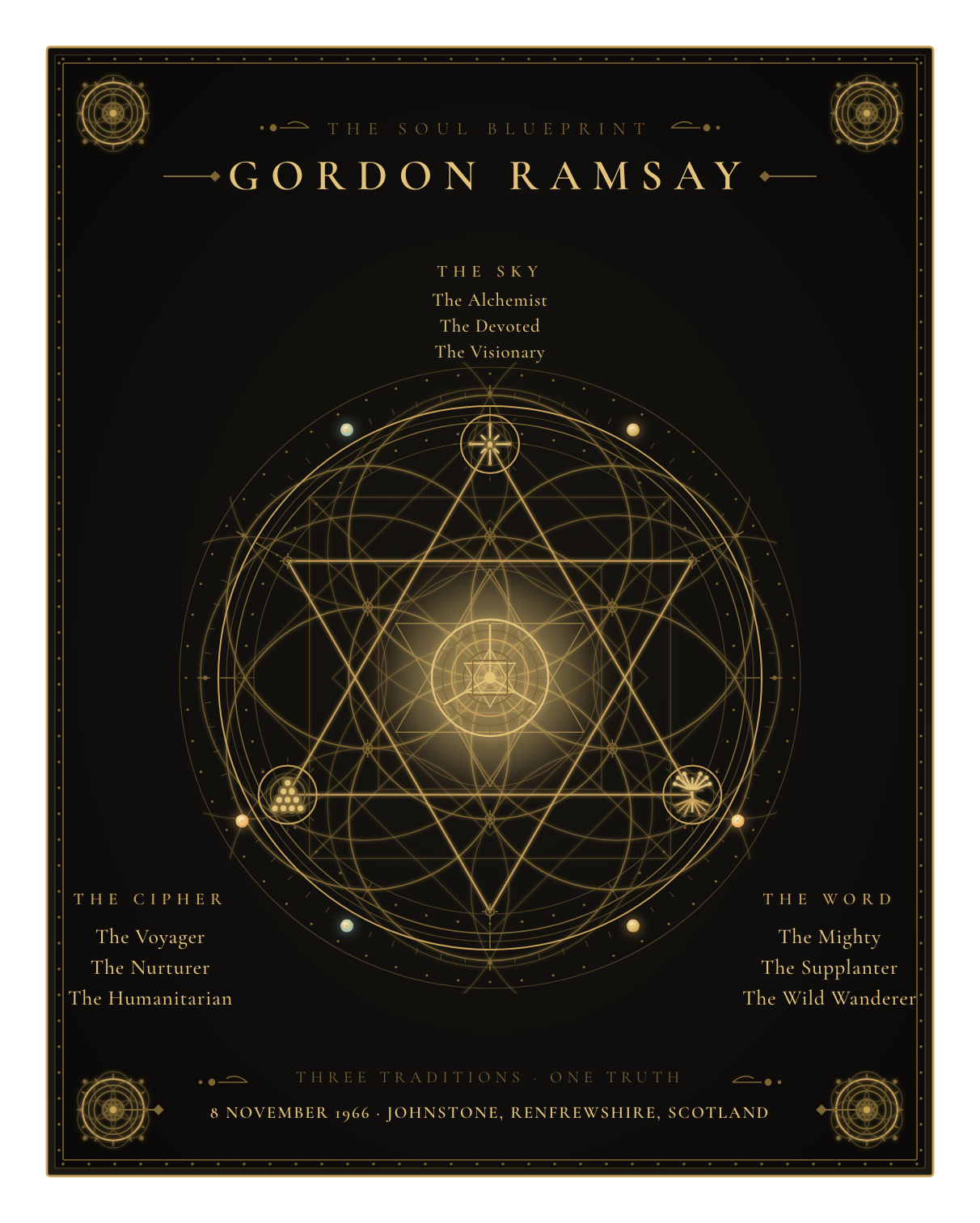
One seal, three languages. The sky he was born under at the apex, the numbers beneath his name at the lower left, the name itself at the lower right — three traditions engraved into one artifact. There is no rising sign, no houses, no angles: without a verified birth time they cannot be honestly drawn. What is true is what is shown.
At a Glance
- Full traditional name
- Gordon James Ramsay
- Born
- November 8, 1966 · Johnstone
- Sun
- Scorpio 15.6° — the essential fire of the life
- Rising
- Birth time unverified — the Ascendant is offered conditionally, never asserted
- Moon
- Virgo 19.7° — the inner life
- Mind · Value · Will
- Mercury Sagittarius · Venus Scorpio · Mars Virgo
- Discipline · Direction
- Saturn Pisces · North Node Taurus
- Life Path
- 5 — The Free Soul
- Title-name Destiny
- 6 — The Nurturer
- Birth-name Destiny
- 9 — The Humanitarian
- Master Numbers
- None preserved at the final layer
- Soul archetype
- The Nurturer who lives the Free Soul’s path
The kitchen at Chelsea in 1998 is narrow, white-hot, and absolutely silent except for the knife work—the sound of a blade meeting the board in rhythm so precise it could measure a heartbeat. Gordon Ramsay is thirty-one years old, and he has just opened his own restaurant with his own name on the door. The light through the service window is the colour of a challenge. He moves through that kitchen the way a solitary fish moves upstream, every motion calibrated, every decision his alone to make or unmake. This is the moment the world will later recognize—not the television personality, not the voice that will become famous for its edge, but the figure in the white coat, transformed utterly by the force of his own demand upon himself.
There are always two versions of a soul that arrive in the world. One is the figure the fragments of the world perceive—the temperament, the public signature, the stories told about them. The other is the source from which all the fragments flow, the deep intelligence that moved through the life before the life was photographed and narrated and simplified into personality. The first can be named and repeated. The second can only be read if one learns to listen beneath the chatter, the way a hydrologist reads not the rapids of a river but the groundwater that feeds it—the invisible current that rises from a place no map can show.
This reading reads the source. It meets Gordon Ramsay not as the figure the entertainment apparatus has made famous, but as the soul whose blueprint arrived carrying a particular signature—a transformation wrapped inside precision, an intensity that is not violent but regenerative, a mind that grasps patterns and speaks them without apology. It reads the inheritance he was born into, the defining fractures that became his most useful tools, the territories where he came alive, and the singular invitation his life has been delivering all along.
What follows is not biography prettified. It is the structure underneath the biography—the soul’s logic, the reason he was born into exactly the chaos and exactitude that shaped him, and the thing he is still becoming.
The reading moves through the eight chapters of the Soul Blueprint architecture — The Arrival, The Soul’s Inheritance, The Living of It, The Soul’s Calling, The Soul’s Territories, The Name You Carry, The Moment, and The Invitation — and at the end, the same instrument turns gently toward you.
His soul has a blueprint.
So do you.
The same three languages — the sky, the numbers, the name — are waiting in your own.
The Arrival
The soul that arrived in November 1966 carried a paradox that would define every threshold of his life: the burning need to merge with something larger than himself—to be remade through union with a craft, a standard, a vision—paired with an equally fierce insistence on remaining himself, separate and uncompromised, masters of his own ground. This is the paradox of the soul whose self comes alive only through transformative intensity, whose desire to go beneath the surface and be remade is not a weakness but the mechanism of his aliveness itself.
He arrived carrying a mind that sees through to the principle—the pattern behind the chaos, the standard behind the performance. This mind is not cautious. It speaks what it sees, and it speaks it with enthusiasm, with the voice of a natural teacher who cannot help but point to what he has grasped. Alongside this lives a will that is surgical in its precision, that expresses itself not through force but through the mastery of the exact gesture, the right technique applied with efficiency and skill. And beneath all of it runs a depth of feeling and commitment—a capacity for total, transformative intimacy—that is all-or-nothing, unafraid of going all the way into what he loves.
The paradox: a soul built for merging, for the intensity of union and remade aliveness, who insisted from the beginning on his own sovereignty. Not domination—mastery. The capacity to do the work truly well, to own the result, to refuse to be diminished or compromised by the structures he moved through. The arrival carried the signature of a man who would need to lose everything false in order to find what was actually his to keep. This is the soul that came to rebuild—not himself, but the kingdom of standards around him, one kitchen, one table, one impossible demand at a time.
The Soul’s Inheritance
He was born into instability—a childhood marked by constant movement, by his father’s perpetual aspirations and their failures, by a family that could not find solid ground. His father was a man of ambitions that never settled, a swimming pool manager, a welder, a shopkeeper, each venture followed by the next collapse. The family was hopelessly itinerant, always moving, never belonging. And his father was occasionally violent, hard-drinking, a womaniser who abused and neglected the family he moved them all for.
His mother was a nurse—a woman trained to tend to others’ emergencies, to bring order and clarity to crisis. His older sister worked as a waitress in a local Indian restaurant, and in his youth he worked alongside her in that kitchen, as a pot washer, learning the lowest rung of the trade while his family fractured around him. By sixteen, he had moved out of that home and into a flat of his own, seeking the ground his father had failed to provide.
He came from Scotland—from Johnstone, in Renfrewshire, a place that knew the weight of industrial reality and the virtue of surviving it. He grew up in an era when the standards of European cuisine were regarded as something foreign, inaccessible, something that happened in other countries to other people. His inheritance was one of scarcity—scarcity of stability, of example, of the kind of mentorship that shapes a young man into something coherent. But it was also an inheritance of necessity: the absolute clarity that comes when you have nothing to depend on but your own capacity to learn, to perform, to become indispensable through sheer will and precision.
The Living of It
His childhood should have broken him—should have left him scattered, unsafe, unable to trust the ground beneath him. Instead, it became the material from which he learned the only language that would ever truly hold him: the language of standards, of clarity, of work that could not be faked or approximated. He threw himself toward football as a boy—represented Warwickshire at under-14, played with the focus of someone seeking a kingdom he could call his own. And at seventeen, during a trial with Rangers F.C., the club he had supported since childhood, a serious knee injury ended that dream.
The wound arrived precisely when he needed it—when he was old enough to grieve and young enough to pivot. Instead of a footballer, he would become something else: at nineteen, he enrolled at North Oxfordshire Technical College, sponsored by the Rotarians, to study hotel management. He was learning the architecture of service, the way a kitchen holds standards, the way precision becomes the only reliable ground. In the mid-1980s he worked as a commis chef at Wroxton House Hotel—at the very bottom of a professional kitchen, learning the grammar of technique.
Then came the true education. At Harveys restaurant, under Marco Pierre White, he learned for two years and ten months what it cost to demand excellence, what it meant to be transformed by proximity to a master. At Le Gavroche in Mayfair, at Albert Roux’s recommendation, he spent a year understanding the structure of a three-Michelin-starred kitchen from the inside. At Hotel Diva in the French Alps, he worked as Roux’s number two. At twenty-three, he moved to Paris for three years to work with Michelin-starred chefs Guy Savoy and Joël Robuchon—to apprentice himself to the very principle of how food could be transformed into art. He even worked as a personal chef on a private yacht. Each of these was not a job but an initiation—a merging with a standard that remade him, cost him, asked him to surrender his own preferences in order to become something larger.
If this is what was true for him, what might be true for you?
The Soul’s Calling
The calling that arrived was not to become a chef in the simple sense—someone who cooks food well. The calling was to articulate a principle, to speak what he had seen in the depths, and to teach it without apology. His voice is expansive, philosophical, grounded in the big picture of what a kitchen is supposed to be—not a place of chaos or improvisation but of integrity, of standards that matter because they create something that nourishes not just the body but the human being who enters that space.
He came alive in the act of transmission—of taking what he had learned through his own merging with the masters and making it visible, making it teachable, refusing to let mediocrity masquerade as acceptability. His mind grasps patterns and speaks them. The television world found him later, but the calling was there from the beginning: to demonstrate that precision and intensity and uncompromising standards were not signs of coldness but signs of respect—respect for the craft, respect for those who would eat what he prepared, respect for the truth of what a thing actually requires.
What he was called to do, and what he has done, is to make the invisible visible—to show that the work matters, that the standard matters, that the refusal to settle for false or mediocre versions of a thing is not arrogance but a form of love. His voice is the voice of someone who cannot help but teach, who sees the principle and must point to it, who speaks with an enthusiasm and frankness that does not pause to check whether it is comfortable.
The Soul’s Territories
His most alive territory is the kitchen itself—not as a room but as a container where precision, intensity, and transformation meet. In that space, the exact gesture matters. The temperature of the pan, the timing of the flame, the way a sauce breaks or holds—these are not details but the architecture of integrity. He has lived inside that territory the way a mystic lives inside a practice: through merger and remade aliveness. Every restaurant he has opened, every kitchen he has run, every standard he has demanded is an expression of this single territory—the place where the work either holds or fails, and there is no middle ground.
His second territory is mentorship and transmission—the space where what he learned in the depths gets passed to the next person. Marco Pierre White, Albert Roux, Guy Savoy, Joël Robuchon—these were his initiators. And he has become an initiator to others: chefs who worked under him, apprentices, a whole lineage of people who learned by being held to the standard he embodied. The television programs later made this visible, but the territory existed long before the cameras—it is the ancient human practice of one master showing another how to see, how to hold the line, how to refuse compromise.
His third territory is the refusal of false comfort—the insistence that growth happens not through flattery but through honest encounter with reality. This is the territory where his intensity lives, where his voice becomes sharp because sharpness is sometimes the only truth-telling available. Whether in the kitchen or on television, this is where he is most himself: meeting people at the threshold of their own capacity and asking them to step into something truer. This territory has made him famous and sometimes reviled, but it is the one where the real work happens—where the invitation to become more than one was is extended and held firm, and the choice belongs entirely to the other person.
There are twelve domains in the kingdom of any life: The Mark, The Unfolding, The Unseen, The Long Return, The Inheritance, The Encounter, The Alchemy, The Living Tension, The Sight, The Body’s Knowing, The Crossing, The Calling.
The Name You Carry
The name Gordon carries within it the resonance of authority and sovereignty—the sound of someone who stands on his own ground, who holds the line. There is a weight to it, a kind of solidity that mirrors the soul’s deep need to master the practical detail, to create order from chaos through the precision of his own hand. The name itself is Scottish, rooted in the earth and the stone of a particular place—not exotic, not decorative, but substantial. It is the name of someone who builds things that stand.
James—his middle name, his father’s name—carries the resonance of service and the double edge of inheritance. To carry your father’s name is to carry both the aspiration and the wound. His father was a man of failed ambitions, a man who moved from one dream to another without ever rooting them in the ground of discipline or honest work. James is the name of a servant, of someone called to do the work truly well. In carrying this name, he inherited both the wound of his father’s instability and the calling to do something different—to make the work hold where it had failed.
Ramsay—the family name—carries the sound of something established, something that has weight and history. To claim the name Ramsay is to claim a place, a legacy, a responsibility to make that name mean something real. When he opened his restaurant and put his own name on the door, he was not simply making a business decision—he was claiming his own ground absolutely, refusing to remain in the shadow of his mentors or his family’s failures. The name Ramsay became his signature, his commitment: this is what I build, this is what I stand for, this is what the name will now mean in the world.
The Moment
In July 1998, Gordon Ramsay left Aubergine—the restaurant he had built into brilliance, the place where he had earned his first Michelin star in fourteen months and his second by 1997. He left because the owners wanted to turn it into a chain, to multiply it, to make it convenient and scalable and false. He could have stayed, could have accepted the compromise, could have watched what he had made be diluted into something manageable and mediocre. Instead, he walked away from everything he had built there.
The leaving was not strategic—it was an expression of the deepest part of his nature. The soul that cannot merge with what is false has no choice but to leave. He moved to Chelsea, and in 1998, with help from his father-in-law Chris Hutcheson and former colleagues, he opened Restaurant Gordon Ramsay—a small, French-influenced restaurant with his own name on the door and no one else’s vision to compromise with. Three years later, in 2001, it won its third Michelin star, making him the first Scot ever to achieve that feat.
But the defining moment was not the star itself. The defining moment was the choice to leave Aubergine, to refuse the path of expansion and compromise, and to stake everything on his own absolute commitment to the standard. In that moment, he had to trust that what he had learned—the precision, the intensity, the refusal to settle—was actually his, actually real, and that he could build something on the ground of his own mastery alone. The star that followed was simply the world’s confirmation of what he had already decided: that integrity, uncompromised, was the only ground worth standing on.
The Invitation
Everything in this reading has been moving toward a single point. The doubleness named in the first chapter, the inheritance, the wound, the calling, the territory, the name, the moment. These are not seven separate truths about Gordon Ramsay. They are one truth, named from seven different angles. And they all converge here.
Gordon Ramsay is being asked, has been asked, is still being asked to hold the line between two human truths that most people collapse into one: that standards matter absolutely and that human beings matter absolutely, and these two do not contradict each other. The invitation is to demonstrate, through his entire life and work, that the refusal to accept mediocrity is not a failure of compassion but an expression of it—that when you demand excellence from someone, you are saying you are capable of more than you know, and I will not let you settle for less.
This has cost him. He has been arrested, accused, made controversial. His intensity has been read as cruelty by people who could not distinguish between the sharpness of honest feedback and the violence of genuine malice. His father was a man of violence—of the kind that tears down without building anything in its place. The son was called to something different: to use intensity as a tool of transformation, not destruction. To use the sharpness of his voice and his standards not to diminish people but to call them toward their own capacity. This distinction has been misunderstood. The public has often read his demanding presence as simply harsh, without grasping the underlying structure: that he demands excellence because he believes in the person’s capacity to achieve it.
What was being released, gradually, across the decades, was the young man’s need to prove something through perfect performance, through the accumulation of Michelin stars and accolades and recognition. The scars from a childhood of instability and paternal violence and the shattered dream of being a footballer created in him an over-mastered intensity—a way of holding everything together through the sheer force of precision and control. The invitation has been to release this grip slightly, to allow the work itself to be enough without needing it to be proof of his worth. At the same time, he has been called toward simplicity and self-reliance, toward the capacity to rest in what is genuinely enough, toward building a steadiness that does not depend on external validation.
The territory of television and celebrity that found him—especially after Boiling Point in 1999 made him one of the best-known chefs in the world—became both a stage for the transmission he was meant to do and a mirror in which he could see the patterns of his own intensity magnified and reflected back to him. The public argument, the sharp feedback, the moment of calling someone toward what they were capable of: all of this became visible, debatable, subject to endless interpretation. Some saw cruelty. Some saw transformation. The truth, as it usually is, was more precise than either narrative: he was demonstrating, repeatedly, that you do not diminish someone by holding them to a standard. You elevate them. You say: I see you. You are capable of more than this. Do it again, and do it true.
What became available because he said Yes to this calling is a legacy that extends far beyond the restaurants and the television programs. He built a restaurant empire—seventeen Michelin stars earned across his establishments, currently holding eight. He was appointed an OBE by Queen Elizabeth II in 2006 for services to the hospitality industry. He was inducted into the Culinary Hall of Fame in 2013. But more than this, he changed the conversation about what a kitchen could be, what standards could mean, what it looked like when someone refused to compromise and built something real on that refusal.
His children have become remarkable in their own right—Tilly as a television chef and presenter, Megan serving in the Metropolitan Police, Jack training as a Royal Marines commando, Holly building her own path as a fashion designer. They have inherited from him not the wound of instability but the capacity for commitment, for standing on their own ground, for doing the work truly well. His wife, Tana Hutcheson—a Montessori-trained schoolteacher—brought into the partnership her own clarity about what nurture and discipline mean together, what it looks like to care for the development of human beings. The marriage, the family, the restaurants, the transmission of standards from one generation to the next: all of this emerged from his willingness to be remade by his work, to merge completely with the standards he believed in, and to hold that line without apology.
He was not late. He was exactly where the soul-clock said he should be. The mission had been inscribed at the threshold of his first breath. What was being asked of him, he has been walking. The naming has been done.
This Is Not Coincidence
The astrology speaks: the self that comes alive through transformative union, the mind that grasps the principle and speaks it with enthusiasm, the will expressed as surgical precision, the capacity for total intimacy paired with the drive to release false intensity and build simple, self-reliant stability. The numerology speaks independently: the nurturer (Title Destiny 6) and the humanitarian (Birth Destiny 9) and the free soul (Life Path 5)—three numbers that describe a figure called to hold absolute standards in service to human transformation, a soul that must refuse false paths in order to remain true. The names speak: Gordon the sovereign, James the servant, Ramsay the established ground—three words that together name a man called to build something real on the refusal to compromise, to claim his own authority absolutely, and to offer that clarity as a gift to others. Three entirely different languages. One truth. The soul arrived carrying the fire of transformation wrapped inside the precision of mastery, speaking the principle it had learned, refusing to settle for anything but the real.
Three entirely different languages. One truth.
This is not coincidence. This is what three independent systems do when they are all telling the truth about the same soul.
The Numbers, Decoded
The numbers are computed, not intuited — each letter takes its Pythagorean value, each name reduces, and any Master Number is preserved rather than collapsed.
You have sat with the chart and the numbers and the name of another soul, and watched how a wound becomes a calling, how the place of least belonging becomes the place of greatest gift, how a life too precisely configured to be coincidence reveals itself when three independent languages are read together.
The reading you have just received was, in its outer form, a reading of his soul. But its inner form was a reading written for yours. You did not arrive without a Blueprint either. May this reading be the beginning of the reading you finally receive of yourself. May the light you carry — in whatever particular, irreplaceable form it has taken inside the specific life you were given.
Some lives carry a pattern this clear.
Yours does too.
You’ve read the shape of his soul. The same three languages — the sky, the numbers, the word — are waiting in your own name and birth date. Begin yours, free, below.
Or, when you’re ready, begin your own full Soul Blueprint reading →
Frequently Asked Questions
What is Gordon Ramsay’s birth chart?
Gordon Ramsay was born on November 8, 1966, in Johnstone, Scotland, making him a Scorpio Sun. The birth time is unverified, so the Ascendant (rising sign) cannot be reliably determined. His chart includes Mercury in Sagittarius (an expansive, philosophical mind that grasps principles and speaks them), Venus in Scorpio (love and value expressed through total, transformative intimacy), Mars in Virgo (will expressed as surgical precision and mastery of craft), and Saturn in Pisces (the discipline of giving form to the boundless, the challenge of channeling the imaginal into real work).
What is Gordon Ramsay’s numerology?
Gordon Ramsay’s numerology carries three distinct numbers. His Title Destiny (from ‘Gordon Ramsay’) is 6, the Nurturer—a soul called to hold standards and clarity in service of human development. His Birth Destiny (from ‘Gordon James Ramsay’) is 9, the Humanitarian—a figure oriented toward transformation and transmission of principles on a larger scale. His Life Path (from the birth date, November 8, 1966) is 5, the Free Soul—someone called to refuse false paths and claim absolute sovereignty over their own work.
What does the name Gordon Ramsay mean?
Gordon is a Scottish name resonating with authority and sovereignty—the sound of someone who stands on his own ground. James, his middle name, is his father’s name, carrying both the aspiration and the wound of that inheritance and the calling to serve the work truly well. Ramsay is the family name, established and weighted with responsibility—and when he put his own name on his restaurant door in Chelsea, he claimed that ground absolutely, refusing to remain in anyone’s shadow and committing himself to making that name mean something real in the world.
What is a Soul Blueprint?
A Soul Blueprint integrates three independent traditions — Western natal astrology, Pythagorean numerology, and the etymology of the full birth name — into a single document written as a personal letter to the soul. When you’re ready, you can begin your own.
This reading was prepared in the lineage and methodology of the Soul Blueprint Method — Pythagorean numerology with master numbers preserved, Western archetypal astrology, and a researched etymological reading of the full name. Gordon Ramsay’s birth date (November 8, 1966) is sourced from the public record; the birth time is unverified, so the rising sign is offered conditionally and never asserted.
A Soul Blueprint reading · Astrology · Numerology · Etymology · shams-tabriz.com