
Fka Twigs’s Birth Chart, Numerology, and Name Decoded
Fka Twigs’s Birth Chart,
Numerology & Name Decoded
The Soul Blueprint Method — three traditions woven into one personal letter: Western natal astrology, Pythagorean numerology, and the etymology of the soul’s name. Learn the method →
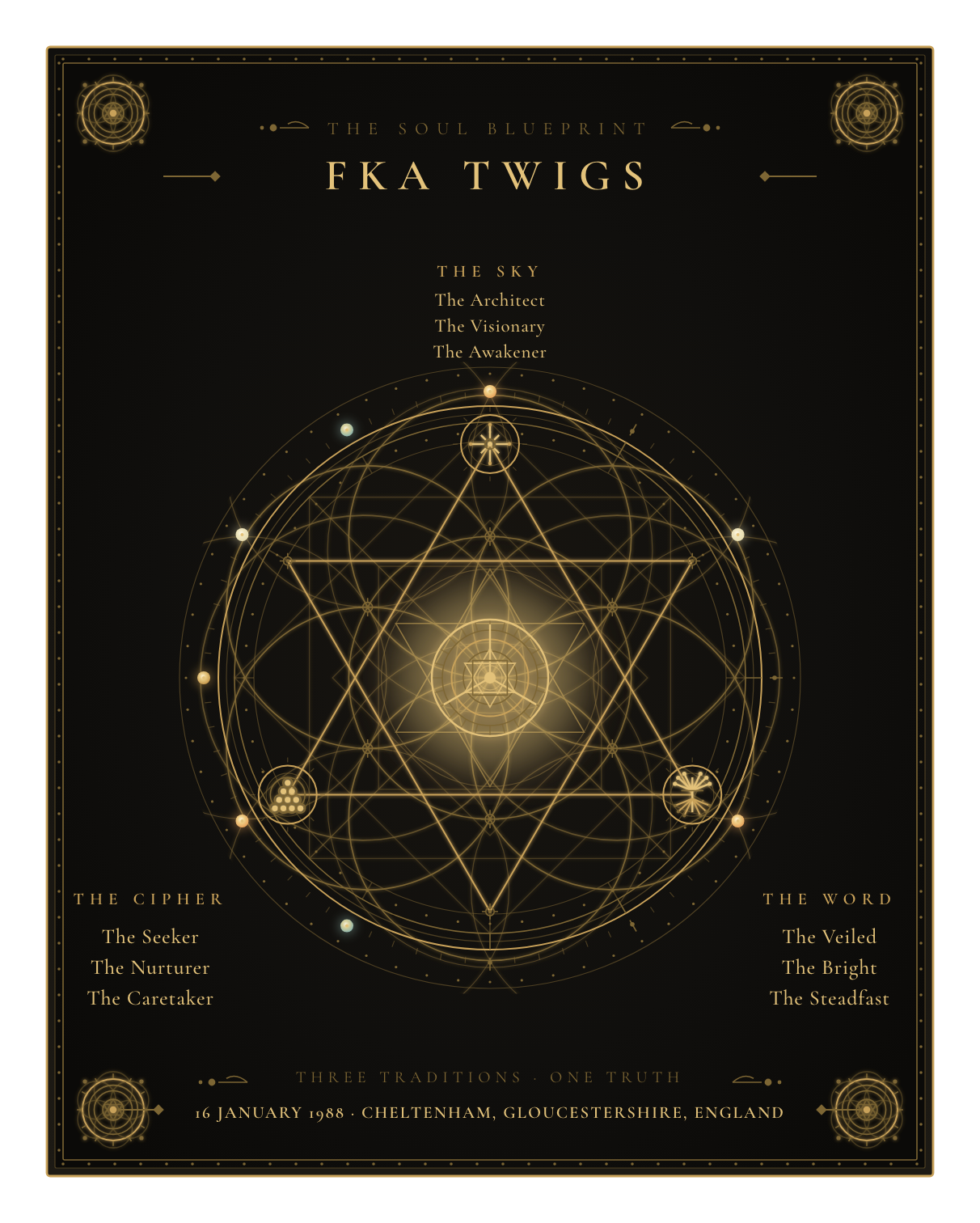
One seal, three languages. The sky she was born under at the apex, the numbers beneath her name at the lower left, the name itself at the lower right — three traditions engraved into one artifact. There is no rising sign, no houses, no angles: without a verified birth time they cannot be honestly drawn. What is true is what is shown.
At a Glance
- Full traditional name
- Tahliah Debrett Barnett
- Born
- January 16, 1988 · Cheltenham
- Sun
- Capricorn 25.6° — the essential fire of the life
- Rising
- Birth time unverified — the Ascendant is offered conditionally, never asserted
- Moon
- Sagittarius 17.7° — the inner life
- Mind · Value · Will
- Mercury Aquarius · Venus Pisces · Mars Sagittarius
- Discipline · Direction
- Saturn Sagittarius · North Node Pisces
- Life Path
- 7 — The Seeker
- Title-name Destiny
- 6 — The Nurturer
- Birth-name Destiny
- 6 — The Nurturer
- Master Numbers
- None preserved at the final layer
- Soul archetype
- The Nurturer who lives the Seeker’s path
It is 2012, and the light in a South London studio falls in strips across the floor where she moves—joints cracking, spine articulating through sequences that most bodies cannot hold. She is twenty-four years old, unknown to nearly everyone, working in the narrow spaces between forms: dancer, backup body in other people’s videos, singer in nightclubs, maker of art in youth spaces where money does not reach. The camera finds her there, in that particular year, for the cover of i-D magazine—a fragment of arrival, the first small mirror held up by the world to say: we see you.
But the world’s fragments are always partial, are they not? The magazine cover, the dance video, the stage name spoken aloud—these are the surfaces through which she moves, and they tell one kind of story: the official narrative of a career ascending, a voice finding its instruments, a body becoming famous for the way it breaks and remakes itself. Yet underneath all fragments runs a current that the world does not name—a source, a blueprint, a soul-inheritance moving through time with its own logic and its own necessity. The two stories are not the same. The fragments are what the public eye assembles; the source is what moves beneath, what chooses the fragments as its vessels.
This reading reads the source. It reads the soul underneath the name, the blueprint underneath the biography, the arrival underneath all the years of building. It asks not who the world sees but who came into being with a particular charge, a particular inheritance, a particular work to do. It listens not to the surface story but to the deep current that has been moving through her entire becoming—the one that chose the body, chose the eras, chose the necessary breakings and the redemptions that came after.
What follows is not interpretation overlaid upon fact. It is the soul’s own grammar, read back to itself.
The reading moves through the eight chapters of the Soul Blueprint architecture — The Arrival, The Soul’s Inheritance, The Living of It, The Soul’s Calling, The Soul’s Territories, The Name You Carry, The Moment, and The Invitation — and at the end, the same instrument turns gently toward you.
Her soul has a blueprint.
So do you.
The same three languages — the sky, the numbers, the name — are waiting in your own.
The Arrival
She arrived carrying a paradox that no single frame could hold: the soul that builds enduring structures by refusing every structure that tries to contain her. There is a self in her that knows the weight of consequence, that assumes authority without apology, that moves with the certainty of one who has already earned her place through the sheer integrity of her presence. This is the signature of a soul born to master time itself—to take what is formless and make it architectural, to carry responsibility as a crown rather than a burden. And yet this same self arrived also demanding meaning, demanding faith, demanding that every structure she builds be lit from within by something transcendent. She cannot build for building’s sake; the work must point toward the far horizon. She must feel that she is part of something larger than herself, or the mastery becomes dead weight.
This is why she moves the way she moves—why her joints crack and her body articulates through impossible sequences. The body is the structure; the spirit is the meaning. She refuses to choose between them. She arrived as the soul that would spend her entire life proving that discipline and transcendence are not opposites but lovers, that you can build something that lasts AND that opens the heart to the infinite at the same time. The individual power seeking its way out, not against the weight but through it, alchemizing consequence into grace. This is the paradox she carried into the world before anyone knew her name.
The Soul’s Inheritance
She was born into music and movement as inheritance—not as hobby but as the substance of the household itself. Her mother was a dancer and gymnast, her stepfather a jazz fanatic of Bajan descent, and the air she breathed from childhood was already organized by rhythm, by the body’s intelligence, by the deep knowledge that music is a language older than words. Spanish ancestry moved through her mother’s line as well—another layer of the cultural inheritance, another chord in the polyphonic song of her becoming.
She was raised in Cheltenham, England, in the 1990s, in a particular kind of postcolonial household where cultures met and made new things together. She attended St Edward’s School on a scholarship—a Catholic institution where she learned that excellence was something you could earn, something that could be granted to you if you proved yourself worthy. From a young age she undertook opera and ballet lessons, participated in school productions, learned the discipline of the trained body. But she did not meet her biological father until she was eighteen—which means the first eighteen years of her life were shaped by a particular kind of absence, a presence that had to be imagined rather than lived.
This is crucial: she was born into movement and music but also into a kind of fissure at the heart of things—a father-shaped gap that would teach her early on that love and presence are not guaranteed, that you must build your own meaning in the spaces where the world does not hand it to you. She inherited both abundance and fracture, both the richness of a musical household and the loneliness of an absent lineage. Everything that would come after had already been seeded in this terrain.
The Living of It
At sixteen she began making music in youth clubs—not in recording studios, not in the official channels of the music industry, but in the spaces where the institution did not yet care. At seventeen she moved to South London to pursue a career as a dancer, enrolling at the BRIT School, entering the machinery of professional training. She worked as a backup dancer in music videos for other people’s visions: Kylie Minogue, Plan B, Ed Sheeran, Taio Cruz, Dionne Bromfield, Jessie J, Wretch 32—years of being the body that supported another’s narrative, the presence that made someone else’s image complete.
She worked as a hostess in a strip club. She sang at the Box Soho in Soho, City of Westminster. She transferred to Croydon College to study fine arts. She did the labor that most artists do in the years before anyone knows their name—the work that costs you in small daily ways, the work that requires you to believe in something when no mirror reflects it back to you yet. She was living the soul’s great discipline: the slow, unglamorous alchemy of making yourself into a vessel.
Then in 2012, at twenty-four, she self-released her music debut EP1 on Bandcamp. The machinery began to turn. In 2013 came ‘Water Me,’ the video directed by Jesse Kanda. In 2014, her debut album LP1 reached number 16 on the UK Albums Chart and was nominated for the Mercury Prize. The world turned toward her. But what the world did not see was the cost of those years—the nights in clubs, the backup-dancer work, the years of making things in spaces that did not yet have an audience. What lasts is what has been forged in obscurity, tempered in the places where no one is watching. She had paid the price that grants you the right to arrive.
If this is what was true for her, what might be true for you?
The Soul’s Calling
The soul came into this incarnation with a calling to speak a language that the culture had not yet made room for—to use her body and her voice as instruments of a new kind of truth-telling. Her mind works by stepping back to see the entire system at once, to question what has been taken as given, to think in patterns rather than in fragments. She is not meant to follow the architecture that has already been built; she is meant to see the architecture and ask: what if we built differently? What if we built from the body? What if we built from the sacred?
She came to demonstrate that the feminine body is not an object to be looked at but an instrument of knowledge, of invention, of spiritual inquiry. She came to show that unconditional tenderness and radical formal innovation are not opposites but partners. She came to use dance, music, visual art—whatever form was necessary—to crack open the world’s certainties and invite people into a larger view of what is possible. Her voice is not meant to comfort the already comfortable; it is meant to disturb the sleeping and to wake them toward something they had not yet imagined.
This is why she has directed her own films, made her own aesthetic choices, refused to be contained in any single medium or form. The calling is to be a systems-thinker who uses the body as her primary text—to reshape how we think about intimacy, vulnerability, power, and the sacred by showing, not by explaining. She is a reformer, not because she is angry at the old forms but because she has seen the whole pattern and knows what wants to be born next.
The Soul’s Territories
The first territory is the body itself—not as commodity but as archive. She has lived her entire adult life in territories where the body speaks what words cannot, where the spine articulates philosophy, where the crack of a joint is a small revelation. Her work as a dancer, as a choreographer, as a movement-maker has always held this truth: the body remembers what the conscious mind forgets, and the body knows things that language has not yet named. In this territory she has built a practice of radical listening—listening to what her own joints tell her, what her own nervous system wants to teach her and others. The videos, the performances, the films all emerge from this deep inquiry into the body’s intelligence.
The second territory is the visual language of cinema and visual art—the world of image, color, composition, the way that seeing is itself a form of knowledge. Her collaborations with visual artists, her direction of her own music videos and films like Soundtrack 7, her work in fine arts training—all of this emerges from a soul that thinks visually, that knows that an image can communicate what a lyric cannot. She does not make videos to illustrate her music; she makes visual works that exist in their own right, that invite the viewer into the same inquiry the music is conducting.
The third territory is the inquiry into vulnerability and transcendence as a spiritual practice. Her albums—LP1, Magdalene, Eusexua, Eusexua Afterglow—are not documents of emotion but instruments of transformation. They invite the listener into territories of heartbreak, desire, spiritual longing, and the strange grace that comes when you allow yourself to be completely unmade by love. This is sacred work, held in secular forms. She is mapping the territories where the personal becomes transpersonal, where your own wound becomes everyone’s wound, where vulnerability becomes a path to the infinite. These three territories—the body, the image, the sacred—are not separate in her work; they are woven into a single inquiry into what it means to be human, to love, to grieve, to transform.
There are twelve domains in the kingdom of any life: The Mark, The Unfolding, The Unseen, The Long Return, The Inheritance, The Encounter, The Alchemy, The Living Tension, The Sight, The Body’s Knowing, The Crossing, The Calling.
The Name You Carry
The name she was born with—Tahliah Debrett Barnett—carries within it a genealogy she did not choose and a landscape she inherited. Tahliah, Debrett, Barnett: three words that anchor her in a particular England, a particular century, a particular combination of legacies. These are the names she began with, the names written on her documents, the names that belonged to her before she had any say in the matter.
But at some point in her early twenties, she began to move away from those names—not rejecting them, but releasing the idea that they were her only option. She became known as Twigs for the way her joints crack, for the way her body breaks and remakes itself. The nickname was accurate; it was rooted in her physicality, in something true about the way she moves. But then another act also claimed the name, and she had to choose: surrender the identity she had begun to build, or transform it again.
She added the letters FKA to her professional name—and here is where the real naming begins. FKA does not stand for ‘formerly known as,’ she insisted. It is simply a collection of letters she chose for their masculine and strong sound. Not an abbreviation but an incantation. Not a description of what was but a declaration of what is. The choice to use letters rather than a word, to refuse the conventional meaning everyone would project onto those letters, to assert instead that they are simply the sound of strength—this is the work of a soul refusing to be named by the world’s logic. She takes the world’s fragments and reassembles them according to her own geometry. The name becomes her first act of artistic autonomy: I choose what I am called, not because I am rejecting the past but because I am claiming the right to speak myself into being. FKA Twigs is not a stage name covering up Tahliah Barnett; it is the same soul, consciously authoring its own introduction.
The Moment
In December 2017, she had surgery to remove fibroid tumours from her uterus—tumours that had been living in her body for years, invisible, slowly accumulating, filling her with what she would later describe as ‘a fruit bowl of pain every day.’ The surgery was the moment when the invisible became visible, when the damage could be seen and extracted. But it was also a threshold moment: the moment when the soul had to face directly the question of what the body holds and what it costs to carry structures inside yourself that are not meant to be there.
This was not just a medical event; it was a spiritual reckoning. In the years that followed, she began to understand her body differently—not as a machine to be disciplined but as a living text that speaks its own needs, its own boundaries, its own capacity. In 2020 she adopted a vegan diet, recognizing that the substances she put into her body mattered, that care is not weakness but the deepest form of self-knowledge. The season that began with surgery and moved into dietary transformation was a season of learning that building something that lasts includes learning to build something that can sustain itself, that can receive care without shame.
But the year 2017-2020 held another rupture as well, one that would force her into the work of her life. The relationship that had been one of the most visible public stories of her existence came to an end. In December 2020 she filed a lawsuit against Shia LaBeouf, accusing him of sexual battery, assault, and infliction of emotional distress. The private pain became public testimony. The soul that had spent her entire life transforming vulnerability into art suddenly had to transform something darker—had to hold her own wound in public view, had to name what had been done to her, had to move through a legal proceeding that would stretch for years. The surgery removed the physical tumours; the lawsuit forced the removal of a different kind of damage—the damage that accumulates when you love someone who uses that love as a weapon.
The Invitation
Everything in this reading has been moving toward a single point. The doubleness named in the first chapter, the inheritance, the wound, the calling, the territory, the name, the moment. These are not seven separate truths about Fka Twigs. They are one truth, named from seven different angles. And they all converge here.
The invitation arrived not as a whisper but as a fracture—the body’s own refusal to keep silent, a fibroid condition that demanded she stop building the perfect structure and begin to listen instead. In December 2017, when she underwent surgery to remove those tumours, she was forced into a threshold that the soul had been circling for years: the choice between mastering every detail of her own survival or surrendering into trust, into the body’s own wisdom, into the mercy of release. The invitation was this—can you let go of the need to engineer your own safety and instead open to a larger current? She had spent years as the backup dancer, the video director, the architect of every frame, the one who stood behind the camera and orchestrated meaning from raw material. She had built LP1 with such rigorous intention that it reached the Mercury Prize. She had made herself indispensable by being the one who saw the pattern, who corrected, who controlled the outcome. But the body was asking something different. It was asking her to stop.
What was being released in that moment—and in the years that followed—was the terror of meaninglessness that had always lived underneath her drive. She had inherited a need to prove that her existence mattered, to build something that would outlast her, to construct order from the chaos she had been born into. Her father’s absence until she was eighteen had taught her young that love could vanish, that you could not depend on what should hold you. Her mother’s strength, her stepfather’s faith—these had shown her that you could survive by building your own ground. But survival is not the same as living. The invitation was asking her to discover the difference.
The soul was being called toward something she had resisted for a long time: the opening of the heart without the armor of perfectionism, the release of the fantasy that she could control what happens to those she loves, the slow, terrifying walk toward trusting that meaning could hold without her managing it every moment. After the surgery, after living with what she has described as ‘a fruit bowl of pain every day,’ she chose to shift her entire physical life—adopting a vegan diet in 2020 when she discovered that animal products were wounding her further. This was not control; this was listening. This was the soul saying yes to its own care, its own intuition, its own body as a teacher.
But the invitation contained a second movement, darker and more demanding. In 2020, she filed a lawsuit against Shia LaBeouf, accusing him of sexual battery, assault, and infliction of emotional distress—an act that required her to speak what she had been trained by circumstance to keep silent, to name harm as harm, to step out of the role of the one who survives quietly and into the role of the one who speaks the truth even when the world does not want to hear it. The invitation was asking her to stop protecting the men who hurt her, to stop building meaning around their violence by making it her own problem to solve. This too was surrender—but a surrender to her own voice, to her own authority, to the claim that her testimony matters.
What became available because she said yes to all of this was a transformation in her art. The album Magdalene, released in November 2019—just as she was beginning to name what had happened to her—was a work of such raw, unbounded compassion that it ranked number one on four year-end lists. The work was no longer the perfectionist’s sculpture; it was the wounded healer’s offering. The music could now hold pain without needing to transcend it, could hold love without needing to control it, could hold faith without needing to engineer its arrival. She began to testify publicly—before the United States Senate Judiciary Subcommittee on Intellectual Property in April 2024, speaking about deepfakes and artificial intelligence, using her voice not as an artist but as a citizen, as a woman, as a witness to the technologies that could be used to unmake her.
The invitation is still unfolding. She is still in the act of saying yes—to love that does not require her to be invulnerable, to art that does not require her to prove its permanence, to a voice that does not need permission to exist. The work she is making now, released as Eusexua in 2025, is the work of a soul who has learned that the strongest structure is the one that bends, that the deepest authority comes from having been broken and refusing to pretend otherwise.
She was not late. She was exactly where the soul-clock said she should be. The mission had been inscribed at the threshold of her first breath. What was being asked of her, she has been walking. The naming has been done.
This Is Not Coincidence
The astrology: A soul born under Capricorn’s demand for enduring structure and tested mastery, with the Moon in Sagittarius insisting that every structure must be lit from within by faith and meaning—and Venus exalted in Pisces pointing forward as the soul’s own medicine, the compass toward what it is learning to become. Saturn in Sagittarius deepens the same truth: belief and faith must be earned, examined, lived until they become bedrock. The numerology: A soul whose title carries the number 6—the Nurturer—and whose birth destiny also resonates as 6, the one who tends and cares and creates sanctuary. But the Life Path is 7, the Seeker, the one who must question, investigate, pierce through surface to source. The soul was born to nurture, but the path demands she seek; she must learn to nurture through truth-telling, to care by refusing easy comfort, to build sanctuary by insisting on what is real. The name: Tahliah Debrett Barnett, anchored in English landscape and genealogy. But then FKA Twigs—letters chosen for their masculine and strong sound, a refusal of the world’s logic, a claim: I will speak myself into being. The names say: I inherit; I arrive as myself; I refuse to be named by anyone but my own understanding. Three entirely different languages. One truth: The soul came to master structure by learning surrender, to build cathedrals by listening to what has been broken.
Three entirely different languages. One truth.
This is not coincidence. This is what three independent systems do when they are all telling the truth about the same soul.
The Numbers, Decoded
The numbers are computed, not intuited — each letter takes its Pythagorean value, each name reduces, and any Master Number is preserved rather than collapsed.
You have sat with the chart and the numbers and the name of another soul, and watched how a wound becomes a calling, how the place of least belonging becomes the place of greatest gift, how a life too precisely configured to be coincidence reveals itself when three independent languages are read together.
The reading you have just received was, in its outer form, a reading of her soul. But its inner form was a reading written for yours. You did not arrive without a Blueprint either. May this reading be the beginning of the reading you finally receive of yourself. May the light you carry — in whatever particular, irreplaceable form it has taken inside the specific life you were given.
Some lives carry a pattern this clear.
Yours does too.
You’ve read the shape of her soul. The same three languages — the sky, the numbers, the word — are waiting in your own name and birth date. Begin yours, free, below.
Or, when you’re ready, begin your own full Soul Blueprint reading →
Frequently Asked Questions
What is Fka Twigs’s birth chart?
Fka Twigs was born on January 16, 1988, in Cheltenham, England, with the Sun in Capricorn—the signature of a self that builds enduring structure and assumes real responsibility. Her Moon is in Sagittarius, the emotional nature that seeks meaning and is steadied by faith in something larger. Her Mercury is in Aquarius, giving her a systemic, objective mind that sees the whole pattern. Venus, exalted in Pisces, speaks to compassionate and transcendent love. Mars in Sagittarius fuels her will toward adventure and the pursuit of meaning. Saturn in Sagittarius indicates that her great work is a hard-earned, tested philosophy. Because her birth time is unverified, a circulated rising sign cannot be asserted as fact.
What is Fka Twigs’s numerology?
Fka Twigs’s Title Destiny is 6, the Nurturer—reflecting the archetype carried by her professional name. Her Birth Destiny is also 6, from her given name Tahliah Debrett Barnett, reinforcing the soul’s role as caretaker and creator of sanctuary. Her Life Path is 7, the Seeker, derived from her birth date of January 16, 1988. The 6s speak to care and nurture; the 7 insists on inquiry, questioning, and the search for truth beneath surfaces. Together they describe a soul called to tend others while never ceasing to investigate what is real.
What does the name Fka Twigs mean?
The name Tahliah Debrett Barnett anchors her in English genealogy and landscape. But her chosen professional name—FKA Twigs—represents a radical act of self-authoring. The letters FKA do not stand for ‘formerly known as,’ as the world might assume; she chose them simply for their masculine and strong sound, a refusal to be named by conventional logic. Twigs comes from the way her joints crack, a literal description of her body’s articulation. Together, FKA Twigs is not a stage name covering an earlier identity but a conscious claim: I will speak myself into being.
What is a Soul Blueprint?
A Soul Blueprint integrates three independent traditions — Western natal astrology, Pythagorean numerology, and the etymology of the full birth name — into a single document written as a personal letter to the soul. When you’re ready, you can begin your own.
This reading was prepared in the lineage and methodology of the Soul Blueprint Method — Pythagorean numerology with master numbers preserved, Western archetypal astrology, and a researched etymological reading of the full name. Fka Twigs’s birth date (January 16, 1988) is sourced from the public record; the birth time is unverified, so the rising sign is offered conditionally and never asserted.
A Soul Blueprint reading · Astrology · Numerology · Etymology · shams-tabriz.com