
Tom Holland’s Birth Chart, Numerology, and Name Decoded
Tom Holland’s Birth Chart,
Numerology & Name Decoded
The Soul Blueprint Method — three traditions woven into one personal letter: Western natal astrology, Pythagorean numerology, and the etymology of the soul’s name. Learn the method →
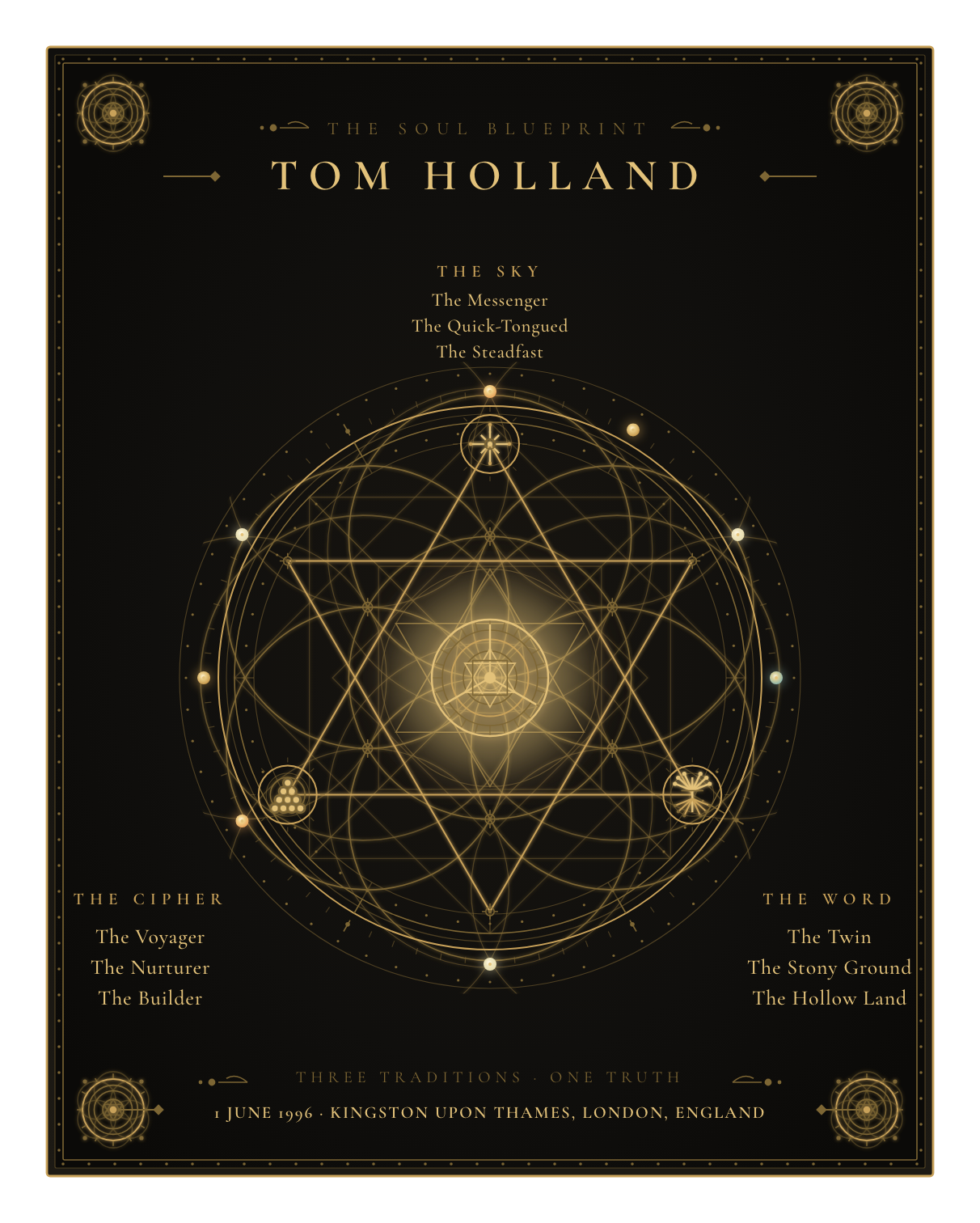
One seal, three languages. The sky he was born under at the apex, the numbers beneath his name at the lower left, the name itself at the lower right — three traditions engraved into one artifact. There is no rising sign, no houses, no angles: without a verified birth time they cannot be honestly drawn. What is true is what is shown.
At a Glance
- Full traditional name
- Thomas Stanley Holland
- Born
- June 1, 1996 · Kingston upon Thames
- Sun
- Gemini 11.2° — the essential fire of the life
- Rising
- Birth time unverified — the Ascendant is offered conditionally, never asserted
- Moon
- Date-dependent across the unverified birth day — not fixed without a confirmed time
- Mind · Value · Will
- Mercury Taurus · Venus Gemini · Mars Taurus
- Discipline · Direction
- Saturn Aries · North Node Libra
- Life Path
- 5 — The Free Soul
- Title-name Destiny
- 6 — The Nurturer
- Birth-name Destiny
- 4 — The Builder
- Master Numbers
- None preserved at the final layer
- Soul archetype
- The Nurturer who lives the Free Soul’s path
June 2008: a boy of twelve stands in the wings at the Victoria Palace Theatre in London’s West End, the hem of his Billy Elliot costume still wet with the particular sweat of a debut performance—and the theatre is roaring. The lights have found him. The stage has claimed him. In that suspended moment before the curtain falls and the weight of what has just happened settles into his bones, he is not yet aware that he has stepped into a machinery of his own becoming—that the boy who arrived at hip hop classes in Wimbledon five years earlier, spotted by a choreographer at a dance festival, has just traded the certainty of a childhood for the bright, relentless visibility of a public soul.
But the world sees only the surface: a talented young performer, a dancer-turned-actor, the boy in the musical, later the teenager in the blockbuster films, the actor whose face screens across continents. The fragments the world assembles from images and headlines and box-office figures make a clean story—precocious, fortunate, ascending. Yet beneath that collected autobiography runs a different current entirely: the source from which all the outward movement springs. That source is not the sum of his roles or his earnings or even his remarkable persistence through an industry that grinds most away. It is the deeper pattern—the soul’s actual design, the blueprint he arrived carrying, the inheritance he was born into, the territories his gifts have been called to inhabit, the precise wound that became his qualification to do what he does.
This reading does not concern itself with the public narrative. It reads the source instead—the architecture underneath, the signature that preceded and will outlast every role, every film, every moment of acclaim. It reads the soul that came alive when the boy walked into that theatre, and the soul that walks still, steadier and more aware, into the territories that are still opening before him.
The reading moves through the eight chapters of the Soul Blueprint architecture — The Arrival, The Soul’s Inheritance, The Living of It, The Soul’s Calling, The Soul’s Territories, The Name You Carry, The Moment, and The Invitation — and at the end, the same instrument turns gently toward you.
His soul has a blueprint.
So do you.
The same three languages — the sky, the numbers, the name — are waiting in your own.
The Arrival
He arrived as a being constitutionally alive to connection—wired not for solitude but for the constant search for new relationships, new words, new ways of being in dialogue with the world. This is not the arrival of the isolated prodigy or the self-contained virtuoso; this is the soul who becomes most fully himself in the act of reaching toward another, in the exchange, in the many-sided dance of meeting. His Sun signals a self that is vivid precisely because it extends constantly through link after link—the curious mind that does not settle into certainty but wanders instead into ever-new territory, learning, apprenticing, finding itself alive in the spaces between people.
Yet he also arrived carrying an immense patience—a will that does not ignite quickly but once set into motion becomes nearly unmovable. A warrior’s endurance lives in him, but not a warrior’s impulsiveness. His deliberate, grounded thinking and the slow, measured way words come from him mean that when he commits to something—a role, a partnership, a direction—he holds the line. The paradox is acute: a being built for constant discovery and exchange, yet possessed of the will to persist long after the initial excitement has faded, to build something real that lasts.
The soul arrived carrying both the many-faced wanderer and the patient builder—the man who becomes himself through others, yet who will not abandon the ground once he has claimed it. This is the signature that would shape every door he walked through: the capacity to be restless and devoted at once, to meet others as equals and to endure what meeting asks.
The Soul’s Inheritance
He was born into a household where the making of things was not abstract but native—a father who had learned to shape words and perform them, a mother whose eye knew how to see and frame the light. Both parents carried the language of creation as something ordinary, something one simply did. This was not a family that spoke about art from the outside; it was a family that inhabited it, that understood the particular discipline and vulnerability it required. There were younger brothers in the house—the particular current that moves through a family with multiple children, the brotherhood and the noise and the knowing that you are not the only one.
At seven, a diagnosis arrived—dyslexia—and with it, a decision by his parents that their son would have access to the particular attention his mind required. This early encounter with a difference, with needing something extra to make sense of what others absorbed easily, wove itself into his inheritance before he could name it. It marked him, not as deficient, but as someone who would learn differently, who would have to find his own path into understanding.
But the real inheritance was perhaps simpler: a father who became his unofficial guide through an industry his father understood from within, parents whose names and faces meant something in certain circles, and the implicit knowledge that your own work could matter, could touch people, could be offered to the world. His childhood was folded into the space between private life and public visibility, between the ordinary rhythms of school and home and the knowledge that one of his parents’ professions meant that attention sometimes turned that direction. He inherited, in short, the infrastructure of a life that could support the arrival of what would come.
The Living of It
The living of it began at nine, in hip hop classes at a school in Wimbledon—the body learning first what words might only obscure. Then came the moment at the Richmond Dance Festival when the choreographer saw him and arranged the audition for Billy Elliot. What followed was two years of training in ballet, tap dancing, acrobatics—not casual instruction but the kind of discipline that rewrites the body from the ground up. And then the stage: the Victoria Palace Theatre, the debut, the promotion to the lead role, the performance night after night after night for two years straight until 2010.
But something shifted in the living of it. The body that had learned to dance onstage was not the same body that would later stand before a film camera. The Impossible arrived in 2012—a different kind of acting entirely, one that asked not for movement through space but for stillness, for the capacity to sit with grief and terror and let them move through him while he remained almost motionless. In the audition, he had recited a letter to his mother with enough emotional truth that the director saw something and cast him. The film premiered at Toronto to critical acclaim. Something in him had shifted from performer to actor, from the visible movement of the body on stage to the microscopic movements of the face and the inner life.
Then came the Marvel deal—six pictures, Spider-Man, the machinery of the blockbuster, the extraordinary reach and the relentless visibility. Yet he had not abandoned the stage or the willingness to attempt against-type roles. He had become a father of his own production company by 2024. The cost of the living had been, at times, the cost of visibility itself—the weight of being watched, the difficulty of privacy, the particular burden of being labeled the one who spoils the plot. Yet his presence in the world had become, by the nature of his will and his gifts, nearly inescapable.
If this is what was true for him, what might be true for you?
The Soul’s Calling
The calling that shaped itself in him was not to hide or to perform in isolation, but to speak—to give voice to what he had learned through his own body and vulnerability, to reach toward others through the work itself. His mind works deliberately, grounded in what is tangible and real; when he speaks, words do not come easily or in flood, but when they arrive, they carry weight. He was called to be an apprentice first—to learn the craft by standing near those who already knew it, to absorb through proximity and attention rather than through assertion.
But there was a deeper calling underneath: the call to demonstrate that connection and persistence could coexist, that you could be built for reaching toward others—for companionship, for the discovery of what others held—and also built for staying. The Marvel films gave him a platform of unprecedented scale, yet the calling was not truly about the scale. It was about showing up, night after night, role after role, in the face of an industry that asks performers to be interchangeable, and refusing to be. His Life Path speaks of the need for freedom and movement, yet he has chosen repeatedly to ground himself—in a production company, in a partnership, in the commitment to build something real.
The Soul’s Territories
His first most-alive territory is the territory of transformation through embodiment—the space where the body itself becomes the language. This began with dance and moved into acting, but the principle remained constant: truth arrives not through words first but through the physical presence, the gesture, the way the face holds light. Whether he was moving across the stage at the Victoria Palace or standing before a camera in a tsunami, the territory remained the one where what the soul holds can be made visible through the instrument of the flesh. Here, he is most fluent.
His second territory is the art of apprenticeship and learning—the refusal to arrive as someone who already knows. From his first hip hop classes to the two years of ballet and tap and acrobatics before his stage debut, from his transition from stage to film under directors like Juan Antonio Bayona, he has inhabited the role of the student with a kind of sacred attentiveness. He learns by standing near mastery, by watching, by allowing others to teach him. This territory holds the recognition that becoming is ongoing, that the man of twenty-eight is not yet finished becoming, that there are always new territories to apprentice in.
His third territory is the careful building of real things—the creation of Billy17, his production company; the return to stage in Romeo and Juliet; the deliberate choice to remain engaged in the work rather than to coast on what he had already achieved. This is the territory where his will to persist transforms into architecture: not the architecture of fame or accumulation, but the architecture of craft, of legacy, of things that will outlast the particular moment of his visibility. Here, in the space between the many connections he makes and the real things he builds to hold them, the deeper mythology of his life begins to reveal itself.
There are twelve domains in the kingdom of any life: The Mark, The Unfolding, The Unseen, The Long Return, The Inheritance, The Encounter, The Alchemy, The Living Tension, The Sight, The Body’s Knowing, The Crossing, The Calling.
The Name You Carry
The name Thomas carries within it a resonance of the twin—the one who sees, who witnesses, who stands at the threshold between worlds and can name what he perceives. There is also within it an ancient solidity, a name borne by saints and builders and those who made things that lasted. It is a name of inquiry and of substance both—the questioner who also knows how to hold ground. When shortened to Tom, it becomes simpler, more approachable, a name that does not demand formality but invites companionship. This is the container in which the public face has lived: Thomas the substantial, Tom the companion.
Stanley, in the middle, adds a note of steadiness—a name drawn from the notion of a stony place, ground that is clear and unmovable. It suggests a location, a standing-place, something that will not shift with fashion or circumstance. It is a name that has carried workers and builders and those who made their way through persistence rather than charm. To carry both the questioning witness (Thomas) and the steady ground-holder (Stanley) in one name is to carry an internal dialogue—the part that reaches out and asks, and the part that plants itself and holds what it has claimed.
Holland itself is a geography—a land that exists, a place of origin. It grounds the entire name in something territorial, something that can be mapped and returned to. Thomas Stanley Holland: the questioner and witness, the steady builder, placed in a territory that is real and actual. The numerology of these names speaks in its own language of nurturing and building and movement, but the names themselves whisper of a life that would need to be both reaching and rooted, both curious and committed to what it has chosen.
The Moment
It was 2012 when The Impossible premiered at the Toronto International Film Festival—a moment that arrived without fanfare until the film itself arrived, and then everything changed. He was sixteen years old. He had left the stage where he had performed nightly as Billy Elliot, where his body had learned the discipline of repetition and the particular kind of presence that only live performance demands. Now he stood before a camera in a film about a family devastated by the 2004 Indian Ocean earthquake and tsunami, playing a teenage boy trapped in catastrophe, separated from his family, uncertain whether he would survive.
The film had been made with a director who had seen something in him during an audition—had watched him recite a letter to his mother with such emotional nakedness that Juan Antonio Bayona knew he had found his actor. The film premiered and the critical response was immediate: this was not a young performer trading on precocity or charm. This was an actor who had the capacity to sit with devastation and let it inhabit him. The nomination for the Goya Award for Best New Actor arrived. But more importantly, something shifted in him—a recognition that moved through him like the earthquake itself.
Working with Naomi Watts in that film, he had realized that this was what he wanted to do. Not the performance, not the applause, but the acting—the work of becoming someone else so entirely that you could hold their grief, their terror, their particular human vulnerability. The premiere at Toronto was the moment the world began to see him as something more than the boy from the West End musical. It was also the moment he began to see himself that way. Everything that followed—the Marvel films, the blockbuster success, the nine billion dollars in worldwide box office—was built on the foundation of what that moment revealed: that he could carry weight, that he could be trusted with the world’s attention, that his will and his vulnerability together made him capable of things he had not yet imagined.
The Invitation
Everything in this reading has been moving toward a single point. The doubleness named in the first chapter, the inheritance, the wound, the calling, the territory, the name, the moment. These are not seven separate truths about Tom Holland. They are one truth, named from seven different angles. And they all converge here.
He is being asked to hold two things at once, and to hold them without letting either one collapse into the other—the visibility and the privacy, the many connections the world demands and the singular commitments that alone make life real. From the earliest days of his work, this has been the terrain of his becoming: learning to be seen by millions while remaining somehow intact, learning to be known as a public figure while maintaining the threshold between the public and the sacred interior life. This is not a small asking. It is the particular work of a soul called to reach toward many while building something singular.
What he has been releasing is the illusion that he can be everything to everyone—the people pleaser, the one who shows up always, who absorbs without boundary. In 2022, he participated in Dry January and discovered something important enough to shape his life around: the knowledge of when he had been using connection and social presence as a way to escape the weight of being himself. He became a teetotaller. Later, he would speak publicly about ADHD, about the particular way his mind moves and wanders. These were not confessions of failure but acts of radical honesty—the releasing of the mask that says a successful person must have no edges, no complications, no particular ways in which the mind and body resist the demands placed upon them.
What he has been called toward is partnership that is actual—not the fantasy of partnership, but the real work of it. In 2021, he confirmed a relationship with Zendaya, his co-star in the Spider-Man films. By 2023, they had bought a home together in London. By December 2024, they were engaged. This is not the love story the magazines tell; it is something quieter and more substantial. It is the choice to build something real with another person—to learn the arts of cooperation and fairness, to consider another human being as an equal rather than as a reflection of yourself, to release the over-mastered self-reliance that once felt like strength. He has been called, in other words, to become a partner in the fullest sense—not the performer in a relationship, but the builder of one.
What became available because he said yes to this was the capacity to direct his own work. In 2024, Billy17—his production company, named after the theatre where he had stood as a child—landed a deal with Sony Pictures. He is set to star in Christopher Nolan’s adaptation of The Odyssey. These are not the projects of someone merely accepting what comes; these are the projects of someone who has begun to shape the terrain itself, who understands that building something that lasts requires not just showing up but actively choosing what kind of stories will be told and how. The boy who was spotted at a dance festival and auditioned for a musical because someone else saw his potential has become a man who is now the one doing the seeing, doing the choosing, doing the building.
What also became available is a different kind of vulnerability—not the vulnerability of the performer exposed before an audience, but the vulnerability of someone who has said publicly: I have dyslexia. I have ADHD. I struggle with burnout. I have been an impossible people pleaser. I am learning what it means to have boundaries. This is the territory where the real work happens, the territory where he is no longer simply the actor playing a part but the man living a life that is increasingly his own choosing. He is learning to act in the world with deliberation and patience, to say yes when it matters and no when it protects what is sacred. He is learning, in other words, to graduate from the one who is acted upon to the one who acts—not impulsively, not from ego, but with the steady, grounded intention of someone who knows what he is building and why.
He was not late. He was exactly where the soul-clock said he should be. The mission had been inscribed at the threshold of his first breath. What was being asked of him, he has been walking. The naming has been done.
This Is Not Coincidence
The astrology names a self constitutionally alive to connection—a being whose identity arrives through the reaching toward others, whose mind is agile and restless, whose will is patient and immovable, whose Saturn calls him to learn the discipline of true assertiveness rather than either compliance or force. The numerology independently names a soul carrying the archetype of the Nurturer in his public presence, the Builder in his deeper inheritance, and the Free Soul in his life trajectory—three energies that demand he create structures that serve others while remaining internally unchained. The etymology of his names whispers of witness and solid ground and a territory that is real. Three entirely different languages. One truth: a man learning to build the life itself, not just to inhabit the roles he is given—to move from connection as hunger to connection as offering, from visibility as exposure to visibility as service, from the many-faced wanderer to the one who plants something that lasts.
Three entirely different languages. One truth.
This is not coincidence. This is what three independent systems do when they are all telling the truth about the same soul.
The Numbers, Decoded
The numbers are computed, not intuited — each letter takes its Pythagorean value, each name reduces, and any Master Number is preserved rather than collapsed.
You have sat with the chart and the numbers and the name of another soul, and watched how a wound becomes a calling, how the place of least belonging becomes the place of greatest gift, how a life too precisely configured to be coincidence reveals itself when three independent languages are read together.
The reading you have just received was, in its outer form, a reading of his soul. But its inner form was a reading written for yours. You did not arrive without a Blueprint either. May this reading be the beginning of the reading you finally receive of yourself. May the light you carry — in whatever particular, irreplaceable form it has taken inside the specific life you were given.
Some lives carry a pattern this clear.
Yours does too.
You’ve read the shape of his soul. The same three languages — the sky, the numbers, the word — are waiting in your own name and birth date. Begin yours, free, below.
Or, when you’re ready, begin your own full Soul Blueprint reading →
Frequently Asked Questions
What is Tom Holland’s birth chart?
Tom Holland was born on June 1, 1996, in Kingston upon Thames, London. His Sun is in Gemini, the sign of connection, curiosity, and the many-sided mind. His Mercury is in Taurus, giving him a slow, deliberate, grounded way of thinking and speaking. Venus in Gemini means his affection is expressed through words, wit, and playful discovery. Mars in Taurus provides him with extraordinary patience and persistent will. Saturn in Aries calls him toward the maturing of his capacity to act with discipline and courage. Because his birth time is unverified, his rising sign cannot be reliably determined.
What is Tom Holland’s numerology?
Tom Holland’s numerology carries three foundational numbers: his Title Destiny (6) names him as the Nurturer in his public presence, his Birth Destiny (4) identifies him as the Builder in his deeper inheritance, and his Life Path (5) speaks of the Free Soul—a being called toward freedom and movement. Together, these numbers describe a soul who nurtures through building, who finds freedom in offering structure to others, who is called to create things that serve and last.
What does the name Tom Holland mean?
The name Thomas carries the resonance of witness and inquiry—the one who sees and asks. Stanley adds steadiness and solidity, the notion of unmovable ground. Holland roots the entire name in territory—in something actual and mappable. Together, Thomas Stanley Holland speaks of a questioner and builder placed in a real geography, a being called to reach out while remaining rooted, to discover while holding ground.
What is a Soul Blueprint?
A Soul Blueprint integrates three independent traditions — Western natal astrology, Pythagorean numerology, and the etymology of the full birth name — into a single document written as a personal letter to the soul. When you’re ready, you can begin your own.
This reading was prepared in the lineage and methodology of the Soul Blueprint Method — Pythagorean numerology with master numbers preserved, Western archetypal astrology, and a researched etymological reading of the full name. Tom Holland’s birth date (June 1, 1996) is sourced from the public record; the birth time is unverified, so the rising sign is offered conditionally and never asserted.
A Soul Blueprint reading · Astrology · Numerology · Etymology · shams-tabriz.com