
JFK Jr’s Birth Chart, Numerology, and Name Decoded
JFK Jr’s Birth Chart,
Numerology & Name Decoded
The Soul Blueprint Method — three traditions woven into one personal letter: Western natal astrology, Pythagorean numerology, and the etymology of the soul’s name. Learn the method →
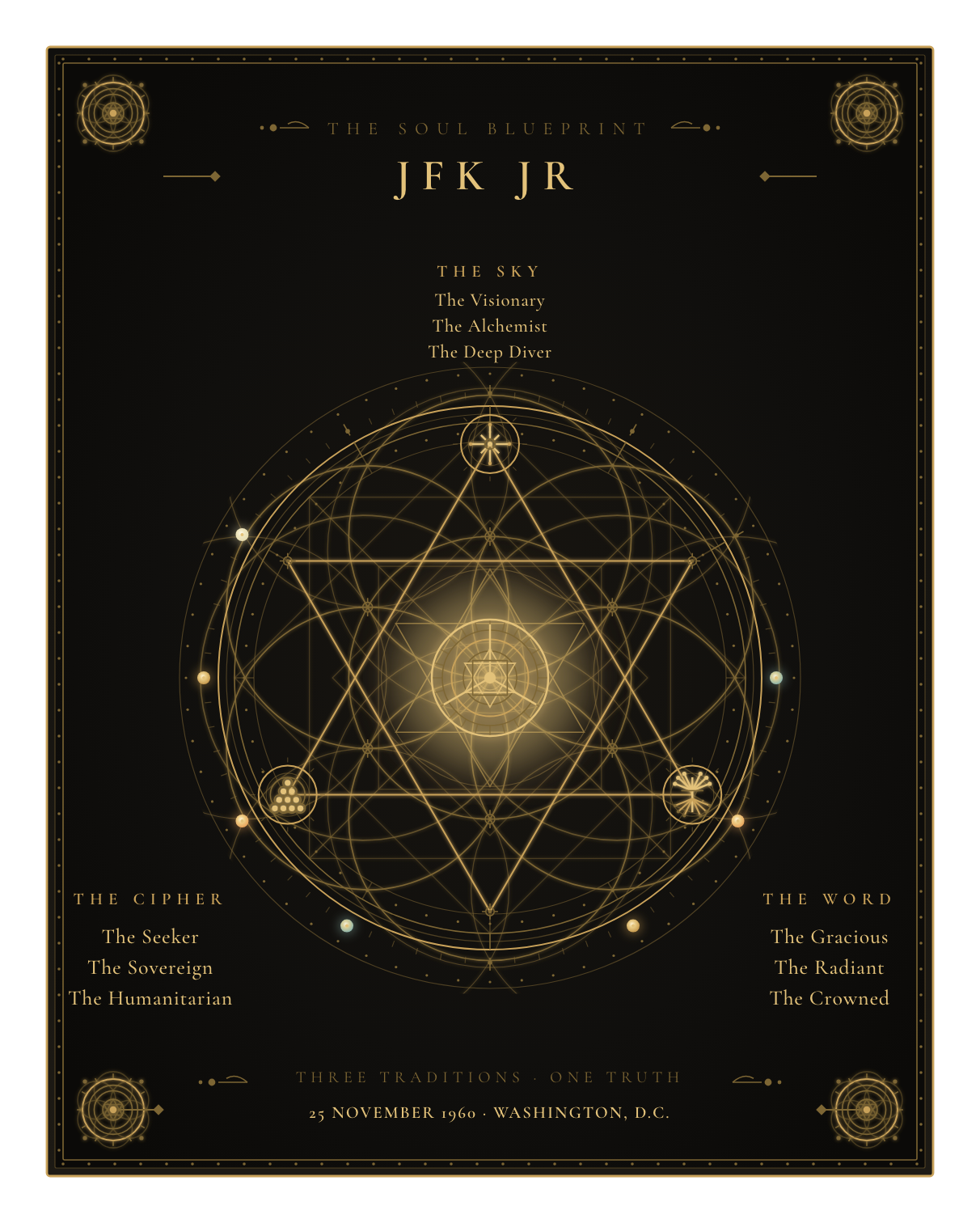
One seal, three languages. The sky he was born under at the apex, the numbers beneath his name at the lower left, the name itself at the lower right — three traditions engraved into one artifact. There is no rising sign, no houses, no angles: without a verified birth time they cannot be honestly drawn. What is true is what is shown.
At a Glance
- Full traditional name
- John Fitzgerald Kennedy Jr.
- Born
- November 25, 1960 · Washington, D.C.
- Sun
- Sagittarius 3.4° — the essential fire of the life
- Rising
- Birth time unverified — the Ascendant is offered conditionally, never asserted
- Moon
- Date-dependent across the unverified birth day — not fixed without a confirmed time
- Mind · Value · Will
- Mercury Scorpio · Venus Capricorn · Mars Cancer
- Discipline · Direction
- Saturn Capricorn · North Node Virgo
- Life Path
- 7 — The Seeker
- Title-name Destiny
- 1 — The Pioneer
- Birth-name Destiny
- 9 — The Humanitarian
- Master Numbers
- None preserved at the final layer
- Soul archetype
- The Pioneer who lives the Seeker’s path
It is September 1995, and the light in a Manhattan conference room is the white-bright of early autumn, the kind that shows every dust-mote and makes the moment feel somehow caught in glass. A young man stands at the center of a gathered press—dark-haired, composed in the particular way of those born into scrutiny—and announces the launch of a magazine called George. The room is electric, cameras flash, questions come fast. But what strikes the observer is not the celebrity of the name he carries, but the clarity in his voice when he speaks of what the magazine will do: to bring politics and culture into conversation, to make the serious matter livable, to say what others have been afraid to say. The fragments the world calls them—the inherited name, the genetic fortune, the years spent in the white rooms of power—these are like the surface of a river, catching light, visible to all. But beneath that surface, where the current runs deep and unseen, there is another story entirely: the source-water of the soul itself, moving toward expression, toward utterance, toward some form of usefulness that the world has not yet recognized. This reading reads the source. It traces not the famous face or the family weight or the corridors he walked, but the blueprint itself—the deep map that arrived in this particular body on November 25, 1960, in Washington, carrying specific instruction about what the soul came to know and do.
The reading moves through the eight chapters of the Soul Blueprint architecture — The Arrival, The Soul’s Inheritance, The Living of It, The Soul’s Calling, The Soul’s Territories, The Name You Carry, The Moment, and The Invitation — and at the end, the same instrument turns gently toward you.
His soul has a blueprint.
So do you.
The same three languages — the sky, the numbers, the name — are waiting in your own.
The Arrival
He arrived carrying a paradox that would shape his entire existence: the self that comes alive by seeking meaning pressed hard against the weight of an inheritance so complete, so public, so all-consuming that meaning itself became difficult to locate beyond the family shadow. The pilgrim-impulse arrived in a body already claimed by history—born into the vast unchartered realm of political power and dynasty, the quest for eternal values that should have been his alone to pursue became instead inseparable from the nation’s collective memory. His mind expanded naturally toward the far horizon, seeking in religion and philosophy and public service some ground of truth beyond the personal, yet every horizon he approached was already occupied—already mapped by his father’s legacy, his mother’s vigilance, his family’s relentless orbit. The soul that comes alive by seeking meaning had to seek it therefore in the spaces between the roles: in a magazine that would hold both politics and culture, in the work of bringing hidden things to light, in the willingness to ask questions that polite society preferred unasked. He was born to be a seeker in a family of monuments. The arrival was not of an ordinary pilgrim, but of one whose seeking would have to happen in the full glare of the world’s attention, whose questions would have to be both deeply personal and impossibly public at once.
The Soul’s Inheritance
He was born into the American kingdom at its moment of brightest ascension—the child of the 35th president and the First Lady, arriving into the White House during the first three years of his life, when power and beauty and the machinery of the state seemed to move in unison. The inheritance was staggering: not merely money or position, but a family lineage understood by millions as the closest thing American democracy had produced to royalty, a name that carried the weight of political vision and martyrdom and the complex grief of a nation. His father’s assassination when he was three years old—the salute he offered at the flag-draped casket, caught forever on film—sealed the inheritance into something even more intractable: not merely a son’s loss, but a nation’s wound made visible in a child’s gesture. The years that followed moved him between worlds: his mother’s determination to shield him from the machinery of his own fame, the uncles who carried forward the family’s political ambition, the cousins whose lives ran parallel to his own in the same dynasty. The family itself was restless—his mother’s remarriage to a shipping magnate, the move to a private island, the constant negotiation between obscurity and the impossible weight of being recognized everywhere. He inherited not merely a name but an entire nation’s projection, not merely wealth but an expectation of greatness, not merely a lineage but a template for what his life should become. The material he was built from was the stuff of modern American myth.
The Living of It
The living of it began in the space between what the world expected and what his own nature insisted upon. He came of age in the shadow of an assassination that happened before he had language for it, yet the image of his childhood salute would follow him his entire life—a moment of perfect, unbearable clarity that the world had seen and would not release. His mother’s fierce protection became both gift and constraint: she disapproved of his desire to pursue acting, believing it unsuitable, and the conflict between his own inclinations and her will became an early form of the wound he would carry—the collision between personal authenticity and the role assigned to him by birth. The cost was a kind of division: he pursued the law, earning his degree, failing the bar exam twice before passing on the third attempt, working as an assistant district attorney handling cases of consumer fraud and landlord-tenant disputes—solid, responsible, public-service work that honored the family legacy. Yet alongside this, he moved: into journalism, into performance, into the founding of a magazine that would let him ask questions without the pretense of either pure politics or pure entertainment. The wound was the impossibility of a simple life, and the qualification it forged was the ability to hold multiple identities without collapsing into any single one. He learned to navigate between worlds—between the weight of his name and the desire for his own voice, between the family’s expectation of him and the soul’s own necessity. This navigation cost him coherence in the moment, but it prepared him for something the family had never quite managed: the synthesis of power and authenticity, of legacy and personal truth.
If this is what was true for him, what might be true for you?
The Soul’s Calling
The soul came to demonstrate something the family knew intellectually but had never quite embodied: that the meaning worth seeking is not found in the accumulation of power or position, but in the willingness to speak what is true and to ask the questions that create space for others to do the same. His voice arrived with intensity and penetrating sight—the mind that sees through pretense to the real motive, that names what others avoid saying, that refuses the comfort of polished surfaces. This was the calling: to be an investigator not merely of facts but of the hidden assumptions beneath them, to conduct interviews that would matter, to write editor’s columns that would say the difficult thing, to create a space in the public sphere where the serious and the cultural could speak to each other without the usual armor. The calling was also to demonstrate that it was possible to inherit without being consumed by inheritance—to carry a name, to honor a lineage, to continue a family’s devotion to public service, yet to do it in a form that was entirely one’s own. The seeker’s voice was asking the culture: What if politics could be alive? What if we could speak to each other without masks? What if the next generation inherited not the machine itself, but the courage to transform it? This was the Life Path of the seeker: not to find final answers, but to keep the question alive—to insist that meaning must be renewed in each generation, that authority comes from truthfulness rather than position, and that the vastness worth exploring lies not in the external world only, but in what we are willing to see and say about ourselves.
The Soul’s Territories
The first territory that held him most alive was the territory of the investigative voice—the journalist, the interviewer, the one who would ask Louis Farrakhan and Billy Graham and Garth Brooks the questions no one else had asked, who would write with an incisive clarity about the contradictions at the heart of American public life. In this territory, the penetrating mind came alive; the pretense fell away; the conversation became real. The second territory was the creation and stewardship of the magazine itself—George, which arrived in 1995 as his attempt to synthesize the impossible: to make politics livable, to show that culture and power belong in the same conversation, to create a form that had never quite existed before. This was the building, the legacy-making, the long-haul commitment—the devotion proven over time and through the real work of negotiation, disagreement, and the slow crafting of something substantial. The third territory was the work of service to those without power: heading Reaching Up, the nonprofit organization that provided educational and professional opportunities to workers assisting people with disabilities, an extension of the soul’s deepest instruction to move beyond the personal toward the useful, the concrete, the devotion to those who have been forgotten. These three territories—the voice that questions, the work that builds, the service that grounds—together form the skeleton of a deeper personal mythology: a life organized not around the inheritance itself, but around what the inheritance might be transformed into, what use might be made of the name, what voice might come alive when the soul says yes to its own nature rather than to the role the world has already written.
There are twelve domains in the kingdom of any life: The Mark, The Unfolding, The Unseen, The Long Return, The Inheritance, The Encounter, The Alchemy, The Living Tension, The Sight, The Body’s Knowing, The Crossing, The Calling.
The Name You Carry
The name that arrived with him carries in its very syllables the resonance of a particular American story: John, a common name, the everyman’s name, suggesting ordinariness and grace together; Fitzgerald, the Irish lineage, the immigrant’s journey transformed into something that could stand beside the presidency itself; Kennedy, the dynasty, the whole weight of a family’s ambition and idealism and the blood it had cost. Yet these names did not arrive as mere inheritance—they arrived as an inheritance that demanded something specific of the one who carried them. The name itself was a kind of question posed to him from birth: What will you do with this? How will you make it your own? How will you honor it without being consumed by it? The childhood nickname ‘John-John,’ born from a reporter’s mishearing, became the diminutive by which the world knew him, yet the family itself did not use it—another small distance, another gap between the world’s name for him and his own. The names he carried suggested that he was meant to be a bridge: between the old world (Fitzgerald and Kennedy) and the new, between the particular family and the broader culture, between the inherited role and the self that might yet become. They carried in them the instruction to take something ancient (the lineage) and make it speak to something contemporary (the questions the moment was asking). The resonance is of a soul who must reconcile opposing forces in the sound of a single name—must be both John and Kennedy, both the ordinary seeker and the public figure, both the son of what was and the father of what might yet be.
The Moment
There is a moment that contains all the others, that illuminates the entire architecture of the life, and it arrives on a particular day in 1988 at the Democratic National Convention in Atlanta. He rises to introduce his uncle Senator Ted Kennedy, and as he speaks, something becomes visible: the voice of the seeker finding its true register, the penetrating mind discovering its public form, the soul’s calling becoming audible to a nation watching. The standing ovation that follows—two minutes, unbroken—is not merely applause for the name he carries; it is recognition of something else, something the world has been waiting to see: that the next generation has arrived, that the legacy can be carried forward not through repetition but through transformation, that he himself is not merely the monument’s child but a living being with a voice that matters. The moment reveals the paradox he has lived: he is the child of the most visible tragedy in American history, yet he is also absolutely his own person. The salute at the casket when he was three years old had made him famous for what he could not do, could not speak, could not choose—a symbol rather than a subject. But in Atlanta, he becomes a subject; he speaks; he is heard. And in that moment, the question that has haunted him since birth—Can I be myself and still honor the name?—finds a provisional answer: Yes. The answer is not final; the question will continue. But for that night, the soul’s long seeking finds a landing place, a moment when the inheritance and the authenticity are not at war, when what he came to say and what the world needs to hear align.
The Invitation
Everything in this reading has been moving toward a single point. The doubleness named in the first chapter, the inheritance, the wound, the calling, the territory, the name, the moment. These are not seven separate truths about JFK Jr. They are one truth, named from seven different angles. And they all converge here.
What was being asked of this soul was nothing less than the transformation of inheritance into voice—the taking of a name that had become a symbol, a tragedy, a national property, and the gradual discovery that it could become instead a tool for truth-telling, for asking the questions that matter, for demonstrating that the next generation did not need to repeat the past but could instead examine it, question it, and move beyond it into something new. The asking was tender and relentless both: You will carry this name. Will you let it crush you, or will you make it speak? The soul’s entire early life was the negotiation of this asking: the failed bar exams that forced a reckoning with the limits of what could be inherited (one cannot inherit competence; one must earn it); the work as an assistant district attorney that grounded him in the actual mechanics of justice rather than its symbols; the journalism that let him pursue the investigation of truth without the full apparatus of political power. What was being released—and this took the entire first half of his life—was the idea that he was merely the sum of his lineage, that his value came from who his father had been, that the role assigned to him at birth was the only role available. The shedding was painful: the disapproval of his mother when he pursued acting, the tension with his co-founder when the magazine began to take a shape that did not match the original plan, the constant negotiations with a world that wanted him to be either a politician (fulfilling the family legacy in its most obvious form) or an entertainment figure (a beautiful empty symbol) and found it difficult to accept what he actually was: a seeker, an investigator, a voice that asked questions because the soul demanded it. What was being called toward was the creation of a form that had never quite existed in American public life: a magazine that would be genuinely alive, that would hold both the serious and the cultural without false hierarchy, that would allow him to interview figures from every walk of American life and ask them the real questions. George itself was the answering to the calling—not a political magazine (too narrow), not an entertainment magazine (too empty), but something like a conversation about what it means to be alive in a democracy. The magazine launched in 1995 and became the visible form of an interior work: the transformation of the inherited name into an inherited voice, something that could be passed forward not as a burden but as an invitation to others to think more clearly, speak more truthfully, ask better questions. What became available because the Yes was said—because he said yes to his own nature rather than to the role his birth seemed to prescribe—was a kind of permission that radiated outward: if he could be both a Kennedy and authentically himself, then perhaps others could too. If the next generation could honor the past while making its own voice heard, then perhaps the nation itself could do the same. The work of the magazine, the interviews he conducted, the columns he wrote, all of it was an extended meditation on this possibility: We can be grateful for what we inherit. We can honor it. And we can still ask it hard questions. We can still become ourselves. The soul was demonstrating through the actual living of the life that this synthesis was possible, that you need not choose between loyalty to the past and authenticity in the present, that a voice can be both personal and public, that a name can carry meaning without crushing the one who carries it. In the final years, this work continued—the magazine struggling and then recovering, the investigations deepening, the interviews becoming more probing, the soul’s trajectory always moving toward a kind of usefulness, a kind of service, a kind of honest speech that the world needed and did not yet know how to ask for.
He was not late. He was exactly where the soul-clock said he should be. The mission had been inscribed at the threshold of his first breath. What was being asked of him, he has been walking. The naming has been done.
This Is Not Coincidence
The astrology says: a mind born to penetrate beneath surfaces and speak the hidden truth, a will that protects and provides through fierce feeling for what is vulnerable, a love that commits and builds for the long haul, all of it organized by the Sun’s quest for meaning in the far horizons of eternal values and the far sphere of society. The numerology says: a Pioneer called to break the old forms, a Humanitarian whose very presence asks the world to account for those without power, a Seeker whose entire life is the question What is true, and what must I do about it?—three entirely different languages, speaking from three entirely different angles of the chart and the name. The names themselves—John, Fitzgerald, Kennedy—carry the ordinary, the immigrant’s transformation, the dynasty’s weight. Three entirely different languages. One truth: The soul arrived to ask the culture a question it had not learned to ask itself.
Three entirely different languages. One truth.
This is not coincidence. This is what three independent systems do when they are all telling the truth about the same soul.
The Numbers, Decoded
The numbers are computed, not intuited — each letter takes its Pythagorean value, each name reduces, and any Master Number is preserved rather than collapsed.
You have sat with the chart and the numbers and the name of another soul, and watched how a wound becomes a calling, how the place of least belonging becomes the place of greatest gift, how a life too precisely configured to be coincidence reveals itself when three independent languages are read together.
The reading you have just received was, in its outer form, a reading of his soul. But its inner form was a reading written for yours. You did not arrive without a Blueprint either. May this reading be the beginning of the reading you finally receive of yourself. May the light you carry — in whatever particular, irreplaceable form it has taken inside the specific life you were given.
Some lives carry a pattern this clear.
Yours does too.
You’ve read the shape of his soul. The same three languages — the sky, the numbers, the word — are waiting in your own name and birth date. Begin yours, free, below.
Or, when you’re ready, begin your own full Soul Blueprint reading →
Frequently Asked Questions
What is JFK Jr’s birth chart?
JFK Jr’s natal chart shows a Sagittarius Sun—the mind expanded toward the horizon, seeking meaning and eternal values in the far sphere of society. Mercury in Scorpio gives him a penetrating, investigative mind that sees through pretense to hidden truth. Venus in Capricorn speaks to love that commits and builds for the long haul, expressed through loyalty and the work of lasting legacy. Mars in Cancer is the will that protects and provides, driven by feeling for the vulnerable, and Saturn in Capricorn in its own sign carries the mastery of earned authority and the discipline of real achievement. The rising sign cannot be fixed without a verified birth time, so the ascendant remains unknown.
What is JFK Jr’s numerology?
JFK Jr’s numerology carries three distinct archetypal currents: his public name yields Title Destiny 1, The Pioneer, suggesting the soul’s instruction to break new ground and create what has not existed before. His full birth name John Fitzgerald Kennedy Jr. yields Birth Destiny 9, The Humanitarian, speaking to a life organized around service to those without power and the vision of the greater whole. His birth date November 25, 1960, yields Life Path 7, The Seeker, the soul’s essential question: What is true, and what must I do about it? Together, these three numbers organize the entire architecture of the life.
What does the name JFK Jr mean?
The name John—common, accessible, suggesting ordinariness and grace—arrives first. Fitzgerald carries the Irish lineage, the immigrant’s journey transformed. Kennedy is the dynasty, the weight of a family’s ambition and idealism. Together, they form a kind of instruction posed to the one who carries them: How will you honor this inheritance? How will you make it speak to your own truth? The resonance suggests a soul meant to be a bridge between what was and what might yet be, between the particular family and the broader culture.
What is a Soul Blueprint?
A Soul Blueprint integrates three independent traditions — Western natal astrology, Pythagorean numerology, and the etymology of the full birth name — into a single document written as a personal letter to the soul. When you’re ready, you can begin your own.
This reading was prepared in the lineage and methodology of the Soul Blueprint Method — Pythagorean numerology with master numbers preserved, Western archetypal astrology, and a researched etymological reading of the full name. JFK Jr’s birth date (November 25, 1960) is sourced from the public record; the birth time is unverified, so the rising sign is offered conditionally and never asserted.
A Soul Blueprint reading · Astrology · Numerology · Etymology · shams-tabriz.com