
Travis Kelce’s Birth Chart, Numerology, and Name Decoded
Travis Kelce’s Birth Chart,
Numerology & Name Decoded
The Soul Blueprint Method — three traditions woven into one personal letter: Western natal astrology, Pythagorean numerology, and the etymology of the soul’s name. Learn the method →
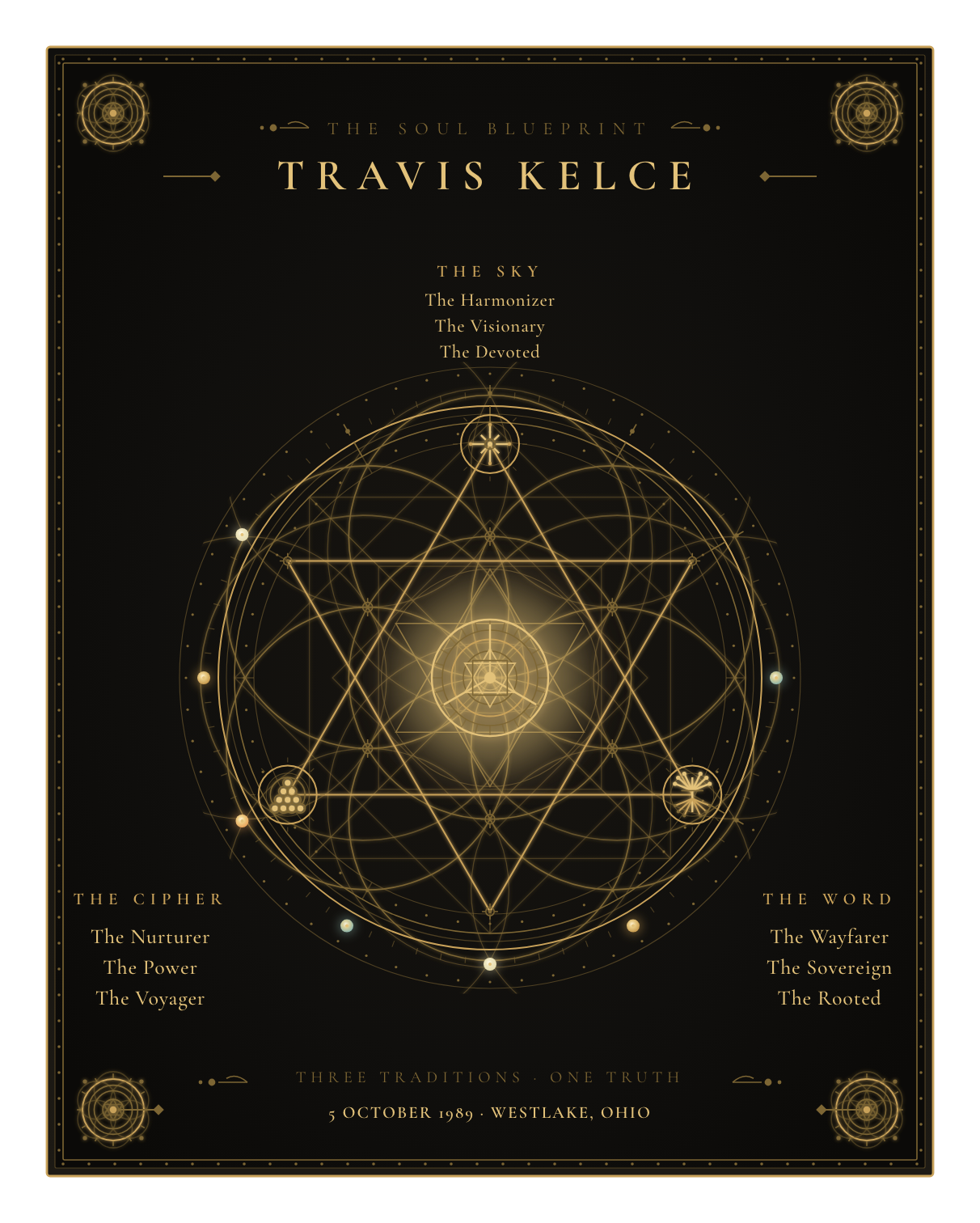
One seal, three languages. The sky he was born under at the apex, the numbers beneath his name at the lower left, the name itself at the lower right — three traditions engraved into one artifact. There is no rising sign, no houses, no angles: without a verified birth time they cannot be honestly drawn. What is true is what is shown.
At a Glance
- Full traditional name
- Travis Michael Kelce
- Born
- October 5, 1989 · Westlake
- Sun
- Libra 12.4° — the essential fire of the life
- Rising
- Birth time unverified — the Ascendant is offered conditionally, never asserted
- Moon
- Sagittarius 15.3° — the inner life
- Mind · Value · Will
- Mercury Virgo · Venus Scorpio · Mars Libra
- Discipline · Direction
- Saturn Capricorn · North Node Aquarius
- Life Path
- 6 — The Nurturer
- Title-name Destiny
- 8 — The Sovereign
- Birth-name Destiny
- 5 — The Free Soul
- Master Numbers
- None preserved at the final layer
- Soul archetype
- The Sovereign who lives the Nurturer’s path
It is late afternoon in Kansas City in January 2020, the light falling at that angle that turns the Arrowhead Stadium into something ancient — a vessel holding a season that has not yet broken into the known. Travis Kelce is in the corridor between the locker room and the field, his hands moving as he speaks to a teammate, his whole body animated in the way of someone for whom presence is not a choice but a trade. The ball is on the grass. The season is closing. And in him — in the particular shape of his attention, the frequency of his yes — something is already calculating the next threshold.
The world calls him a tight end, a champion, a record-breaker, a media figure, a partner in spectacle. The statistics pile like river sediment: the receptions, the yards, the championships claimed. But beneath the accumulated facts of a life — beneath the names and the seasons and the public geometry of what he has done — there moves a source. Not the history that the world records, but the soul-shape that arrived carrying its own blueprint, its own requirement, its own medicine for the time it was born into. The river’s surface shows the light and the movement and the debris; underneath, the current knows what it came to carry.
This reading descends beneath the surface. It reads not the public Travis Kelce — the one the cameras know, the one the statistics build — but the soul underneath, the one that arrived in October 1989 with its own signature, its own wound, its own genius, its own refusal. It reads the blueprint.
What follows is the soul’s own truth, told in the language of the celestial and the numerical, the ancestral and the biographical — the fragments of an arrival that the world did not yet recognize as such.
The reading moves through the eight chapters of the Soul Blueprint architecture — The Arrival, The Soul’s Inheritance, The Living of It, The Soul’s Calling, The Soul’s Territories, The Name You Carry, The Moment, and The Invitation — and at the end, the same instrument turns gently toward you.
His soul has a blueprint.
So do you.
The same three languages — the sky, the numbers, the name — are waiting in your own.
The Arrival
The soul that arrived on October 5, 1989, came bearing a paradox at its center: the individual who becomes himself by merging into something larger, the self born from the act of meeting the other fully. This is not a solitary genius — the kind of soul that builds power through separation and the cultivation of its own exceptional light. This is the relational soul, the one for whom identity is not a possession but a continuous birth into connection, into the group, into the field where other selves are also present.
The signature shape is Libra, which means the self that comes alive through relationship, the identity that measures itself against the balance-point between what it wants and what the other needs. He is the mediator, the one who reads the room and positions himself within it not as master but as conscious part — a unit becoming whole only in the moment of meeting. This is not weakness; it is a very particular kind of strength, the strength that flows through diplomacy, through strategy, through the willingness to serve the greater architecture even while remaining himself.
The paradox lives at the center of his arrival: he must be exceptional to matter, and he must dissolve the need for exceptionalism to become truly himself. The championship titles, the records broken, the accolades accumulated — these are not the end-point of his soul’s journey. They are the threshold. What he came to demonstrate is something far more difficult: that a man can be at the absolute peak of his performance and simultaneously hold an equanimity about it, that he can be the alpha and the equal, the star and the steward. The soul arrived already knowing it would have to unlearn the equation between worth and applause.
The Soul’s Inheritance
He was born into the Midwest in the autumn of 1989, into a family that understood the discipline of work and the invisible architecture of small-town life. His father had moved through the steel industry as a sales representative — a man navigating the systems that built America’s bones, learning to read the market and the men who moved through it. His mother had been a bank executive, the kind of woman who understands precision and the careful stewardship of other people’s trust. The home was one where currency mattered — not just the financial kind, but the currency of responsibility, of showing up, of knowing what was owed.
But there was also a brother — Jason, older, who would himself become a center for the Philadelphia Eagles, a man who played with his body and his intelligence in a place where both were constantly tested. To be the younger brother of someone who had already proven himself in the kingdom that mattered was to arrive into a particular inheritance: not competition, exactly, but a kind of inherited knowledge that excellence was possible, that your body could be a tool for something larger than itself, that the family name could be carried into the professional realm and there be tested and authenticated.
He carried also the ancestral line through his mother — the Croatian heritage, the grandparents’ lineage from Brod Moravice and Velike Drage in the Gorski Kotar region, that particular Eastern European inheritance of resilience, of the knowledge that survival requires both strength and the willingness to bend. This was not wealth passed down; it was the knowledge that life asks hard things and that a person must meet those demands with both their body and their character.
The era was the late 1980s and 1990s, when the mechanisms of American sport were becoming more professionalized, more visible, more capable of transforming a single human into a property, a brand, a template for success. He was born into the possibility of that transformation.
The Living of It
The living of it began in high school in Cleveland Heights, where he threw the ball and ran with it, where his body was already learning the language of competition, already discovering that he could move through space in ways that were noticed. The facts recorded: three-year letter winner as a quarterback, 1,016 running yards and 10 touchdowns, 1,523 passing yards and 21 touchdowns in his senior season. These are the numbers; what they hide is the cost of learning, at a young age, that your body is currency, that excellence is expected, that the family name carries weight.
Then came the threshold at Cincinnati — the scholarship, the redshirting year, the adjustment to a body that was learning new positions, new speeds, new demands. And then, in 2010, the suspension. The testing positive for marijuana, the violation of team rules, the removal from play. This was the wound that would become qualification: the early knowledge that excellence is not a shield against failure, that a person can be talented and still break the rules, that a professional life requires not just talent but the maturation to meet the demands that come with it. The cost was a season lost, the humiliation of suspension, the necessity of return.
What came after was the second act — the return, the proving ground again, the slow accumulation of receptions and yards and touchdowns. The bone bruise in his rookie NFL season with the Chiefs, the injured reserve status, the necessity of healing and re-learning his body. The incremental rise: 2014 as the leading receiver, 2015 as a Pro Bowler, 2016 as First-team All-Pro, the contracts signed that bound him to the franchise, the seasons stretching into years of consistency and excellence.
But underneath the statistics was something less visible: the cost of being relational in a sport built on individual heroics, the cost of moving through the landscape of media and spectacle while trying to remain fundamentally sane, the cost of being a young man who had already learned that failure was possible and that survival required both humility and the refusal to quit.
If this is what was true for him, what might be true for you?
The Soul’s Calling
The calling that arrived for this soul was not primarily to break records, though records would be broken. It was to demonstrate — in the very texture of how a life is lived — that excellence and service are not opposites but partners. He came to show that a person can be extraordinary and simultaneously hold the collective in mind, that the individual and the group are not enemies but partners in the same dance.
Mercury, the god of the careful word and the precise thought, works in Virgo through this soul — giving him the capacity to think with exactness, to refine his understanding, to say what needs to be said with clarity and usefulness. This is not the voice of the performer who needs to be heard; it is the voice of the craftsman, the one who builds something that works, that lasts, that serves a function. When he speaks, the words are measured and direct — the gift of someone who understands that language is a tool, not a stage.
The Life Path unfolds as the Nurturer — the soul whose fundamental calling is to tend, to support, to move through the world with the question of what is needed. Not in a soft way, but in a way that builds structures, that creates spaces where others can flourish, that understands that strength is often most visible in what it gives rather than what it takes. The podcast with his brother, the music festival, the foundation in Cleveland — these are not distractions from his core calling. They are the calling itself, made visible in the world.
What he came to do is this: to teach, through the example of a life fully lived, that a person can be at the center of the arena and simultaneously know that they are part of something much larger, that their excellence is a gift to be stewarded rather than a crown to be worn.
The Soul’s Territories
The first territory is the Field — not merely the rectangular space where football is played, but the entire realm of physical excellence, of a body learning to move with precision and purpose, of the knowledge that mastery is not achieved but continuously earned. In this territory, he has discovered what it means to be exceptional: not the absence of limitation, but the continuous conversation with limitation, the willingness to train when others rest, to refine when others accept, to push the boundary of what the human body can do. The field has taught him that excellence is a practice, not a destination.
The second territory is the Collective — the team, the franchise, the group of men who move together toward a single purpose. This is the territory where his deepest signature lives: he is most alive when he is part of something larger than himself, when his excellence is being fed into the success of the group, when his individual achievement serves the whole. The championships won, the records broken — these gain their meaning not from isolation but from the fact that they were achieved in partnership, that his hands caught the ball that his brother-in-arms threw, that the victory belonged to no one person.
The third territory is the Threshold — the space between what was and what comes next, the realm of transformation and becoming. The suspension and return, the injuries and recoveries, the public evolution from the young man breaking rules to the mature champion — these have been his education in how a life moves through seasons, in how a person learns to let go of one version of themselves and become another. This territory has no fixed walls; it exists in the constant motion between who he was and who he is arriving to become.
Each territory has given him something necessary. Together, they form the deeper mythology — the story of a soul learning that exceptionalism is most meaningful when it serves something beyond itself, when the individual genius bends itself toward the collective flourishing.
There are twelve domains in the kingdom of any life: The Mark, The Unfolding, The Unseen, The Long Return, The Inheritance, The Encounter, The Alchemy, The Living Tension, The Sight, The Body’s Knowing, The Crossing, The Calling.
The Name You Carry
The names a soul carries are not decorative; they are the linguistic embodiment of the calling, the ancestral frequency already present before the world gives them meaning. Travis — the name carries an uncertain etymology, and in that uncertainty there is a kind of freedom: it is a name without a fixed meaning, a sound that arrives clean into the world, unencumbered by the weight of a long history. It is a name that must be filled with its own meaning through the living of the life, through the accumulation of deeds and choices and the particular texture of a person’s presence. To be named Travis is to arrive with the responsibility of writing your own definition.
Michael — the name of the archangel who stands at the threshold between the divine and the mortal, the one who fights, who stands guard, who knows the difference between what should be and what is. It is a name that carries the frequency of discrimination, of the capacity to see clearly and act decisively. In his life, this name has moved through him as the discernment to know when to push and when to yield, when to accept limitation and when to break through it.
Kelce — the family name, arriving through his mother’s lineage, carrying the Croatian heritage of Brod Moravice and Velike Drage, those places in the Gorski Kotar region where the ancestors weathered what the mountains and the history demanded. It is a name rooted in resilience, in the knowledge that survival requires both strength and the flexibility to bend without breaking. To carry this name is to carry the inheritance of people who understood that life is not about the individual achievement but about the continuation of the line, the stewardship of what was passed down.
These three names together form a frequency: the unnamed potential arriving into the call to discrimination and service, rooted in an ancestral lineage of resilience. They sing together the song of a soul who came to write its own definition while serving something larger.
The Moment
The moment arrived in February 2019, when the Kansas City Chiefs faced the San Francisco 49ers in Super Bowl LIV, and the whole arc of a life that had been lived in relative obscurity — relative to what was coming — suddenly became the center of the world’s attention. This was not his first championship, but it was the first time that the trophy held in his hands could be fully felt as his own, as the result of years of discipline and the willingness to carry both the excellence and the humility that comes with it.
But the deeper moment came much later, in the 2022 season, when his older brother Jason lined up across from him on the field in Super Bowl LVII — the Philadelphia Eagles against the Kansas City Chiefs. This was the convergence that could not have been planned, the moment when the entire architecture of his life suddenly collapsed into a single point of meaning. To play against his brother in the Super Bowl, to catch six passes for 81 yards and a touchdown while his brother lined up as the center for the opposing team — this was not simply a game. This was the soul’s entire inheritance coming into view at once.
The victory that night (38–35) held within it something deeper than the score: it held the knowledge that the family could be divided by the field and still remain whole, that excellence could exist in two brothers simultaneously, that the competitive arena could not destroy the deeper bond. In that moment, the records and the accolades suddenly became secondary. What became visible was what he had been moving toward all along: the capacity to be at the absolute center of the spotlight and know that the light was not for him alone.
This was the threshold where the individual Travis Kelce became the brother, became the part of something that exceeded his own achievement. The moment revealed that all the excellence, all the discipline, all the years of training and pushing and refusing to quit had been in service of something that transcended the individual heroic narrative. It was the moment when the soul could finally exhale, knowing that it had been true to its calling.
The Invitation
Everything in this reading has been moving toward a single point. The doubleness named in the first chapter, the inheritance, the wound, the calling, the territory, the name, the moment. These are not seven separate truths about Travis Kelce. They are one truth, named from seven different angles. And they all converge here.
The invitation that has been extended to this soul across the years is both precise and unrelenting: to demonstrate that a person can be exceptional without being exceptional about their exceptionalism, that the brightest light in the room can simultaneously hold space for every other light to shine. This is not the invitation that the younger Travis would have understood. The invitation arrived slowly, in increments, through the living itself.
What was being asked of him, from the very beginning, was a kind of maturation that the culture does not typically offer to its talented young men: the maturation into understanding that your excellence is not yours alone, that the records you break belong to the game, that the championships you win belong to the collective that made them possible. The invitation began with the suspension in his college years — the hard lesson that talent alone is not enough, that a person must also be trustworthy, must also be capable of hearing the law and living inside it. This was the first No, the first boundary-setting, the first clear communication that excellence without character is not excellence at all.
Then came the invitation to release the need to be the center. In the league, in the franchise, in the eyes of the world, he has the capacity to command attention, to be the focal point, to gather the applause. But what has been asked of him — and what he has increasingly answered — is the release of the need for that centrality. The evidence lives in how he plays: in the way he moves the ball, creates space for others, understands that the quarterback’s success is his success, that the team’s victory is sweeter than any individual stat. What was being released was the illusion that worth comes from being special, from being applauded, from being seen as singular.
What was being called toward was something far more beautiful: the capacity to be fully alive in the collective, to find his sense of meaning not in the spotlight but in the knowledge that he is part of something larger than himself, that his excellence serves an architecture that exceeds his own ambition. The championships won with the Kansas City Chiefs are not his trophies; they are the franchise’s proof of what is possible when a person of extraordinary talent is willing to bend that talent toward the group’s flourishing.
What became available because the Yes was said — because he committed to this invitation, often without knowing it explicitly — is a freedom that the world does not typically associate with the warrior, the champion, the record-breaker. He became free from the burden of needing to prove himself endlessly, free from the exhaustion of performing his own specialness, free to move through the landscape of his excellence with equanimity, with humor, with the kind of relaxation that comes from knowing you are enough. The podcast with his brother, the music festival, the foundation work in Cleveland, the willingness to step in front of cameras and speak about things that matter beyond football — these are not distractions from his core purpose. They are the flowering of a soul that has answered the invitation to serve something larger.
He is being asked, in this moment of his life, to hold a particular kind of wisdom: that a person can be at the absolute apex of their professional achievement and simultaneously know that their worth is not dependent on that achievement, that the measure of a life is not the records in the book but the integrity of how the records were made, the people who were lifted in the making, the precedent set for younger men who will come after. This is the invitation that continues, every season, every game, every moment of public visibility: to be the champion who remembers that he is part of a team, to be the individual who does not mistake individual achievement for individual worth.
He is being asked to teach, through the texture of his living, that excellence and humility are not opposites but partners — that a person can break every record in the book and still know that the book belongs to something larger than the breaking of it.
He was not late. He was exactly where the soul-clock said he should be. The mission had been inscribed at the threshold of his first breath. What was being asked of him, he has been walking. The naming has been done.
This Is Not Coincidence
The astrology shows a soul born when the Sun was in Libra — the self that is born into relationship, that comes alive through meeting the other, whose identity is forged in the balance between personal will and the collective need. Mercury in Virgo speaks the precise, discerning intelligence that builds things that work and last. Venus in Scorpio carries the capacity for profound loyalty and total commitment — love that goes all the way or not at all. Mars in Libra is the warrior who fights through strategy, diplomacy, and the defense of fairness rather than through domination. Saturn in Capricorn, in its own domicile, speaks the calling to earn real authority through integrity and the willingness to carry responsibility. The North Node direction is Aquarius — the soul’s medicine is to release the need for personal spotlight and recognition and to serve the collective, to develop equality, to find meaning beyond applause. The numerology speaks independently: the Title Destiny is 8, the Sovereign — the archetype of the one who commands authority and builds legacies. The Birth Destiny is 5, the Free Soul — the soul born to experience life fully, to move through multiple expressions, to know freedom viscerally. The Life Path is 6, the Nurturer — the calling to tend, to support, to understand that strength moves through giving rather than taking. Three entirely different languages arrive at the same truth: This is a soul born to be exceptional and then to spend a lifetime learning that exceptionalism means something when it serves something larger than itself.
Three entirely different languages. One truth.
This is not coincidence. This is what three independent systems do when they are all telling the truth about the same soul.
The Numbers, Decoded
The numbers are computed, not intuited — each letter takes its Pythagorean value, each name reduces, and any Master Number is preserved rather than collapsed.
You have sat with the chart and the numbers and the name of another soul, and watched how a wound becomes a calling, how the place of least belonging becomes the place of greatest gift, how a life too precisely configured to be coincidence reveals itself when three independent languages are read together.
The reading you have just received was, in its outer form, a reading of his soul. But its inner form was a reading written for yours. You did not arrive without a Blueprint either. May this reading be the beginning of the reading you finally receive of yourself. May the light you carry — in whatever particular, irreplaceable form it has taken inside the specific life you were given.
Some lives carry a pattern this clear.
Yours does too.
You’ve read the shape of his soul. The same three languages — the sky, the numbers, the word — are waiting in your own name and birth date. Begin yours, free, below.
Or, when you’re ready, begin your own full Soul Blueprint reading →
Frequently Asked Questions
What is Travis Kelce’s birth chart?
Travis Kelce was born on October 5, 1989, with the Sun in Libra — the sign of relationship, balance, and the self that becomes whole through conscious partnership. His Mercury is in Virgo, a placement of precise, discriminating intelligence and clear communication. Venus in Scorpio speaks profound emotional depth and transformative loyalty. Mars in Libra brings a strategic, diplomatic will that fights for fairness and balance rather than domination. Saturn in Capricorn, in its own domicile, anchors the calling to earn real authority through integrity and responsibility. The rising sign cannot be fixed without a verified birth time.
What is Travis Kelce’s numerology?
Travis Kelce’s Title Destiny is 8, the Sovereign — the archetype of command and authority, the one who builds legacies and holds power responsibly. His Birth Destiny is 5, the Free Soul — the soul born to move through multiple expressions and to know freedom viscerally. His Life Path is 6, the Nurturer — the calling to tend, to support others, and to understand that strength moves through giving. Together, the three numbers speak a soul called to excellence, to freedom, and to service.
What does the name Travis Kelce mean?
Travis is a name whose etymology remains uncertain, arriving into the world without a fixed historical weight — it must be filled with meaning through the living of the life itself. Michael carries the frequency of the archangel who stands at the threshold, the one who sees clearly and discriminates between what is and what should be. Kelce is the family surname, arriving through his mother’s Croatian heritage from the Gorski Kotar region — a lineage rooted in resilience, in the knowledge that survival requires both strength and the flexibility to bend without breaking. Together, the names sing the frequency of unnamed potential arriving into the call to clear discrimination and ancestral service.
What is a Soul Blueprint?
A Soul Blueprint integrates three independent traditions — Western natal astrology, Pythagorean numerology, and the etymology of the full birth name — into a single document written as a personal letter to the soul. When you’re ready, you can begin your own.
This reading was prepared in the lineage and methodology of the Soul Blueprint Method — Pythagorean numerology with master numbers preserved, Western archetypal astrology, and a researched etymological reading of the full name. Travis Kelce’s birth date (October 5, 1989) is sourced from the public record; the birth time is unverified, so the rising sign is offered conditionally and never asserted.
A Soul Blueprint reading · Astrology · Numerology · Etymology · shams-tabriz.com