
Dua Lipa’s Birth Chart, Numerology, and Name Decoded
Dua Lipa’s Birth Chart,
Numerology & Name Decoded
The Soul Blueprint Method — three traditions woven into one personal letter: Western natal astrology, Pythagorean numerology, and the etymology of the soul’s name. Learn the method →
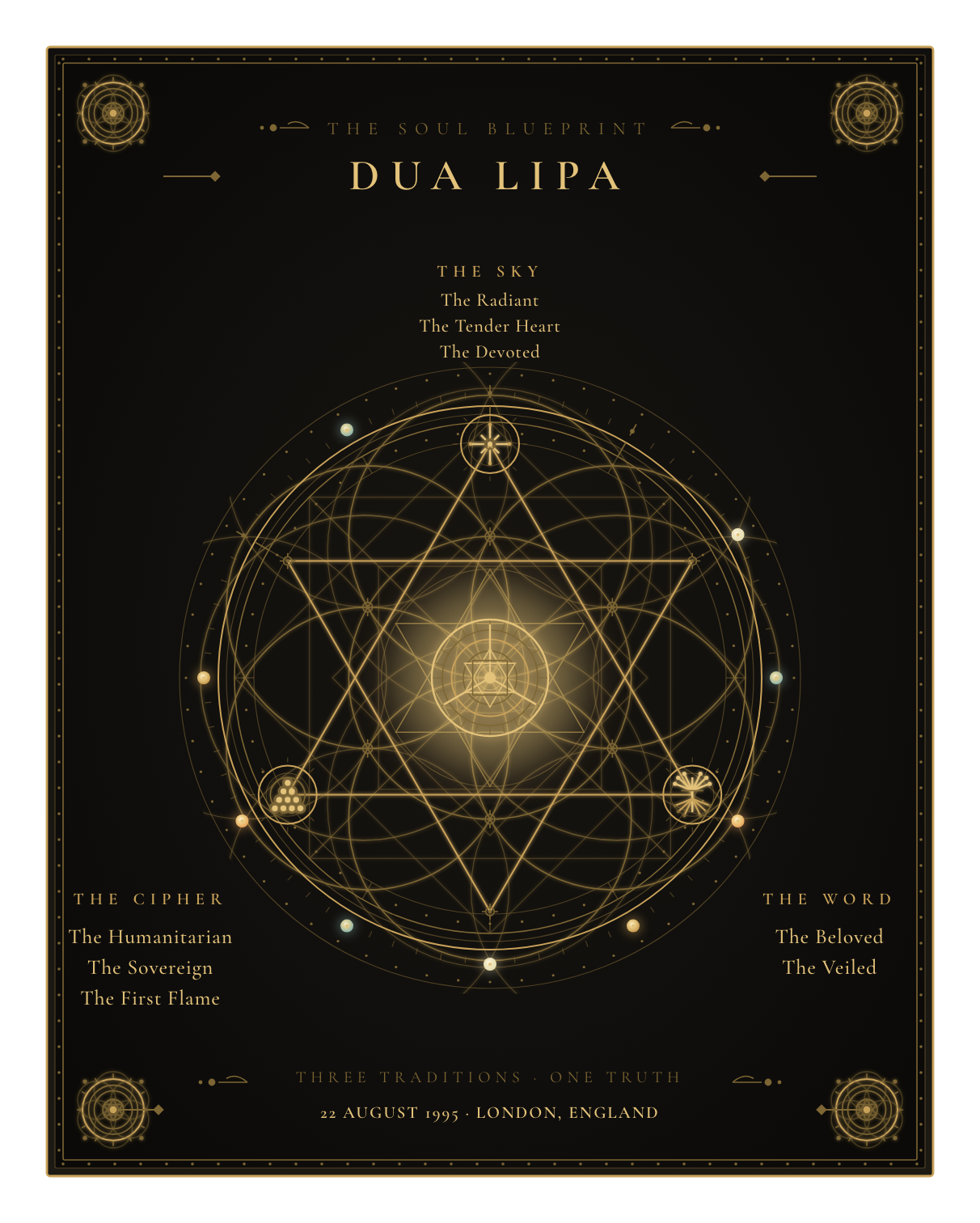
One seal, three languages. The sky she was born under at the apex, the numbers beneath her name at the lower left, the name itself at the lower right — three traditions engraved into one artifact. There is no rising sign, no houses, no angles: without a verified birth time they cannot be honestly drawn. What is true is what is shown.
At a Glance
- Full traditional name
- Dua Lipa
- Born
- August 22, 1995 · London
- Sun
- Leo 28.9° — the essential fire of the life
- Rising
- Birth time unverified — the Ascendant is offered conditionally, never asserted
- Moon
- Cancer 16.2° — the inner life
- Mind · Value · Will
- Mercury Virgo · Venus Leo · Mars Libra
- Discipline · Direction
- Saturn Pisces · North Node Libra
- Life Path
- 9 — The Humanitarian
- Title-name Destiny
- 1 — The Pioneer
- Birth-name Destiny
- 1 — The Pioneer
- Master Numbers
- None preserved at the final layer
- Soul archetype
- The Pioneer who lives the Humanitarian’s path
It is August 2017 in London, and the light is coming through the windows of a studio where a young woman in her early twenties is hearing, for the first time in the world’s ear, the voice that will not be forgotten. ‘New Rules’ is playing. The song is spare, precise, almost mathematical in its clarity—each word placed exactly where it belongs, each breath accounted for. She stands in that light knowing something has arrived that she cannot call back, something that will remake the whole geography of her life. The world will know her name now. The world will try to say who she is.
But the world speaks in fragments. It names what it can see—the chart positions, the song peaks, the award ceremonies, the collaborations, the numbers on a screen—and calls this a person. And yet beneath the fragments runs something else: a source, a coherence, a soul that came into form carrying its own logic and its own fire. The fragments are real. They are also not the whole story. A river is not the same as its tributaries, though the tributaries are what you can touch.
This reading reads the source. It follows the blueprint backward from the arrival, through the inheritance, into the bone-deep calling that brought this particular soul forward at this particular moment in time. It asks not ‘what did she accomplish’ but ‘what was she born to demonstrate, and what price did it cost to say yes to that?’ It listens for the coherence beneath the light.
What follows is written in the old way—as a letter about a soul, not a biography of a name. The reader is overhearing something meant for deeper recognition.
The reading moves through the eight chapters of the Soul Blueprint architecture — The Arrival, The Soul’s Inheritance, The Living of It, The Soul’s Calling, The Soul’s Territories, The Name You Carry, The Moment, and The Invitation — and at the end, the same instrument turns gently toward you.
Her soul has a blueprint.
So do you.
The same three languages — the sky, the numbers, the name — are waiting in your own.
The Arrival
She came alive through radiant creative expression—the self that radiates outward to create and to be recognized, that literally gives form and life to what the imagination holds. This is the signature of arrival: the soul that comes into the world carrying the fire to bring something to life and to have that life be seen. There is no apologizing for it, no dimming of it; the work is to pour the self outward in such a way that others feel alive in its presence.
But this fire arrived carrying a paradox. The soul came bearing both the drive to create and radiate and a reigning need for home, for the quiet sanctuary where the heart can rest and be healed. She is the one who must give generously to the world and yet return, always, to the place where she is held. The warmth that gives life to others cannot stay outside forever; it must cycle back to shelter.
She came also bearing a will that works through partnership and fairness rather than through dominion—the soul that fights not for conquest but for balance, for the other’s due, for the dignity of the equal. And she came bearing a mind of surgical precision, a voice that cuts away what is false and leaves only what is exactly true. Every word counts. Every note is in the right place.
This is the signature: the radiant creator who gives warmly, the strategist of fairness, the one whose precision serves her generosity. She arrived carrying all of it at once, already whole, already coherent—the question would never be ‘who will she become?’ but rather ‘what will she be willing to risk to let this arrive into the world?’
The Soul’s Inheritance
She was born into a lineage of music-makers and keepers—a father whose instrument and voice carried the weight of his own creative fire, who filled the home with the songs of the great storytellers: Bowie, Dylan, Sting. The house itself was a kind of conservatory where the child could hear, daily, what it meant to make something beautiful and true. This was not instruction in the formal sense; it was inheritance by atmosphere, by the music that played while life was being lived.
She was born into a family that understood sacrifice and return. When she was fifteen years old, the family made the decision to relocate, to move back to their country after years abroad. But she—the eldest, the one already burning with the calling—made another choice: to stay, to move alone to a new city, to attend school and pursue the music that had already begun to call her name. This was not rebellion; it was the soul’s own Yes, spoken in the only language it knew. She left to become what she came to become.
She was born into an era of digital transformation, when a young artist could be discovered through the internet, when the old gatekeepers were beginning to lose their grip. She was born into a moment when the music industry itself was learning to listen differently. And she was born carrying the name Dua—a word meaning love in the language of her lineage, a syllable that would carry her story around the world. She inherited the earth of two countries, the language of music, the example of a father who made his own art, and the particular loneliness and freedom of being the one who goes forward first.
The Living of It
The living of it began early—at five years old, already singing, already knowing that this was the work. By nine, she was formally trained, attending the school where young artists learn the craft of presentation and voice. She was building the instrument. But at fifteen came the threshold that would define everything that followed: the departure, the aloneness, the hunger that had to sustain itself on faith and on a clarity of purpose that most adults never know.
The signature wound arrived in a room at school—a teacher who told her she could not sing. This is a particular kind of cruelty, especially to a young girl already burning with the knowing that music is her life. It would have been easy to believe it, to internalize the judgment and go quiet. Instead, something in her transformed it into fuel. The wound became the qualification. She would prove, not to the teacher but to herself, that the voice was real, that the calling was true.
The living cost her the ordinary things: the stability of living with her family, the ease of being a regular teenager in one place. It cost her the safety of knowing she would succeed. For years, she worked without certainty—as a waitress, as an unsigned artist, as a young woman betting everything on a belief that the music would arrive. In 2013, a management company saw what she was carrying and offered her enough money to stop the waitressing and commit fully to the work. Even then, there was no guarantee. She was building something in the dark, trusting that the light would come.
When it came—when ‘New Rules’ reached the top of the charts in 2017, when the song became the marker that the world could finally hear what she had always known—it was not a surprise to her. It was an arrival that had been promised by her own precision, her own refusal to dim the fire, her own willingness to be alone with the calling for as long as it took.
If this is what was true for her, what might be true for you?
The Soul’s Calling
She came to speak the truth that can be heard—the calling to make music that is exact, useful, and clear. The mind that serves her is a craftsman’s mind, one that refuses the approximate, that sees precisely what is and is not so, and that uses words and melodies the way a jeweler uses light: each one placed to illuminate exactly what needs to be seen. Her voice became an instrument of clarity in a world full of noise.
But the calling goes deeper than technique. She came to demonstrate how radiant self-expression can be offered as a gift rather than as a demand for admiration—how the fire that creates can also warm others, can lift them, can make them feel more alive in the presence of what she brings forward. The songs are about love, about boundaries, about the human heart learning to know itself. They are personal and universal at once.
She came also bearing a particular medicine: the will to fight for fairness, for the other’s dignity, for balance in the room where power lives. She speaks for those who are learning to know their own worth. She has used her platform to advocate for women, for LGBTQ+ rights, for the idea that the music industry itself must change in how it holds and honors the artists who make it sing. This is not separate from her art; it is the same fire expressed through a different channel.
The calling, at its deepest, is to show that precision and warmth are not opposites—that the one who thinks clearly can also love deeply, that the artist who demands excellence of herself can also be generous with others, that the voice which speaks truth can also heal. She came to demonstrate this integration, and she has spent her life proving it possible.
The Soul’s Territories
The first territory is the studio itself—the space where the voice is refined, where the songs are built note by note, word by word, with the exactitude of a surgeon and the warmth of someone who understands that every choice ripples into the listener’s heart. Here she is most alive, most precisely herself, where the fire finds its form. This is where the inheritance meets the calling, where the music her father played at home becomes the music she speaks to the world.
The second territory is the stage—not as a place of ego, but as a place of meeting. Here the radiant self reaches out to touch thousands of hearts at once, to make them feel alive, to prove that they are not alone in what they feel. She has said that she learned to bring full presence to this space, to give her entire self in the moment of performance. The stage became the place where the warmth that gives life could be poured out directly, where the distance between artist and audience dissolved into something mutual.
The third territory is the one she has been building quietly: the work of advocacy and return. She created a foundation with her father to raise funds for people in Kosovo facing hardship. She has claimed citizenship in both Albania and Kosovo, carrying the inheritance forward not as a story but as a living presence. She has used her platform to speak for fairness, for the equal dignity of all people regardless of gender or orientation. This territory holds the medicine of her Mars—the will that fights not for dominion but for balance, for the other’s due.
These three territories—the studio, the stage, the work of return and justice—are not separate aspects of who she is. They are the same soul expressing itself through different channels, weaving together precision and generosity, personal excellence and collective care. Together they sketch the deeper mythology: a soul who came to show that the artist and the advocate, the creator and the healer, are one.
There are twelve domains in the kingdom of any life: The Mark, The Unfolding, The Unseen, The Long Return, The Inheritance, The Encounter, The Alchemy, The Living Tension, The Sight, The Body’s Knowing, The Crossing, The Calling.
The Name You Carry
The name Dua carries the resonance of love—not love as sentiment or attachment, but love as the force that chooses the other, that recognizes the other’s dignity, that stands with the other as an equal. This name arrived as a suggestion from the grandmother, a syllable of inheritance, a word that would travel everywhere she traveled and speak something true about what she came to offer. To be called Dua is to carry the instruction to love, to choose warmth, to recognize the heart in the room. The name itself became a kind of promise.
The surname Lipa carries the weight of the paternal line—the lineage of the musician, the maker, the one who understood that music is a form of truth-telling. This is the family name that holds the example of the father’s art, the grandmother’s wisdom, the inheritance of those who came before and understood how to make something beautiful and enduring. It is a Kosovar name, rooted in the earth of a particular place and a particular history.
Together, the names speak: love meets lineage, the universal inheritance of the heart meets the specific geography of family and place. She carries a name that asks her to be both—to love universally and to remember where she comes from, to radiate the warmth of her calling and to return to the shelter of home and heritage. The names carry a kind of instruction encoded in sound, in the syllables themselves. To speak her name is to invoke both the personal fire and the family inheritance, both the reaching outward and the returning home. She has lived both dimensions of what her names carry.
The Moment
It began in 2017 when ‘New Rules’ reached the top of the charts—not because the song was the first or the best, but because in that moment, the world finally caught up to what she had always known. The song rose to number one in August of that year, and it marked something that would reshape everything that followed: the first solo female artist to claim that position since another woman had done it two years before. But what mattered was not the ranking. What mattered was that the voice that had been dismissed as unworthy, that had been told it could not sing, had become a voice the entire country could not stop hearing.
In the months that followed, the recognition multiplied. By 2018, she had won two Brit Awards—as British Female Solo Artist and as British Breakthrough Act—becoming the first female artist to receive five nominations in that year alone. Her collaboration with Calvin Harris, ‘One Kiss,’ became the biggest-selling song of that entire year in the UK. She was everywhere, and yet the moment revealed something unexpected: a viral comment, meant as mockery, that called out her ‘lack of energy’ on stage. The internet turned it into a meme. ‘Go girl, give us nothing,’ the comment said. And something in her heard it as an invitation to prove them wrong.
This was not a humiliation that broke her; it was a threshold. She understood that the precision which served her in the studio had to find its expression on stage, that the warmth she carried had to be visible, had to reach across the distance and make people feel that she was present with them. She committed to becoming not just a singer with a perfect voice, but a performer who could pour the full radiance of herself into the room. The criticism became the catalyst for transformation. By the time she released ‘Future Nostalgia’ in 2020, she had become not just an artist but a presence, a force, someone whose entire being moved with intention and grace. The wound had become the qualification once more.
The Invitation
Everything in this reading has been moving toward a single point. The doubleness named in the first chapter, the inheritance, the wound, the calling, the territory, the name, the moment. These are not seven separate truths about Dua Lipa. They are one truth, named from seven different angles. And they all converge here.
She is being asked to hold a particular kind of power—not the power to dominate, but the power to give form to something true, to speak with precision and warmth simultaneously, to be so clear in her vision that others can follow her into territories they did not know existed. This is the asking: to use the radiant fire not for ego but for service, to let the music speak what cannot be said in words, to bring the listener into the presence of their own heart. She carries a mind that can analyze, refine, and perfect; she is being asked to use that mind in service of the soul’s deeper expression, not in service of control.
What was being released was the small self—the version of her that could believe a teacher’s judgment, that could accept the limitation as final, that could perform the song without bringing the whole of her presence to the room. What was being released was the fear that she was not enough, that her voice was not real, that the calling would somehow prove to be a delusion. She had to let go of the need for proof from anyone else and root herself instead in the knowing that only she could carry. This releasing was not a single moment; it was a years-long practice of saying No to doubt and Yes to the fire every single day.
What was being called toward was relationship—not as a dissolution of self, but as a deepening of it. The calling was to learn that the stage is not a place to project the self outward at the world, but a place to meet the world as an equal, to create a space where artist and audience could recognize each other. The calling was to use her platform not to be admired but to advocate for fairness, for the dignity of those whose voices are smaller, for the music industry itself to transform in how it holds and honors the artists who make it sing. She was being called toward the medicine that only she could bring—the integration of excellence and generosity, of precision and warmth, of the personal fire and the collective good.
What became available because she said Yes is a territory that extends far beyond music. She has begun to own the master recordings and publishing rights that are the foundation of an artist’s true autonomy—not in the spirit of accumulation, but in the spirit of sovereignty, of being able to make her own choices about how her work moves in the world. She has claimed citizenship in both the countries of her heritage, making the return concrete, making the inheritance visible not just in music but in political belonging. She has been named one of the most influential people on Earth by Time magazine, not because she is famous, but because something about the way she lives—the precision, the warmth, the refusal to dim the fire, the commitment to fairness—is teaching others how to live.
She is being asked to keep showing that the artist and the advocate are one, that you can make music of surgical clarity and still love the world deeply, that you can come from a small country and speak to billions without losing the home that made you. She is being asked to be proof that the soul’s calling, lived fully and without apology, does transform not just the one who carries it but the entire field around her. She is living the answer to the question: what happens when someone says a complete and radical Yes to what they came here to do? The answer, it turns out, is everything. Her presence in the world is reshaping what is possible for those who come after her, who hear the voice and understand that their own fire is not a delusion, that precision and warmth are not opposites, that a young person with a calling can build something real and true and make the whole world listen.
She was not late. She was exactly where the soul-clock said she should be. The mission had been inscribed at the threshold of her first breath. What was being asked of her, she has been walking. The naming has been done.
This Is Not Coincidence
The astrology reads it this way: the self that radiates outward to create and to be recognized, whose warmth and generosity literally give life to others, arrives carrying also a mind of surgical discrimination and a will that acts through partnership and fairness rather than dominion. The numerology reads it independently: the pioneer who leads and actualizes, combined with the humanitarian who serves the whole, together creating a soul who brings something entirely new into the world while insisting on justice and collective care. The names—Dua meaning love, rooted in the lineage of Lipa—speak the same instruction: radiate the warmth, remember the family, choose the other as an equal. Three entirely different languages. One truth. The fire that warms is also the fire that illuminates what needs to change.
Three entirely different languages. One truth.
This is not coincidence. This is what three independent systems do when they are all telling the truth about the same soul.
The Numbers, Decoded
The numbers are computed, not intuited — each letter takes its Pythagorean value, each name reduces, and any Master Number is preserved rather than collapsed.
You have sat with the chart and the numbers and the name of another soul, and watched how a wound becomes a calling, how the place of least belonging becomes the place of greatest gift, how a life too precisely configured to be coincidence reveals itself when three independent languages are read together.
The reading you have just received was, in its outer form, a reading of her soul. But its inner form was a reading written for yours. You did not arrive without a Blueprint either. May this reading be the beginning of the reading you finally receive of yourself. May the light you carry — in whatever particular, irreplaceable form it has taken inside the specific life you were given.
Some lives carry a pattern this clear.
Yours does too.
You’ve read the shape of her soul. The same three languages — the sky, the numbers, the word — are waiting in your own name and birth date. Begin yours, free, below.
Or, when you’re ready, begin your own full Soul Blueprint reading →
Frequently Asked Questions
What is Dua Lipa’s birth chart?
Dua Lipa was born on August 22, 1995, in London, with the Sun in Leo—the self that radiates outward to create and be recognized. Her Mercury is in Virgo, giving her a mind of surgical precision; her Venus is in Leo, expressing warmth and generous affection; her Mars is in Libra, a will that acts through partnership and fairness; and her Saturn is in Pisces, the discipline of giving form to the boundless. Her Moon is in Cancer, the emotional nature at home in the instinct to nurture and be nurtured. Because the birth time is unverified, the Rising sign (ascendant) cannot be determined with certainty.
What is Dua Lipa’s numerology?
Dua Lipa’s numerology carries three core numbers that govern her soul’s expression. Her Title Destiny is 1—The Pioneer, the soul that actualizes and leads. Her Birth Destiny is also 1, reinforcing that same pioneer signature. Her Life Path is 9—The Humanitarian, the soul whose deeper calling is to serve the collective good. Together, these three numbers create an archetype: the pioneer who leads not for ego but in service of something larger than herself.
What does the name Dua Lipa mean?
The name Dua means love in Albanian, a syllable that carries the instruction to choose warmth, to recognize the dignity of the other, to stand with those around her as an equal. Her grandmother suggested this name, making it an explicit inheritance. The surname Lipa is rooted in her paternal lineage—the family of musicians and makers who understand that music is a form of truth-telling. Together, the names speak an instruction: to radiate the warmth of her calling and to remember always where she comes from.
What is a Soul Blueprint?
A Soul Blueprint integrates three independent traditions — Western natal astrology, Pythagorean numerology, and the etymology of the full birth name — into a single document written as a personal letter to the soul. When you’re ready, you can begin your own.
This reading was prepared in the lineage and methodology of the Soul Blueprint Method — Pythagorean numerology with master numbers preserved, Western archetypal astrology, and a researched etymological reading of the full name. Dua Lipa’s birth date (August 22, 1995) is sourced from the public record; the birth time is unverified, so the rising sign is offered conditionally and never asserted.
A Soul Blueprint reading · Astrology · Numerology · Etymology · shams-tabriz.com