
David Lynch’s Birth Chart, Numerology, and Name Decoded
David Lynch’s Birth Chart,
Numerology & Name Decoded
The Soul Blueprint Method — three traditions woven into one personal letter: Western natal astrology, Pythagorean numerology, and the etymology of the soul’s name. Learn the method →
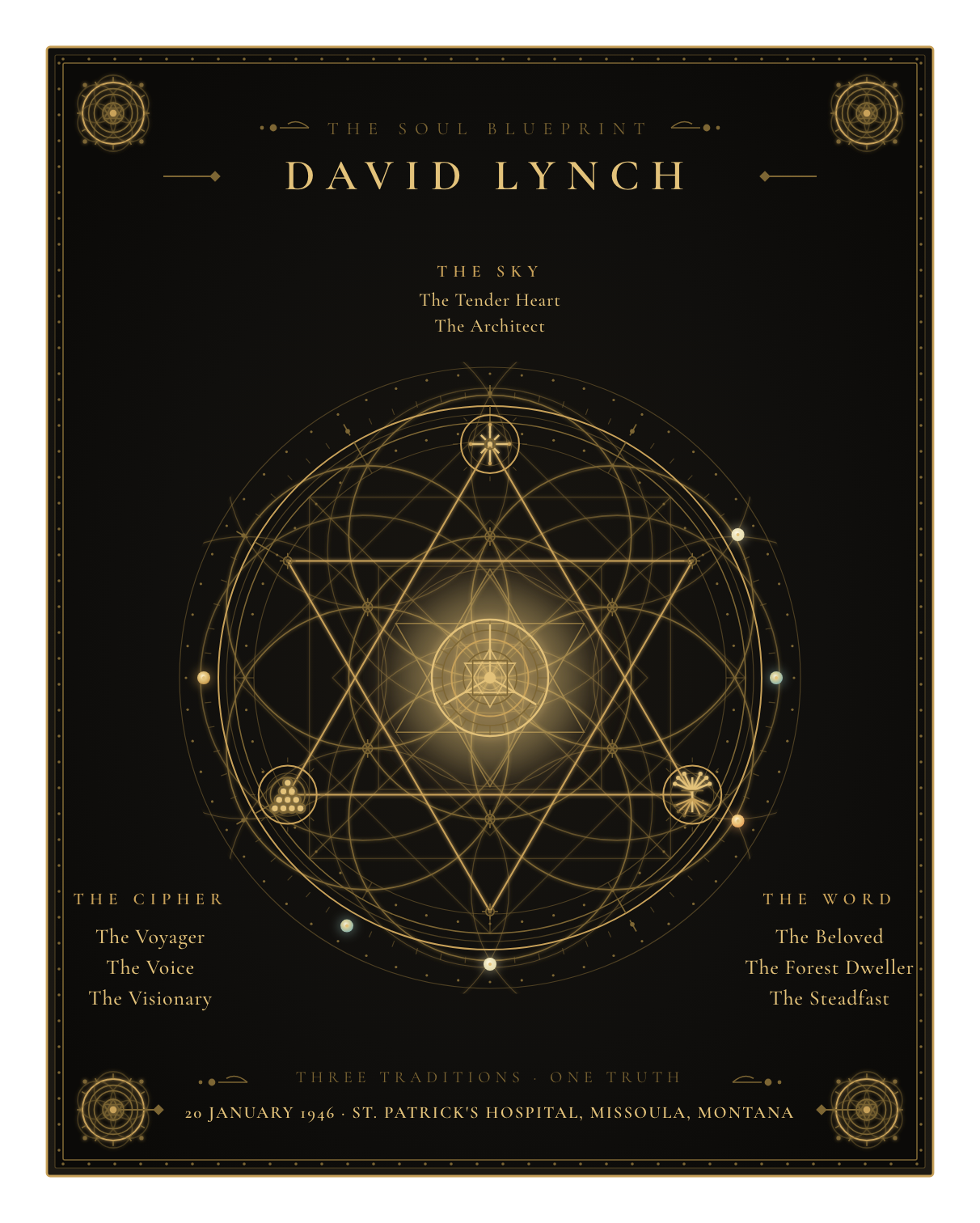
One seal, three languages. The sky he was born under at the apex, the numbers beneath his name at the lower left, the name itself at the lower right — three traditions engraved into one artifact. There is no rising sign, no houses, no angles: without a verified birth time they cannot be honestly drawn. What is true is what is shown.
At a Glance
- Full traditional name
- David Keith Lynch
- Born
- January 20, 1946 · Missoula
- Sun
- Aquarius 0.1° — the essential fire of the life
- Rising
- Birth time unverified — the Ascendant is offered conditionally, never asserted
- Moon
- Virgo 10.1° — the inner life
- Mind · Value · Will
- Mercury Capricorn · Venus Capricorn · Mars Cancer
- Discipline · Direction
- Saturn Cancer · North Node Gemini
- Life Path
- 5 — The Free Soul
- Title-name Destiny
- 3 — The Communicator
- Birth-name Destiny
- 11 — The Illuminator
- Master Numbers
- 11
- Soul archetype
- The Communicator who lives the Free Soul’s path
In the winter of 1972, in abandoned stables outside Philadelphia, a young man stood among industrial decay—crumbling brick, the smell of rust and old animal straw—and began to build a film frame by frame. The light was thin and gray. The budget was almost nothing. He had already decided that whatever came from his hands would be strange, precise, and would not look away from what lies beneath the surface of things. Five years he would spend in those stables, a discipline so extreme it bordered on monastic—the kind of commitment that marks a soul not confused about its work, even when the world has no name for it yet.
The fragments the world calls a life are like a river’s surface—the visible current, the name we give it, the map we trace. But beneath runs the source, the original spring that feeds all the motion above. Biographers will tell you what David Lynch made, the films and the television, the coffee line and the meditation foundation. They will catalog the marriages, the awards, the cultural impact—all of it true and none of it the thing that moved through the form. That source-water runs deeper. It arrives in a life with specific architecture, specific medicine, specific gravitational pull. This reading reads the source—not the biography, but the blueprint underneath it, the soul-geometry that made the hands move and the eyes remain open when easier spirits would have closed them.
The reading moves through the eight chapters of the Soul Blueprint architecture — The Arrival, The Soul’s Inheritance, The Living of It, The Soul’s Calling, The Soul’s Territories, The Name You Carry, The Moment, and The Invitation — and at the end, the same instrument turns gently toward you.
His soul has a blueprint.
So do you.
The same three languages — the sky, the numbers, the name — are waiting in your own.
The Arrival
The visionary fire arrived in a form that comes alive by liberating and reforming what the world has settled into thinking is fixed—a self that leans into the machinery of civilization itself, not withdrawn from it, but intimate with it, studying it, teaching it to see what it has forgotten how to see. This is the soul of the seer and the revolutionist, the one who comes bearing invention not for its own sake but as an act of humanitarian urgency: the world is asleep and I have come to wake it. The paradox that carried him was this—he arrived with absolute certainty about the need for vision and reform, yet the tools he would use to reform the given order were not clarity itself but mystery, not explanation but dream, not the architecture of obviousness but the architecture of the unspoken and the barely-seen. To liberate through obscurity. To revolutionize by refusing to settle the image into safety. This is the signature he carried from the beginning: a mind that thinks in structure and consequence, a heart that builds and commits through the long haul, and beneath both—a fierce protectiveness of the vulnerable, the suppressed, the thing that civilization steps over without noticing. He came to show what was hidden in plain sight.
The Soul’s Inheritance
He was born into the lineage of the investigator and the nurturer—a mother who taught language, a father who studied the living world through the discipline of science, both of them engaged in the work of learning and transmitting truth. The era was post-war America, the mythology was the suburban dream, the landscape was Montana—a frontier sensibility paired with the anxiety of the atomic age. He was a boy scout in that landscape, learning structure and duty, learning the codes of citizenship and order. But he was also a sensitive child in the presence of decay—he would come to speak of the industrial underbelly he encountered in Philadelphia as the material that cracked him open, the visual language that taught him what art had to do. The inheritance was contradictory and perfect: order and chaos, science and intuition, the frontier mythology and the knowledge that beneath the surface of peace lives a different story. His father’s commitment to rigorous inquiry gave him the discipline. His mother’s work with language gave him the understanding that words and images are the machinery through which consciousness is transmitted. He grew up in a household where investigation was honored, where precision mattered, where the work of understanding was sacred. The foundation was built from exactitude and from the unspoken understanding that there was always more to see if you were willing to look.
The Living of It
The soul came to live this inheritance by refusing to settle it into comfort, by taking the discipline he had been given and driving it toward territories that made him vulnerable—territories of mystery, dream, and the exposure of what lies beneath the mythology he had been given. The cost was in the refusal of resolution. He would create images so precise in their strangeness that audiences could not look away, and this meant building the capacity to remain in the room with what disturbs, what confuses, what will not be domesticated into meaning. Five years in those stables, building Eraserhead frame by frame with almost no resources—this was the signature struggle lived out in its pure form: the commitment to vision so absolute that survival itself becomes secondary. The wound that qualified him was the understanding that civilization rests on a lie, that the surface of American small-town life and suburban peace covers a turbulence that demands exposure. He did not turn away from this knowledge. Instead, he made it his work to render it visible, to build the films and the television that would refuse the comfort of easy answers. This meant being willing to be misunderstood, to be called difficult, to create work that people would resist because it showed them what they had been trained not to see. The marriage to precision and the marriage to mystery cost him in loneliness, in the need to remain disciplined even when isolation was the price.
If this is what was true for him, what might be true for you?
The Soul’s Calling
The calling that moved through him was the calling of the communicator and the illuminator—a soul sent to transmit vision through form, to build languages that the ordinary mind does not yet speak. Mercury gave him the strategic voice, the measured and authoritative speech, the mind that thinks in structures and sequences and consequences, but it was a mind in service of something larger: the revelation of what lies beneath the surface. The Life Path direction moved him toward freedom and the breaking of conditioning—toward the development of the many-sided curiosity, the willingness to question rather than pronounce, to gather the immediate facts firsthand rather than remain locked in the abstract certainty. What he came to demonstrate was this: that art is not decoration, that film and television are instruments of consciousness itself, that the work of the artist is to build the architecture through which others can see. His voice became unmistakable because it refused to simplify, because it carried absolute commitment to precision paired with absolute refusal to explain. He taught the world—through the work itself, not through manifestos—that the strange and the dreamlike are not failures of clarity but higher clarities, that mystery is not the opposite of truth but its deeper home.
The Soul’s Territories
The territory of cinema as revelation became the place where his gifts converged most powerfully—the medium that allowed him to build, frame by precise frame, the architectures of dream and the visual languages through which the unconscious could speak. This was the territory where his commitment to building something lasting, something that would outlive him, met his fierce protection of the vulnerable and the suppressed. Every film was a structure erected against forgetting, a form built to show what the world steps over.
The territory of the television series opened a different capacity in him—the long-form narrative that could sustain mystery across time, that could build communities of viewers held in shared unknowing. Twin Peaks became the demonstration of what television could be when a vision was given true authority: not entertainment designed to settle the audience into comfort, but a form that honored complexity and refused resolution.
The territory of meditation and consciousness itself—the initiation into Transcendental Meditation in 1973 marked the moment when his investigation of the inner world became formally disciplined, when the search for truth moved from the external landscape of industrial decay and small-town corruption into the interior territories of mind itself. This became the medicine he would eventually give back to others through the Foundation, the offering of tools by which other souls could find their own interior clarity. Each territory held the same signature: precision, commitment, the willingness to go deep, and beneath all of it, the fierce love for what is vulnerable and needs protection.
There are twelve domains in the kingdom of any life: The Mark, The Unfolding, The Unseen, The Long Return, The Inheritance, The Encounter, The Alchemy, The Living Tension, The Sight, The Body’s Knowing, The Crossing, The Calling.
The Name You Carry
The names carry a resonance that moves through him like a current. David speaks to the beloved, the one chosen, the one who carries an old lineage of prophecy and vision—there is a weight of witnessing in it, a quality of being seen by something larger. Keith carries the sense of the keeper, the one who tends what has been entrusted, the name of solidity and root. Lynch carries the old knowledge—the name itself suggests the wild wood, the unmarked territory, the place where the ordinary rules do not hold dominion. Together, the names carry a paradox: the beloved visionary who tends what is sacred, who builds his work in the unmarked territories of consciousness. The full name—David Keith Lynch—vibrates with the frequency of one who has been chosen to see and to speak what he sees, who carries the responsibility of that seeing, and who does not retreat from the territories that civilization prefers to ignore. It is a name that sits well on a soul committed to both precision and mystery, to building structures that last and to refusing the comfort of the already-known.
The Moment
In 1990, in the space of a single turning of the calendar, two arrivals converged that would define the shape of his life forward: Wild at Heart arrived at Cannes in May and carried the Palme d’Or, the crown of cinema, and in the same year Twin Peaks arrived on American television in April and became not a show but a phenomenon, a collective dream that seized the culture and held it. The moment was not accidental—it was the culmination of decades of discipline, of five-year commitments to films no one wanted to finance, of building the architecture of vision in conditions of near-total constraint. By 1990, he had earned the authority to be believed, to be heard, to be given platforms large enough to hold what he needed to say. The miracle of that year was not that he succeeded—he had already succeeded in the work itself, had already proven the integrity of his vision—but that the world caught up. That suddenly, millions of people were willing to sit in the strangeness, to remain in the mystery, to let themselves be disturbed and enlarged by what he was showing them. Twin Peaks revealed something he had always known: that the hunger for genuine vision, for art that does not condescend, for narratives that honor complexity—that hunger was not marginal. It was waiting. The year revealed that a soul committed to the difficult work, the precise work, the work that refuses to settle into comfort, can eventually move the world itself. It was the proof of the calling.
The Invitation
Everything in this reading has been moving toward a single point. The doubleness named in the first chapter, the inheritance, the wound, the calling, the territory, the name, the moment. These are not seven separate truths about David Lynch. They are one truth, named from seven different angles. And they all converge here.
What was being asked of this soul was a form of radical fidelity—not to the marketplace, not to the machinery of industry, not to the comfort of repeating what had already worked, but to the vision itself, to the commitment to show what lies beneath the surface of what the world has agreed to call normal. From the beginning, the question posed to him was this: Will you remain true to what you see, even when the world offers you resources contingent on compromise? Will you build the architecture of your vision even when no one is watching, even when the budget is almost nothing, even when the established orders of cinema and television resist what you are trying to do? The yes he said—lived out in those five years in the stables, in the refusal of the studio interference on Dune, in the commitment to films that confused and disturbed rather than settling audiences into false peace—the yes he said meant releasing the smaller self, the self that wants approval, the self that measures success by the applause of the moment. What was being released was the temptation toward explanation, toward closure, toward the reduction of mystery into meaning that can be packaged and sold. He was being asked to release the comfort of being understood in real time, to accept that his work would be resisted, that critics would call it obscure or difficult, that even those closest to him might not fully comprehend what he was building.
What was being called toward was the deeper fidelity—to the Source itself, to the vision that arrives through consciousness when the small self gets out of the way. In 1973, the initiation into Transcendental Meditation formalized this calling, gave him a practice through which to deepen the listening, to create the interior silence from which the true images arrive. The meditation was not separate from the films—it was the same commitment, lived on two fronts: the commitment to precision and clarity on the level of form, and the commitment to the silence and the mystery on the level of consciousness itself. What was called toward was also the gift of transmission—not just to create for oneself, but to build the structures through which others could begin to see, to begin to wake. The Foundation he created in 2005, offering Transcendental Meditation to at-risk populations, to incarcerated people, to students, was the living proof of this: the yes to the calling meant eventually becoming the one who teaches others how to access the interior clarity from which true vision arises.
What became available because the yes was said was precisely this: the authority to move the culture itself. By the time Twin Peaks arrived in 1990, he had built the integrity so completely that millions of people were willing to enter the strangeness with him, to sit in the unknowing, to let themselves be disturbed and enlarged. The term ‘Lynchian’ entered the language—not as a description of a style, but as the name for a particular quality of consciousness, a particular way of seeing that refuses the surface and goes deeper. What became available was the proof that the committed soul, the one who refuses compromise, eventually becomes a mirror in which the culture can see itself more truly. The work he was creating was being called toward its own visibility, its own power to move others. And because he had remained faithful to the vision itself, had not diluted it or explained it away, the work carried an authority that no amount of conventional success could have purchased. The films and the television and eventually even the coffee and the nightclub and the music—all of it was animated by the same commitment: to build, to create, to show what lies beneath, to remain precise and true. The yes he said to the calling meant becoming, over time, not just an artist but a teaching, a demonstration of what fidelity to vision actually looks like when it is lived to the end.
He was not late. He was exactly where the soul-clock said he should be. The mission had been inscribed at the threshold of his first breath. What was being asked of him, he has been walking. The naming has been done.
This Is Not Coincidence
The astrology speaks: a self that arrives to liberate and reform through vision, paired with a mind that thinks in structure and consequence, and beneath both a fierce protection of the vulnerable—the exact architecture of one who would spend five years building Eraserhead in abandoned stables, who would refuse studio interference, who would show what civilization steps over without noticing. The numerology speaks independently: a soul sent to illuminate through communication, carrying the vibration of the awakener and the revealer, directed toward the development of curiosity and many-sided learning, moving always toward freedom and the breaking of what no longer serves. The names speak: the beloved one chosen to see, carrying the responsibility of that seeing, who tends what is sacred in the unmarked territories of consciousness itself. Three entirely different languages. One truth. A soul that comes alive by being true to what it sees, and the world eventually learns to see through the eyes it has spent a lifetime teaching.
Three entirely different languages. One truth.
This is not coincidence. This is what three independent systems do when they are all telling the truth about the same soul.
The Numbers, Decoded
The numbers are computed, not intuited — each letter takes its Pythagorean value, each name reduces, and any Master Number is preserved rather than collapsed.
You have sat with the chart and the numbers and the name of another soul, and watched how a wound becomes a calling, how the place of least belonging becomes the place of greatest gift, how a life too precisely configured to be coincidence reveals itself when three independent languages are read together.
The reading you have just received was, in its outer form, a reading of his soul. But its inner form was a reading written for yours. You did not arrive without a Blueprint either. May this reading be the beginning of the reading you finally receive of yourself. May the light you carry — in whatever particular, irreplaceable form it has taken inside the specific life you were given.
Some lives carry a pattern this clear.
Yours does too.
You’ve read the shape of his soul. The same three languages — the sky, the numbers, the word — are waiting in your own name and birth date. Begin yours, free, below.
Or, when you’re ready, begin your own full Soul Blueprint reading →
Frequently Asked Questions
What is David Lynch’s birth chart?
David Lynch’s birth chart is anchored in Aquarius Sun—the visionary and reformist who leans into civilization itself to liberate and transform it. His Mercury is in Capricorn, giving him a strategic, structured, and authoritative mind that thinks in consequences and sequence. His Venus is also in Capricorn, expressing love and value through loyalty, responsibility, and the building of something lasting. His Mars is in Cancer, a fierce protective will driven by feeling, the warrior who defends the vulnerable and provides nourishment. His Saturn is in Cancer, teaching the great work of building emotional safety and inner home. Because his birth time is unverified, the rising sign cannot be reliably assigned. The birth date itself—January 20, 1946—is fixed and date-stable.
What is David Lynch’s numerology?
David Lynch carries three numerological signatures: his Title Destiny (from the public name David Lynch) is 3, The Communicator—the soul sent to transmit vision through form and language. His Birth Destiny (from his full legal name David Keith Lynch) is 11, The Illuminator—a master number preserved and not reduced, carrying the vibration of the awakener and the revealer of hidden truths. His Life Path (from his birth date, January 20, 1946) is 5, The Free Soul—directing him toward freedom, the breaking of conditioning, and the many-sided curiosity that develops through direct experience and questioning. Together, these three archetypes describe a soul sent to awaken, to communicate, and to liberate through the vision itself.
What does the name David Lynch mean?
David carries the resonance of the beloved, the chosen one, the witness—a name that speaks to being seen by something larger and carrying a lineage of prophecy. Keith speaks to the keeper, the tender of what is sacred, the name of solidity and root. Lynch carries the old knowledge, the unmarked territory, the place where ordinary rules do not hold dominion. Together, David Keith Lynch resonates as the beloved visionary who tends what is sacred, who builds in the unmapped territories of consciousness, and who carries the responsibility of what he has been chosen to see.
What is a Soul Blueprint?
A Soul Blueprint integrates three independent traditions — Western natal astrology, Pythagorean numerology, and the etymology of the full birth name — into a single document written as a personal letter to the soul. When you’re ready, you can begin your own.
This reading was prepared in the lineage and methodology of the Soul Blueprint Method — Pythagorean numerology with master numbers preserved, Western archetypal astrology, and a researched etymological reading of the full name. David Lynch’s birth date (January 20, 1946) is sourced from the public record; the birth time is unverified, so the rising sign is offered conditionally and never asserted.
A Soul Blueprint reading · Astrology · Numerology · Etymology · shams-tabriz.com