
Jennifer Lopez’s Birth Chart, Numerology, and Name Decoded
Jennifer Lopez’s Birth Chart,
Numerology & Name Decoded
The Soul Blueprint Method — three traditions woven into one personal letter: Western natal astrology, Pythagorean numerology, and the etymology of the soul’s name. Learn the method →
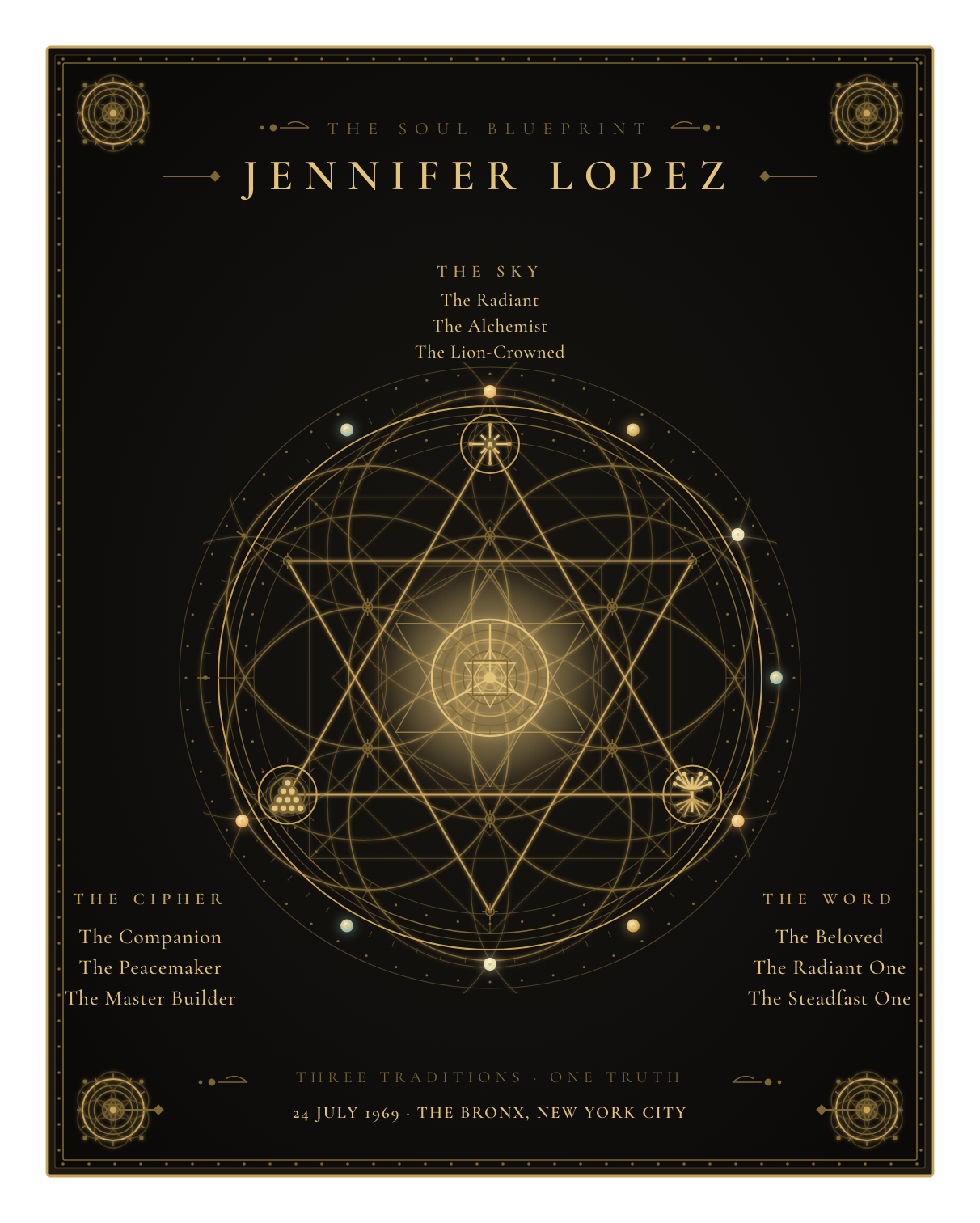
One seal, three languages. The sky she was born under at the apex, the numbers beneath her name at the lower left, the name itself at the lower right — three traditions engraved into one artifact. There is no rising sign, no houses, no angles: without a verified birth time they cannot be honestly drawn. What is true is what is shown.
At a Glance
- Full traditional name
- Jennifer Lynn Lopez
- Born
- July 24, 1969 · The Bronx
- Sun
- Leo 1.6° — the essential fire of the life
- Rising
- Birth time unverified — the Ascendant is offered conditionally, never asserted
- Moon
- Date-dependent across the unverified birth day — not fixed without a confirmed time
- Mind · Value · Will
- Mercury Leo · Venus Gemini · Mars Sagittarius
- Discipline · Direction
- Saturn Taurus · North Node Pisces
- Life Path
- 2 — The Cooperator
- Title-name Destiny
- 2 — The Cooperator
- Birth-name Destiny
- 22 — The Master Builder
- Master Numbers
- 22
- Soul archetype
- The Cooperator who lives the Cooperator’s path
The Bronx, 1989. A young woman stands in a rehearsal studio in Europe, touring with a Broadway revue, and she is the only chorus member without a solo—the only one who arrives onstage and disappears into the body of the whole. The light falls the same on everyone; the applause does not separate her name from the names of those who sang alone. She was eighteen when she left college, burning with a certainty her parents did not share, to study dance at Phil Black Dance Studio, and her mother and father did not speak to her for eight months because they believed she was throwing her life away. Now she was in the middle of a continent that was not home, dancing five nights a week, learning how to move when no one was watching her move.
The world will spend decades calling her a diva, a demanding presence, a woman built for the camera and the spotlight—and there is a current in her that does love the radiant eye, the stage, the giving of herself outward until thousands feel alive. But underneath that reading lies another current entirely: the soul that arrived knowing how to build something, how to gather the scattered parts into an architecture that holds, how to understand what people need before they know they need it themselves. The river and the surface of the river are not the same water. One moves underground through stone and root; the other catches light and is seen. This reading traces the source beneath the public face—the blueprint that was set down at birth and the way that blueprint lived itself through time.
The reading moves through the eight chapters of the Soul Blueprint architecture — The Arrival, The Soul’s Inheritance, The Living of It, The Soul’s Calling, The Soul’s Territories, The Name You Carry, The Moment, and The Invitation — and at the end, the same instrument turns gently toward you.
Her soul has a blueprint.
So do you.
The same three languages — the sky, the numbers, the name — are waiting in your own.
The Arrival
She arrived with a fire that could not sit still—a self that comes alive only when it is radiating outward, creating something, bringing a vision to form where there was none before. This is not the fire that conquers through domination; it is the fire that gives life, that warms the cold places in other people and makes them feel seen. Her Sun lived in Leo’s domain, the house where the self must create and be recognized or wither inward—and the soul she carried knew this from the beginning. She could not be invisible and remain whole.
But the paradox she arrived carrying was this: she wanted to create and be seen, and yet the world kept trying to put her in the background. She danced as a Fly Girl while others got the lines. She was a backup dancer for the icons—Janet Jackson, MC Hammer, the New Kids on the Block—learning the architecture of stardom from the margins. The soul that came to radiate was born into a template that asked her first to serve, to watch, to move in harmony with the vision someone else had already claimed. The invitation at the threshold was not yet the full stage—it was the apprenticeship of the beloved second, the one who makes the star shine brighter. What she did with that apprenticeship would reshape everything that followed.
The Soul’s Inheritance
She was born into the Bronx in 1969, into a family that had the immigrant’s shape—the father who had served in the Army and then moved through the careful, modest world of a computer technician at an insurance company; the mother who was a homemaker at first and then became a teacher, a Tupperware saleswoman, a woman who learned to make money from nothing. There were sisters, a household where Spanish was spoken alongside English, where the body was taught to work and not complain, where security meant you earned what you received. The Bronx in those years was a place where being Latina meant you carried an inheritance the larger culture had not yet decided it wanted—but her parents had already decided what they wanted for her: a practical education, a stable life, the slow accumulation of what cannot be lost.
The era she was born into was one where the American dream still had sharp edges—you climbed or you didn’t; you worked or you fell. There was no space in that inheritance for an eighteen-year-old leaving college to become a dancer, no category in her parents’ understanding for an artistic calling that was not yet profitable. What she received from them was not permission; it was the opposite. She received the knowledge that if she wanted what she wanted, she would have to build it herself, on ground that was not yet prepared, with no one’s blessing but her own. That refusal to bless her became the thing that made her real.
The Living of It
The living of it meant she had to become unbreakable in her commitment while everyone around her—parents, early casting directors, the industry that watched her dance in the background—told her she was in the wrong place, that she was not the one who was supposed to shine. She was not given the solo. She had to watch other backup dancers become famous while she remained one of the faceless bodies moving in formation. The signature wound was this: she had to prove over and over that she was worthy of the space she was taking up, that her presence mattered, that her voice deserved to be heard above the noise of those who had been given the microphone first.
It cost her eight months of her parents’ silence. It cost her years of auditions where she was told no. It cost her the anonymity that her sisters and classmates still had—the ability to walk through the world without being watched, without the pressure of becoming something. The wound lived in the question: Am I enough? And the only answer that finally worked was to make herself undeniable—not by waiting to be chosen, but by choosing herself, again and again, until the world had no choice but to acknowledge what she had built. The role as Selena in 1997, the film with George Clooney, the number-one album in 2001—these were the moments when the external world finally aligned with what she had always known about herself. But that knowledge had to survive in her before the world could see it.
If this is what was true for her, what might be true for you?
The Soul’s Calling
Her calling arrived wrapped in language—not the language of words alone, but the language of presence, of storytelling through the body and the voice together. She was born with a mind that thinks in vivid wholes, that sees the architecture of a narrative and knows how to deliver it with warmth and conviction. This mind does not break things into fragments; it gathers them into something that speaks. Her Mercury lived in Leo’s territory, the place where thought becomes voice, where the mind learns to perform itself, to persuade not through logic alone but through the radiance of being fully present in what one is saying.
She came to demonstrate that a woman from the Bronx, with her accent and her body and her particular way of moving through the world, could tell stories that belonged to everyone—could be Selena, could dance on the Super Bowl stage while holding the Puerto Rican flag, could build a brand that made her name synonymous with an entire aesthetic and way of living. She was called to build bridges between the world that made her and the world that had not yet made room for her. The calling was not to be famous; it was to be heard, to speak across the distances, to show that a voice from the margins could reshape the center. Every role, every album, every business venture was an act of translation—bringing the world of her inheritance into the places that had been closed to it.
The Soul’s Territories
The first territory is Performance itself—the stage, the camera, the moment when she steps into view and the entire architecture of her being becomes an instrument. In this territory she lives as though she is simultaneously giving everything away and claiming everything at once. The body moves, the voice rises, and what moves through her moves through thousands of others at the same moment. This is not showing off; it is an act of profound generosity, the sharing of an aliveness that some souls carry and most do not. The Super Bowl halftime stage, the award shows, the concerts where she is the center of gravity—these are not escapes from herself but the truest versions of the self arriving in public form.
The second territory is Building—not just performing, but creating the systems and structures that allow others to perform, to be seen, to have a pathway where none existed before. Nuyorican Productions, the lifestyle brand, the fragrance line, the music label ventures—all of these emerge from a soul that understands that a single performance is beautiful but temporary, whereas a building that houses many performances lasts. In this territory she becomes the architect, the one who studies how things are made and remakes them so that the next person has an easier entrance.
The third territory is Transmission of worthiness—the deliberate work of showing other women, especially Latina women, that they deserve to take up space, to be paid well for their labor, to have their names on the contracts. This appears in her acting choices, in her visibility, in the Lopez Family Foundation and the work of healthcare access, in every moment she refuses to be small. In this territory she is saying: I came from where you came from, and I am building proof that we belong here. These three territories braided together form something larger than any single achievement—they trace the mythology of a soul learning to transform not just herself but the entire landscape she moved through.
There are twelve domains in the kingdom of any life: The Mark, The Unfolding, The Unseen, The Long Return, The Inheritance, The Encounter, The Alchemy, The Living Tension, The Sight, The Body’s Knowing, The Crossing, The Calling.
The Name You Carry
The names she carries hold frequencies that have lived in her from the beginning. Jennifer—a name that arrived in English culture bearing the light of the fairy, the shining one, a name that contains both gentleness and radiance, the ability to be soft and luminous at once. It is a name that does not announce itself as exotic or other; it settled her into a space where she could be heard without the extra burden of explanation. And yet she has spent her life explaining, teaching, translating—so the name’s surface simplicity has become a kind of tool, a way to be approachable while carrying the complexity of multiple worlds.
Lynn, the middle name, holds a different frequency—the water-word, the soft murmur, the thing that flows and connects. In her full name, Jennifer Lynn Lopez, there lives a motion: the shining one, the flowing, the bridge. Lopez itself carries the inheritance—the Spanish surname that marks her as having arrived from somewhere else, as holding a particular lineage of story and language. For decades, the world would call her Jennifer Lopez, collapsing the Lynn, making her name into a brand. But the full name holds something the shortened version does not: the current underneath, the flowing persistence, the bridge between what was given at birth and what she has built.
When she named her debut album On the 6, she was reclaiming the geography of her name—the Subway line that connected the Bronx where she was made to Manhattan where she was becoming. The names we carry are not separate from the geography we come from; they are the map written into us. Jennifer Lynn Lopez—the shining one, the flowing bridge, the one who carries a particular people’s inheritance—arrived carrying her own surname as both inheritance and instruction.
The Moment
There is a moment when the life shifts, and for her it arrived in 2001 and extended through the years that followed—the moment when she became the first woman in American history to have a number-one film and a number-one album simultaneously, when her face was on every magazine, when she had built so much so quickly that even she could not keep up with it. The album was called J.Lo, and it was the sound of someone arriving fully into the territory she had been preparing for her entire life. She had the power now. She could choose her roles. She could command a price that had never been asked before. She was the highest-paid Latina actress, the woman whose name on a poster meant the film would be watched.
And in that same moment, the cost began to arrive as well. The media had decided she was a diva, and they did not mean it as a compliment—they meant it as a weapon, a way to diminish her power by making it seem excessive, demanding, unsexy. The relationship with Ben Affleck became a circus the world watched and judged. The film Gigli failed completely. And by 2001, in the middle of making a film called Enough, something inside her broke—not the will, but the container that had been holding her together. She suffered a nervous breakdown, described as the height of her fame, the moment when being seen by everyone became indistinguishable from being erased.
This defining season revealed something she had not yet learned: that visibility without solitude becomes a kind of drowning, that the radiance that had always been her gift could become a prison if she did not learn to close the door, to be private, to exist in spaces where no one was watching. The breakdown was the beginning of a wisdom she would carry forward—that the performance and the withdrawal are both necessary, that a soul cannot give endlessly without returning to a place of gathering and rest.
The Invitation
Everything in this reading has been moving toward a single point. The doubleness named in the first chapter, the inheritance, the wound, the calling, the territory, the name, the moment. These are not seven separate truths about Jennifer Lopez. They are one truth, named from seven different angles. And they all converge here.
What is being asked of Jennifer Lopez is nothing less than the continuous reformation of what is possible for a woman from her lineage to become—and she has been saying yes to that request since she was eighteen years old and walked away from college into a dance studio. The asking arrives in different forms across the decades: it arrives as the voice that needs to be heard in a room where only certain accents have been legitimized; it arrives as the body that must prove it is not decoration but architecture; it arrives as the mind that must learn to build systems while the world is still teaching her to perform. She is being asked to release the need to earn permission, again and again and again, at each new threshold, each new territory, each new form her ambition takes.
What is being released is the hunger for external validation that was necessary when she was dancing in the background, when she needed the industry to notice her in order to survive professionally. There was a season—documented in the Movieline interview that was misquoted and weaponized against her, echoing through decades of tabloid narrative—when she did speak from a place of defensiveness, of needing to assert her value, of feeling she had to demand the recognition that should have been given freely. That defensive claiming had to burn away. The nervousness breakdown in 2001 was the fire. What emerged from it was something quieter and more durable: a woman who no longer needed the entire world to agree that she was valuable. She had already agreed with herself.
What is being called toward is a deepening relationship with the act of building that does not require her to be the one in front. The production company, the fragrance empire, the television ventures as judge rather than performer—these are all invitations toward a kind of power that operates behind the scenes, that creates opportunities for others without needing to be centered. The American Idol judges’ chair was a turning point: it humanized her to people who had only known her as an image, and it allowed her to exercise a different kind of authority—the authority of someone who has walked the path and can now guide others along it. The Super Bowl halftime show in 2020, when she performed wrapped in the Puerto Rican flag with images of the border crisis visible on the field, was an act of claiming and releasing simultaneously: claiming her inheritance, releasing the need to make it palatable to everyone.
What became available because she said yes is a kind of freedom that does not come from permission but from the evidence of her own living. She has now become the architecture she was always meant to build—not a single shining moment but a structure that houses multiple forms of power simultaneously. She is the actress and the producer, the performer and the judge, the businesswoman and the cultural symbol. The numerology of her birth name holds it all: the Master Builder that emerged from Jennifer Lynn Lopez, the architecture of someone who arrived knowing how to create lasting structures. Her films have grossed more than three billion dollars cumulatively. Her business ventures have generated more than five billion in sales. These are not vanity metrics; they are the proof that her vision, when she committed to it, reshaped not just her own life but the entire landscape of what is possible.
The marriages and the breakups, the public relationships that became tabloid fodder, the constant scrutiny of her body, her age, her relevance—all of this has been the price of being visible, and she has not looked away from it. Instead, she has integrated it. She has let the difficulty teach her. The album This Is Me… Then, dedicated to Ben Affleck in 2002, gave way to This Is Me… Now in 2024—a cycle of two decades in which she learned that the self is not fixed, that the stories we tell about ourselves need to be retold, that coming back to the same territory with new wisdom is not failure but deepening. She is still becoming, still learning how to release what no longer serves, still walking the territories that were opened when she said yes to the eighteen-year-old inside her who knew, with a certainty that no one shared, that she had something to give the world. She is still building.
She was not late. She was exactly where the soul-clock said she should be. The mission had been inscribed at the threshold of her first breath. What was being asked of her, she has been walking. The naming has been done.
This Is Not Coincidence
The astrology speaks plainly: a Sun in Leo carries the signature of creative self-actualization, the self that comes alive through radiant outpouring and being recognized for what it creates. A Mercury in Leo gives that outpouring a voice—warm, confident, persuasive, the mind that thinks in vivid wholes and delivers them with presence. A Mars in Sagittarius adds the crusading enthusiasm, the will to fight for a vision and expand its reach far beyond the immediate horizon. These are the signatures of someone built to create, to broadcast, to make the invisible visible. The numerology names three archetypes independently: the Title Destiny (2) as the Cooperator, the Birth Destiny (22) as the Master Builder, the Life Path (2) as the Cooperator again. The repeating 2 speaks of partnership, of translation between worlds, of the one who understands that no vision is completed alone—yet the 22, the Master Builder, is the promise that cooperation is not weakness but the architecture of something that lasts. The numerology does not speak of performance; it speaks of building systems, of creating structures, of working with others to make the impossible real. The name Jennifer Lopez arrives as the shining one who carries a surname that announces a particular lineage, a particular people, a bridge between worlds. Three entirely different languages—astrology’s fire and visibility, numerology’s architecture and cooperation, the name’s announcement of inheritance—speaking one truth: She came to make visible what had been hidden, to build what would last, and to do it while holding the hands of those who came after.
Three entirely different languages. One truth.
This is not coincidence. This is what three independent systems do when they are all telling the truth about the same soul.
The Numbers, Decoded
The numbers are computed, not intuited — each letter takes its Pythagorean value, each name reduces, and any Master Number is preserved rather than collapsed.
You have sat with the chart and the numbers and the name of another soul, and watched how a wound becomes a calling, how the place of least belonging becomes the place of greatest gift, how a life too precisely configured to be coincidence reveals itself when three independent languages are read together.
The reading you have just received was, in its outer form, a reading of her soul. But its inner form was a reading written for yours. You did not arrive without a Blueprint either. May this reading be the beginning of the reading you finally receive of yourself. May the light you carry — in whatever particular, irreplaceable form it has taken inside the specific life you were given.
Some lives carry a pattern this clear.
Yours does too.
You’ve read the shape of her soul. The same three languages — the sky, the numbers, the word — are waiting in your own name and birth date. Begin yours, free, below.
Or, when you’re ready, begin your own full Soul Blueprint reading →
Frequently Asked Questions
What is Jennifer Lopez’s birth chart?
Jennifer Lopez was born on July 24, 1969, with the Sun in Leo—the sign of creative self-actualization and radiant outpouring. Her Mercury is also in Leo, giving her a warm, confident, expressive mind built for storytelling and persuasion. Her Venus is in Gemini, expressing affection and value through wit, conversation, and intellectual companionship; her Mars is in Sagittarius, driving her will toward enthusiastic expansion and the pursuit of a vision larger than the immediate moment. Her Saturn is in Taurus, asking her to build real, lasting security and self-worth that does not depend on external validation. Because her birth time is unverified, the rising sign cannot be fixed; the Sun sign and the inner planetary signatures (Mercury, Venus, Mars, Saturn) remain the stable anchors of her natal blueprint.
What is Jennifer Lopez’s numerology?
Jennifer Lopez carries three numerological identities that speak different aspects of her soul’s geometry. Her Title Destiny (calculated from Jennifer Lopez) is 2, the Cooperator—the soul that understands partnership, translation, and the power of working with others. Her Birth Destiny (calculated from Jennifer Lynn Lopez) is 22, the Master Builder—a master number that promises the creation of lasting structures and institutions. Her Life Path (calculated from her birth date, July 24, 1969) is also 2, the Cooperator, reinforcing the theme of partnership and collaboration throughout her lived experience. Together, these three numbers trace a soul called both to create enduring buildings and to do so in concert with others.
What does the name Jennifer Lopez mean?
The name Jennifer carries the frequency of the shining one, a light-bearing quality that has allowed her to move through the world with approachability and radiance. Lynn, her middle name, introduces the water-element—flow, continuity, the current that connects. Lopez, her surname, announces her inheritance, her particular lineage, and the geography she comes from. Together, Jennifer Lynn Lopez forms a full signature: the radiant one, flowing, carrying a bridge between worlds. When she named her debut album On the 6, referencing the New York City Subway line connecting the Bronx to Manhattan, she reclaimed the geography written into her name—the literal and metaphorical journey from where she came to where she was becoming.
What is a Soul Blueprint?
A Soul Blueprint integrates three independent traditions — Western natal astrology, Pythagorean numerology, and the etymology of the full birth name — into a single document written as a personal letter to the soul. When you’re ready, you can begin your own.
This reading was prepared in the lineage and methodology of the Soul Blueprint Method — Pythagorean numerology with master numbers preserved, Western archetypal astrology, and a researched etymological reading of the full name. Jennifer Lopez’s birth date (July 24, 1969) is sourced from the public record; the birth time is unverified, so the rising sign is offered conditionally and never asserted.
A Soul Blueprint reading · Astrology · Numerology · Etymology · shams-tabriz.com