
Tate Mcrae’s Birth Chart, Numerology, and Name Decoded
Tate Mcrae’s Birth Chart,
Numerology & Name Decoded
The Soul Blueprint Method — three traditions woven into one personal letter: Western natal astrology, Pythagorean numerology, and the etymology of the soul’s name. Learn the method →
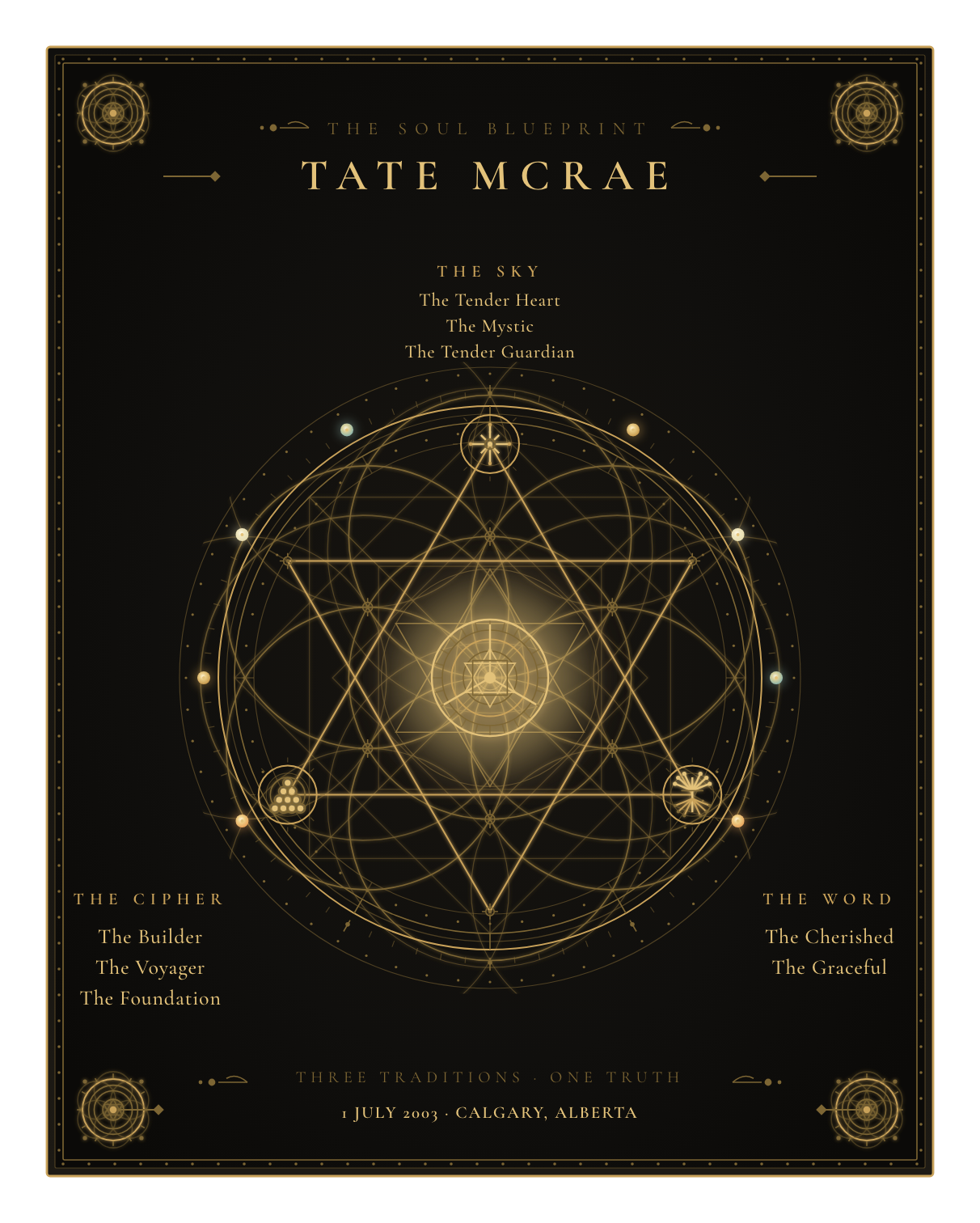
One seal, three languages. The sky she was born under at the apex, the numbers beneath her name at the lower left, the name itself at the lower right — three traditions engraved into one artifact. There is no rising sign, no houses, no angles: without a verified birth time they cannot be honestly drawn. What is true is what is shown.
At a Glance
- Full traditional name
- Tate Mcrae
- Born
- July 1, 2003 · Calgary
- Sun
- Cancer 9.5° — the essential fire of the life
- Rising
- Birth time unverified — the Ascendant is offered conditionally, never asserted
- Moon
- Date-dependent across the unverified birth day — not fixed without a confirmed time
- Mind · Value · Will
- Mercury Cancer · Venus Gemini · Mars Pisces
- Discipline · Direction
- Saturn Cancer · North Node Taurus
- Life Path
- 4 — The Builder
- Title-name Destiny
- 5 — The Free Soul
- Birth-name Destiny
- 5 — The Free Soul
- Master Numbers
- None preserved at the final layer
- Soul archetype
- The Free Soul who lives the Builder’s path
A Calgary studio in the summer of 2016, afternoon light falling sideways through the tall windows—Tate McRae stands in the wings of a massive television stage, waiting for her cue on So You Think You Can Dance, the cameras already rolling. She is thirteen years old. She has been dancing since she could walk, and now the whole country is about to see what her body knows. This is the threshold: the moment when the private, disciplined, repeating hours in rooms like her mother’s dance company studio—YYC Dance Project, where she had trained through all styles, ballet, contemporary, jazz, the full vocabulary of movement—become a public fact. She places third in that competition, advancing further than any Canadian in the show’s history. The world begins to notice.
But notice is not the same as knowing. The fragments the world calls her—the dancer, the singer, the social-media phenomenon, the girl whose songs charted during lockdown—are like rapids and eddies on the surface of a river. They move and catch light and create the appearance of all there is. Underneath, deeper than fame or achievement or the visible resume, runs another current: the source itself. That source moves with intention, with a clarity that gathers scattered light into something permanent and rooted—something that knows how to build a home, how to draw the world inward until it becomes legible, enduring, true.
This reading traces not the rapids but the river. Not the fragments the world has named but the soul that moves beneath them—the inheritance she carried into incarnation, the wound that became her greatest qualification, the calling she came to live, and the moment that broke her open and remade her entirely.
What follows is the architecture of that soul: how it arrived, what it was asked to release, what it was invited toward, and what became possible because she said Yes.
The reading moves through the eight chapters of the Soul Blueprint architecture — The Arrival, The Soul’s Inheritance, The Living of It, The Soul’s Calling, The Soul’s Territories, The Name You Carry, The Moment, and The Invitation — and at the end, the same instrument turns gently toward you.
Her soul has a blueprint.
So do you.
The same three languages — the sky, the numbers, the name — are waiting in your own.
The Arrival
She arrived as the soul that makes things permanent. The self that comes alive by drawing scattered life inward—by giving what has begun a form so clear-cut, so enduring, so rooted in felt foundation that it can shelter and protect what grows from it. This is the paradox she carries: she is both the one who feels everything, and the one who must build a home strong enough to hold it.
The gift forged under discipline and time—this too is woven into her arrival. She came into a soul already shaped by the demand to make emotional safety from within, to construct an inner architecture that does not depend on another’s certainty. The Great Work is hers from birth: to build herself from the inside out, to learn that she can be her own source of care, her own foundation. And because this work is hard, because it requires her to feel vulnerable and tend to it anyway, she also arrives with an extraordinary capacity to understand others who are building themselves in solitude.
She is the builder who must also feel, the focalized light who must also tend the darkness underneath. She came to live this: to take what is tender and make it permanent, to speak from the heart in a voice so clear it becomes enduring architecture for others. Not by hardening. But by feeling so deeply that the feeling itself becomes structure.
The Soul’s Inheritance
She was born into a family of movement and motion. Her mother, a German dance instructor, carried into the household the language of the body as intelligence—as a way of knowing, of expressing, of communicating what words alone cannot reach. From her mother came the inheritance of making dance a home, a sanctuary, eventually a company (YYC Dance Project) where others could come to learn the same grammar.
Her father, a lawyer for oil and gas companies, carried a different inheritance—the Scottish lineage, the precision of legal architecture, the logic of building things that hold. A man who worked in the language of frameworks and structures, who understood how to build systems that lasted.
At two years old, she moved with her family to Oman for three years, crossing an ocean, living in a different time, a different light. The American International School Muscat became the first threshold place. She learned young that home is not always the place you were born—that it can be built in exile, in the spaces between countries, in the body’s memory of what was left.
She was born in 2003, into the early digital age, into a world where a bedroom could become a stage, where YouTube was learning to speak, where the old gatekeepers of fame were beginning to fracture. She inherited the possibility of making herself visible without permission, but also—by birth era—the vulnerability of doing so while the rules for that visibility were still being written. She came of age into the pandemic, into isolation, into the paradox of becoming known while being separated from the very thing she needed: the presence of others, the live audience, the felt return of her own fire.
The Living of It
The life was lived in motion, from the beginning—across countries, across disciplines, across platforms that did not yet have names for what she was doing. At six years old, recreational dance training began the first education. At eight, the training intensified, became competitive. She entered Drewitz Dance Productions and began the long apprenticeship of disciplining her body to speak with precision.
From eleven forward, she trained at her mother’s company—YYC Dance Project—and at the School of Alberta Ballet, learning the classical vocabulary. But the cost of this discipline was loneliness. The cost was the hours in the studio while others her age lived differently. The cost was learning young that excellence requires a kind of solitude, a willingness to repeat, to fail, to return, to build calluses and muscle memory and the internal authority that comes only from sustained practice.
At thirteen, she placed third on national television. The world saw her. But what the world did not see was what this moment cost—that she had already won at the highest levels of dance competition, already earned a scholarship to Berlin State Ballet, already knew that her body was extraordinary. What the world did not see was the disassociation that came when her breakthrough success happened during the pandemic, when performances occurred in isolation, in studios, in the emptiness of early COVID lockdown. She rose to mainstream music popularity during a time when she could not be live with anyone. Fame came to her as a ghost, something she watched happen to herself from a distance.
This was the signature wound: learning to become visible in a time when visibility had been severed from presence. The wound became her qualification because it taught her to sing, to write, to speak into the void as if someone were there listening. And someone was—but she could not see them, could not feel the return. This forged in her an extraordinary empathy for anyone who has loved in isolation, created in silence, become known while feeling utterly alone.
If this is what was true for her, what might be true for you?
The Soul’s Calling
She came to demonstrate the voice that speaks from the shelter of feeling. The calling is not to be a technician of song—though she is—but to be a translator. To take the tender, the hurt, the love that has no words, and give it a form so clear, so rooted in emotional truth, that it becomes permanent. To sing the way one speaks to a person you trust in darkness: with indirection, with the protection of metaphor, with the understanding that what is most true is often what cannot be said directly.
Her voice—the literal voice, but also the voice as calling—is Mercury in the same element as her Sun: a feeling-toned intelligence, intuitive, memory-rich, protective. She thinks by feeling. She speaks by attunement. The songs she makes are not about virtuosity; they are about reaching through the radio or the screen and finding the person on the other side who has felt what she has felt. This is the work: to build a shelter of words and melody where others can remember themselves.
She came to demonstrate also that the builder can be playful, can dance while singing, can bring the joy and wit and curiosity of the mind into spaces of profound tenderness. She came to show that strength does not mean hardness—that the most enduring things are built by those willing to stay soft, to remain available, to speak from the heart while their hands are still building.
The Soul’s Territories
The first living territory is Dance—the grammar learned from childhood, the vocabulary of the body as intelligence. In this territory she learned precision, discipline, the knowledge that excellence requires repetition and solitude. Here she won across all age categories, from Mini to Teen, advancing further than any dancer before her in the history of those competitions. Dance taught her that the body is a voice, that movement can speak what words cannot, that beauty is built through sustained practice. This territory holds for her the foundation of all later work—the understanding that artistry requires both discipline and vulnerability, that mastery comes from returning again and again to the threshold of what you do not yet know.
The second territory is Music and Songwriting—the newer language that emerged from the bedroom, from YouTube, from the willingness to sing without gatekeepers. Here she became known first to a world watching through screens—’One Day’ attracting over 40 million views, ‘You Broke Me First’ becoming the longest-charting song released by a female artist in 2020 on the Billboard Hot 100, at 38 weeks. This territory holds the technology of reaching others through isolation—of becoming a voice in the dark that somehow finds the dark where others are listening. She won the Grammy nomination here, she topped the charts, she learned that a bedroom could be a cathedral.
The third territory is Presence and Platform—the contemporary gift of being seen, of building community across digital distance, of using visibility not as narcissism but as service. Over 1.5 billion views on YouTube, over 8.4 billion career streams across platforms—these are not vanities but maps of where people are listening. This territory asks her: how do you stay yourself when you are known everywhere? How do you remain rooted in the emotional foundation when the world wants to claim you?
Each of these territories points to a deeper mythology: the story of the soul who learned to speak through the body, then through song, then through the trembling act of being truly seen—and who did all of this without losing the shelter of her own interior home.
There are twelve domains in the kingdom of any life: The Mark, The Unfolding, The Unseen, The Long Return, The Inheritance, The Encounter, The Alchemy, The Living Tension, The Sight, The Body’s Knowing, The Crossing, The Calling.
The Name You Carry
The name she carries holds a peculiar resonance. Tate—a name compact, clean-lined, unmistakable. It arrives like a single focus of light, like something that has been distilled to its essential form. It carries the energy of the soul who must make things clear-cut, who arrives already knowing how to gather scattered things into permanence. The name itself is an architecture: four letters, two syllables, the sound of something that does not waver.
McRae—the Scottish surname, the inheritance from her father’s line. McRae carries the weight of ancestry, of a people who built things to last, who understood structure and endurance. It is a name that says: you come from somewhere. You carry something forward. This is not accident—that her building-work, her discipline, her capacity to make permanent things comes from a lineage that knows how to do exactly that.
Together, the names form a paradox that is also their deepest truth: Tate McRae is the girl who must be her own source, her own focalized light (Tate), and who also carries forward something ancient, something inherited, something rooted in the people who came before (McRae). She is the contemporary soul—self-made, self-published, risen through no traditional gate—and the ancient soul, carrying forward the discipline and structure that built civilizations.
The names do not fight each other. They complete each other. Tate says: be clear. McRae says: be rooted. Together they say: be clear about what you came to build, and root it in something that will last longer than you.
The Moment
The defining moment was not one moment but a season—the early years of the pandemic, roughly 2020 to 2021, when her music began to break into mainstream consciousness at the precise moment when the world had to stay still. She had uploaded ‘One Day’ to YouTube in 2017, self-released, and it had drawn 40 million views from a girl who was still a teenager, still unknown to most. But mainstream arrival came during lockdown, during isolation—when performances were done in studios, in isolation, when the late-night shows were empty, when the awards shows were virtual, when all connection had been severed from touch.
‘You Broke Me First’ released in April 2020, just as the world was learning the new language of quarantine. The song charted for 38 weeks on the Billboard Hot 100—longer than any female artist’s song released that year. She became known as ‘a bonafide star of the lockdown,’ a girl who rose to fame while separated from the very thing that had built her: the presence of others, the live audience, the felt reciprocity of performance.
What this moment revealed was the cost and the gift together. The cost: that she became known while being disassociated from her own fame, watching it happen to her from a distance, unable to feel its reality because she could not feel the return of live presence. The gift: that she learned to sing into the void as if someone were listening. She learned that intimacy does not require a room—that a voice traveling through time and isolation can reach another lonely person in their own isolation and say: you are not alone. This is what the pandemic forced her to discover: that her real power was not in filling a theater but in reaching one person, unseen, at the moment they needed to be understood.
The Invitation
Everything in this reading has been moving toward a single point. The doubleness named in the first chapter, the inheritance, the wound, the calling, the territory, the name, the moment. These are not seven separate truths about Tate Mcrae. They are one truth, named from seven different angles. And they all converge here.
What is being asked of this soul is the continuous reconciliation of two truths that pull in different directions: she must remain radically available—open to feeling, to the tender places, to the vulnerability that allows her to reach others—and she must also be her own fortress, her own source of safety, because no external thing can be trusted to provide it. She is being asked to build a home inside herself so solid, so real, that she can afford to stay soft.
She is being asked to use her visibility—the platform, the hundreds of millions who have heard her voice—not to hide in it but to deepen into it. Not to perform a version of herself that is ‘relatable’ in the way the algorithm wants, but to speak from the specific, rooted place where her truth actually lives. She is being asked to sing the songs that only she can sing because only she has lived her particular loneliness, only she has loved the particular people she has loved, only she has felt the particular disassociation of becoming known while isolated.
What was being released in her was the false promise that achievement would solve the core wound—that if she won enough competitions, charted enough songs, reached enough people, she would finally feel safe, finally feel worthy of love and presence. The pandemic forced this release: it showed her that all the achievement in the world does not fill the void when you are singing into one. She had to release the bargain that says: if I am excellent enough, I will be safe enough.
What was being called toward was something simpler and more radical: the willingness to stay in the feeling itself, not because it would lead somewhere, but because that is where truth lives. To build her work not from the desperation to be known but from the depth of having felt things that need to be witnessed. To understand that her greatest power is not in her achievement but in her capacity to remain human, vulnerable, specific—to sing the songs that come from the particular wounds of her particular life, knowing that when she does this, she reaches not ‘the masses’ but the person listening in their own dark room who needs to hear it.
What became available because she said Yes to this asking is a different kind of fame—not the fever dream of the lockdown years, but a real relationship with an audience that knows her not because they follow her but because she has somehow named something in them that they did not have language for. She is becoming known not for being perfect but for being precisely, stubbornly herself—for continuing to write the songs from her own life even as that life becomes more complicated, more public, more difficult to live in private. What became available is the possibility of real connection, not through a screen, but through a song that traveled through a screen and touched the actual person on the other side.
She is learning, in real time, to live the paradox of her arrival: to be focused and clear about what she came to do, to build it with discipline and care, to make it permanent—and to do all of this without needing the world to tell her she is doing it right. She is learning to tend the emotional foundation from within, not waiting for others to provide the care she needed when she was younger. She is learning that the home she came to build was always an interior home, and that once it is solid, she can afford to love without armor, to create without desperation, to be seen without being unmade.
She was not late. She was exactly where the soul-clock said she should be. The mission had been inscribed at the threshold of her first breath. What was being asked of her, she has been walking. The naming has been done.
This Is Not Coincidence
The astrology names a soul who builds emotional security from within—Cancer at the core, the ability to focalize scattered life into something permanent and rooted, moving through the world by feeling rather than by force. The numerology names the same soul from a different angle: Life Path 4, the Builder, whose task is to create structure, foundation, the solid ground on which others can stand. Two entirely different languages. One truth: she came to build a home that has no walls because it exists inside. The astrology says the will moves as fluid inspiration and imagination, the artist-mystic who fights for the vulnerable and the dream. The numerology says the Title Destiny and Birth Destiny are both 5, the Free Soul, whose gift is liberation and the courage to move beyond the given boundaries. Two entirely different languages. One truth: she is learning that true freedom is not escape but the willingness to feel everything while remaining rooted.
Three entirely different languages. One truth.
This is not coincidence. This is what three independent systems do when they are all telling the truth about the same soul.
The Numbers, Decoded
The numbers are computed, not intuited — each letter takes its Pythagorean value, each name reduces, and any Master Number is preserved rather than collapsed.
You have sat with the chart and the numbers and the name of another soul, and watched how a wound becomes a calling, how the place of least belonging becomes the place of greatest gift, how a life too precisely configured to be coincidence reveals itself when three independent languages are read together.
The reading you have just received was, in its outer form, a reading of her soul. But its inner form was a reading written for yours. You did not arrive without a Blueprint either. May this reading be the beginning of the reading you finally receive of yourself. May the light you carry — in whatever particular, irreplaceable form it has taken inside the specific life you were given.
Some lives carry a pattern this clear.
Yours does too.
You’ve read the shape of her soul. The same three languages — the sky, the numbers, the word — are waiting in your own name and birth date. Begin yours, free, below.
Or, when you’re ready, begin your own full Soul Blueprint reading →
Frequently Asked Questions
What is Tate Mcrae’s birth chart?
Tate McRae was born on July 1, 2003 in Calgary, Alberta. Her Sun is in Cancer, the sign of emotional depth and the capacity to focalize life into lasting form. Her Mercury is also in Cancer, giving her an intuitive, feeling-toned voice that speaks through emotional resonance and belonging. Her Venus is in Gemini, expressing affection through conversation, wit, and the joy of shared discovery; her Mars is in Pisces, a fluid, inspired will that moves through imagination and compassion rather than force. Her Saturn is also in Cancer, indicating that her greatest work is the building of emotional security and inner home from within. The birth time is unverified, so her rising sign cannot be fixed from the available data.
What is Tate Mcrae’s numerology?
Tate McRae’s numerology shows a soul shaped by the archetype of the Builder and the Free Soul. Her Life Path is 4, the Builder, whose purpose is to create foundation, structure, and enduring work. Her Title Destiny (from the name Tate Mcrae) is 5, the Free Soul, and her Birth Destiny (from the birth date) is also 5—indicating that her calling involves liberation, courage, and the breaking of traditional boundaries. Together, these numbers suggest a soul who must build something real and lasting while remaining free to evolve, to change, and to live authentically.
What does the name Tate Mcrae mean?
The name Tate is compact and clear-lined, carrying the energy of focus and distillation. It arrives like something already gathered into its essential form—four letters that do not waver. McRae is a Scottish surname, the inheritance of lineage and structure, rooted in ancestry. Together, Tate McRae names the paradox: the contemporary soul who must be her own source of light (Tate) while also carrying forward something ancient and rooted (McRae). The names do not contradict—they complete each other, suggesting a person who is both radically self-made and deeply ancestral, both present-tense and rooted in what came before.
What is a Soul Blueprint?
A Soul Blueprint integrates three independent traditions — Western natal astrology, Pythagorean numerology, and the etymology of the full birth name — into a single document written as a personal letter to the soul. When you’re ready, you can begin your own.
This reading was prepared in the lineage and methodology of the Soul Blueprint Method — Pythagorean numerology with master numbers preserved, Western archetypal astrology, and a researched etymological reading of the full name. Tate Mcrae’s birth date (July 1, 2003) is sourced from the public record; the birth time is unverified, so the rising sign is offered conditionally and never asserted.
A Soul Blueprint reading · Astrology · Numerology · Etymology · shams-tabriz.com