
Emma Stone’s Birth Chart, Numerology, and Name Decoded
Emma Stone’s Birth Chart,
Numerology & Name Decoded
The Soul Blueprint Method — three traditions woven into one personal letter: Western natal astrology, Pythagorean numerology, and the etymology of the soul’s name. Learn the method →
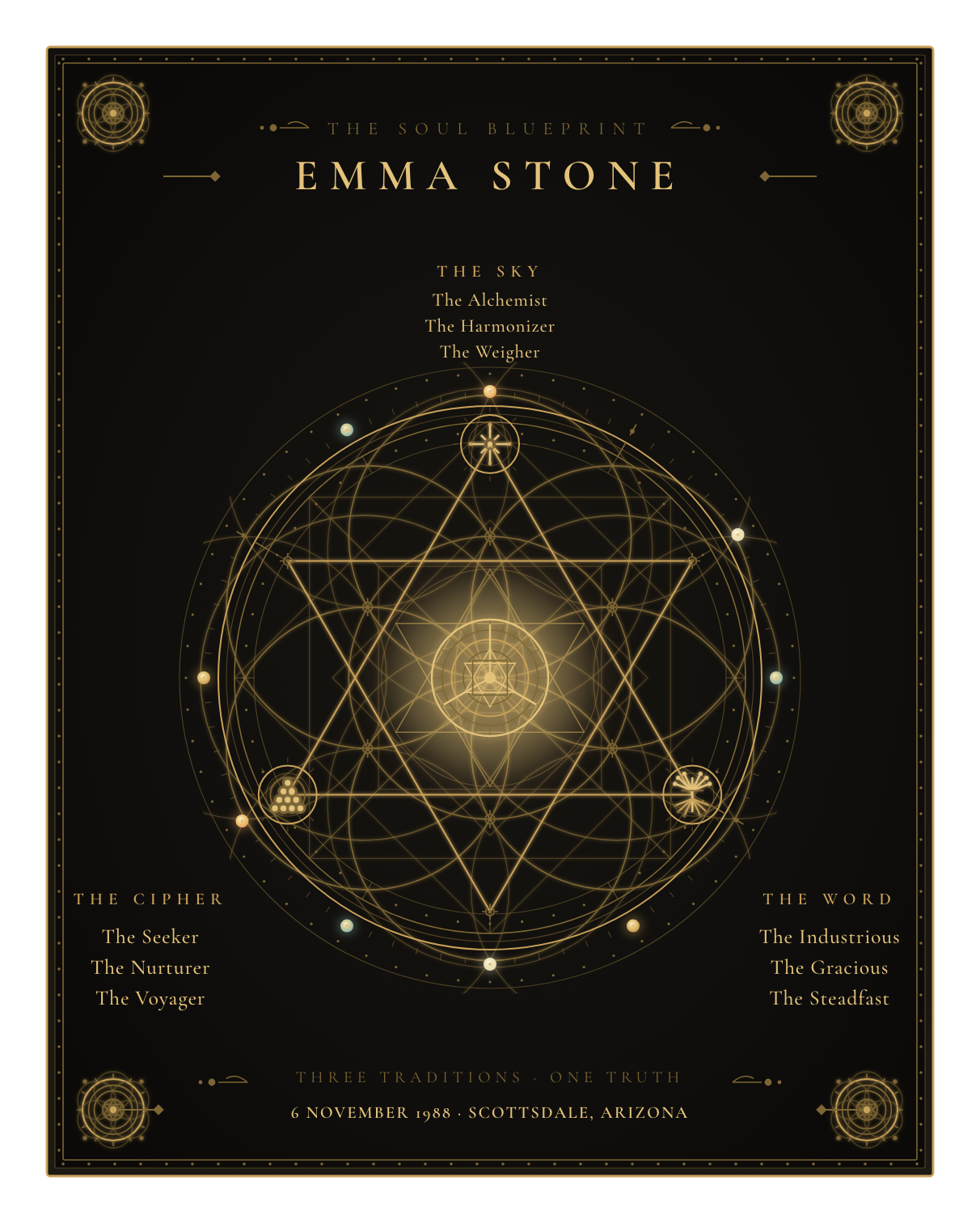
One seal, three languages. The sky she was born under at the apex, the numbers beneath her name at the lower left, the name itself at the lower right — three traditions engraved into one artifact. There is no rising sign, no houses, no angles: without a verified birth time they cannot be honestly drawn. What is true is what is shown.
At a Glance
- Full traditional name
- Emily Jean Stone
- Born
- November 6, 1988 · Scottsdale
- Sun
- Scorpio 14.6° — the essential fire of the life
- Rising
- Birth time unverified — the Ascendant is offered conditionally, never asserted
- Moon
- Libra 12.9° — the inner life
- Mind · Value · Will
- Mercury Scorpio · Venus Libra · Mars Aries
- Discipline · Direction
- Saturn Sagittarius · North Node Pisces
- Life Path
- 7 — The Seeker
- Title-name Destiny
- 6 — The Nurturer
- Birth-name Destiny
- 5 — The Free Soul
- Master Numbers
- None preserved at the final layer
- Soul archetype
- The Nurturer who lives the Seeker’s path
She is standing in the Arizona heat of 1988—a newborn in Scottsdale, born on the sixth of November, the light beginning its long descent into the shortening days of late autumn, and already the signature is inscribed: a soul arriving with the capacity to go deeper than the surface allows, to merge and be remade through what she touches, and to do it all while holding an absolute need for harmony, for the other person’s peace, for beauty held in balance. The world will see the fragments: a girl with a husky voice she did not choose, who suffered panic attacks in childhood, who moved to Los Angeles at fifteen with a PowerPoint presentation and her mother’s trust, who became an actress, who won two Academy Awards, who refused to speak about her intimate life even as the cameras surrounded her house. The fragments are real. But they are the river’s surface—the foam and motion—while underneath runs a singular current, a source that moves all of it: a soul wired to dissolve the boundary between self and other, to be intensified and remade by what she gives herself to, and to do that work with an insistence on fairness, on the dignity of the person across from her, on making beauty not just bearable but true. This reading reads the source.
The reading moves through the eight chapters of the Soul Blueprint architecture — The Arrival, The Soul’s Inheritance, The Living of It, The Soul’s Calling, The Soul’s Territories, The Name You Carry, The Moment, and The Invitation — and at the end, the same instrument turns gently toward you.
Her soul has a blueprint.
So do you.
The same three languages — the sky, the numbers, the name — are waiting in your own.
The Arrival
She arrived carrying a paradox that has never settled: the simultaneous hunger to be separate—to have her own will, her own voice, her own line—and the overwhelming pull toward merger, toward going so deep with what she touched that the distinction between her and it dissolved into something larger, something remade. This is the signature of a soul for whom transformation is not a consequence but a necessity, a baseline condition of being alive. She did not come to manage or maintain; she came to penetrate, to descend, to allow herself to be overwhelmed by what she merged with so that something greater could be constituted. The voice itself—that low, husky signature born from infant colic, from vocal cords learning their shape through pain—became the instrument of this arrival: not pretty, not light, but penetrating, incisive, unafraid of what lives beneath the polished surface. The soul did not arrive to stay as she was; she arrived to be broken open and remade by everything she touched. Her mind moved the same way—investigative, relentless, seeing through pretense to the hidden motive—and her will was direct, courageous, ready to meet any threshold without hesitation. But all of this intensity, this depth-diving, this refusal to stay on the surface, was held in the arms of another need just as fierce: the requirement that whatever she did, whatever she merged with, whatever she became, it had to be beautiful, fair, harmonious, held in relationship—not alone, but with the other person met and attuned to, their peace as essential as her own transformation.
The Soul’s Inheritance
She was born into the inheritance of making things work—a father who built companies, who founded and ran, who took raw material and made structures that stood; a mother who kept the household, who held the home as a sanctuary where safety could be learned. She was born into a specific American moment: the late 1980s in Arizona, in a family of European ancestry (German, English, Scottish, Irish threads woven through the paternal line, a Swedish grandfather’s name anglicized into something American, the family’s own small transformation already inscribed in the surname itself). She was born with a younger brother, with the shape of a family around her. But the most significant inheritance was not material but physical and emotional: she inherited a body that would teach her about vulnerability before she was old enough to understand it—vocal cords scarred by colic, giving her a voice that was not the voice she was born expecting to have, but a voice marked, distinctive, unable to blend into any chorus. And she inherited a nervous system that, for three years of her childhood, became a territory of panic—anxiety that showed up daily, that sent her to the school nurse, that demanded reassurance from her mother again and again, that made her body feel like a room she could not calm. The inheritance, then, was not only the middle-class stability of a family business and a homekeeper’s care, but the early knowledge that the body keeps its own truth, that fear arrives unbidden, and that the only medicine—as it turned out—was not rational but participatory: the local theater, the stage, the act of becoming someone else and being met there.
The Living of It
The living of it began as an escape and became a calling. At four years old, she wanted to act—not as a fantasy but as a practice, a way to move through the world. By eleven, she was on stage as Otter in The Wind in the Willows, and then in sixteen productions at the local theater, each one a small death and resurrection. But between the wanting and the doing, the body intervened: three years of panic attacks that made the everyday world feel dangerous, that taught her the cost of being alive in a nervous system that had no off switch, that sent her seeking for a cure that doctors could not provide. The cure, when it came, was not medication but metamorphosis—the stage itself became the antidote, the place where she could be someone other than the girl whose body was betraying her, and in being other, she became herself. She moved through this inheritance by dropping out of school at fifteen, by creating a presentation to convince her mother that California was worth the risk, by leaving everything that was known. She auditioned for NBC’s Heroes and failed—called it later her ‘rock bottom,’ the moment when everything she had gambled on seemed to crumble. But she did not retreat; she kept going, working with smaller and smaller parts, learning the craft through incremental proving, until she discovered asthma while filming a scene—another body truth arriving to show her that she had been living in a body she did not fully know. What it cost was the privacy she wanted, the refusal to be photographed, the dignity of a self that was not constantly available for consumption. What it gave her was the only medicine that had ever worked: the stage, the character, the merger with something larger than the panic-stricken girl who had needed it most.
If this is what was true for her, what might be true for you?
The Soul’s Calling
The calling that emerged was not to perform beauty or to be admired, but to penetrate—to take on roles that required her to go beneath the polished surface, to inhabit the character so completely that she and they became indistinguishable, and to do this with a mind that saw through every pretense to the actual human being underneath. She was called to use her incisive voice, her investigative depth, her willingness to be remade by what she touched, not for light entertainment but for truth-telling. When she played Gwen Stacy, she returned to her natural color; when she played Sally Bowles on Broadway, she was not playing a caricature but a woman desperate and alive; when she played Mia in La La Land, she was playing the dream of becoming merged with something larger, and the stage became a place where merger and ache could be held together. The calling deepened into something more precise: she was called to work with filmmakers (particularly one whose vision demanded that she dissolve into the character completely, that she serve the story rather than be served by it) who saw her capacity for depth and pushed her to territories she had not yet inhabited. She was called to take on roles that required physical transformation—to gain weight, to shave her head, to perform nudity, to embody a woman recovering from addiction, a kidnapping victim, a resurrected suicide survivor—not for shock but for truth, to show what it looks like when a human being is remade by circumstance. The voice that emerged was one that spoke to the actual world, not a fantasy version of it—a voice that could say no, that could defend a boundary, that could want openly.
The Soul’s Territories
One territory where she is most alive is the threshold between character and self—the place where she enters a role so completely that the membrane between Emily and whoever she is playing becomes gossamer-thin, and something true emerges that was never written in the script. This is the territory of La La Land and Poor Things, of The Favourite and Kinds of Kindness: the films where she is not performing a character but becoming a human being on screen, where the audience forgets there is acting happening because there is only truth. What this territory holds is the proof that merger is not dissolution—that she can give herself completely to another consciousness (the director’s, the character’s, the story’s) and emerge not erased but more herself, more alive, more real.
Another territory is the one she guards most fiercely: the private self, the refusal to speak about her intimate life even when the world demands it, the marriage she keeps sacred, the daughter she protects, the home that is not for public consumption. What this territory holds is the knowledge that depth is not performed—it is lived, in the dark, away from the camera, in the rooms where no one is watching. This is where the harmony and beauty that she needs so desperately can actually exist, unspoiled by the machinery of visibility.
A third territory is the one she has recently claimed: the production company built with her husband, the films she is choosing to make rather than being chosen for, the collaborations with filmmakers whose vision aligns with her own. What this territory holds is agency—the capacity to say yes or no, to shape what she merges with, to serve a vision rather than be served by fame. Each of these territories is a place where her soul becomes visible, where the paradox of being both utterly herself and utterly dissolved into something larger can be lived without contradiction.
There are twelve domains in the kingdom of any life: The Mark, The Unfolding, The Unseen, The Long Return, The Inheritance, The Encounter, The Alchemy, The Living Tension, The Sight, The Body’s Knowing, The Crossing, The Calling.
The Name You Carry
The names she carries are a map of the soul she arrived to be. Emily—the name she was given at birth, the name her collaborators now call her on set, the name that carries her back to her original self—holds a resonance that is both historical and intimate: it speaks to a certain dignity, a formality, a sense of someone who has interiority, who lives in the examined life. Jean—her middle name, her mother’s lineage made literal—carries the feminine thread, the relational note, the reminder that she came from women and returns always to the feminine in some form. Emma—the name she chose, the name the world knows her by, taken from Emma Bunton of the Spice Girls, carries a lightness, a accessibility, a deliberate choice to be both herself and not entirely herself, to have a public face distinct from the private one. And Stone—the surname inherited from a Swedish grandfather who became American, from Sten to Stone, a name that speaks of solidity, of foundation, of something that endures and does not dissolve, a counterweight to the Scorpio pull toward merger and transformation. Together, the names carry the full paradox: Emily Jean Stone is both the private, examined, relational self and the chosen public identity; she is both the daughter of history and the architect of her own becoming; she is both penetrating depth and immovable foundation. The names are not arbitrary. They are the verbal blueprint of who arrived and who she chose to become.
The Moment
The defining moment began not as a moment but as a season: November 2014, when she opened as Sally Bowles in the Broadway revival of Cabaret, taking over a role that had been made famous by someone else, stepping into a dressing room where another woman’s energy still lived in the walls. This was not just a role; it was a threshold—she was bringing all of herself to a character for eight performances a week, eight weeks a month, a level of merger and repetition that was different from film, where you could do one take and move on. In the audience during one of those performances was a filmmaker named Damien Chazelle, who had been thinking about casting an actress for a film he was making about Los Angeles, about dancers, about the ache of becoming merged with a dream. He watched her become Mia Dolan on stage—watched her hold the tension between wanting and being wanted, between hope and heartbreak—and he saw something in her that he knew he needed. He cast her in La La Land, a film about transformation through art, about two people who merge only to dissolve, about the cost of merger. When she received the Academy Award for that role in February 2017, she was standing on a stage in front of the world, and the moment revealed everything the soul had arrived to understand: that transformation is real, that merger is not weakness but depth, that the willingness to be remade by what you touch is the only way to touch anything at all. The moment showed her too that this work—this penetrating, dissolving, remade-by-what-she-touched work—was not peripheral but central, not a side effect of being alive but the entire point. The moment revealed her to herself.
The Invitation
Everything in this reading has been moving toward a single point. The doubleness named in the first chapter, the inheritance, the wound, the calling, the territory, the name, the moment. These are not seven separate truths about Emma Stone. They are one truth, named from seven different angles. And they all converge here.
What is being asked of this soul is nothing less than the willingness to be remade repeatedly, to enter territories that the previous self has not yet inhabited, to dissolve the boundary between who she was and who the story requires her to become—and to do this not recklessly but with absolute precision, with the discipline of someone who has learned that depth demands a kind of technical mastery that looks like grace. She is being asked to serve a vision larger than her own ego, to make herself available to filmmakers and stories that require her to strip away the protective layers, to embody women in extremity (addiction, humiliation, resurrection, abduction, madness), to use her body not as a object to be admired but as an instrument of truth-telling. This asking has not diminished; it has accelerated. Yorgos Lanthimos—a filmmaker whose vision demands total dissolution into character—has become the primary architect of her recent work: she has played in four of his films, each one demanding that she go further, deeper, more completely into territories that felt impossible before she entered them. For Poor Things, she performed full nudity in graphic sexual scenes, played a woman literally resurrected and learning to inhabit her body for the first time; for Bugonia, she shaved her head, played a CEO kidnapped and tortured, embodied a woman in absolute extremity. The asking is: will you go all the way? Will you let nothing stop you from serving the truth of the story?
What was being released in the Yes to this asking was the need to protect herself, to keep a boundary between the private self and the public one, to maintain a separateness that felt like dignity but was actually a kind of contraction. The asking released her from the idea that depth was something to be guarded, that the most sacred parts of herself should remain hidden, that merger was a vulnerability to be managed rather than a power to be inhabited fully. She has moved, over twenty years, from a girl who suffered panic attacks (the body’s way of saying I cannot hold all of this) to a woman who can hold almost anything, can merge almost completely, can be remade again and again.
What was being called toward was a kind of mastery that looks nothing like control. It is the mastery of someone who has learned to serve something larger than herself—the story, the character, the filmmaker’s vision—without losing herself in the service. It is the mastery of someone who understands that her gifts (the incisive mind, the penetrating voice, the capacity for depth) are not hers to use for her own glory but hers to offer to the work. And it is the mastery of knowing when to merge and when to protect, when to dissolve and when to maintain boundaries—choosing carefully which visions she will serve, which filmmakers she will work with, which stories deserve the level of transformation she can offer.
What became available because the Yes was said is a kind of immortality that has nothing to do with fame or awards (though those have come). It is the immortality of having created something that will outlive her, of having allowed herself to be the instrument through which stories are told that needed her specific gifts to be told truly. She is available now to other people in a way she was not before—not through social media or public confession, but through the characters she has inhabited, the truths she has embodied on screen, the proof that a human being can be remade by what she gives herself to and emerge more alive, more real, more true. The invitations keep arriving: to work with Ari Aster, to play in ensemble pieces, to take on roles that push her into territories she has not yet explored. She is not slowing down; she is accelerating. The soul that arrived with the paradox of needing to be both utterly separate and utterly merged has learned to live that paradox not as a contradiction but as the very engine of her work. She serves the story. The story serves the world. And she is not late to this work; she has been preparing for it since the first moment she stood on a stage and discovered that being someone else was the only way to be herself.
She was not late. She was exactly where the soul-clock said she should be. The mission had been inscribed at the threshold of her first breath. What was being asked of her, she has been walking. The naming has been done.
This Is Not Coincidence
The astrology says: a soul wired for transformative union, for going beneath surfaces to what is hidden, for being intensified and remade through merger—and that intensity is held in the steadying arms of a need for harmony, for relationship itself, for beauty and fairness and the other person’s peace. The numerology independently says: a soul born to navigate between the managed perfection that controls anxiety and the surrender that releases it, between the freedom of not knowing and the discipline of seeking, between nurturing others and being set free. The names say: Emily carries the examined, relational self; Jean carries the feminine thread; Emma carries the chosen public identity; and Stone carries the foundation that does not dissolve. Three entirely different languages. One truth: A soul arrived carrying the capacity to merge completely with what she touches, to be remade by it, and to do that work while holding the world with absolute fairness and grace.
Three entirely different languages. One truth.
This is not coincidence. This is what three independent systems do when they are all telling the truth about the same soul.
The Numbers, Decoded
The numbers are computed, not intuited — each letter takes its Pythagorean value, each name reduces, and any Master Number is preserved rather than collapsed.
You have sat with the chart and the numbers and the name of another soul, and watched how a wound becomes a calling, how the place of least belonging becomes the place of greatest gift, how a life too precisely configured to be coincidence reveals itself when three independent languages are read together.
The reading you have just received was, in its outer form, a reading of her soul. But its inner form was a reading written for yours. You did not arrive without a Blueprint either. May this reading be the beginning of the reading you finally receive of yourself. May the light you carry — in whatever particular, irreplaceable form it has taken inside the specific life you were given.
Some lives carry a pattern this clear.
Yours does too.
You’ve read the shape of her soul. The same three languages — the sky, the numbers, the word — are waiting in your own name and birth date. Begin yours, free, below.
Or, when you’re ready, begin your own full Soul Blueprint reading →
Frequently Asked Questions
What is Emma Stone’s birth chart?
Emma Stone’s natal chart is marked by a Scorpio Sun (the self that comes alive through transformative union and depth), Mercury in Scorpio (a penetrating, investigative mind that sees through pretense), Venus in Libra (love of relationship, harmony, and beauty), and Mars in Aries (direct, courageous will). Her Moon is in Libra, steadying her emotional life through the need for harmonious intimacy and aesthetic experience, and Saturn in Sagittarius grounds her philosophical and spiritual work. Her birth time is unverified, so the rising sign cannot be asserted with certainty.
What is Emma Stone’s numerology?
Emma Stone’s numerology carries three distinct archetypal energies: her Title Destiny (from ‘Emma Stone’) is 6, the Nurturer—a soul called to hold others and create beauty and fairness; her Birth Destiny (from her given name ‘Emily Jean Stone’) is 5, the Free Soul—the drive toward liberation and experience; and her Life Path (from her birth date, November 6, 1988) is 7, the Seeker—the soul that searches for meaning and depth. Together, these three numbers shape a figure who must navigate between nurturing others, claiming her own freedom, and pursuing a deeper truth.
What does the name Emma Stone mean?
Emma is a name she chose deliberately, taken from Emma Bunton of the Spice Girls, representing her conscious decision to have a public identity distinct from but rooted in her private self. Emily—her birth name—carries a sense of formality and interiority, the examined life, and it is the name she has recently reclaimed, asking collaborators to call her by it on set as an anchor to her original self. Jean, her middle name, carries her mother’s lineage and the feminine thread. Stone, her surname, was anglicized from the Swedish family name Sten by her grandfather when the family became American, making the name itself a small transformation—from Sten to Stone, from one identity to another.
What is a Soul Blueprint?
A Soul Blueprint integrates three independent traditions — Western natal astrology, Pythagorean numerology, and the etymology of the full birth name — into a single document written as a personal letter to the soul. When you’re ready, you can begin your own.
This reading was prepared in the lineage and methodology of the Soul Blueprint Method — Pythagorean numerology with master numbers preserved, Western archetypal astrology, and a researched etymological reading of the full name. Emma Stone’s birth date (November 6, 1988) is sourced from the public record; the birth time is unverified, so the rising sign is offered conditionally and never asserted.
A Soul Blueprint reading · Astrology · Numerology · Etymology · shams-tabriz.com