
Princess Diana’s Birth Chart, Numerology, and Name Decoded
Princess Diana’s Birth Chart,
Numerology & Name Decoded
The Soul Blueprint Method — three traditions woven into one personal letter: Western natal astrology, Pythagorean numerology, and the etymology of the soul’s name. Learn the method →
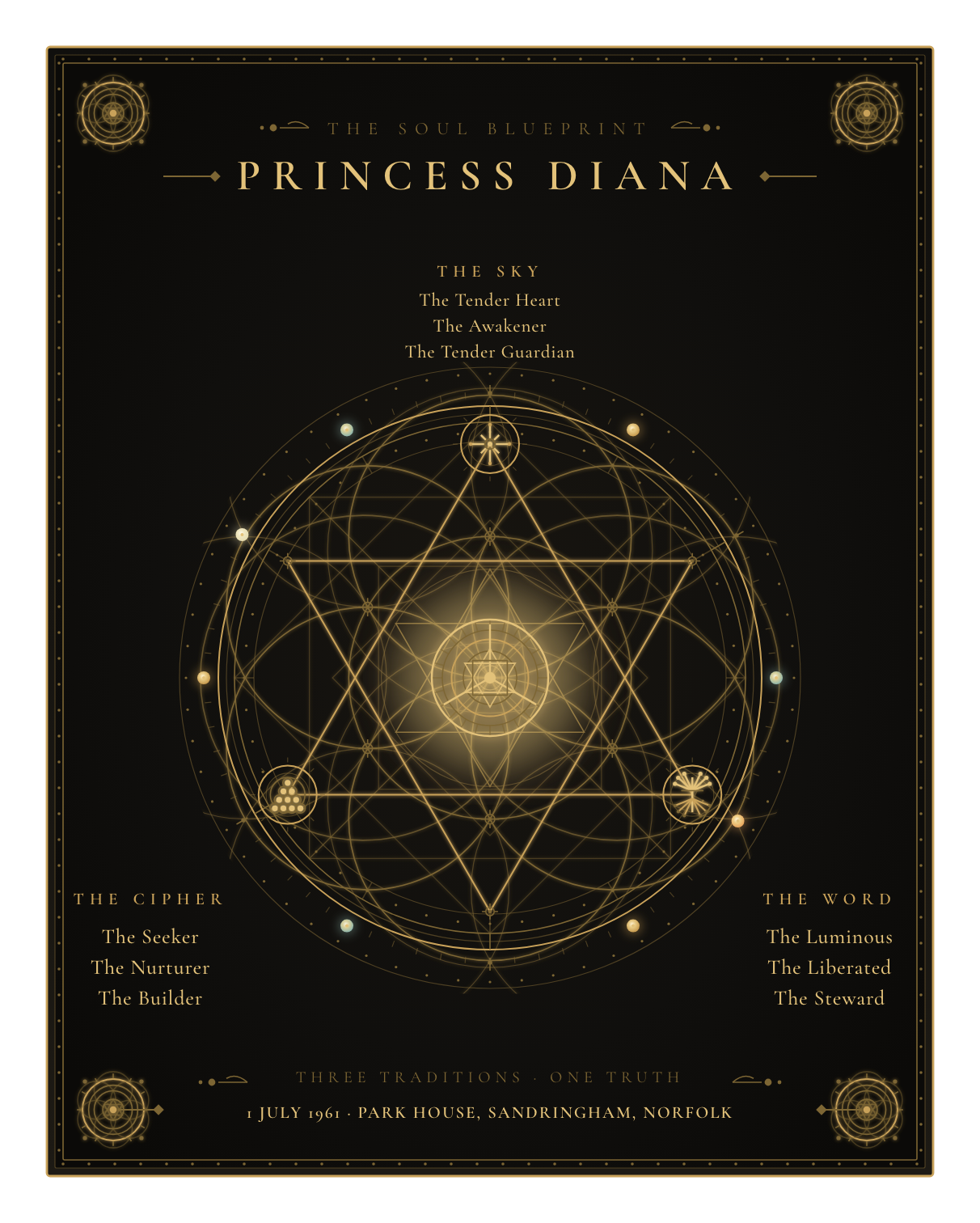
One seal, three languages. The sky she was born under at the apex, the numbers beneath her name at the lower left, the name itself at the lower right — three traditions engraved into one artifact. There is no rising sign, no houses, no angles: without a verified birth time they cannot be honestly drawn. What is true is what is shown.
At a Glance
- Full traditional name
- Diana Frances Spencer
- Born
- July 1, 1961 · Sandringham House
- Sun
- Cancer 9.4° — the essential fire of the life
- Rising
- Birth time unverified — the Ascendant is offered conditionally, never asserted
- Moon
- Aquarius 20.3° — the inner life
- Mind · Value · Will
- Mercury Cancer · Venus Taurus · Mars Virgo
- Discipline · Direction
- Saturn Capricorn · North Node Leo
- Life Path
- 7 — The Seeker
- Title-name Destiny
- 6 — The Nurturer
- Birth-name Destiny
- 4 — The Builder
- Master Numbers
- None preserved at the final layer
- Soul archetype
- The Nurturer who lives the Seeker’s path
She stood in the galleries at St. Paul’s Cathedral in the summer light of 1981, twenty years old, a woman who had worked as a nursery teacher’s assistant, a dance instructor, a nanny—the ordinary labours of a young woman finding her footing—and now the world’s eye had turned toward her with an intensity that would never, from that day forward, diminish. Seven hundred and fifty million people watched. The light came through the stained glass in fragments, and she moved through it as though entering a river whose current she could feel but not yet name. The fragments the world calls a life are often mistaken for the whole—the wedding dress, the fairytale, the princess, the crown. But beneath those surfaces runs a source far deeper: a soul that arrived carrying a particular signature, a way of being that had nothing to do with titles and everything to do with how a heart orients itself toward those around it, how it focusses the scattered energies of a world into shelter and belonging. This reading traces that source. Not the public narrative, which has been told ten thousand times in ten thousand lights, but the blueprint itself—the soul’s essential signature, the inheritance it was born into, the wound that became its greatest qualification, the calling it came to embody, and the invitation that was placed before it on the threshold of its most consequential moment. What follows is not the story the world knows. It is the architecture underneath.
The reading moves through the eight chapters of the Soul Blueprint architecture — The Arrival, The Soul’s Inheritance, The Living of It, The Soul’s Calling, The Soul’s Territories, The Name You Carry, The Moment, and The Invitation — and at the end, the same instrument turns gently toward you.
Her soul has a blueprint.
So do you.
The same three languages — the sky, the numbers, the name — are waiting in your own.
The Arrival
She arrived carrying the paradox of the one who focusses—whose identity is formed not by self-assertion but by the act of drawing scattered life inward, making shelter and a clear enduring foundation from what is broken or chaotic. This is the signature of the self that lives by focalization: giving form to what has scattered, emotional depth as a genuine intelligence, feeling that guides and protects. She was a Cancer soul, which means she came alive by making things clear-cut and permanent, by creating a home—whether literal or emotional—from which growth could proceed. Combined with the destiny of the Nurturer and the soul-path of the Seeker, she arrived as someone who would take what was fractured in the world around her and, through the alchemy of presence and tender attention, transform it into sanctuary. She did not come to rule; she came to hold. The paradox is this: the one who gives form to chaos must first have lived in it. The one who learns to shelter must have felt unshelterable. The one whose calling is to focalize the scattered must have known the particular desolation of life coming undone. She carried all of this in her arrival—the builder’s discipline, the seeker’s restlessness, the nurturer’s instinct to gather the broken into her own hands and make it whole.
The Soul’s Inheritance
She was born into the British nobility on the first of July, 1961, in Norfolk—Park House, Sandringham—a child of the Spencers, an ancient family whose women had served as ladies-in-waiting to queens. Her paternal grandmother, Cynthia Spencer, Countess Spencer, had held that post; her maternal grandmother, Ruth Roche, Baroness Fermoy, had done the same. This was a lineage of service within the structures of power, of women who moved in the orbit of monarchy without claiming its centre. She had a brother and two sisters—John, who died shortly after his birth, Sarah, and Jane—and later a younger brother Charles. The family held land, title, and a particular station in the world’s architecture. But the foundation was unstable. When she was seven years old, her parents divorced—a rupture at the centre of the family home. Her childhood became a custody battle, her father ultimately winning the right to keep her. Then, in 1975, her father inherited the earldom, and with it came a new identity: she became Lady Diana Spencer. She was fourteen. The inheritance she received was thus bifurcated: on one side, the discipline of an ancient lineage, the expectation of duty, the knowledge of how to move within power’s rooms; on the other, the particular knowledge of a home that could not hold itself together, of a family fractured, of a child who had to learn early that the structures around her were not as permanent as they appeared.
The Living of It
She lived it by working—moving from one modest employment to another before her engagement, her hands always occupied with care. She worked as a voluntary assistant at a psychiatric hospital near Dartford in the mid-1970s, tending to those the world had forgotten. She worked as a nanny, as a dance instructor until a skiing accident stopped her mid-motion for three months, as a playgroup assistant, as a cleaning worker for her sister and friends, as a nursery teacher’s assistant. These were not the occupations of nobility; they were the occupations of someone who needed to be near need, who could not rest in the abstraction of privilege. She moved through London in those years—young, unknown, searching for the shape her life would take. And then, in November 1977, when she was sixteen and he was twenty-nine, she first met the man who would become her husband. He was dating her older sister Sarah at the time. The meeting was ordinary; the consequence was not. The cost of what followed—the engagement at twenty, the wedding watched by three-quarters of a billion people, the entrance into a marriage that was incompatible at its root, the years of visible strain, the postpartum depressions after the births of her sons William and Harry, the affair of her husband with another woman, the slow and public unravelling—these costs accumulated in her body, in her mind, in the particular illness that no royal protocol could ameliorate. She struggled with bulimia, with depression, with self-harm. She lived the paradox she carried: the nurturer who could not nurture herself, the focuser who had lost the capacity to make her own life clear.
If this is what was true for her, what might be true for you?
The Soul’s Calling
Her calling was to speak what was forbidden, to touch what was untouchable, to walk into the rooms where the world had turned its face away. She was a voice that spoke the language of the heart—intuitive, tender, image-laden, indirect—a mind that thought through feeling and emotional undertow, that could attune itself to the listener and shelter them in the act of communication itself. Her Mercury was in Cancer, which meant her thinking came alive through belonging, through the resonance between her own feeling and the feeling of those she addressed. She came to demonstrate that a royal person could touch a dying man without gloves, that the princess could sit with the small and forgotten and make them feel seen. She opened centres for those with AIDS; she toured minefields in ballistic helmets; she visited hospices and hospitals and the homes of the dispossessed. The Life Path of the Seeker meant she was meant to question, to probe, to refuse the easy answers that power offered. And she did. In a BBC interview watched by twenty-three million people, she spoke aloud about the incompatibility at the root of her marriage, about her struggles with her own mind, about the particular loneliness of her position. She spoke the truth that was forbidden to speak. Her calling was to demonstrate that feeling was not weakness, that vulnerability could be a form of authority, that the heart’s intelligence was as real as any other kind.
The Soul’s Territories
Diana’s soul moved most vividly through three territories that shaped her entire inheritance — each one a landscape where her particular gifts could arrive and take root.
The first was the territory of service rendered with precision and genuine care. Her will moved toward exactness — toward getting the work truly right, whether she was moving through a psychiatric hospital ward, teaching young children their first steps in movement, or later, walking into rooms where the abandoned lived. This was not the will of the hurried or the performative; it was the will that notices what is needed and moves to meet it with competence and steadiness. She worked with children, with the ill, with those society had turned away from — and in each place, her hands knew what to do. This territory taught her that her power lay not in position but in precise, effective effort applied to the thing itself.
The second was the territory of emotional attunement and protective presence. Her mind worked through feeling — through the tones beneath words, the atmospheres in rooms, the vulnerability in a glance. She did not think in abstractions; she thought in images, in the emotional undertow of a moment, in what a body needed to feel safe. This was the intelligence of the heart speaking to the heart. In hospices, in hospitals, in the presence of those who were dying — she knew how to be there without flinching, without gloves, without the distance that fear creates. This territory taught her that feeling itself was a genuine intelligence, and that tenderness was its own form of strength.
The third was the territory of sensual presence and embodied loyalty. She loved through the senses — through touch, through beauty, through the steadiness of showing up. Her affections were not theoretical; they were lived in the body, in the rooms she made, in the way she held her children, in the loyalty she offered those she had chosen. This was love that could be relied upon, that endured, that reassured through presence itself.
Together, these three territories — the precise will, the feeling-mind, the embodied heart — formed the actual kingdom where Diana’s soul learned who she was meant to become.
There are twelve domains in the kingdom of any life: The Mark, The Unfolding, The Unseen, The Long Return, The Inheritance, The Encounter, The Alchemy, The Living Tension, The Sight, The Body’s Knowing, The Crossing, The Calling.
The Name You Carry
The name Diana carries the resonance of the hunt, of the wild and untamed, of the goddess who moved through the forest with her bow and her companions—sovereignty outside the structures of marriage and domesticity. It is a name of independence, of the one who chooses her own path, who refuses the binding that would contain her. And yet the name also carries the meaning of the divine feminine itself, the sacred in the shape of a woman. In her, these two meanings collided: the princess as hunted and as divine, as the one who both served the formal structures of power and embodied a kind of wild authenticity that those structures could never fully contain. Frances, her middle name, carries its own resonance—the French, the foreigner, the one from beyond the threshold. It is a name that speaks of generosity and openness, of the generous heart. Spencer, the family name, carries in its root the meaning of the one who dispenses, who distributes, who gives out—not the one who accumulates but the one whose gift is in the giving. So in her full birth name—Diana Frances Spencer—there is already a prophecy written: the divine wild one, generous and foreigner to power, whose gift was in the dispension of her own self toward those who had been rendered invisible. The world would know her as Princess Diana, but that title masked what her own name had already named: a soul whose essence was wild, generous, and oriented toward the giving of herself.
The Moment
The moment arrived in December 1992, when the separation from Charles was announced—not suddenly, but as the culmination of years of visible strain, years of watching a marriage that could not hold the weight of what had been placed upon it. But the true revealing came four years later, in the aftermath of the divorce decree in the summer of 1996, when she stood at a threshold: no longer the Princess, no longer the wife, no longer the woman whose identity was bound up in a role she had never chosen. She was thirty-five years old. She had become her own figure, her own authority. And then, in the final year of her life, in 1997, she moved toward something new—a relationship with a heart surgeon, a man described by those who knew her as the love of her life, a connection that was her own choosing, uncomplicated by dynasty or duty. And then a shift again: within a month, she had begun a relationship with someone else, someone whose father was a businessman, someone whose life was outside the protocols she had always inhabited. She was trying on freedom. She was asking what it might mean to love without the machinery of power watching, to choose without the weight of inheritance determining the choice. In August 1997, she visited Bosnia, walking through minefields in ballistic protection, continuing the work that had become her calling. Days later, in the last hours of August, she was in Paris, moving through the city with someone, pursued by photographers, trying to escape the camera’s gaze. The moment that had been building—the soul’s confrontation with its own threshold—arrived not as transcendence but as ending.
The Invitation
Everything in this reading has been moving toward a single point. The doubleness named in the first chapter, the inheritance, the wound, the calling, the territory, the name, the moment. These are not seven separate truths about Princess Diana. They are one truth, named from seven different angles. And they all converge here.
She was born into a calling that arrived not as whisper but as avalanche—the weight of name, of lineage, of a kingdom’s expectation arriving in her blood before she could say no. Her father carried the title of Earl; her grandmothers had served at the heart of the Crown itself, lady-in-waiting to the Queen Mother in those deep rooms where duty and devotion were the only currency that mattered. Diana inherited not a choice but an assignment: to be worthy of the Spencer name, to carry forward the discipline of service, to know her place in a hierarchy so old it seemed written into the stones of her family home. The soul born into nobility is asked first to submit—to learn that her own wanting comes second to the structure that holds her.
But something else was moving beneath that inheritance, something that would not consent to pure submission. She was being asked to learn the difference between obedience and authenticity, between the role that was handed to her and the self that was struggling to be born. Her emotional nature needed something her family’s world could not easily give: the permission to be wholly herself, to break free from the emotional scripts that had been written for her across generations. Her parents’ divorce when she was seven years old shattered the illusion that duty and structure guaranteed safety—it taught her that even the most carefully ordered homes could fracture, that loyalty could fail, that the foundation she’d been taught to trust could give way. The custody battles that followed were not merely legal disputes; they were a soul-level lesson in powerlessness, in being divided between two people who claimed to love her, in learning that love and pain could occupy the same house.
She was being called to develop something her lineage had not prepared her for: the capacity to express her own heart directly, to speak her own truth even when it contradicted the careful propriety her world demanded. The work of her hands in those early years—volunteering at the psychiatric hospital near Dartford, working as a nanny, teaching small children at the nursery in Pimlico—was not the work her title suggested she should do. This was the soul insisting on contact with real suffering, with people whose struggles were not hidden behind drawing-room manners. She was learning to mother, to tend, to use her hands and her presence to comfort what was broken. She was practicing the medicine of authenticity in the only places where such work was allowed: among those who had nothing to lose by demanding her genuine self.
Then came the invitation that would reshape everything. At twenty years old, she was asked to become Princess of Wales—to say yes to a role so immense it would dwarf any individual identity she might have been assembling. On the day she married Charles, 750 million people watched her stumble over his names at the altar, reversing the order, speaking aloud the tremor in her own hand. It was not an accident. It was a soul speaking its own confusion into a moment that demanded perfect compliance. What became available when she said yes was access to a kingdom’s suffering—the poor, the ill, the destigmatized and forgotten whom even royalty ordinarily turned away from. She was given the platform and the courage to touch AIDS patients without gloves, to walk through minefields in Angola, to sit with dying children and mothers without flinching. The role she accepted gave her permission to do the work her soul had always been called toward: to bear witness, to dignify through her presence, to translate her own hard-won understanding of fracture and survival into compassionate action.
But the invitation contained a deeper cost. She was being asked to hold two contradictory truths at once: to be the woman the nation had dreamed her to be—the fairy tale, the beauty, the symbol of hope—while her own inner life was collapsing under the weight of marital incompatibility, infidelity, and the slow erosion of being seen as a person rather than a symbol. The separation and divorce that came in the 1990s were not failures; they were the soul’s insistence on being real, on naming what could not be healed by duty or public performance. What became available through that breaking was the capacity to speak her own story—the Panorama interview that reached 23 million viewers was an act of unprecedented vulnerability from a woman of her station, a claiming of her own voice that no previous Princess of Wales had dared attempt.
The invitation, then, was this: to learn that identity itself is not something handed down but something fought for, in the small rooms of private struggle and the large rooms of public witness; to discover that the heart’s need for authenticity cannot be subordinated to the crown’s need for symbol; to find that when a soul says yes to being seen—truly seen, wounds and all—it becomes a medicine for everyone who has learned to hide.
She was not late. She was exactly where the soul-clock said she should be. The mission had been inscribed at the threshold of her first breath. What was being asked of her, she has been walking. The naming has been done.
This Is Not Coincidence
The astrology speaks: a Cancer Sun that lives by drawing scattered life inward to make shelter and a clear enduring foundation, combined with an Aquarius Moon that needs freedom and individuation, that feels steadied only by honesty and authenticity of self—these two forces were always in conversation, one calling toward belonging and focalization, the other calling toward liberation and the courage to be seen. The numerology speaks independently: a Title Destiny of 6, the Nurturer, a Birth Destiny of 4, the Builder, and a Life Path of 7, the Seeker—three numbers that together describe a soul that came to give form to what was broken, to build with precision and care, and to question everything that stood in the way of that work. The name speaks: Diana, the wild and divine; Frances, the generous foreigner; Spencer, the one who dispenses—a full name that already carried the prophecy of a soul whose gift was in the alchemical act of giving herself toward those the world had turned away from. Three entirely different languages. One truth. The soul arrived to teach the world that vulnerability and authority were not opposites, but the same thing spoken in different dialects.
Three entirely different languages. One truth.
This is not coincidence. This is what three independent systems do when they are all telling the truth about the same soul.
The Numbers, Decoded
The numbers are computed, not intuited — each letter takes its Pythagorean value, each name reduces, and any Master Number is preserved rather than collapsed.
You have sat with the chart and the numbers and the name of another soul, and watched how a wound becomes a calling, how the place of least belonging becomes the place of greatest gift, how a life too precisely configured to be coincidence reveals itself when three independent languages are read together.
The reading you have just received was, in its outer form, a reading of her soul. But its inner form was a reading written for yours. You did not arrive without a Blueprint either. May this reading be the beginning of the reading you finally receive of yourself. May the light you carry — in whatever particular, irreplaceable form it has taken inside the specific life you were given.
Some lives carry a pattern this clear.
Yours does too.
You’ve read the shape of her soul. The same three languages — the sky, the numbers, the word — are waiting in your own name and birth date. Begin yours, free, below.
Or, when you’re ready, begin your own full Soul Blueprint reading →
Frequently Asked Questions
What is Princess Diana’s birth chart?
Princess Diana’s birth chart is Sun in Cancer, Mercury in Cancer, Venus in Taurus, Mars in Virgo, Saturn in Capricorn, Moon in Aquarius, and North Node in Leo. The birth time is unverified—no reliable hospital record or family documentation has circulated—which means the rising sign (Ascendant) cannot be determined with certainty. The Sun sign and Moon sign are date-stable and can be asserted.
What is Princess Diana’s numerology?
Princess Diana’s numerology shows three governing numbers: her Title Destiny (from ‘Princess Diana’) is 6, the Nurturer; her Birth Destiny (from ‘Diana Frances Spencer’) is 4, the Builder; and her Life Path (from her birth date, 1 July 1961) is 7, the Seeker. Together, these three archetypes describe a soul whose essence was to give form to what was broken, to build with precision and integrity, and to refuse the easy answers that power offered.
What does the name Princess Diana mean?
Diana means the divine feminine and the wild goddess of the hunt—a name that carries both sovereignty and independence. Frances carries the resonance of generosity and openness, the generous heart. Spencer, the family name, derives from the one who dispenses or distributes rather than accumulates. Together—Diana Frances Spencer—the name prophesies a soul whose gift was in the generous dispensing of herself toward those whom the world had rendered invisible.
What is a Soul Blueprint?
A Soul Blueprint integrates three independent traditions — Western natal astrology, Pythagorean numerology, and the etymology of the full birth name — into a single document written as a personal letter to the soul. When you’re ready, you can begin your own.
This reading was prepared in the lineage and methodology of the Soul Blueprint Method — Pythagorean numerology with master numbers preserved, Western archetypal astrology, and a researched etymological reading of the full name. Princess Diana’s birth date (July 1, 1961) is sourced from the public record; the birth time is unverified, so the rising sign is offered conditionally and never asserted.
A Soul Blueprint reading · Astrology · Numerology · Etymology · shams-tabriz.com