
Timothee Chalamet’s Birth Chart, Numerology, and Name Decoded
Timothee Chalamet’s Birth Chart,
Numerology & Name Decoded
The Soul Blueprint Method — three traditions woven into one personal letter: Western natal astrology, Pythagorean numerology, and the etymology of the soul’s name. Learn the method →
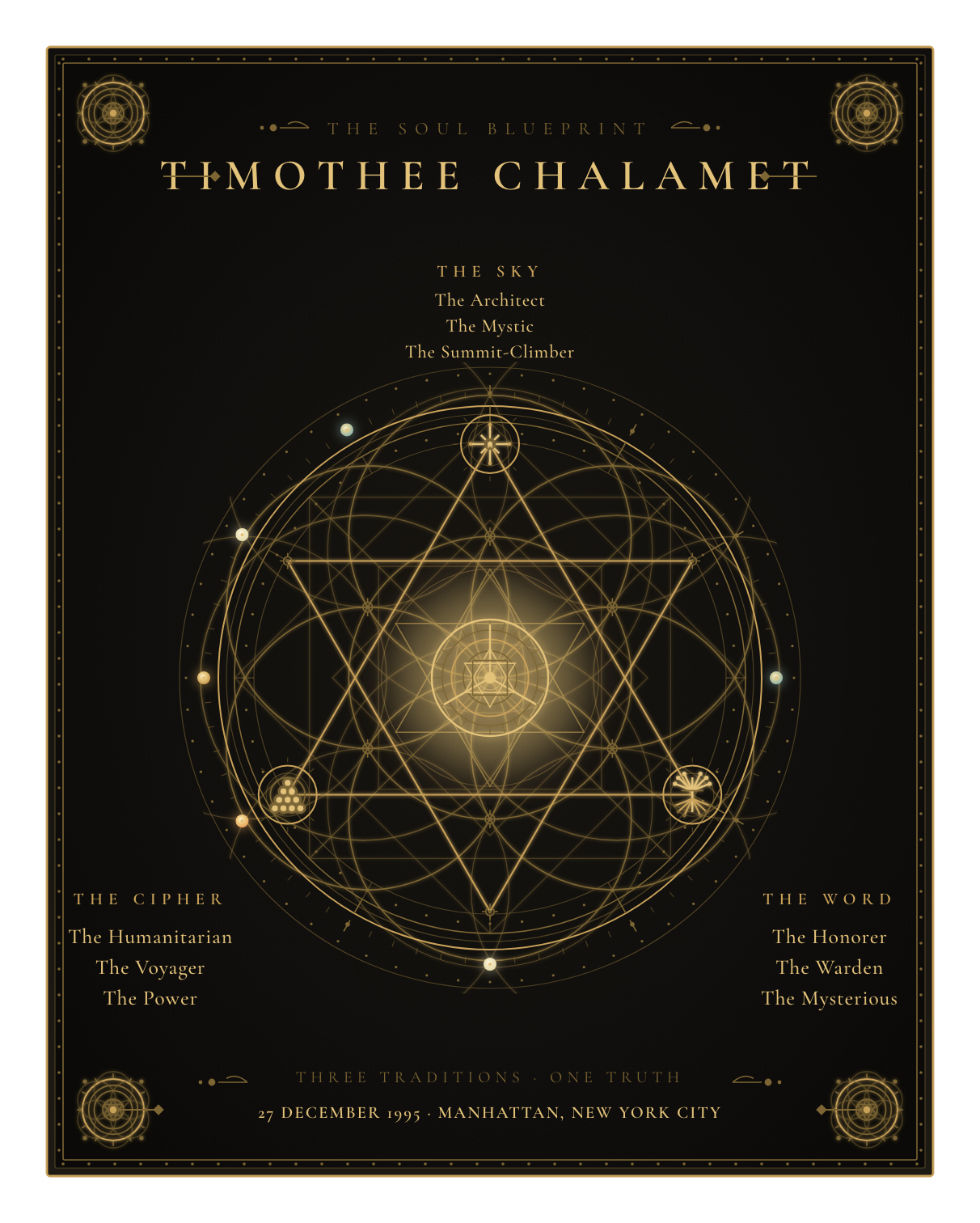
One seal, three languages. The sky he was born under at the apex, the numbers beneath his name at the lower left, the name itself at the lower right — three traditions engraved into one artifact. There is no rising sign, no houses, no angles: without a verified birth time they cannot be honestly drawn. What is true is what is shown.
At a Glance
- Full traditional name
- Timothée Hal Chalamet
- Born
- December 27, 1995 · Manhattan
- Sun
- Capricorn 5.5° — the essential fire of the life
- Rising
- Birth time unverified — the Ascendant is offered conditionally, never asserted
- Moon
- Pisces 22.1° — the inner life
- Mind · Value · Will
- Mercury Capricorn · Venus Aquarius · Mars Capricorn
- Discipline · Direction
- Saturn Pisces · North Node Libra
- Life Path
- 9 — The Humanitarian
- Title-name Destiny
- 5 — The Free Soul
- Birth-name Destiny
- 8 — The Sovereign
- Master Numbers
- None preserved at the final layer
- Soul archetype
- The Free Soul who lives the Humanitarian’s path
It is late autumn 2016, and the light in Manhattan is that particular New York cold-gold that arrives when the sun sits lower than the buildings—and in a small theater off Broadway, a young actor is inhabiting the stage with a presence so exact, so inhabited, that the watching becomes an almost involuntary act of recognition. The room knows it is witnessing something that has not yet learned its own name. He moves through the role—the prodigal son returning to claim inheritance he never sought—with the clarity of someone who has already lived inside consequence, who understands in his bones what it costs to be accountable. The fragments the world would eventually call him—”the new DiCaprio,” the fashion icon, the youngest-nominated actor of a generation, the face on a thousand curated feeds—these are the debris of public seeing, the river’s spray caught and labeled. But the source is deeper. The source is a self that arrived carrying a fundamental architecture: the capacity to build enduring structure while remaining permeable to depths that exceed all building. This reading approaches that source. Not the persona that crystallized by accident of timing and casting directors’ eyes, but the blueprint—the original arriving instruction—that made this particular soul, in this particular body, with these particular names, capable of doing what he has done and what he is still doing.
The reading moves through the eight chapters of the Soul Blueprint architecture — The Arrival, The Soul’s Inheritance, The Living of It, The Soul’s Calling, The Soul’s Territories, The Name You Carry, The Moment, and The Invitation — and at the end, the same instrument turns gently toward you.
His soul has a blueprint.
So do you.
The same three languages — the sky, the numbers, the name — are waiting in your own.
The Arrival
He arrived on the threshold between one year and the next—December’s closing day, the moment when the old structure is visibly crumbling and the new one has not yet taken solid form. The self that emerged into this timing carries an essential paradox: the capacity to build what endures, paired with an almost oceanic sensitivity to what lies beneath all building. The figure who emerged into Manhattan in 1995 was built for structure—for mastery of time, for taking on weight, for proving himself through consequence and office. And yet the emotional truth underneath that architecture is boundless, permeable, contemplative—a heart that needs to identify itself with something larger than the self alone. This is not contradiction; it is the precise blueprint of the soul who can inhabit a role so completely that the distinction between the built persona and the deeper self becomes nearly invisible to the watching eye. The individual power seeking its way out of the great weight of structure—this is his signature. He came to demonstrate that integrity under pressure is not a denial of depth, but its fullest expression. The strength that holds others is itself held by something immeasurable. The paradox he carries is also his greatest capacity: to build with precision while remaining open to the formless. To carry responsibility without losing the contemplative ground beneath it.
The Soul’s Inheritance
He was born into the inheritance of border-crossing—a father from Nîmes, France, carrying the Protestant weight of his own lineage into New York correspondence and UNICEF’s work; a mother who had danced on Broadway, who taught language, who knew the body as an instrument of expression and the word as a door between worlds. The figure arrived into a federally subsidized artists’ building in Hell’s Kitchen, into a building designed for those who had chosen art over conventional security—into a household where the assumption was not that comfort came first, but that meaning did. His sister would become an actress; his uncle and aunt worked in film. The inheritance was not wealth but cultural fluency—the capacity to read a room, to move between languages and systems, to understand that art was not decoration but a way of knowing. He grew up bilingual, moving between English and French, between New York and a small village in France where summers existed outside ordinary time. He inherited a mother who had been a dancer and understood the body’s intelligence; a father who understood words as bearers of consequence; a family that had organized itself around the principle that creative work was not a luxury but a calling. The era into which he emerged—the 1990s, the digital turn, New York still recovering its nerve—placed him in a generation that would have to learn to inhabit both the screen and the street, both the algorithmic and the embodied.
The Living of It
The living of it began early, in the ordinary way—commercials, small television appearances, the accumulation of minor parts that looked like scattered work but was actually the precise apprenticeship the soul required. At LaGuardia High School, he encountered a turning point: a drama teacher who insisted on his capacity when the initial interview had rejected him. The insistence of one person who saw what was not yet visible became the threshold crossing. He was a young person caught between the intellectual pull of Columbia University—cultural anthropology, the study of human systems—and the unmistakable call toward the embodied work of acting. For a time, he tried to hold both. The cost was the collision itself: the difficulty of assimilating to the university’s pace and structure while the actor’s work was calling him forward in a different register. The qualification came through the refusal to split himself further. He transferred to NYU Gallatin, a school designed for students who could not fit into conventional structures, then stepped away from formal education entirely to avoid the accumulation of debt that would have forced his hand toward income rather than integrity. The signature wound was the wound of choosing—of having to release the intellectual path to claim the embodied one, of learning that responsibility sometimes means saying no to security in order to say yes to what actually matters. What he qualified for through this cost was the capacity to commit to a vision over years, to prepare for a single role with the intensity that most people reserve for entire careers.
If this is what was true for him, what might be true for you?
The Soul’s Calling
What emerged as his calling was not performance in the sense of display, but the precise architecture of human interiority—the capacity to inhabit consciousness so completely that the watching becomes an act of recognition rather than observation. His mind is structured for strategy and consequence; his words, when he speaks publicly, are measured and economical—he does not gesture toward meaning but builds it into the structure of the sentence itself. The calling that took shape was to demonstrate, through the specific work of acting, that a human being can be both strategically masterful and profoundly permeable—that integrity does not require the hardening of the heart. He came to show how consciousness itself can be an instrument, how attention can be both exacting and boundless. The voice that emerged—whether through chosen roles or through the deliberate construction of a public presence—speaks with authority about what is real. He does not perform depth; he demonstrates it. The Life Path he carries is the humanitarian path—the soul oriented toward what serves the collective awakening. His specific calling has been to show, through the precision of his chosen work, that transformation is possible: that a human being shaped by discipline can remain open to mystery, that structure and formlessness are not enemies but partners in the work of becoming.
The Soul’s Territories
His most-alive territories reveal the architecture of this soul’s actual involvement with the world. The first is the territory of cinematic transformation—the work of inhabiting characters with such precision and depth that the boundary between the actor’s interiority and the character’s consciousness becomes permeable. In the roles he has chosen—the lovestruck young man in Guadagnino’s vision, the methamphetamine-addicted teenager, the medieval king, the heir to an alien throne, the legendary musician—he demonstrates the capacity to carry another’s consciousness without losing his own. The second territory is the dominion of collaborative vision—the partnerships he has formed with directors and designers who recognized in him the capacity to hold and realize their most exacting creative intentions. Guadagnino, Gerwig, Villeneuve, Mangold—these are not merely collaborators but fellow architects, and the work that emerges is the fruit of precise mutual understanding. The third territory is the realm of aesthetic sovereignty—his relationship to the body itself as an instrument of meaning. Through fashion, through the deliberate choices about how to inhabit his own form in public space, he has claimed the right to refuse conventional masculine codes, to wear what serves the vision rather than the norm. These three territories—the cinematic, the collaborative, and the aesthetic—converge in a deeper mythology: the soul who comes to demonstrate that mastery and permeability are not opposed but necessary partners.
There are twelve domains in the kingdom of any life: The Mark, The Unfolding, The Unseen, The Long Return, The Inheritance, The Encounter, The Alchemy, The Living Tension, The Sight, The Body’s Knowing, The Crossing, The Calling.
The Name You Carry
The names he carries weave a subtle resonance through the blueprint of this soul. Timothée—arriving from the Greek root that speaks of honoring the divine, of the one who witnesses the sacred—names a consciousness oriented toward what transcends the personal. The name itself is French-inflected, French-sounding, carrying his father’s lineage forward into the New York present. Hal—whether in its English or Germanic echoes—speaks to the inner hall, the chamber where decisions are made in solitude. Chalamet—the French surname that anchors the family inheritance, the lineage that reaches back to the south of France, to Protestant heritage, to a way of understanding responsibility that is both secular and moral. Taken together, the names compose a figure oriented toward the sacred within the secular, toward the inner chamber where choices are made, toward the responsibility that comes through inheritance and place. The resonance of these names, carried together in the public world, is the resonance of someone who honors something beyond the personal self while remaining grounded in family, in place, in the concrete particulars of a lived life. The names speak: witness the sacred. Make your decisions in the inner chamber. Remember where you come from. This is the instruction the names carry—not as formula but as subtle orientation, a kind of waymarking for the soul who bears them.
The Moment
The defining moment arrived in the form of a single role—Call Me by Your Name, 2016-2017, the pivot year that transformed the young actor working steadily in television into the consciousness the world would recognize. But the moment was not simply the role itself; it was the preparation that preceded it, the totality of choice that said yes to the vision. He learned Italian. He learned to play the piano and guitar—not as a performance gesture but as a way of understanding the character’s interior life through the body’s intelligence, the way a musician knows from the fingertips what the mind cannot yet articulate. The director Luca Guadagnino became not simply a collaborator but a kind of midwife to this emergence—someone who saw in him the capacity to hold both extreme youth and extreme consciousness simultaneously. The film asked him to be permeable, to allow himself to be inhabited by eros and heartbreak and the specific texture of sexual awakening, not as performance but as lived truth in the moment of performance. What this moment revealed was that the strategy he had been developing his entire life—the capacity to take responsibility, to build precisely, to carry weight—could serve the opposite impulse: the capacity to dissolve into another’s consciousness, to become transparent, to allow himself to be broken open by feeling. The Academy Award nomination that followed was the world’s recognition of what had already happened: the transformation of a young actor into a consciousness capable of holding collective attention. But the real moment was the yes itself—the choice to prepare with absolute seriousness, to become what the vision required, to refuse the ordinary path and commit entirely to the particular.
The Invitation
Everything in this reading has been moving toward a single point. The doubleness named in the first chapter, the inheritance, the wound, the calling, the territory, the name, the moment. These are not seven separate truths about Timothee Chalamet. They are one truth, named from seven different angles. And they all converge here.
What was being asked of this soul was nothing less than the demonstration of a possibility: that a human being shaped by the necessity to build, to structure, to take responsibility, can remain radically open to what cannot be built. The asking began in the particular roles he chose—characters who stood at thresholds, who were being broken open by circumstance or feeling or the arrival of something larger than themselves. It was a sustained questioning, across years and across different collaborators: Can you remain permeable while remaining precise? Can you build while remaining dissolved? Can you carry weight while remaining light? The figure began to answer through the work itself. In the roles that took shape—across the spectrum from the young lover to the warrior-prince to the legendary musician—he demonstrated again and again that structure and formlessness are not enemies but necessary partners. He was being asked to show this not just through the work of acting but through the entire architecture of how he inhabited public space—through the refusal to accept conventional categories about masculine presentation, through the collaboration with fashion and design that allowed him to think of the body as a territory of experimentation rather than a fixed form. What was being released in saying yes to this asking was the last vestige of the need to prove himself through conventional metrics of power. The armor that had protected him—the strategic mind, the disciplined will, the capacity to structure everything—was being asked to soften without becoming ineffective. What was being called toward was a deeper kind of sovereignty: not the sovereignty of the conqueror who dominates through force, but the sovereignty of the one who remains true to an internal standard even when the external pressure is absolute. This meant declining roles that did not serve the vision. It meant making the costly choice to step away from education in order to commit to the work that actually called him. It meant building a public presence that refused easy categorization, that insisted on the right to change and to be changed. What became available because he said yes to this asking was the capacity to hold attention in a way that transcends entertainment or celebrity. The audiences who watched the work began to report experiences of profound recognition—not recognition of the actor as a personality, but recognition of themselves in the character’s interiority, in the consciousness being demonstrated. The work began to function as a kind of mirror or threshold: the person entering through it could see themselves more clearly, could recognize capacities in themselves they had not yet named. The partnerships that formed—with directors and designers and creative collaborators—became increasingly precise because he had developed the capacity to listen without defending, to receive direction without losing his own authority, to hold both the vision of another and his own integrity simultaneously. The figure began to operate in a register where the distinction between personal and universal consciousness became nearly invisible. He was not simply playing a role; he was demonstrating a human capacity. He was not simply building a career; he was participating in a kind of collective becoming. The yes that was being asked of him was not a yes to fame or recognition—these arrived as consequences—but a yes to the possibility that consciousness itself could be deepened and refined through the instrument of the human being willing to be changed by what he carried. Each role became a kind of initiation, a descent into a consciousness that required him to release some version of himself he had previously inhabited. Each collaboration became a conversation between equals about what human interiority could reveal when examined with absolute attention. The work is still unfolding. The asking continues. The figure remains in the middle of the demonstration, showing what becomes possible when a soul shaped for structure agrees to be dissolved by the very dimensions it was built to contain.
He was not late. He was exactly where the soul-clock said he should be. The mission had been inscribed at the threshold of his first breath. What was being asked of him, he has been walking. The naming has been done.
This Is Not Coincidence
Passage One: The birth chart speaks a self that arrives as Capricorn—the builder, the one who takes responsibility and carries weight through time, whose strength is proved through consequence and office. The numbers speak independently: the Title Destiny is 5, the Free Soul—the consciousness oriented toward liberation and change; the Birth Destiny is 8, the Sovereign—the master of material and social structures. The names themselves—Timothée (witnessing the sacred), Chalamet (French, anchored in lineage)—speak of a consciousness that honors what transcends the self while remaining grounded in inheritance and place. Three entirely different languages. One truth: The soul came to demonstrate that the structure which holds others is itself held by something immeasurable. Passage Two: The Moon in Pisces—the emotional nature taught to identify itself with the larger framework of consciousness, boundless and permeable—stands in direct conversation with Saturn in Pisces, which asks the soul to give form to the formless, to make faith structurally sound. Mercury in Capricorn, the mind that thinks in consequence and structure, speaks truth-claims economically; Venus in Aquarius refuses possession and insists on equality and the free meeting of minds. The Life Path is 9, the Humanitarian—the soul oriented toward collective awakening and service. Three languages again. One architecture: The figure who builds the most precisely is the one who remains most radically open to what cannot be built.
Three entirely different languages. One truth.
This is not coincidence. This is what three independent systems do when they are all telling the truth about the same soul.
The Numbers, Decoded
The numbers are computed, not intuited — each letter takes its Pythagorean value, each name reduces, and any Master Number is preserved rather than collapsed.
You have sat with the chart and the numbers and the name of another soul, and watched how a wound becomes a calling, how the place of least belonging becomes the place of greatest gift, how a life too precisely configured to be coincidence reveals itself when three independent languages are read together.
The reading you have just received was, in its outer form, a reading of his soul. But its inner form was a reading written for yours. You did not arrive without a Blueprint either. May this reading be the beginning of the reading you finally receive of yourself. May the light you carry — in whatever particular, irreplaceable form it has taken inside the specific life you were given.
Some lives carry a pattern this clear.
Yours does too.
You’ve read the shape of his soul. The same three languages — the sky, the numbers, the word — are waiting in your own name and birth date. Begin yours, free, below.
Or, when you’re ready, begin your own full Soul Blueprint reading →
Frequently Asked Questions
What is Timothee Chalamet’s birth chart?
Timothée Chalamet was born with the Sun in Capricorn—the sign of structure, responsibility, and enduring consequence. His Mercury is also in Capricorn, shaping a mind that thinks in strategy and the long view; his Mars in Capricorn gives him disciplined, goal-directed will. His Venus is in Aquarius, oriented toward freedom and equality in relationship; his Saturn is in Pisces, asking him to give form to the formless. His Moon is in Pisces, making his emotional nature contemplative and permeable to larger frameworks of consciousness. The birth time is unverified, so his rising sign cannot be reliably determined.
What is Timothee Chalamet’s numerology?
Timothée Chalamet carries three core numerological archetypes. His Title Destiny is 5—the Free Soul, oriented toward liberation, change, and the breaking of conventional forms. His Birth Destiny is 8—the Sovereign, the master of structure and material consequence. His Life Path is 9—the Humanitarian, the soul oriented toward collective awakening and service. These three numbers together compose a figure shaped to demonstrate that sovereignty and freedom are not opposed, and that the deepest service comes through the precise refinement of one’s own consciousness.
What does the name Timothee Chalamet mean?
Timothée derives from the Greek roots meaning ‘honoring the divine’ or ‘one who witnesses the sacred’—a name oriented toward what transcends the personal self. Hal, whether in its English or Germanic echoes, suggests the inner hall, the chamber where solitary decisions are made. Chalamet is the French family surname, anchoring the lineage to the south of France and the Protestant heritage carried forward by his father’s line. Together, the names compose an instruction: witness the sacred; make your decisions in solitude; remember your inheritance.
What is a Soul Blueprint?
A Soul Blueprint integrates three independent traditions — Western natal astrology, Pythagorean numerology, and the etymology of the full birth name — into a single document written as a personal letter to the soul. When you’re ready, you can begin your own.
This reading was prepared in the lineage and methodology of the Soul Blueprint Method — Pythagorean numerology with master numbers preserved, Western archetypal astrology, and a researched etymological reading of the full name. Timothee Chalamet’s birth date (December 27, 1995) is sourced from the public record; the birth time is unverified, so the rising sign is offered conditionally and never asserted.
A Soul Blueprint reading · Astrology · Numerology · Etymology · shams-tabriz.com