
Finn Wolfhard’s Birth Chart, Numerology, and Name Decoded
Finn Wolfhard’s Birth Chart,
Numerology & Name Decoded
The Soul Blueprint Method — three traditions woven into one personal letter: Western natal astrology, Pythagorean numerology, and the etymology of the soul’s name. Learn the method →
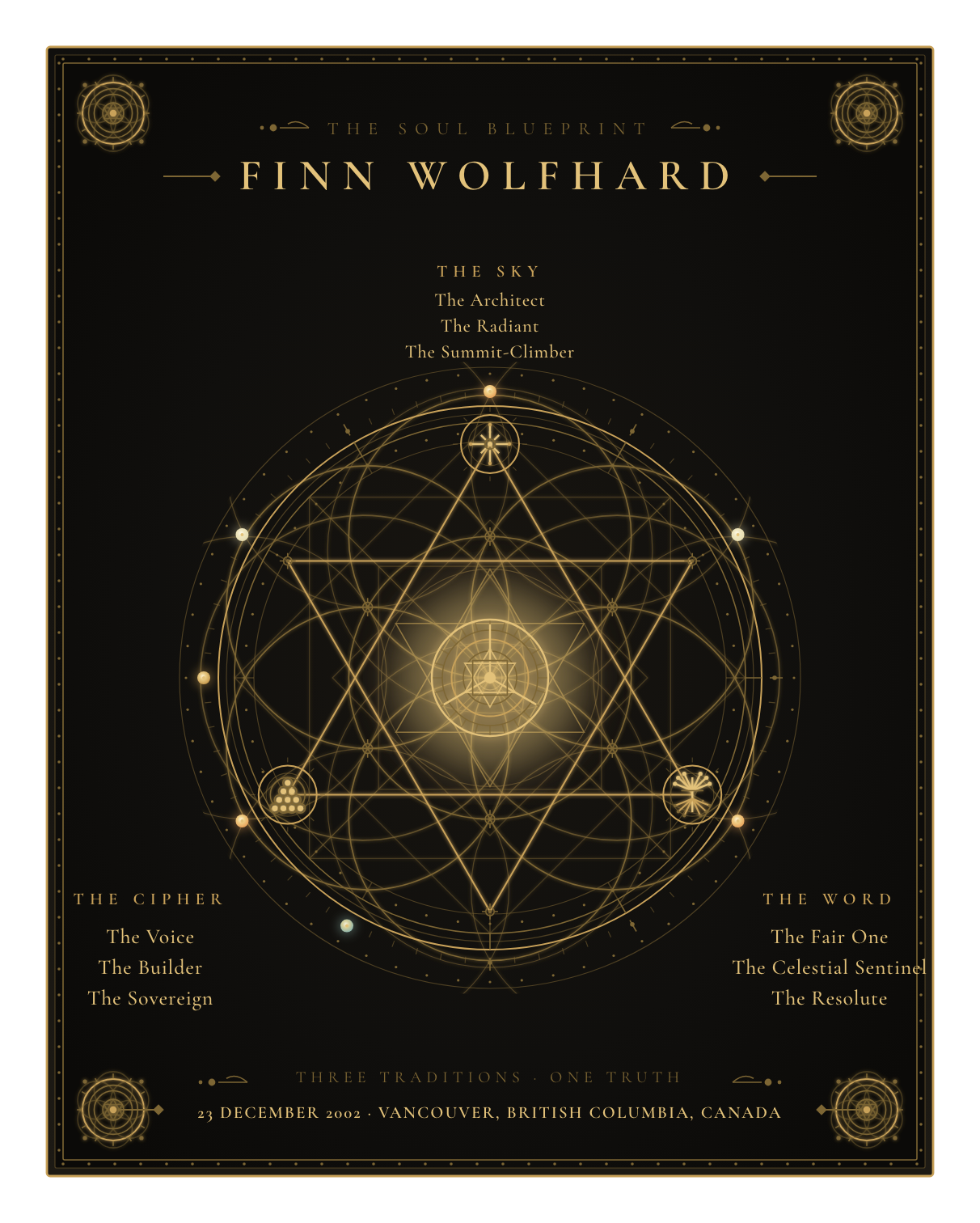
One seal, three languages. The sky he was born under at the apex, the numbers beneath his name at the lower left, the name itself at the lower right — three traditions engraved into one artifact. There is no rising sign, no houses, no angles: without a verified birth time they cannot be honestly drawn. What is true is what is shown.
At a Glance
- Full traditional name
- Finn Michael Wolfhard
- Born
- December 23, 2002 · Vancouver
- Sun
- Capricorn 1.8° — the essential fire of the life
- Rising
- Birth time unverified — the Ascendant is offered conditionally, never asserted
- Moon
- Leo 20.8° — the inner life
- Mind · Value · Will
- Mercury Capricorn · Venus Scorpio · Mars Scorpio
- Discipline · Direction
- Saturn Gemini · North Node Gemini
- Life Path
- 3 — The Communicator
- Title-name Destiny
- 4 — The Builder
- Birth-name Destiny
- 1 — The Pioneer
- Master Numbers
- None preserved at the final layer
- Soul archetype
- The Builder who lives the Communicator’s path
The light in a Vancouver studio in 2012 is pale and northern, the kind that lasts too long in the evenings—Finn Wolfhard, nine years old, steps into a music video for a band called Facts, singing “Retro Oceans,” his first appearance before a camera, his voice already carrying something older than his years. He does not yet know that this moment is the hinge, that the threshold is opening, that the soul arriving on December 23, 2002, carrying an inheritance of structure and consequence, will spend the next thirteen years learning how to build something that lasts in a medium designed to burn itself away. The world will call him a child actor, a television face, a musician, a director, a ensemble player in the mythology of a generation—fragments scattered like light on water, the surface reading mistaking the name for the source. But beneath the names the industry assigns him, beneath the roles and the bands and the public persona, there moves something more rooted: a soul built to carry weight, to take real responsibility, to stand in the office of consequence and prove itself through enduring structure. This reading descends past the fragments—past the casting calls and the SAG Awards, past the anxiety he has spoken about openly and the fierce commitments he has made—to the source itself, the blueprint that has been calling him forward since before he arrived.
The reading moves through the eight chapters of the Soul Blueprint architecture — The Arrival, The Soul’s Inheritance, The Living of It, The Soul’s Calling, The Soul’s Territories, The Name You Carry, The Moment, and The Invitation — and at the end, the same instrument turns gently toward you.
His soul has a blueprint.
So do you.
The same three languages — the sky, the numbers, the name — are waiting in your own.
The Arrival
Finn Wolfhard arrived carrying a paradox that would shape every threshold he would cross: the self that comes alive by building enduring structure and taking real responsibility, born into an age of flux and dissolution—an old soul placed in a time and industry that specializes in the ephemeral, the viral, the next-week-old. His signature is the Capricorn’s ancient knowing: mastery of consequence and time, the capacity to build what lasts and to carry weight. But he arrived also with a heart that burns to be seen, to shine warmly, to feel its way into radiant form—a Leo’s need for attention and the opportunity for creative self-expression, a reigning warmth that cannot be buried under the weight of office. The paradox: he is a builder by soul-nature, yet he builds in an industry that tears down constantly. He carries the authority of consequence, yet he carries it in a body that is always young, always watched, always on the cusp of being replaced. The tension is not a flaw—it is the very friction that has made him real. The soul arrived knowing it would have to prove itself not through the easy paths of celebrity or fame—those burn away—but through the actual work of structure, through learning to say no, through choosing what endures over what glitters. The self that builds enduring things while surrounded by the disposable is the soul that learns to distinguish true value from the world’s chatter.
The Soul’s Inheritance
He was born into the lineage of the observer and the builder—a father whose work centered on understanding the claims and structures of Indigenous land, a man oriented toward consequence and documentation, toward the long work of seeing what is true beneath the surface. His brother Nick walked the same path of performance, which meant Finn was not born into the fantasy that this work was easy or inevitable, but into the practical knowledge of what the work costs. He arrived as a French and German boy with Jewish heritage, in Vancouver, a city at the edge of the continent where the Pacific light is clear and unforgiving—where what is built must be built to weather actual conditions, not imagined ones. He was schooled in the Catholic tradition, which taught him the language of conscience and the weight of inherited responsibility, the sense that choices have consequences that move outward and persist. He was born at the threshold of the digital age, into an era where the camera would become intimate and ubiquitous, where a child could be recognized by millions before he understood what it meant to be seen. This was not accident but the meeting-place of his soul’s nature with the world’s readiness: a builder arriving just as the apparatus of image-making was becoming the primary architecture of culture itself. He inherited a father’s gravity and a brother’s example, a heritage that taught him that to participate in this industry was not to abandon consequence but to accept it as a given—to become, from the beginning, someone who would have to choose what endured.
The Living of It
The living of it began in small ways—a music video at nine, a guest role in a science fiction series at eleven—but the turning came when Stranger Things found him at thirteen, when the weight of millions of eyes landed on a boy who was still learning who he was. What arrived with that fame was not triumph but its hidden cost: panic attacks that seized him in his mid-teens, anxiety that rose up precisely because he was being asked to hold a public self while his private self was still forming, still fragile. The soul built to carry weight discovered that the weight of being watched, of representing something to strangers, of being the vessel for other people’s attachment and projection—this weight was different from the weight of consequence and structure he had come to carry. He had to learn, in the midst of ascension and success, that the building he was meant to do required that he protect something interior, something real and not-for-the-camera. He made the choice that marked a true passage: in 2017, he parted ways with his agency and fired his agent, a decision made not from bitterness but from the deep knowledge that his soul could not be represented by someone whose integrity was compromised. This act—direct, clean, and consequential—showed the Mars beneath the Capricorn: the will that goes all the way down, nothing half-felt, refusing to collude with what was false. He has spoken openly about his struggles, about therapy, about the cost of early fame, which is itself a form of building—the construction of honesty in a culture built on image. The anxiety did not disappear; it became a teacher, a threshold guardian that forced him to distinguish between what the world wanted from him and what his own soul was actually calling him to do.
If this is what was true for him, what might be true for you?
The Soul’s Calling
The soul came to demonstrate something about the possibility of integrity in an industry built on persuasion and forgetting—the possibility that one could build something real in a medium designed to be disposable. His calling is not primarily to act, though acting arrived first; it is to speak and to make, to think in sequences that lead somewhere, to construct meaning from fragments and then offer it back to the world. The Mercury that lives in structured, strategic, realistic thought—Hermes as architect—has moved him gradually from performance toward direction, toward collaboration, toward the actual work of writing and making films that say something he believes. The voice that lives in him is measured, economical, weighed—not the voice of someone who speaks for effect, but someone who speaks because something needs to be said and he has thought about how to say it truly. He arrived at this calling through the body of the character Mike Wheeler, a boy who listens and observes before he acts, who is loyal in a way that is almost old-fashioned, who carries the weight of his friendships as real responsibility—and the soul simply stepped into the role that was already true. The calling is to be a witness who builds, a maker who thinks in consequence, a young man who refuses the path of endless promotion and instead asks himself what he actually wants to make and why. This is the voice that speaks: structured, strategic, refusing the easy word, asking the real question.
The Soul’s Territories
His territories are the spaces where intention can meet form, where something interior can be made visible without being destroyed in the process. The first is the territory of collaborative filmmaking and direction—the work he began at seventeen with Night Shifts, the short that showed he could think visually, could compose frames and moments, could translate the interior into image. This is where the builder’s hand becomes visible, where the soul can exercise actual choice about what is shown and how. Hell of a Summer, made in 2023 with Billy Bryk, deepened this territory: a film that premiered at Toronto, that was named second runner-up for the People’s Choice Award—work that asked something of him beyond performance, that required him to think in narrative, in structure, in the long view of what a story could do. The second is the territory of music and the voice expressed as song—Calpurnia, the Vancouver band where he was lead vocalist and songwriter until 2019, and The Aubreys after, and now his solo album Happy Birthday, released in 2025. Here the Leo heart finds its radiant form, the inner world given permission to sing and roar, the structured Capricorn will choosing what is worth singing about. Music is where the resistance dissolves; where what he builds does not need to justify itself through narrative or character. The third is the territory of witness and conscience—his advocacy work, his benefit concerts for Sweet Relief, his support for those affected by the Ukraine conflict, his commitment to autism and Indigenous children’s causes. These are not marginal to his soul’s work; they are where the inherited gravity of his father’s concern for land claims and consequence moves into his own voice and action. Here the builder and the witness are the same person, and the structure he is building is one of actual care, of consequence made visible as gift.
There are twelve domains in the kingdom of any life: The Mark, The Unfolding, The Unseen, The Long Return, The Inheritance, The Encounter, The Alchemy, The Living Tension, The Sight, The Body’s Knowing, The Crossing, The Calling.
The Name You Carry
The name Finn carries the resonance of the wanderer, the seeker, the one who moves through the story itself—there is something in the sound that suggests movement, discovery, a lightness that seems to contradict the weight of the family name. Yet Finn Wolfhard is a name that contains a deliberate paradox: the delicate given-name paired with the substantial, almost Germanic weight of Wolfhard, as though the soul came with both impulses written into it, the wanderer and the builder, the one who moves and the one who stays. The second name Michael speaks to the archangel, the great principle, the one who stands and defends—and in his full birth name Finn Michael Wolfhard, there is a conversation between the mobile and the rooted, the particular and the archetypal. The name Wolfhard itself, carried from his lineage, holds something of the old Germanic sense of the strong holding-place, the hard shelter—and Finn lives inside that shelter as the one who will explore it and then choose to build within it. The fullness of the name is the soul’s own paradox made linguistic: he is the wanderer who learns that true freedom comes not from motion but from the deep commitment to build something that lasts, to care for the structure that shelters others, to take the weight of the family name forward and make it mean something true in his own time. His friends call him Finn; the industry calls him Finn Wolfhard; but the complete name holds all three impulses—the mobile, the archangelic, the rooted—as though from birth the soul was inscribed with everything it would need to understand about what it came to do.
The Moment
There is a moment in a young soul’s life when the scaffolding of the world becomes visible, and he sees, for the first time, what it costs to build anything that lasts. For Finn Wolfhard, that moment arrived in the autumn of 2017—not as a single lightning-strike, but as a slow unveiling that moved through him like a fever breaking into clarity.
He had been cast into two parallel 1980s narratives almost by accident: Mike Wheeler in Stranger Things, which had already opened the world’s eye toward him, and Richie Tozier in It, a second miracle that had arrived only after the first director’s departure freed the role to find him again. Two worlds, both set in the same decade, both requiring him to inhabit boyhood at the very moment his own boyhood was being consumed by the machinery of fame itself. The irony was not lost on him—or it became impossible to ignore once the panic arrived.
By mid-adolescence, the weight of consequence had become visible. The anxiety came first, then the panic attacks—the body’s way of saying that the structure he was being asked to carry was too heavy for a mind still learning how to think clearly. He sought therapy, and in that seeking, something shifted: the capacity to name the rupture became the first tool of repair.
But there was another reckoning that same year. In October 2017, Wolfhard parted ways with his agency and fired an agent, refusing to remain silent about allegations of harm to other young men in the industry—an act of witnessing that had nothing to do with his own safety and everything to do with his sense of office. He had not been assaulted himself, yet he understood, with the clarity of someone learning to think strategically about consequence, that silence itself is a structure, and structures protect those who benefit from them.
The soul who accepts real weight learns what it means to use his voice not for himself, but as a tool of integrity.
These were not the moments a young star was supposed to claim publicly. Yet he claimed them—the anxiety, the therapy, the refusal to stay complicit. The threshold between boyhood and the responsible use of power had been crossed. He would not return.
The Invitation
Everything in this reading has been moving toward a single point. The doubleness named in the first chapter, the inheritance, the wound, the calling, the territory, the name, the moment. These are not seven separate truths about Finn Wolfhard. They are one truth, named from seven different angles. And they all converge here.
What is being asked of Finn Wolfhard now, in his twenty-second year, is nothing less than the full claim of his own authority—not the authority of fame or recognition, but the authority that comes from having thought deeply about what one actually wants to make and why, from having turned away from the paths that would have been easiest, from having learned to distinguish between the world’s hunger for his image and his own soul’s hunger for meaningful work. He is being asked to complete the arc that began in that Vancouver studio in 2012: to move from being a vessel for other people’s stories to being the author and architect of his own. The Stranger Things has ended; the ensemble that won him the SAG Award is complete. The television work that made him visible is behind him. What remains is the actual choice: whether he will let that visibility become his prison or his platform—and everything in his soul suggests he has already chosen. He is releasing the last threads of the need to be a performer in the old sense, the boy who arrives at auditions hoping to be chosen. What he is calling toward is the maker’s work: the films he directs with Billy Bryk, the music he releases under his own name, the screenplay he is writing with his father about The Replacements—a biopic being developed in 2025 that represents a convergence of his two deepest territories, music and direction, and the inheritance of his father’s concern for truth and structure. The work he is moving toward requires something he did not have at fifteen: the refusal to compete, the discipline to say no to what does not serve, the strategic patience to build something that lasts. What became available the moment he said yes to this actual authority is the permission to fail on his own terms, to make work that might not be popular but is honest, to build in the spaces where intention can meet form without corruption. He is no longer trying to prove himself through accumulation—through roles, awards, visibility—but through the substance of what he makes. The question of whether he will have an acting career has become irrelevant; the question now is whether he will become the director, the writer, the artist whose work carries the weight of real thought and real care. And this is already happening. Happy Birthday, his debut solo album released in June 2025, is the sound of someone who has moved past the need to be heard and into the clarity of what he actually has to say. Hell of a Summer, the feature film he co-directed and co-wrote, represents the full exercise of his authority in the visual medium. The Replacements biopic, written with his father, brings together the two lineages—the performer and the thinker, the one who makes and the one who understands what it means—into a single work. What is becoming clear is that the soul did not arrive to be a star; it arrived to be a builder, and the work of building requires that you refuse the shortcuts, that you think in long sequences, that you say no to more than you say yes to, that you protect something interior and real. The anxiety that seized him in his mid-teens was not a weakness but a signal: a sign that the false paths were false, that the easy choices would lead away from what he actually came to do. He is now in the position to trust that signal completely. The figures who will matter most in the culture will not be those who accumulated the most visibility but those who built the most carefully, who thought the most honestly, who refused to collude with corruption and chose instead to make something real. This is what is being asked of him, and this is what he is already answering.
He was not late. He was exactly where the soul-clock said he should be. The mission had been inscribed at the threshold of his first breath. What was being asked of him, he has been walking. The naming has been done.
This Is Not Coincidence
The astrology says: he arrived carrying a Capricorn sun—the self that proves itself through office and consequence, through building what lasts—yet immediately met this with a Leo moon that burns to be seen, to shine warmly, needing the heart to roar and sing; Mercury in Capricorn gives him the strategist’s voice, economical and weighed, while Venus and Mars both in Scorpio demand that everything he touches go all the way down, transforming him and whatever he touches in equal measure. The numerology says: he carries the Title Destiny of 4, the Builder, the Foundation, alongside the Birth Destiny of 1, the Pioneer who arrives first and claims new territory, and the Life Path of 3, the Communicator whose voice is meant to gather and translate—three entirely separate numbers speaking one truth: a soul whose work is to build new forms of expression, to pioneer structures that did not exist before, and to speak what he has discovered in language that others can hear and use. The name says: Finn, the wanderer, paired with Wolfhard, the rooted stronghold, creating a conversation between motion and foundation, between exploration and the building of shelter—a name that is itself a paradox resolved only in the living of it. Three entirely different languages. One truth. The builder who refuses to build prisons, only cathedrals.
Three entirely different languages. One truth.
This is not coincidence. This is what three independent systems do when they are all telling the truth about the same soul.
The Numbers, Decoded
The numbers are computed, not intuited — each letter takes its Pythagorean value, each name reduces, and any Master Number is preserved rather than collapsed.
You have sat with the chart and the numbers and the name of another soul, and watched how a wound becomes a calling, how the place of least belonging becomes the place of greatest gift, how a life too precisely configured to be coincidence reveals itself when three independent languages are read together.
The reading you have just received was, in its outer form, a reading of his soul. But its inner form was a reading written for yours. You did not arrive without a Blueprint either. May this reading be the beginning of the reading you finally receive of yourself. May the light you carry — in whatever particular, irreplaceable form it has taken inside the specific life you were given.
Some lives carry a pattern this clear.
Yours does too.
You’ve read the shape of his soul. The same three languages — the sky, the numbers, the word — are waiting in your own name and birth date. Begin yours, free, below.
Or, when you’re ready, begin your own full Soul Blueprint reading →
Frequently Asked Questions
What is Finn Wolfhard’s birth chart?
Finn Wolfhard was born on December 23, 2002, with the Sun in Capricorn—the sign of building enduring structure and carrying real responsibility. His birth time remains unverified, so his rising sign cannot be fixed. His Moon in Leo shows an emotional nature that needs warmth and the safety to express itself generously and dramatically. His Mercury in Capricorn gives him a structured, strategic, realistic mind—thought that lives in consequence and sequence, a measured and economical voice. Both his Venus and Mars are in Scorpio, which means his love and his will are intense, deep, and transformative, going all the way or not at all. Saturn in Gemini points to his soul’s Great Work: the disciplining of the mind and the voice, the hard-earned confidence in his own intelligence.
What is Finn Wolfhard’s numerology?
Finn Wolfhard’s numerology carries three primary numbers. His Title Destiny (calculated from Finn Wolfhard) is 4, the Builder—the soul that creates foundation and structure. His Birth Destiny (calculated from Finn Michael Wolfhard) is 1, the Pioneer—the soul that arrives first and claims new territory. His Life Path (calculated from his birth date December 23, 2002) is 3, the Communicator—the voice meant to gather, translate, and express. Together, these three numbers reveal a soul whose work is to build new forms, to pioneer what did not exist before, and to speak what he discovers in language others can use and carry forward.
What does the name Finn Wolfhard mean?
The name Finn carries the resonance of the wanderer and the seeker—a name light and mobile, suggesting movement and discovery. Wolfhard is the family name, substantial and rooted, holding something of the old Germanic sense of the strong holding-place. Together they form a paradox: the wanderer paired with the stronghold, the explorer held within the foundation. The full birth name—Finn Michael Wolfhard—adds the archangelic dimension of Michael, the great principle and defender, creating a three-part conversation between the mobile, the archetypal, and the rooted. The names together suggest a soul whose life work is to explore the structures it has inherited and then choose to build within them, to make them mean something true in its own time.
What is a Soul Blueprint?
A Soul Blueprint integrates three independent traditions — Western natal astrology, Pythagorean numerology, and the etymology of the full birth name — into a single document written as a personal letter to the soul. When you’re ready, you can begin your own.
This reading was prepared in the lineage and methodology of the Soul Blueprint Method — Pythagorean numerology with master numbers preserved, Western archetypal astrology, and a researched etymological reading of the full name. Finn Wolfhard’s birth date (December 23, 2002) is sourced from the public record; the birth time is unverified, so the rising sign is offered conditionally and never asserted.
A Soul Blueprint reading · Astrology · Numerology · Etymology · shams-tabriz.com