
Matthew Mcconaughey’s Birth Chart, Numerology, and Name Decoded
Matthew Mcconaughey’s Birth Chart,
Numerology & Name Decoded
The Soul Blueprint Method — three traditions woven into one personal letter: Western natal astrology, Pythagorean numerology, and the etymology of the soul’s name. Learn the method →
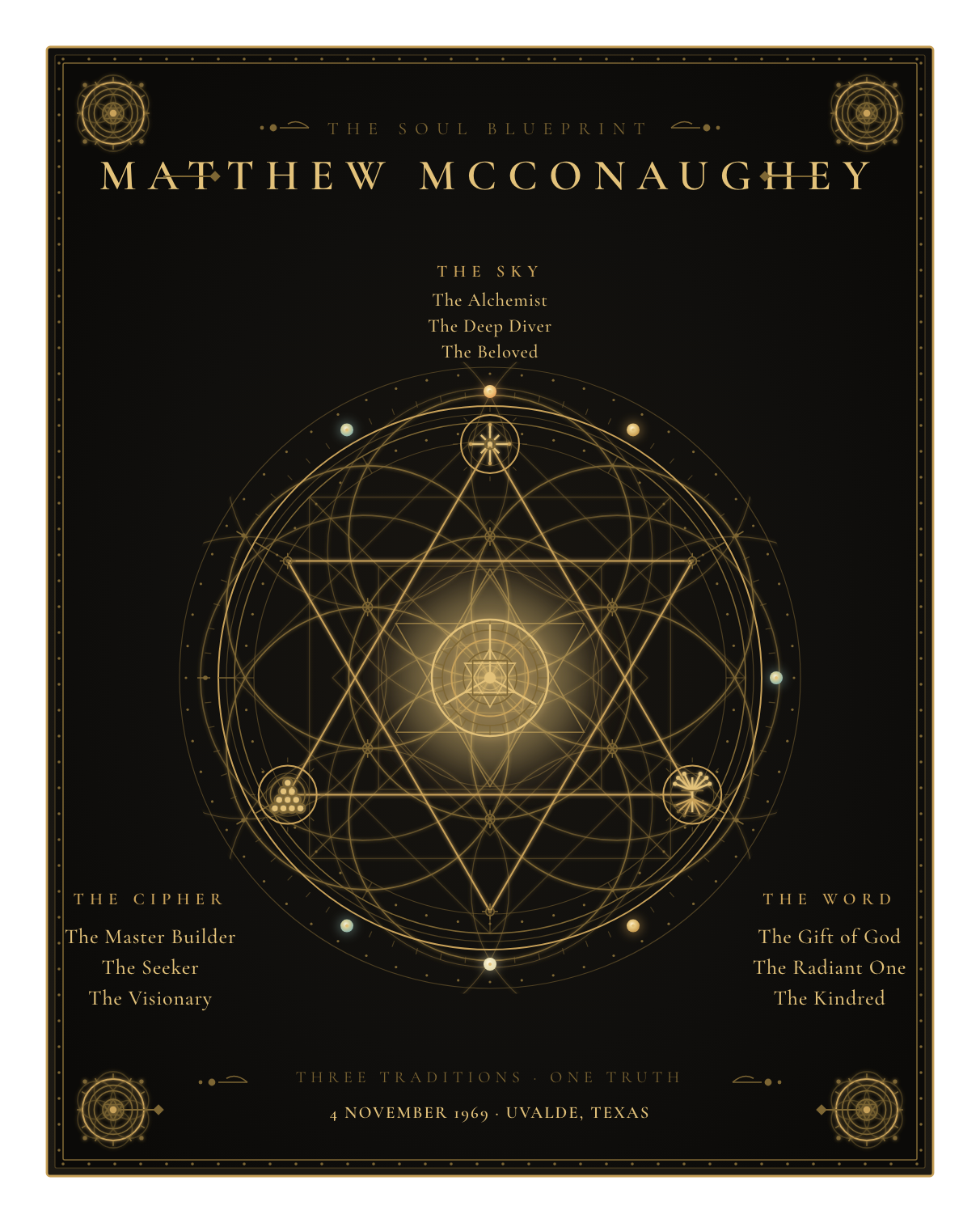
One seal, three languages. The sky he was born under at the apex, the numbers beneath his name at the lower left, the name itself at the lower right — three traditions engraved into one artifact. There is no rising sign, no houses, no angles: without a verified birth time they cannot be honestly drawn. What is true is what is shown.
At a Glance
- Full traditional name
- Matthew David McConaughey
- Born
- November 4, 1969 · Uvalde
- Sun
- Scorpio 12.1° — the essential fire of the life
- Rising
- Birth time unverified — the Ascendant is offered conditionally, never asserted
- Moon
- Virgo 9.1° — the inner life
- Mind · Value · Will
- Mercury Scorpio · Venus Libra · Mars Capricorn
- Discipline · Direction
- Saturn Taurus · North Node Pisces
- Life Path
- 22 — The Master Builder
- Title-name Destiny
- 7 — The Seeker
- Birth-name Destiny
- 11 — The Illuminator
- Master Numbers
- 11, 22
- Soul archetype
- The Seeker who lives the Master Builder’s path
It is 1988, and a boy sits in a classroom in Warnervale, New South Wales—an exchange student of seventeen, far from the Texas heat, watching Australian light pour through windows he does not yet know how to read. He is working as an assistant in an attorney’s office, as a bank teller, as a witness to how lives are ordered by other people’s rules. The year abroad holds him in a suspension: not quite the person he was, not yet the person he will become. This is how arrival often works—a threshold, a pause, a stranger in a foreign room learning the grammar of elsewhere.
The world fragments people into the stories it tells about them: the breakthrough actor, the romantic-comedy star, the sex symbol, the Oscar-winner, the professor, the foundation-builder. Each fragment is true enough. But beneath the fragments runs a single current, an underground river that has moved beneath every surface the life has touched—a river that knows itself before the world ever names it. The fragments are what others have called him. The source is what was always moving underneath.
This reading reads the source. It descends beneath the titles and the roles and the public victories to the original blueprint—the soul’s arrival signature, the inheritance that shaped it, the calling that has moved through every choice, every refusal, every transformation. It is a map not of accomplishment but of essence: what this soul came to know, to do, to become.
We read him as he was written before the world began to write him.
The reading moves through the eight chapters of the Soul Blueprint architecture — The Arrival, The Soul’s Inheritance, The Living of It, The Soul’s Calling, The Soul’s Territories, The Name You Carry, The Moment, and The Invitation — and at the end, the same instrument turns gently toward you.
His soul has a blueprint.
So do you.
The same three languages — the sky, the numbers, the name — are waiting in your own.
The Arrival
He arrived carrying a paradox that would spend a lifetime resolving itself into unity: the self that must be remade through merging, the individual will that discovers its truest power only by surrendering into something larger than itself. This is not the stereotype of the relentless ego—it is deeper and more exacting than that. The soul came alive through transformative union, through the willingness to dissolve the small self and be reconstituted into something that could not have existed alone.
This is also the signature of a seeker, a soul drawn to penetrate what others left on the surface. The mind came alive by probing beneath pretense to the hidden architecture underneath—the voice intense enough to name what had been left unsaid. And yet beneath this investigative fire ran another current: the will that is patient, disciplined, strategic, the warrior-builder whose power accumulates over time, step by step, no shortcuts, no wasted effort.
The paradox resolved into a Master Builder—a soul who came to construct something lasting by first dissolving what no longer served, who learned that true transformation requires both the knife that cuts away and the hands that build again. He arrived to learn that the deepest individuation comes not from holding tighter to the self, but from the courage to be remade. The soul’s signature was written in the language of regeneration, and nothing less than complete authenticity—in work, in relationship, in the refusal to remain small—would ever satisfy it.
The Soul’s Inheritance
He was born into the legacy of builders and witnesses. His father ran an oil pipe supply business—a man who had played college football at Kentucky and Houston, whose life was marked by the discipline of physical mastery and the strategic management of enterprise. His mother was a published author and kindergarten teacher, a woman trained in the work of seeing what was just forming, what was fragile, what could grow. From these two inheritances—the strategic builder and the nurturer-observer—came a child shaped by both the will to create lasting structures and the eyes to perceive what others had missed.
He arrived in Uvalde, Texas, in 1969—a place of oil and cattle, of the border country’s particular light, of a world still believed in family as an unshakeable foundation. He had an older brother who would become known as a millionaire, a man visible in the world’s measure of success; he had another older brother; and he had the particular destiny of being the youngest, the one who watched the older paths being carved before his own began. The family carried Irish heritage, Methodist roots, a Christian faith that would resurface throughout his life as the bedrock beneath every other question.
This was not a family of performers or artists—it was a family of doers, of people who made things work in the real world, who understood that discipline and authenticity were the same thing. Into this world came a soul whose inheritance was the conviction that a life had to mean something, had to be built with intention, had to prove itself in the actual world, not just in dreams or abstractions.
The Living of It
The living of it began in television commercials in the early 1990s—small, invisible work, the kind that teaches you to be seen without being known. He made his film debut as Guy 2 in My Boyfriend’s Back (1993), a credit so minor it was almost erasure. But that same year came the moment that would become the threshold: he was not originally cast for the role of Wooderson in Dazed and Confused. He approached the casting director Don Phillips at a Hyatt hotel bar—an act of audacity that required him to step outside the system entirely—and in that moment of improvisation, largely making up his own lines, he became unforgettable. The role demanded a particular kind of surrender: the actor had to be loose enough to let the character emerge from beneath the page, had to trust the instinct more than the script.
This taught him something essential about transformation: that sometimes the greatest work comes not from control but from the willingness to dissolve control and let something truer emerge. The years that followed—Contact, Amistad, U-571—built a career, but the cost was that the industry came to see him as one thing: the beautiful man who belonged in romantic comedies. By 2005, when he was named Sexiest Man Alive, he had achieved the fame the world said it wanted him to have. And he recognized that he was being slowly erased by the very visibility that was supposed to validate him.
So between 2010 and 2012, he walked away. He chose a two-year hiatus from film work to pursue dramatic roles—a gap that terrified the industry and appeared to the world as a pause or a mistake. Instead, it was a deliberate death of the public image he had been handed, the necessary dissolution before reconstruction. The soul knew itself well enough to refuse the cage, even when the cage was lined with gold.
If this is what was true for him, what might be true for you?
The Soul’s Calling
He came to demonstrate what happens when a soul insists on the truth of itself, when the will to authenticity refuses to be smaller than the audience demands. His voice arrived equipped to penetrate surfaces—the mind that sees through pretense, the incisive language that names what others have left unspoken. He was meant to speak, in public and in private, about what was real.
But his calling was not simply to speak—it was to build. The soul arrived as a Master Builder, a 22, and the work was to construct something that would endure: not just roles or performances, but a life that could stand as witness to what was possible. He came to teach, eventually, in the formal sense—joining the University of Texas at Austin as a professor, transmitting not just the craft but the philosophy of it. He founded a charity dedicated to teaching young people how to live with intention, how to make health and authenticity a practice rather than a luxury. He became a minority owner of a soccer club, claiming the role of cultural guardian.
Deeper than all of these was the calling to remember: to use the public platform he had earned not to hide behind it but to return to the places that had shaped him—his hometown of Uvalde, his home state of Texas, the questions of how to live and what matters. The soul came to demonstrate that visibility itself could be an act of service, that the penetrating voice could be deployed in the cause of compassion, that the will-power could be bent toward what healed rather than what dominated.
The Soul’s Territories
He is most alive in the territory of transformation itself—the space where something dies and something else is born, where the old self must be released for the new one to emerge. This is where his deepest work has always happened, whether in the characters he inhabits (Rust Cohle in True Detective, Ron Woodroof in Dallas Buyers Club), in the deliberate career deaths and rebirths he has chosen, or in the private architecture of a marriage and a family built on principles rather than convenience. In this territory, he meets himself as the soul that understands regeneration is not metaphorical—it is the actual cost of being alive to your own becoming.
He is alive, too, in the territory of relational harmony—the art of meeting another person as a separate sovereignty and creating beauty from that meeting. His partnership with Camila Alves, his frequent creative collaboration with director Richard Linklater (across decades and films), his friendships that endure—all of these speak to a soul who understands that the deepest work is relational work, that grace and proportion matter, that two can create what neither could alone. This is Venus territory, the garden where things grow beautiful because they are tended with care.
And he is alive in the territory of grounded service—the work that is steady, unglamorous, sustained over years and without fanfare. The foundation bearing his name, the teaching he does, the quiet anchoring of his family in a particular place, the willingness to speak to power about gun violence in his hometown even when speaking might cost him. This territory asks: what can I build that will outlast my own visibility? What can I set in motion that will continue without me? It is the Master Builder at work, the soul that knows the difference between a gesture and a structure that holds. Together, these territories sketch the deeper mythology: a life that insists transformation, partnership, and service are not separate—they are one continuous work of building something real.
There are twelve domains in the kingdom of any life: The Mark, The Unfolding, The Unseen, The Long Return, The Inheritance, The Encounter, The Alchemy, The Living Tension, The Sight, The Body’s Knowing, The Crossing, The Calling.
The Name You Carry
The names he carries resonate with what the soul came to enact. Matthew itself arrives as a gift-name, a name that speaks of being given, of inheritance received—the self understood not as self-created but as summoned into being by forces larger than individual will. David reaches backward into the history of kings and shepherds, the man who killed giants with a stone, who sang, who failed and returned, who understood that the deepest power lies not in dominion but in the willingness to be broken and remade. These two names together—the gift received, the servant-king—set the note for a life that would refuse the choice between surrender and strength, that would come to understand they were the same thing.
McConaughey itself, Irish in its root, carries the genealogy of a people who survived through resilience, through the refusal to be erased. It is a name that belongs to a particular earth, to a lineage that knows what it means to be tested and to endure. When he speaks his own name, he speaks it as a claim: I come from somewhere. I know where I come from. I am not abstract. This grounding is essential to everything he has become—the refusal of pretense, the insistence on the real, the building on actual ground rather than in the clouds of abstraction.
Together the names compose a resonance: the one who is given, who serves, who remembers his origin, who refuses to forget the earth he stands on. They speak to a soul that understands individuation not as separation but as the deepening of one’s roots—that becoming more yourself means becoming more connected to what made you, not less. A soul that carries both the wound and the healing in a single gesture, because it has always known that those two are made of the same material.
The Moment
The moment came between 2010 and 2012, though it took years more to understand its full weight. He had recognized that he was trapped—not in circumstance, but in image, in the public permission he had been granted, in the very success that was designed to make him free. The romantic comedies had become a cage so comfortable that nearly everyone, including the industry that had built it, insisted he remain inside. The moment required him to do the thing no success-bound actor is supposed to do: to walk away from the work that validated him, to spend two years in apparent silence and risk, to pursue the kind of roles that might never come, might never pan out, might prove that the public did not want what he actually was.
During this time, he accepted Magic Mike—a role that required him to inhabit a stripper, a man using his body as currency, a character that was both a comment on the commodification he had been experiencing and a way to reclaim ownership of his own image. He accepted Mud, a role that placed him in the Texas landscape he understood in his bones, playing a fugitive who had to confront the cost of his own choices. But the apex of the moment was Dallas Buyers Club: he lost nearly fifty pounds to become Ron Woodroof, a man dying of AIDS, a man transformed by proximity to his own mortality into something more human than he had ever been. He didn’t just play the character—he allowed the character to transform him physically, spiritually, an obliteration of the image the world had frozen him into.
The Academy Award that came in 2014 was the outer confirmation of something the soul already knew: that the greatest work happens in the space between who you thought you were and who you actually are. The moment revealed that authenticity was not a luxury that could wait for better circumstances—it was the price of being alive at all.
The Invitation
Everything in this reading has been moving toward a single point. The doubleness named in the first chapter, the inheritance, the wound, the calling, the territory, the name, the moment. These are not seven separate truths about Matthew Mcconaughey. They are one truth, named from seven different angles. And they all converge here.
The question that arrived at the threshold was precise and unrelenting: Will you choose the life you are actually meant to live, or will you accept the life the world has decided you should have? For him, both were offered simultaneously—the romantic-comedy path was not a lie or a mistake, it was a genuine success, and it would have been easier to continue living it forever. But the soul that carries both the investigative mind and the disciplined will recognized that ease and truth are not the same thing, and the soul was being asked to choose truth at the cost of ease.
What was being released was the permission to be comfortable, the right to rest in the identity that had been constructed for him, the safety of being universally accepted as one clear thing. This was not a release he asked for—it was a death imposed by his own clarity. He had to watch the romantic comedies end, had to accept the years of silence when the roles did not come easily, had to endure the period when the industry was uncertain whether the transformation could actually work. He had to let go of the version of himself that the world had decided was valid, knowing that the world might never accept what came after.
What was being called toward was the possibility of a life that could only be lived if he was willing to be remade. The invitation was toward the territories where real transformation happens—toward roles that required him to diminish himself physically and spiritually, toward a marriage built on principle rather than convenience, toward the work of teaching and building foundations rather than accumulating fame. It was a call toward service, toward the use of visibility as a tool for something beyond visibility itself. The soul was being invited to understand that the deepest power lies not in being seen, but in seeing truly—in developing the compassion and surrender that the disciplined will alone could never create.
Because he said yes to this asking, several things became available. The work became sacred again—each role was chosen not because it was offered but because it demanded something from him that he did not yet know he possessed. The partnership with Camila Alves became possible, a union built on authenticity rather than image, and three children could be raised in a home where the parent was actually present and not performing. The foundation work became real, sustained by a man who understood in his own body what it cost to refuse the easy path. The teaching at the university became a transmission not just of technique but of philosophy—the passing on of what he had learned about the cost and the reward of choosing truth.
Most essentially, he became available to himself. The soul that arrives as both the investigator and the builder, as both the one who must dissolve and the one who must construct, finally had permission to live its own paradox. He could be the man who penetrated surfaces and the man who held steady. He could be the public figure and the private father. He could speak to power about difficult things and do the quiet work of building something that would matter long after his visibility faded. The yes to the transformation opened the door to the life that could only exist if he was willing to be unmade and remade, again and again, until the small self and the greater self were no longer in conflict but were finally, after years of work, the same thing.
He was not late. He was exactly where the soul-clock said he should be. The mission had been inscribed at the threshold of his first breath. What was being asked of him, he has been walking. The naming has been done.
This Is Not Coincidence
The astrology speaks: born under the sign of transformative union, with a mind that penetrates to hidden truth, a will exalted and enduring, a heart steadied by clarity and the need to serve—the blueprint of a soul whose individuation comes not through separation but through the willingness to be remade by merging with what is larger. The numerology speaks, independently: a Life Path of 22, the Master Builder, a Birth Destiny of 11, the Illuminator, a Title Destiny of 7, the Seeker—three numbers that together compose a soul that must build something lasting by first dissolving what no longer serves, that must bring light to what has been hidden, that must never stop asking the deepest questions. The names speak: gift, servant-king, the unbroken lineage of a people who survived through resilience and truth-telling. Three entirely different languages. One truth. A soul arrives at the threshold again and again, asking the same question: Am I willing to be remade?
Three entirely different languages. One truth.
This is not coincidence. This is what three independent systems do when they are all telling the truth about the same soul.
The Numbers, Decoded
The numbers are computed, not intuited — each letter takes its Pythagorean value, each name reduces, and any Master Number is preserved rather than collapsed.
You have sat with the chart and the numbers and the name of another soul, and watched how a wound becomes a calling, how the place of least belonging becomes the place of greatest gift, how a life too precisely configured to be coincidence reveals itself when three independent languages are read together.
The reading you have just received was, in its outer form, a reading of his soul. But its inner form was a reading written for yours. You did not arrive without a Blueprint either. May this reading be the beginning of the reading you finally receive of yourself. May the light you carry — in whatever particular, irreplaceable form it has taken inside the specific life you were given.
Some lives carry a pattern this clear.
Yours does too.
You’ve read the shape of his soul. The same three languages — the sky, the numbers, the word — are waiting in your own name and birth date. Begin yours, free, below.
Or, when you’re ready, begin your own full Soul Blueprint reading →
Frequently Asked Questions
What is Matthew Mcconaughey’s birth chart?
Matthew McConaughey was born on November 4, 1969, in Uvalde, Texas—date-only, so the birth time remains unverified and the rising sign cannot be reliably determined. His Sun is in Scorpio, the sign of transformative union and depth, where the self is remade through merging with what is larger. His Moon is in Virgo, the emotional nature steadied by clarity, precision, and the wish to serve truthfully. Mercury is also in Scorpio, giving him a mind that penetrates beneath surfaces to find hidden truth; Venus is in Libra, expressing his gift for harmony, relationship, and beauty; Mars is in Capricorn, exalting his will as disciplined, strategic, and enduring; and Saturn is in Taurus, bringing him the great work of building real, lasting security and self-worth.
What is Matthew Mcconaughey’s numerology?
Matthew McConaughey’s numerology reveals a soul composed of three powerful archetypes. His Title Destiny is 7, the Seeker—the soul that must never stop asking the deepest questions and penetrating to what lies beneath the surface. His Birth Destiny is 11, the Illuminator—a Master Number that carries the task of bringing light, vision, and spiritual transmission to others. His Life Path is 22, the Master Builder—the rarest frequency in numerology, the soul that must construct something of lasting significance. Together, these numbers compose the signature of a seeker-illuminator-builder: a soul that must question, reveal, and create in service of something real.
What does the name Matthew Mcconaughey mean?
The name Matthew carries the resonance of the gift received, the self understood as summoned into being rather than self-created. David speaks to the king-shepherd, the one who kills giants with stones and sings from brokenness. McConaughey, Irish in its root, anchors the name to a particular earth and lineage—a claim of origin, of belonging to a place and a people. Together, the names compose a soul that knows it comes from somewhere, that refuses to be abstract, that understands individuation as deepening one’s roots rather than abandoning them.
What is a Soul Blueprint?
A Soul Blueprint integrates three independent traditions — Western natal astrology, Pythagorean numerology, and the etymology of the full birth name — into a single document written as a personal letter to the soul. When you’re ready, you can begin your own.
This reading was prepared in the lineage and methodology of the Soul Blueprint Method — Pythagorean numerology with master numbers preserved, Western archetypal astrology, and a researched etymological reading of the full name. Matthew Mcconaughey’s birth date (November 4, 1969) is sourced from the public record; the birth time is unverified, so the rising sign is offered conditionally and never asserted.
A Soul Blueprint reading · Astrology · Numerology · Etymology · shams-tabriz.com