
Halle Berry’s Birth Chart, Numerology, and Name Decoded
Halle Berry’s Birth Chart,
Numerology & Name Decoded
The Soul Blueprint Method — three traditions woven into one personal letter: Western natal astrology, Pythagorean numerology, and the etymology of the soul’s name. Learn the method →
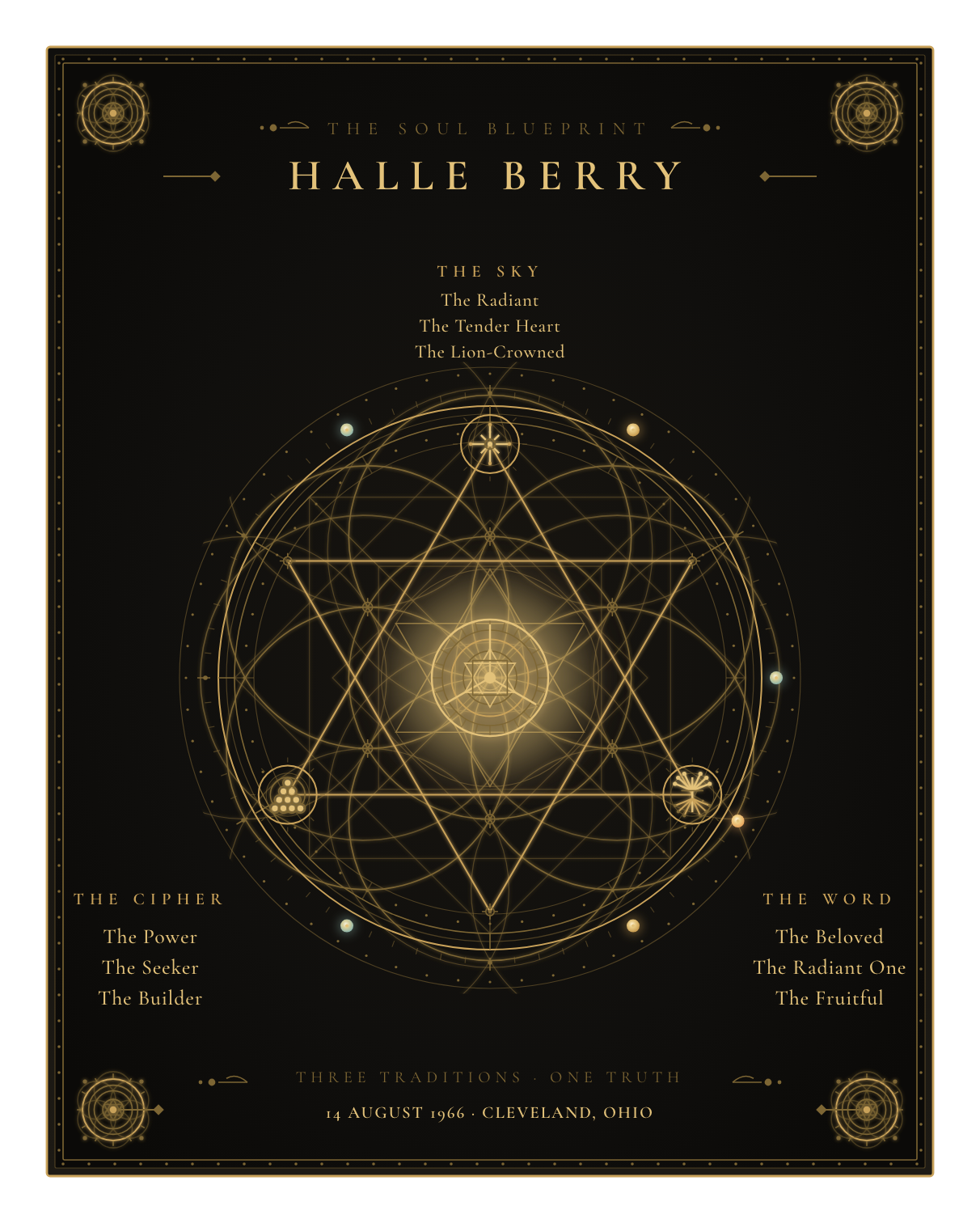
One seal, three languages. The sky she was born under at the apex, the numbers beneath her name at the lower left, the name itself at the lower right — three traditions engraved into one artifact. There is no rising sign, no houses, no angles: without a verified birth time they cannot be honestly drawn. What is true is what is shown.
At a Glance
- Full traditional name
- Maria Halle Berry
- Born
- August 14, 1966 · Cleveland
- Sun
- Leo 21.4° — the essential fire of the life
- Rising
- Birth time unverified — the Ascendant is offered conditionally, never asserted
- Moon
- Date-dependent across the unverified birth day — not fixed without a confirmed time
- Mind · Value · Will
- Mercury Leo · Venus Cancer · Mars Cancer
- Discipline · Direction
- Saturn Pisces · North Node Taurus
- Life Path
- 8 — The Sovereign
- Title-name Destiny
- 7 — The Seeker
- Birth-name Destiny
- 4 — The Builder
- Master Numbers
- None preserved at the final layer
- Soul archetype
- The Seeker who lives the Sovereign’s path
In 2002, in the Dorothy Chandler Pavilion in Los Angeles, a woman in a white gown stood at a microphone in the singular heat of recognition — the first African-American woman ever to win the Academy Award for Best Actress. The light found her face. Her hands trembled. She wept not for herself but for the weight of the door she had walked through — and for all the women whose names were never even called to the stage. That moment, captured in photographs and held in collective memory, shows us the surface of something; yet beneath every surface there runs a current, invisible and prior, that makes the surface possible at all. The world fragments a person into roles and metrics — the beauty rankings, the film credits, the marriages and their ruins, the business ventures, the legal battles. But underneath all that noise runs something simpler and more terrible: a soul’s particular inscription, the blueprint that arrived in a body on August 14, 1966, in Cleveland, Ohio, and has been living itself out ever since, learning and breaking and building across decades. This reading moves past the fragments — past the pageant titles and the Razzie accepted with Oscar in hand, past the tabloid narratives of custody and custody loss — and descends to the source. Here is the soul beneath.
The reading moves through the eight chapters of the Soul Blueprint architecture — The Arrival, The Soul’s Inheritance, The Living of It, The Soul’s Calling, The Soul’s Territories, The Name You Carry, The Moment, and The Invitation — and at the end, the same instrument turns gently toward you.
Her soul has a blueprint.
So do you.
The same three languages — the sky, the numbers, the name — are waiting in your own.
The Arrival
Maria Halle Berry entered the world on an August afternoon in Cleveland, and with her came a paradox that would animate her entire arc: the self that blazes outward to create and be seen, yoked to a will that protects by making home—the sovereign artist learning to build not just for acclaim but for belonging.
She arrived carrying the fire of radiant creative expression—a mind that thinks in vivid wholes, a voice that commands attention, a personality magnetized toward the stage and the spotlight. This is the self that comes alive by externalizing, by bringing form to vision, by being recognized. From earliest childhood she was the one who moved through rooms with presence: honor student, newspaper editor, prom queen, cheerleader—roles that called her outward into visibility. The drive to create and illuminate was wired into her from birth, as natural as breath.
Yet beneath that solar radiance lived another inheritance: the will to protect and nourish, expressed through feeling, through the defense of the vulnerable and the making of emotional safety. She witnessed what happens when a home breaks—when the warrior in a man becomes the destroyer, when beatings and humiliation replace the shelter a family needs. She learned early that tenderness requires its own kind of strength, that love must sometimes stand guard.
The soul arrived as artist and guardian both—the one who must shine, and the one who must hold others safe. This is not a contradiction she resolved; it is the very blueprint she came to inhabit. The Seeker in her would chase recognition across pageants and film sets and ceremonies; the Builder in her would construct shelter, family, dignity—sometimes in the same breath, sometimes in collision. The Sovereign arc would teach her which battles were hers to fight, and which were not.
The Soul’s Inheritance
She was born into the inheritance of two lineages meeting — a psychiatric nurse mother who had immigrated into American life, a psychiatric ward attendant father who would later drive buses, both of them working the margins of institutional care. Her maternal grandmother had come from Liverpool, crossing the Atlantic into a new world; her mother inherited that crossing, that displacement, and passed into Cleveland a different kind of displacement — the marriage of a white woman and a Black man in a era when such unions were still marked by suspicion and pain. The family lived in Oakwood, a neighborhood that required the daughter to navigate racial identity with acute and early consciousness — she has spoken of this as ‘painful and confusing’ in her youth. Her sister grew up alongside her in this same landscape. Her father’s trajectory — from ward attendant to bus driver — traces a path of limited upward mobility, of work that served others’ crises without ascending. Yet the mother was a psychiatric nurse, a woman trained to witness trauma and hold space for the fractured mind. The daughter inherited from both parents a certain initiation into other people’s suffering — she was present, from childhood, to the reality that bodies could be broken, that violence lived in homes, that protection and care were not guaranteed. She witnessed her mother beaten, kicked down stairs, struck with a wine bottle — the home was not a sanctuary but a battlefield, and the daughter learned early that safety had to be fought for, that tenderness was an act of fierce will.
The Living of It
The living of it demanded everything the blueprint had promised, and then demanded it again. She was bullied as a child and learned to fight for protection — not metaphorically but physically, her body becoming her own fortress because no other fortress existed. She became a cheerleader, an honor student, a newspaper editor, a prom queen at Bedford High School — evidence of a young woman who had already learned the ancient art of proving herself, of earning belonging through achievement and visibility. At nineteen she won Miss Ohio USA; at twenty she placed sixth at Miss World 1986, becoming the first African-American to represent the United States at that pageant — a threshold crossed, a door opened by her own radiance. Yet the cost of that visibility began immediately. She moved to New York City in 1989 to pursue acting and found herself briefly homeless, living in a shelter and the YMCA, her body and her beauty suddenly stripped of their protective function — she learned that being seen was not the same as being safe. Her film debut came in 1991 as Vivian in Spike Lee’s Jungle Fever, and in that same year she was beaten by an abusive boyfriend during the filming of The Last Boy Scout, a beating that punctured her eardrum and cost her 80% of the hearing in her left ear — her own body became the threshold of pain. The 1990s unfolded as a cascade of breakthrough and rupture: Boomerang in 1992, marriages entered and exited (David Justice from 1993 to 1997, a period that saw her descend into such profound depression she considered taking her own life), relationships that entangled her in others’ crises and resources. By the end of the decade she had become one of the highest-paid actresses in Hollywood, earning an estimated ten million dollars per film — the external validation had arrived, yet the internal peace had not.
If this is what was true for her, what might be true for you?
The Soul’s Calling
The voice that arrived in this soul came already warm — not the voice of the scholar or the analyst, but the voice of the storyteller, the one who sees the whole and speaks it alive. Her mind does not move through incremental steps; it arrives in vivid, convinced wholes, and when she speaks, the words carry the heat of presence itself. This is the gift of a mind that thinks in images and convictions, not hedgements. She speaks to move people, to draw them toward something they did not yet see — the gift of warm, commanding expression that makes the invisible visible.
Yet the deeper calling embedded in her birth numerology points toward something more austere: the soul came to build. Not to build palaces or monuments — though she has done that in the world’s eyes — but to build the invisible structures that hold the violated and the overlooked. The foundation-layer of this soul’s work is to take the shattered and make it stand again; to take what has been broken by the world’s negligence or violence and give it form, dignity, shelter.
These two callings — the voice that magnetizes and the will to build shelter for those who have been cast out — are not separate in her. They are one movement: the warmth of her expression creates the very safety that the builder in her longs to establish. She speaks not to be admired but to make room — to testify that the overlooked are seen, that their stories matter, that they too belong to the kingdom. The calling is to use the light of recognition as a tool of reconstruction, to bring the illumination of her presence to the thresholds where others have been denied entry.
The Soul’s Territories
Three territories where this soul has lived most vividly: First, the territory of Beauty and Its Cost — she has inhabited this with uncommon consciousness, ranked No. 1 on People magazine’s ’50 Most Beautiful People’ list in 2003, named Esquire magazine’s ‘Sexiest Woman Alive’ in October 2008 at age 42, yet speaking openly about how beauty had been weaponized against her, how it had offered protection and then withdrawn it. She served as a Revlon spokeswoman beginning in 1996, renewing her contract in 2004, yet she did not let beauty become her only story — she insisted on complexity, on roles that demanded range and vulnerability, from Introducing Dorothy Dandridge (which won her a Primetime Emmy and Golden Globe in 1999) to the Marvel universe as Storm. Second, the territory of Legal Testimony and Public Accountability — she has fought bitterly in custody battles, testified before the State Assembly, pleaded no contest to leaving the scene of a car accident in 2000, accepted a Razzie Award for Catwoman in person while holding her Oscar, refusing the shame that institutions tried to impose. She championed anti-paparazzi bill SB 606 and launched 606 Films in 2014, turning her own experience of violation into structural protection for others. Third, the territory of Creative Direction and Visioning — beyond acting, she has moved into producing (Introducing Dorothy Dandridge, Extant as co-executive producer and star), into directing (Bruised), into founding health companies, into advocacy. Each territory reveals a woman not content to be the object of the story but insistent on becoming its author, its protector, and its architect.
There are twelve domains in the kingdom of any life: The Mark, The Unfolding, The Unseen, The Long Return, The Inheritance, The Encounter, The Alchemy, The Living Tension, The Sight, The Body’s Knowing, The Crossing, The Calling.
The Name You Carry
The name she carries holds a peculiar resonance — a name that was not handed down from ancestral tradition but selected by her parents from a local landmark, Halle’s Department Store in Cleveland, a public space transformed into a personal destiny. There is something archetypal in this: the child named for a commercial threshold, a place where people gathered to acquire what they needed, a site of exchange and circulation. Her parents chose Halle as the vehicle of her identity, and the daughter became the living embodiment of that choice — a woman who has circulated through culture as a rare form of visibility, who has become a threshold through which others have passed into new possibilities. At age five, her legal name was changed from Maria Halle Berry to Halle Maria Berry — the middle name elevated to primacy, the commercial landmark made central — as if the soul itself recognized that this was the calling, this was the true name. Maria, her birth name, carries resonances of the maternal, of the sea, of devotion; but it was held in second position, supporting rather than leading. And Berry, the surname, grounds her in the particular, in the family line, yet it too is a surname of uncertain origin, a name that does not announce itself. What the parents intuited in this rearrangement was that this child’s task was not to disappear into tradition but to become a visible threshold, a place of passage — not a dependent or a follower, but the landmark itself around which others orient. The name Halle was their prophecy, woven into a department store’s commercial geography, yet fulfilled in a far more sacred register: a woman who opened doors, who marked passages, who became the visible evidence that transformation was possible.
The Moment
The moment arrived on March 24, 2002, when the Academy Award for Best Actress was announced — Monster’s Ball — and she became the first African-American woman to hold that recognition. Yet the moment had been building for years, accumulating in the body, in the cells, in the psyche — since childhood when she fought for protection, since her film debut in 1991, since Boomerang in 1992, since the marriages that broke, since the depression that nearly ended her, since Introducing Dorothy Dandridge in 1999, since the slow, excruciating climb toward a platform where her voice could be heard. The moment revealed everything: that the work had mattered, that her insistence on radiance had not been narcissism but necessity, that the breakthrough she had fought for was not personal glory but a threshold crossed for others. Standing at that microphone, trembling, she did not accept the award as her own. She accepted it as a door opening backward in time — she honored Lena Horne, Ruby Dee, Dorothy Dandridge, all the women whose faces had been brilliant and whose gifts had been denied the recognition they deserved. She made the moment bigger than herself. In that gesture, she revealed the true North of her soul: that her validation mattered less than the structures it could dismantle, less than the future it could open for those who would follow. The light found her face and held it, and in that light was the completion of an arc that had begun in violence and displacement — the soul’s radiance, finally, publicly, undeniably witnessed.
The Invitation
Everything in this reading has been moving toward a single point. The doubleness named in the first chapter, the inheritance, the wound, the calling, the territory, the name, the moment. These are not seven separate truths about Halle Berry. They are one truth, named from seven different angles. And they all converge here.
The invitation arrived not as a whisper but as a breaking—the shattering of everything a young woman thought she was supposed to be. She stood in the wreckage of her father’s violence, her mother’s terror, a childhood built on witness to brutality and the knowledge that love could wear the mask of devastation. The question the soul faced was exquisitely specific: Will you take what nearly destroyed you and make it into medicine? Will you refuse the inheritance of silence, of shame, of the body as a vessel for others’ rage—and instead become a vessel for something that heals?
Her early search was conducted in the language of beauty pageants and film roles, in being seen and ranked and chosen—the outer architecture of a self seeking validation through the gaze of others. But underneath that striving ran a deeper current, a will that protected not through aggression but through devotion, a tenacity rooted in feeling for those smaller and more vulnerable than herself. She carried within her a feminine intention to nurture, to create belonging, even as she was still learning what belonging could feel like. The invitation required her to move through unbearable seasons—a depression so profound that death seemed preferable to continuation, a marriage that fractured, another that followed, the custody battles that tore at her capacity to hold her children safe. Each rupture was an invitation to release the grip on external validation and to build something internal, something earned from her own ground rather than borrowed from the approval of strangers.
What was being asked of her was the Great Work itself: to take the formless pain—the dissolution she had witnessed, the chaos she had survived, the spiritual overwhelm of violence inherited and transmitted—and to give it structure. To transform compassion into containers that could hold others. To move from being a woman who needed to be rescued into a woman who could rescue, who could produce, who could direct, who could build institutions (a production company bearing her name; an enterprise devoted to women’s invisible suffering in menopause) that gave tangible, real-world form to her vision of care. The soul was being called to stop performing healing and to become the healer—not through mysticism but through disciplined work, through the stubborn, grounded refusal to let the boundless suffering she had witnessed remain unnamed and unsupported.
What was released in the Yes to this invitation was the need to be perfect in the eyes of the world. She accepted a Razzie Award while holding an Oscar—a gesture so truthful it became its own kind of monument, a public declaration that the approval of systems that had once seemed to matter could be held lightly, could even be welcomed as evidence of her humanity rather than her failure. She released the fiction that she owed anyone a flawless image, a body without scars, a narrative without contradiction. She stopped trying to earn her way into belonging and began instead to create belonging for others—through her work, through her advocacy, through the simple act of naming what had been shameful and bringing it into the light.
What was called toward her in this season was not escape but earthing—the development of a quiet, self-reliant stability that could not be shaken by the opinions of critics or the cruelty of strangers. The medicine she needed to embody was peace, not as the absence of struggle but as the trust that she was enough, that her value did not fluctuate with her market price or her relationship status or the number of times her image appeared in magazines. She was being invited to build a life on her own terms, to love when she chose, to leave when love became a cage, to parent with fierceness and intention, to use her visibility not as currency but as a tool for amplification—for the voiceless, for the women no one was asking about menopause, for the children who needed protection from the machinery of celebrity itself.
And what became available, what opened in the moment she said Yes to this reconfiguration, was the discovery that her deepest wound—the violence she had witnessed, the vulnerability she had been forced to understand too young—was not a disqualification from greatness but the very root of it. She could not have become the woman who wins an Academy Award and then uses that moment to honor the Black actresses who were never given the chance unless she had first been the girl who understood, in her bones, what it felt like to be kept out. The invitation was not away from her pain but through it, and into a life where that passage became a bridge for others.
She was not late. She was exactly where the soul-clock said she should be. The mission had been inscribed at the threshold of her first breath. What was being asked of her, she has been walking. The naming has been done.
This Is Not Coincidence
The astrology declares: a Sun in Leo calls forth the radiant creator, the life-giver whose warmth literally animates others — yet this particular Leo carries Saturn in Pisces, the discipline of giving form to formless suffering, the mastery of channeling the spiritual depths into real, grounded work; it carries a North Node pointing toward Taurus, the soul’s calling to release intensity and crisis-entanglement and build simple, self-reliant steadiness from within. Three entirely different languages: The numerology speaks independently: the Title Destiny is 7, the Seeker of truth and testimony; the Birth Destiny is 4, the Builder of real structures; the Life Path is 8, the Sovereign who moves beyond personal gain toward collective transformation — a woman whose numbers say she came to seek, to build, to rule with accountability. The name itself, pulled from a department store and made the center of identity, speaks of a woman who became a threshold, a landmark, a visible passage through which others could move into new possibility. Three entirely different languages. One truth: She came to make visible what systems had hidden, to protect what was vulnerable, to build what was needed, and to prove by her radiance that the door could open.
Three entirely different languages. One truth.
This is not coincidence. This is what three independent systems do when they are all telling the truth about the same soul.
The Numbers, Decoded
The numbers are computed, not intuited — each letter takes its Pythagorean value, each name reduces, and any Master Number is preserved rather than collapsed.
You have sat with the chart and the numbers and the name of another soul, and watched how a wound becomes a calling, how the place of least belonging becomes the place of greatest gift, how a life too precisely configured to be coincidence reveals itself when three independent languages are read together.
The reading you have just received was, in its outer form, a reading of her soul. But its inner form was a reading written for yours. You did not arrive without a Blueprint either. May this reading be the beginning of the reading you finally receive of yourself. May the light you carry — in whatever particular, irreplaceable form it has taken inside the specific life you were given.
Some lives carry a pattern this clear.
Yours does too.
You’ve read the shape of her soul. The same three languages — the sky, the numbers, the word — are waiting in your own name and birth date. Begin yours, free, below.
Or, when you’re ready, begin your own full Soul Blueprint reading →
Frequently Asked Questions
What is Halle Berry’s birth chart?
Halle Berry’s birth chart is anchored in a Leo Sun — the self that radiates creative expression and warmth into the world. Her Mercury is also in Leo, giving her a vivid, compelling mind and storyteller’s voice. Her Venus is in Cancer, expressing love as nurture and protection; her Mars is in Cancer, expressing will as defense and provision for the vulnerable. Saturn in Pisces calls her toward the disciplined channeling of spiritual depth into real, grounded work. The birth time is unverified and circulated in multiple versions, so the rising sign cannot be fixed with certainty.
What is Halle Berry’s numerology?
Halle Berry’s numerology carries three distinct archetypes: Her Title Destiny is 7, the Seeker — a soul called to investigate truth, to test institutions, to speak what others silence. Her Birth Destiny is 4, the Builder — the foundational architect, the one who creates real structures that endure. Her Life Path is 8, the Sovereign — the archetype of power balanced with accountability, the soul who moves beyond personal gain toward collective transformation. Together, these numbers describe a woman called to seek, to build, and to transform.
What does the name Halle Berry mean?
The name Halle Berry carries an unusual origin — ‘Halle’ was selected by her parents from Halle’s Department Store, a local landmark in Cleveland, Ohio, making it a name drawn from commercial geography rather than ancestral tradition. At age five, her legal name was changed from Maria Halle Berry to Halle Maria Berry, elevating the department store name to primacy. The resonance is prophetic: she became a threshold herself, a visible passage through which others could move into new possibility, a landmark around which her culture oriented itself. ‘Berry,’ her surname, grounds her in the particular family line. Together, the names speak of a woman made visible, made central, made the architecture of passage.
What is a Soul Blueprint?
A Soul Blueprint integrates three independent traditions — Western natal astrology, Pythagorean numerology, and the etymology of the full birth name — into a single document written as a personal letter to the soul. When you’re ready, you can begin your own.
This reading was prepared in the lineage and methodology of the Soul Blueprint Method — Pythagorean numerology with master numbers preserved, Western archetypal astrology, and a researched etymological reading of the full name. Halle Berry’s birth date (August 14, 1966) is sourced from the public record; the birth time is unverified, so the rising sign is offered conditionally and never asserted.
A Soul Blueprint reading · Astrology · Numerology · Etymology · shams-tabriz.com