
Pinkpantheress’s Birth Chart, Numerology, and Name Decoded
Pinkpantheress’s Birth Chart,
Numerology & Name Decoded
The Soul Blueprint Method — three traditions woven into one personal letter: Western natal astrology, Pythagorean numerology, and the etymology of the soul’s name. Learn the method →
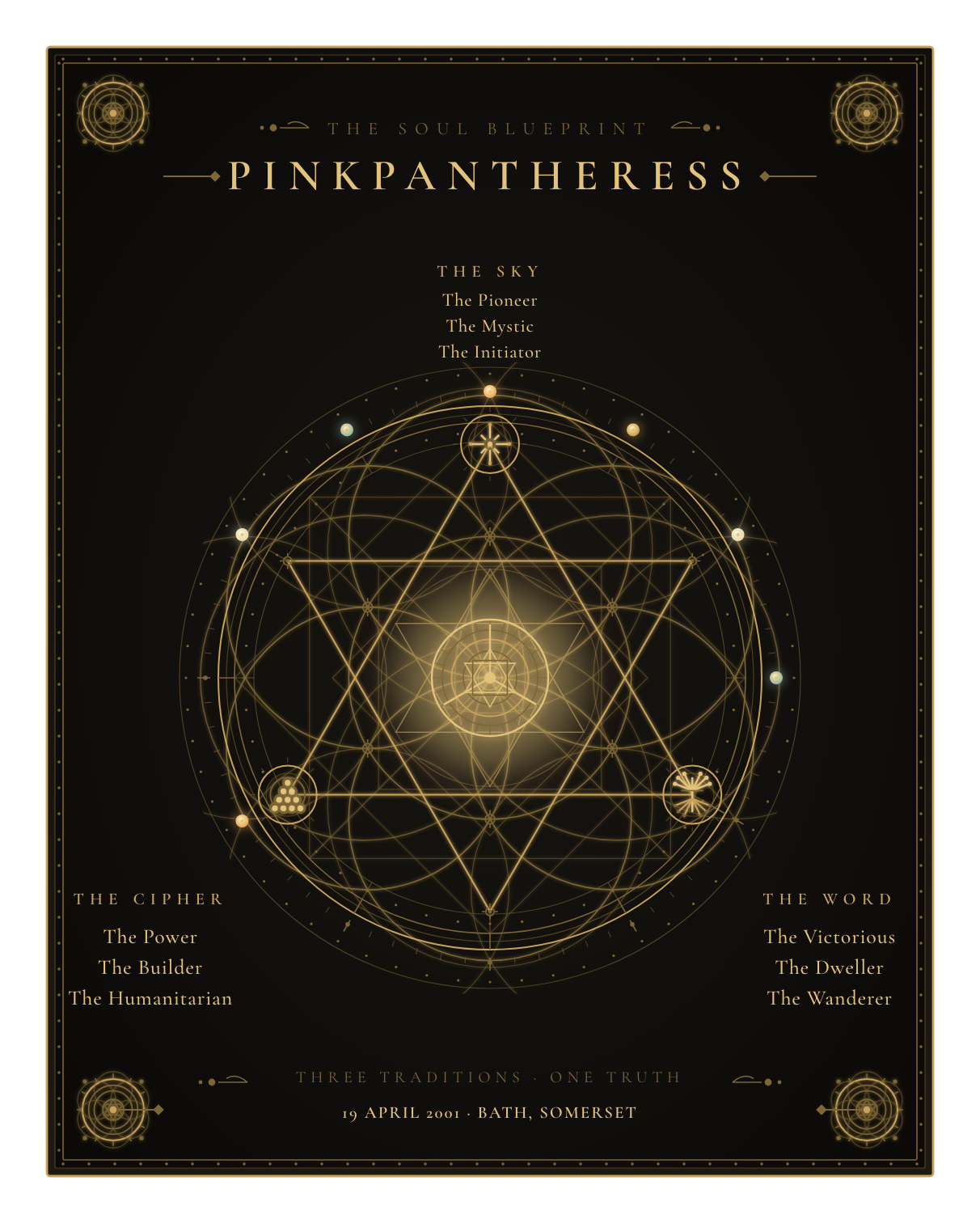
One seal, three languages. The sky she was born under at the apex, the numbers beneath her name at the lower left, the name itself at the lower right — three traditions engraved into one artifact. There is no rising sign, no houses, no angles: without a verified birth time they cannot be honestly drawn. What is true is what is shown.
At a Glance
- Full traditional name
- Victoria Beverley Walker
- Born
- April 19, 2001 · Bath
- Sun
- Aries 29.4° — the essential fire of the life
- Rising
- Birth time unverified — the Ascendant is offered conditionally, never asserted
- Moon
- Pisces 11.0° — the inner life
- Mind · Value · Will
- Mercury Aries · Venus Aries · Mars Sagittarius
- Discipline · Direction
- Saturn Taurus · North Node Cancer
- Life Path
- 8 — The Sovereign
- Title-name Destiny
- 4 — The Builder
- Birth-name Destiny
- 9 — The Humanitarian
- Master Numbers
- None preserved at the final layer
- Soul archetype
- The Builder who lives the Sovereign’s path
In a university hall in London, in the dark of 2020, a young woman sat at the threshold of her own becoming—not yet twenty, hunched over a laptop running GarageBand, building worlds in miniature from the spare sonic materials at hand: a loop, a vocal line, the compressed space of a bedroom turned studio. The light from the screen caught the edges of her face in that particular way of late-night work, when the boundary between dreaming and making grows thin. She had not yet posted anything. The world did not yet know her name. But something was already moving in her—something that would not wait for permission, that would not ask the machinery of the industry if it was ready to listen.
The fragments the world calls a person—the viral moments, the chart positions, the streaming numbers, the cancellations and the honours—these float like flotsam on a river’s surface, catching light, creating the illusion of the whole story. But beneath them flows something older, something that does not depend on visibility or measurement: the actual source from which all those fragments emerged, the spring itself. The biographical timeline is one language. The birth chart is another. The numerology is a third. But underneath all three runs the soul’s own current—the thing that wanted to be born on this date, in this body, carrying these particular frequencies.
This reading reads that source. Not the surfaces that have been photographed and streamed and celebrated and grieved—those are real, but they are not the deepest reality. This is a reading of the blueprint itself: the soul’s signature at arrival, the inheritance she was born into, the territories her gifts opened, the cost of living as this particular kind of being in a world that does not always make room for her kind. What follows is an attempt to see her as the soul sees her—not as the industry saw her, and not even as she may have seen herself in the dark hours of making, but as the blueprint itself knows her to be.
The reading moves through the eight chapters of the Soul Blueprint architecture — The Arrival, The Soul’s Inheritance, The Living of It, The Soul’s Calling, The Soul’s Territories, The Name You Carry, The Moment, and The Invitation — and at the end, the same instrument turns gently toward you.
Her soul has a blueprint.
So do you.
The same three languages — the sky, the numbers, the name — are waiting in your own.
The Arrival
She arrived as the one who begins—the self that forges identity not through reflection but through action, through the sheer fact of initiating what was not yet there. The Aries Sun at the spring equinox speaks a particular language: the will that comes alive by moving first, by burning off the old forms to make space for the new, by dedicating wholly to the act of creation before certainty has had a chance to whisper its doubts. This is not the patient builder; this is the one who starts the fire.
But this particular fire came wrapped in paradox. The soul that arrives to initiate carries also—in its Mercury and Venus—a mind and a heart that are quick, direct, and unafraid to speak the hard thing, to pursue what it wants with ardent clarity, to cut through pretense with a single gesture. And beneath all of this burns a will (the Mars) that is not content with small victories: the spirit of the campaigner, the one who fights for a belief, who is driven by vision and the pursuit of something far beyond the immediate horizon.
Yet wrapped around this constellation of pure initiating fire is something that would soften it, complicate it, and ultimately redeem it: a heart (the Moon) that needs depth, contemplation, and the larger belonging—the feeling nature that must dissolve into something vaster than itself to feel whole. The paradox is this: she arrived to start and to burn, but also to learn what it means to be held, to be vulnerable, to let herself be moved by forces larger than her own will. The blueprint does not resolve this tension; it contains it. And that containing—that is where the actual work begins.
The Soul’s Inheritance
She was born into a particular kind of modern inheritance: a mother who was a carer, a father whose mind moved in the language of mathematics and statistics, a household straddling two continents and two cultures—Kenyan Luo ancestry on one side, English on the other. At five years old, the family moved from Bath to Canterbury, and the child who was born in one landscape grew up learning the textures of another. She had an older brother who understood sound as an engineer understands it: the technical architecture of audio, the way frequencies move through space.
This was an inheritance of making and of care, of precision and creativity, of belonging-and-not-quite-belonging simultaneously. The era she was born into (2001) was the era in which the internet was beginning to colonize childhood, in which the tools of professional creation would eventually become available in a laptop bag, in which a young person could sit alone in a room and reach millions. But she did not know any of that yet. What she knew, as a child taking piano lessons, as a twelve-year-old standing on a school stage singing ‘Stand by Me,’ was the basic human need to be heard—to make a sound and have it travel outward.
When she was twelve, her father moved to the United States for work, and she remained in the UK with her mother. This separation—this too was part of the inheritance: the understanding early that distance is ordinary, that love can persist across geography, that a person can be held by more than one home and fully belong to none of them. All of this—the mixed lineage, the split household, the brother’s technical knowledge, the mother’s attentiveness—became the ground from which the particular kind of music she would make would eventually grow.
The Living of It
To live as this soul meant to live inside a particular kind of intensity: the drive to make, to express, to initiate constantly bumping against a body that was struggling—with the way it appeared to her, with what it could safely hold, with how sound itself could wound it. As early as age fourteen, she was singing in a rock band, covering the music that had inspired her (the raw emotion of Paramore, the defiance of My Chemical Romance), performing first at a school fête and then, increasingly, in public spaces where her voice had to travel and be seen.
The body that was meant to be heard—meant by the blueprint to speak directly, ardently, without fear—began to betray her in ways that were not visible at first. Exposure to loud music, to the feedback from microphones, to the sheer volume required to perform night after night: all of this accumulated in her right ear as a gradual hearing loss that would not announce itself clearly until much later. By the time she understood what was happening—by June 2022, when she had to cancel her appearance at Primavera Sound in Barcelona—she had already been living inside the wound for years, compensating, pushing harder, trying to make the voice travel in a world that was becoming increasingly silent on one side.
But the wound itself became a teacher. To make music while losing the ability to hear it is to learn something fundamental about the relationship between intention and sensation, between the will to express and the body’s capacity to hold that expression. The songs she made grew shorter—two to three minutes, compressed intensity—and darker in their emotional texture. She learned to write from a place that was not primarily autobiographical but deeply, achingly empathetic: the art of storytelling rather than confession. The cost of this living was the slow knowing that her body would not always cooperate with her ambition. And that knowing changed everything.
If this is what was true for her, what might be true for you?
The Soul’s Calling
Her mind arrives before her body does—a quick, decisive instrument that cuts straight to the point, unafraid to speak what others only think. The voice that comes alive by asserting and beginning carries no hesitation; it moves at the speed of a spark, candid and forthright, the kind of clarity that names hard truths without apology. She was made to say the thing that needed saying, to initiate where others waited, to turn thought into utterance the moment the thought arrived. This is not a mind that deliberates endlessly or hedges—it is a mind built for directness, for the clean strike of the word that opens a door.
And yet her calling reaches deeper than mere speech. She arrived to demonstrate the principle of the Sovereign—the soul that builds, that constructs, that takes raw material (sound, image, feeling, story) and transforms it into something that endures. At seventeen, making instrumentals on a single portable music application in her university dormitory, she was already fulfilling this destiny: taking what was available, what was humble, what was close at hand, and building from it something that the world could not ignore. The Humanitarian arc of her birth name whispers another truth beneath—that whatever she makes is meant to serve, to hold space for the struggles and stories of others, to be a vessel for the collective feeling that moves through a generation.
She came to speak what was true, to build what was lasting, and to make both matter to the people who needed them most. The initiation was hers to claim, and she claimed it young—not waiting for permission, not waiting for the right moment or the right resources, but beginning with what lay at hand and letting the momentum of her own certainty carry the work forward into the world.
The Soul’s Territories
The first territory alive in her is the realm of making itself—the studio, the laptop, the GarageBand interface, the space where intention becomes sound. This is not a territory of performance or polish but of raw creation: the moment before anything is broadcast, when the artist is alone with the materials of her craft. In this territory, she has built an astonishing technical fluency, producing much of her own work, understanding the architecture of sound the way her brother taught her to understand it. Here, the speed of her thought translates directly into the speed of making; the directness of her vision meets no obstruction.
The second territory is the landscape of influence and inheritance: the musicians who taught her what was possible (Imogen Heap, Lily Allen, Kelela, Kate Nash), but especially Hayley Williams of Paramore, whose performance at Reading Festival when she was fourteen became the moment when she understood that this—the professional musician’s life—was not a dream but a choice she could actually make. This territory is where gratitude lives, and also where she understands herself as part of a lineage of women makers who came before her and showed her the way.
The third is the territory of the vast audience—the millions who have heard her music through streaming, through TikTok, through the viral moments that began with a snippet of ‘Just a Waste’ and culminated in ‘Boy’s a Liar Pt. 2’ reaching the top of charts worldwide. But this territory is also the one most fraught with contradiction: the place where her vision meets the machinery of the industry, where intimacy is flattened into data, where the audience becomes a force that can both sustain and overwhelm. All three territories together—the solitary making, the lineage of influence, the vast reach—compose the actual landscape of her becoming, each one essential, each one pulling her in a different direction toward a deeper mythology of what it means to be heard.
There are twelve domains in the kingdom of any life: The Mark, The Unfolding, The Unseen, The Long Return, The Inheritance, The Encounter, The Alchemy, The Living Tension, The Sight, The Body’s Knowing, The Crossing, The Calling.
The Name You Carry
The name she was born with—Victoria—carries the resonance of victory, of triumph, of the will that conquers and prevails. It is a name that speaks of sovereignty and mastery, of the self that stands at the peak and surveys the kingdom. Beverley holds the softness of meadows, the pastoral, the grounded and gentle. And Walker: the one who moves, who traverses, who does not stay in one place. Together, the birth names speak of a soul that is victorious, grounded, and perpetually in motion—the sovereign who walks the earth.
But the name she chose for the world—Pinkpantheress—speaks an entirely different language. It arrived from a chance encounter with a trivia question on a game show: ‘What is a female panther called?’ The answer that emerged was ‘pantheress,’ and it held within it a kind of animal elegance, a sleek power, something that moved in the dark with absolute confidence. Pink—the color, the vulnerability, the softness—was added to this, creating a deliberate contradiction: the panther is the hunter, the predator, the one that moves unseen; pink is the color of girlhood, of sweetness, of the traditionally feminine. The name itself is the paradox solved in language: the fierce and the tender, held together without apology.
This name—chosen in the playfulness of a TikTok account, never meant to be a permanent identity until suddenly it was—carries the resonance of the soul’s actual blueprint: the one who arrives to start fires and pursue visions with absolute conviction, but who must also learn to be held, to be vulnerable, to let herself be seen in her softness. The name Pinkpantheress is the blueprint speaking back to the world, telling the truth that the birth name alone could not fully contain. In choosing it, she was naming herself as she actually was: dangerous and tender, moving in the dark, seen by millions, and somehow still invisible.
The Moment
The moment came in late 2020, in a university hall in London, when she posted a video to TikTok that received over 500,000 likes, and something shifted in the physics of her becoming. She was nineteen years old. She had been studying film at the University of the Arts. She had been making music in her bedroom because she could not afford to do it anywhere else, because the tools required had been democratized by technology into something a young person with a laptop could access. And then, suddenly, the attention arrived.
Within weeks, the song ‘Just a Waste’ was spreading across the platform. Within months, ‘Break It Off’ and ‘Pain’ had gone viral, and ‘Pain’ had reached number 35 on the UK Singles Chart—a chart position that, for a song made in a university hall on free software, was not merely success but a kind of rupture in the ordinary rules of how the industry worked. By April 2021, she had signed to Parlophone. By June, to Elektra Records. By August, ‘Just for Me’ had become a top-thirty hit and a song that would accumulate nominations for awards that validated her work in the eyes of the industry she had just entered.
But the moment was not really about the chart positions or the record deals or the validation—though all of those things were real, and they mattered. The moment was about the revelation that the voice she had been developing in solitude, the vision she had been building in fragments, the particular alchemy of sadness and brightness that she had intuited without any guarantee that anyone else would understand it: all of it was heard. By millions. Immediately. Without mediation or gatekeeping. The soul that had arrived to begin, to initiate, to burn off the old forms and create the new—that soul discovered in this moment that the new thing it was creating was already being received. And the responsibility of that—the weight of being suddenly visible to so many—would become the actual curriculum of her becoming.
The Invitation
Everything in this reading has been moving toward a single point. The doubleness named in the first chapter, the inheritance, the wound, the calling, the territory, the name, the moment. These are not seven separate truths about Pinkpantheress. They are one truth, named from seven different angles. And they all converge here.
What is being asked of this soul, in this living, is nothing less than the reconciliation of two seemingly irreconcilable truths: that she is meant to start things, to initiate, to burn with an absolute conviction and speed that brooks no hesitation—and that she is also meant to learn the slow arts of vulnerability, of belonging, of letting herself be held by forces larger than her own will. The blueprint arrived carrying both mandates simultaneously, and the life itself has been the long, difficult process of learning how to honor both.
The industry asked her one thing: to perform, to be visible, to feed the appetite of the audience that had discovered her, to capitalize on the moment while it was hot. The body asked her another: to slow down, to listen to the signals of pain and damage, to recognize that the hearing loss that had been accumulating for years was now undeniable. The soul asked a third thing: to integrate the softness beneath the fire, to develop the capacity to receive care and nurture, to allow herself to be moved by something beyond her own ambition. These three voices were in direct conflict.
What was released in the acknowledgment of this conflict was the false narrative that she could do everything, be everywhere, perform indefinitely without cost or consequence. The cancellation of her appearance at Primavera Sound in June 2022 was not merely a practical decision about hearing loss; it was a threshold moment in which the soul began to reassert its own authority over the machinery of celebrity. The continued cancellations—of tour dates, of performances—that followed were not failures but acts of reclamation, moments in which she chose the integrity of her own becoming over the hunger of the apparatus that sought to consume her.
What was being called toward, in the release of that false narrative, was something far more subtle and far more true: the understanding that the actual work of art-making—the solitary hours in the studio, the technical mastery, the storytelling that does not depend on personal exposure—was sufficient. That she did not need to perform her own fragility for an audience; she could simply make the music and let it speak. That the sovereignty she was meant to build was not about dominion over an audience but about dominion over her own choices, her own boundaries, her own refusal to be consumed.
What became available when this yes was spoken—when she began to say no to the performances and yes to the deeper work—was the possibility of genuine integration. The second mixtape, ‘Fancy That,’ released in May 2025, arrived not as a product of relentless touring and promotion but as the fruit of sustained, careful making. It earned Grammy nominations, it spawned multiple hit singles, and it did all of this without requiring her to sacrifice her physical safety or her emotional integrity. The honorary doctorate from the University of Kent, received on 22 July 2025, was recognition not just of her commercial success but of her actual contribution to the music as an art form, as a voice that had something true to say.
This soul is learning, in real time, what it means to be sovereign: not to rule over others, but to rule over oneself. To say yes to the making and no to the machinery that would consume it. To honor the body that is struggling and the heart that needs depth and the mind that is quick and the will that is visionary—all of them together, without sacrificing any of them to the hunger of the market or the hunger of an audience. She is still in the midst of this learning. The body continues to deteriorate; the hearing loss is progressive and will not be reversed. But the sovereignty is consolidating itself in the face of this deterioration, and that is the actual miracle: not that she transcended the limitation, but that she learned to build something true within it.
She was not late. She was exactly where the soul-clock said she should be. The mission had been inscribed at the threshold of her first breath. What was being asked of her, she has been walking. The naming has been done.
This Is Not Coincidence
The astrology speaks: a Sun in Aries and Mercury in Aries and Venus in Aries—the triple fire of pure initiating will, the mind that starts things, the heart that pursues directly—yoked to a Saturn in Taurus that demands she build real, lasting worth and a North Node in Cancer that asks her to release the armor of self-sufficiency and learn to be held. The numerology speaks: a Life Path 8 (the Sovereign), a Title Destiny 4 (the Builder), and a Birth Destiny 9 (the Humanitarian)—three entirely different languages, saying that she came to establish her own authority, to create structures that last, and to give her gifts to the whole. The name speaks: Victoria Beverley Walker meets Pinkpantheress, the sovereign and the grounded becoming the fierce and the tender, the one who moves unseen through the dark carrying both predator and vulnerability. Three entirely different languages. One truth: She arrived to burn and to build, to start and to stay, to lead and to be held.
Three entirely different languages. One truth.
This is not coincidence. This is what three independent systems do when they are all telling the truth about the same soul.
The Numbers, Decoded
The numbers are computed, not intuited — each letter takes its Pythagorean value, each name reduces, and any Master Number is preserved rather than collapsed.
You have sat with the chart and the numbers and the name of another soul, and watched how a wound becomes a calling, how the place of least belonging becomes the place of greatest gift, how a life too precisely configured to be coincidence reveals itself when three independent languages are read together.
The reading you have just received was, in its outer form, a reading of her soul. But its inner form was a reading written for yours. You did not arrive without a Blueprint either. May this reading be the beginning of the reading you finally receive of yourself. May the light you carry — in whatever particular, irreplaceable form it has taken inside the specific life you were given.
Some lives carry a pattern this clear.
Yours does too.
You’ve read the shape of her soul. The same three languages — the sky, the numbers, the word — are waiting in your own name and birth date. Begin yours, free, below.
Or, when you’re ready, begin your own full Soul Blueprint reading →
Frequently Asked Questions
What is Pinkpantheress’s birth chart?
Pinkpantheress was born on 19 April 2001 in Bath, with no verified birth time. Her Sun is in Aries, the sign of pure initiating will and identity forged through action. Her Mercury is also in Aries—a quick, direct, cutting mind—and her Venus is in Aries as well, expressing love as bold, ardent pursuit. Her Mars is in Sagittarius, the will that fights for vision and meaning. Her Saturn is in Taurus, demanding she build real security and self-worth, and her Moon is in Pisces, the heart that needs depth and belonging to the larger whole. Without a verified birth time, the rising sign cannot be determined.
What is Pinkpantheress’s numerology?
Pinkpantheress carries three foundational numbers: a Life Path 8 (the Sovereign), derived from her birth date, which speaks to the authority and mastery she is meant to establish; a Title Destiny 4 (the Builder), derived from the name Pinkpantheress, which calls her to create lasting structures and systems; and a Birth Destiny 9 (the Humanitarian), derived from her birth name Victoria Beverley Walker, which orients her gifts toward service to the whole. Together, these three numbers describe a soul meant to build something that serves many while standing in her own power.
What does the name Pinkpantheress mean?
The name Victoria Beverley Walker speaks of victory, softness, and perpetual motion—a soul both sovereign and grounded, always in movement. But Pinkpantheress, chosen from a trivia answer and a film, speaks a different language: the merger of fierce and tender, the predator who moves in darkness and the vulnerability of the color pink. In choosing this name, she named the paradox at the heart of her blueprint—the fire and the softness, the strength and the need to be held—all held together without apology.
What is a Soul Blueprint?
A Soul Blueprint integrates three independent traditions — Western natal astrology, Pythagorean numerology, and the etymology of the full birth name — into a single document written as a personal letter to the soul. When you’re ready, you can begin your own.
This reading was prepared in the lineage and methodology of the Soul Blueprint Method — Pythagorean numerology with master numbers preserved, Western archetypal astrology, and a researched etymological reading of the full name. Pinkpantheress’s birth date (April 19, 2001) is sourced from the public record; the birth time is unverified, so the rising sign is offered conditionally and never asserted.
A Soul Blueprint reading · Astrology · Numerology · Etymology · shams-tabriz.com