
Ben Affleck’s Birth Chart, Numerology, and Name Decoded
Ben Affleck’s Birth Chart,
Numerology & Name Decoded
The Soul Blueprint Method — three traditions woven into one personal letter: Western natal astrology, Pythagorean numerology, and the etymology of the soul’s name. Learn the method →
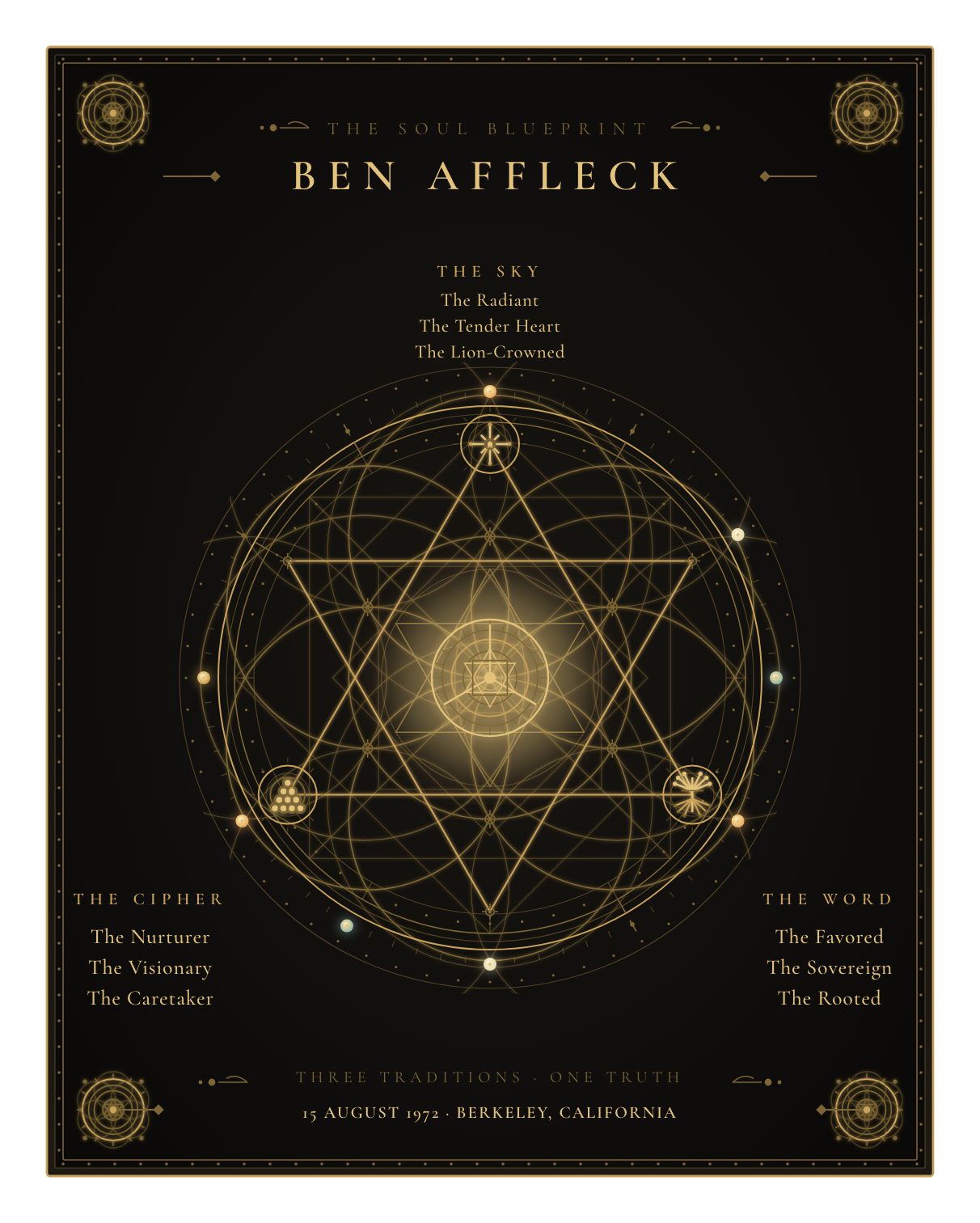
One seal, three languages. The sky he was born under at the apex, the numbers beneath his name at the lower left, the name itself at the lower right — three traditions engraved into one artifact. There is no rising sign, no houses, no angles: without a verified birth time they cannot be honestly drawn. What is true is what is shown.
At a Glance
- Full traditional name
- Benjamin Geza Affleck-Boldt
- Born
- August 15, 1972 · Berkeley
- Sun
- Leo 23.0° — the essential fire of the life
- Rising
- Birth time unverified — the Ascendant is offered conditionally, never asserted
- Moon
- Scorpio 9.3° — the inner life
- Mind · Value · Will
- Mercury Leo · Venus Cancer · Mars Virgo
- Discipline · Direction
- Saturn Gemini · North Node Capricorn
- Life Path
- 6 — The Nurturer
- Title-name Destiny
- 11 — The Illuminator
- Birth-name Destiny
- 6 — The Nurturer
- Master Numbers
- 11
- Soul archetype
- The Illuminator who lives the Nurturer’s path
It is 1981, Berkeley light falling gold through a child’s eyes, and a seven-year-old walks onto a film set for the first time—The Dark End of the Street—and something in him knows already that this is the territory where he belongs: the place where feeling becomes visible, where the invisible Self steps into form and says I am. The camera sees him. The world begins to recognize the radiance underneath the skin. Yet the world will spend decades mistaking the fragments for the whole—the tabloid noise, the career arc, the stumbles public and raw, the love stories that became spectacle—while underneath all of it runs a deeper current, a source that the fragments have never touched. A river and the noise on the surface are not the same river. This reading follows the source.
The reading moves through the eight chapters of the Soul Blueprint architecture — The Arrival, The Soul’s Inheritance, The Living of It, The Soul’s Calling, The Soul’s Territories, The Name You Carry, The Moment, and The Invitation — and at the end, the same instrument turns gently toward you.
His soul has a blueprint.
So do you.
The same three languages — the sky, the numbers, the name — are waiting in your own.
The Arrival
The soul arrived carrying a fundamental paradox—the drive to create, to project outward the inner fire in visible form, and yet the emotional depths that demand honesty so severe it can question everything, even the radiance itself. He came as a creator, a generator of warmth and form—the kind of mind that sees in vivid wholes, that speaks persuasively, that carries the natural gift of the storyteller and performer. And he came also with a heart that probes into the most wounded places, that cannot rest in surface things, that demands transformation through depth. The Sun in his chart speaks the language of dramatic exteriorization—the I-am that creates to be recognized—and yet the Moon beneath it speaks in the language of intensity and survival, of a feeling-nature that must pierce down to truth or suffocate under falsehood. He arrived as both the light-giver and the depth-seeker, and the tension between them would become his greatest forge. This is not a contradiction to be resolved; it is the paradox at the heart of a soul who came to demonstrate what happens when creative radiance learns to integrate its own shadow.
The Soul’s Inheritance
He was born into a lineage of aspiration and rupture—a mother who held education as the pathway to safety, a father whose talent for the stage battled against a hunger that would eventually consume him. His father moved through many lives: playwright, carpenter, mechanic, electrician, bartender, janitor at Harvard, stage manager with the Theater Company of Boston—a man of restless capability and unresolved turbulence. His mother, Harvard-educated, brought the steadiness of an elementary school teacher, the woman who would save his childhood earnings toward a future she hoped would be different from the precarious life of the theatre. He had a brother in the same lineage, also drawn toward the stage. The 1970s and 1980s in Cambridge and Berkeley held both intellectual ferment and the shadow of addiction—his inheritance was not one of ease, but of witness. He came of age watching a parent’s gift turn into a weapon against himself, watching survival and drowning become intimate companions in the same household. And yet something in that watching—that necessity to understand the depths beneath the surface charm—marked him as the one who would have to become conscious, to turn the family’s unresolved pain into knowledge. He arrived into a home where love was real and the wound was also real, and where becoming whole would require facing both.
The Living of It
The living of it began early and in public—a child star by the logic of the industry, his face and talent recognized before he could vote or understand what it meant to be seen. The breakthrough came at twenty-five, when he and a friend co-wrote a screenplay that won him the Academy Award for Best Original Screenplay, the youngest writer ever to achieve this in that category. And in that same moment, the paradox of his arrival began to sharpen: the more his outer form succeeded, the more insistently the depth-seeking Moon demanded that he tell the truth. He made himself vulnerable in the stories he chose—Chasing Amy, Good Will Hunting—scripts that held rawness and emotional precision. Yet the culture’s hunger to commodify his image, to turn him into a consumable fragment, grew alongside his success. The early 2000s brought publicly failed films and a high-profile relationship that became tabloid machinery. And underneath, something darker: the inheritance from his father began to assert itself—anxiety, depression, and the particular hunger that runs in families, the one that no success can satisfy. By the middle of the decade, he could no longer hide from what the depth-seeking Moon had always known: that the radiance alone could not save him, and that the work required going down, not forward.
If this is what was true for him, what might be true for you?
The Soul’s Calling
The soul came to say something specific about transformation through depth—about the creative force that can only become whole by descending into its own shadow and speaking from there. His calling is neither pure performance nor pure introspection; it is the integration of both. He demonstrates what happens when a gifted storyteller chooses to tell the hardest truths—the stories of men who are broken, who are not heroic in the conventional sense, who must find their way through honest confrontation with what they have become. As a director and writer, he has shown the capacity to hold a vision with precision and to demand that everyone in the room meet that standard. The mind is warm and dramatic, yes—it speaks in vivid conviction—but it is also rigorous, shaped by the discipline of structured thought and the will to get the work exactly right. His calling is to demonstrate that the creative force—the light-giver—becomes trustworthy only when it has learned to integrate depth, when it speaks not from the ego’s need to be recognized but from the soul’s need to be true.
The Soul’s Territories
Three territories have come alive in this life with particular intensity: the craft of filmmaking itself—the precise, skillful work of direction, where his will operates as a master technician, getting every detail exactly right, where the drive for excellence becomes a form of service to the story. This is where his mind and his hands and his vision align. A second territory is the interior landscape of addiction and recovery—not as personal drama alone, but as a subject that requires unflinching honesty, a territory he has entered and mapped and brought back to the surface in his performances and his choices of stories. And a third is the lineage itself, the work of remaining connected to family, to friendship forged in childhood, to the bonds that hold meaning even when they are complicated—the territory of belonging and nurture that runs through everything he has built. Each of these territories holds a piece of the larger mythology: the first speaks to the will made precise and excellent, the second to the descent and return, the third to the soul’s refusal to be solitary even when solitude might be safer. Deeper still, beneath all three, runs the story of how a human being learns to transform the inherited wound into the wisdom that allows him to hold others.
There are twelve domains in the kingdom of any life: The Mark, The Unfolding, The Unseen, The Long Return, The Inheritance, The Encounter, The Alchemy, The Living Tension, The Sight, The Body’s Knowing, The Crossing, The Calling.
The Name You Carry
Benjamin carries the resonance of the right hand—the hand that acts, that builds, that reaches toward the future. It speaks to a soul oriented toward action and toward the making of things visible in the world. Affleck, the Scottish surname, carries the weight of a place and a lineage—something rooted, something with geography and history underneath it. And in the full birth name, Benjamin Geza Affleck-Boldt, there is a symmetry: the first name speaks action and reaching, the middle name carries Hungarian resonance (uncertain in its particular meaning, yet present), and the surnames hold both the father’s line and the mother’s—Affleck the paternal anchor, Boldt the maternal ground. Boldt itself resonates with boldness, with courage, with the brave heart. Together, the full name speaks a soul who came to act with courage, to reach toward visibility, and to carry both parents’ inheritance—not one or the other, but both held in the same breath. The name is not decorative; it is architectural. It speaks the blueprint: a soul oriented toward public action, toward the making of things that can be seen, yet rooted in the capacity for emotional depth and the nurturing heart that the maternal line carries. The name itself is a map of the paradox he came to live.
The Moment
At age eleven, something broke open and released him. His father’s addiction had become the architecture of the household, and when his father left—when the family fractured and the household reorganized without him—the child felt relief flood through him. This is not a simple moment; it is the moment when survival knowledge begins. He understood at that age that love and harm could inhabit the same person, that a parent could be both beloved and unsafe, that the deepest honesty sometimes requires saying no. And yet this understanding came at the cost of a childhood innocence that would never fully return. Years later, in his mid-twenties, the inheritance from his father would emerge in him—the same hunger, the same way that feeling-seeking turns into its own shadow. And the cycle that he witnessed would threaten to repeat itself in his own body. The defining season came then: the moment when a career was succeeding brilliantly, when external recognition had arrived exactly as the seven-year-old had promised it would, and when the internal landscape began to crack. It took multiple journeys into treatment, multiple confrontations with the truth that no Oscar could fix what was breaking inside, to arrive at a different kind of integrity. The relief he felt at age eleven—the clarity that something false had to leave—would echo decades later as the clarity that something false had to change in himself. The same depth-seeking Moon that watched his father’s descent would eventually force him to descend himself, to go down into the wound, so that he could return with knowledge instead of repetition.
The Invitation
Everything in this reading has been moving toward a single point. The doubleness named in the first chapter, the inheritance, the wound, the calling, the territory, the name, the moment. These are not seven separate truths about Ben Affleck. They are one truth, named from seven different angles. And they all converge here.
The invitation arrived not as a whisper but as a tremor—a persistent dissonance between the warmth that wanted to give and the depths that needed to know themselves truly. From childhood, Affleck carried two inheritances in his body at once: a father whose own wounds had shattered the family’s safety, and a mother whose steady intelligence and care had held the threshold open. The soul was being asked to become the witness to its own fracture—not to hide it beneath the radiant creative self that could so easily charm and perform, but to walk directly into the places where survival and truth intersected, where the heart’s need to probe its most wounded places became inseparable from the drive to create meaning out of what had been broken.
This was not an easy summons. The creative self wanted to shine, to project outward, to be recognized for the form it could bring to life—and this impulse was pure and real, sourced in the deepest currents of who he was. But the soul was also being asked something harder: to refuse the armor, to let the intensity of feeling become not a private catastrophe but a doorway. The invitation was specific and relentless: become the one who walks toward his own wound instead of away from it. For decades, the refuge came in motion—in work, in performance, in the accumulation of accolades and the machinery of industry. The escape was elegant and productive. But the deeper call was to maturity, to the kind of self-authority that could only be built through the acknowledgment of limitation, accountability, and the willingness to be undone in private so that truth could live in the work.
What was being released was the illusion that brightness could substitute for honesty—that the warmth and creative outpouring could bypass the interior reckoning. The soul had to relinquish the safety of being the talented one, the promising one, the one whose gifts would protect him from the consequences of inherited pain. The mid-twenties brought the first crisis: the recognition that the numbing had begun, that the old family pattern was repeating itself in his own body. This was the moment the invitation became undeniable. He could no longer live as though the wounds belonged only to his father, as though his own hands were clean.
What was being called toward was the kind of creative work that could only come from someone who had looked directly at his own complicity, his own capacity for harm, his own need for transformation. The films began to change. They became investigations—not escapes. The Town, Gone Girl, The Way Back—these were not the work of someone performing mastery. They were the work of someone who had asked himself the hardest questions and refused to turn away. The direction the soul was travelling toward demanded that he learn to see the whole truth—not the sunny version, not the redemptive edit, but the full weight of contradiction, failure, and the possibility of something genuine emerging from the rubble.
The invitation also asked him to release the isolation of private struggle and to step into the vulnerability of public witness. The rehabilitation stays, the relapse, the return—these became not a career liability but a credential, a language through which he could speak to others who were walking the same darkness. The soul was being called toward a kind of leadership that could only come from someone who had been humbled by his own mortality, his own repetition of the family curse, and his own stubborn capacity to show up again.
What became available because he began to say yes—however imperfectly, however incompletely—was the ability to make art from truth instead of from technique alone. The directing work took on a different quality: it became the exercise of precise, skillful craft in service of the questions that mattered most. The production companies built with his brother in spirit, the collaborations that insisted on dignity and shared stake—these emerged not from wounded isolation but from the choice to build differently, to share the weight, to refuse the old hierarchy of the brilliant individual rising alone.
And the invitation is still unfolding. The soul continues to be asked to choose the harder path: to let the creative fire serve something beyond itself, to let the need for truth outweigh the comfort of control, to become the one who tends not just his own wound but his capacity to witness the wounds of others. The work of becoming mature—of releasing the family nest not in abandonment but in earned self-authority—is the Great Work of this lifetime, and it continues to reshape everything he touches.
He was not late. He was exactly where the soul-clock said he should be. The mission had been inscribed at the threshold of his first breath. What was being asked of him, he has been walking. The naming has been done.
This Is Not Coincidence
The chart speaks: a Sun that creates through radiant expression meets a Moon that demands depth and truth, shaped by a Mercury that thinks in vivid wholes and a Mars that executes with exact precision—a soul oriented toward making things visible while being forced to make truth visible. The numerology independently speaks: a Title Destiny of 11, The Illuminator, and a Birth Destiny and Life Path both of 6, The Nurturer—a soul called to illuminate and to nurture, to serve the family (in its widest sense) while bringing light where there is shadow. The names speak: Benjamin reaching toward the future, Affleck rooted in place, Boldt carrying courage, the full architecture pointing toward a soul who came to act in the world with both visibility and depth. Three entirely different languages. One truth: A soul arrived to demonstrate what happens when the light-giver learns to integrate the shadow and becomes trustworthy.
Three entirely different languages. One truth.
This is not coincidence. This is what three independent systems do when they are all telling the truth about the same soul.
The Numbers, Decoded
The numbers are computed, not intuited — each letter takes its Pythagorean value, each name reduces, and any Master Number is preserved rather than collapsed.
You have sat with the chart and the numbers and the name of another soul, and watched how a wound becomes a calling, how the place of least belonging becomes the place of greatest gift, how a life too precisely configured to be coincidence reveals itself when three independent languages are read together.
The reading you have just received was, in its outer form, a reading of his soul. But its inner form was a reading written for yours. You did not arrive without a Blueprint either. May this reading be the beginning of the reading you finally receive of yourself. May the light you carry — in whatever particular, irreplaceable form it has taken inside the specific life you were given.
Some lives carry a pattern this clear.
Yours does too.
You’ve read the shape of his soul. The same three languages — the sky, the numbers, the word — are waiting in your own name and birth date. Begin yours, free, below.
Or, when you’re ready, begin your own full Soul Blueprint reading →
Frequently Asked Questions
What is Ben Affleck’s birth chart?
Ben Affleck’s birth chart is anchored by a Leo Sun—the self expressed through creative radiance and the drive to bring things into visible form. His Mercury is also in Leo, a warm and dramatic mind that thinks in vivid wholes and speaks persuasively. His Venus is in Cancer, a heart oriented toward nurture and belonging. His Mars is in Virgo, a precise and efficient will. His Saturn is in Gemini, indicating that the Great Work involves disciplining the mind and voice. His Moon is in Scorpio, indicating emotional depths that demand truth and transformation. Because the birth time is unverified, the rising sign cannot be reliably determined—what we can speak with certainty is the Sun and the deeper planetary signature.
What is Ben Affleck’s numerology?
Ben Affleck’s numerology reveals three interlocking numbers. His Title Destiny (from Ben Affleck) is 11, The Illuminator—the soul called to bring light and vision into the world. His Birth Destiny (from Benjamin Geza Affleck-Boldt) is 6, The Nurturer, indicating a soul oriented toward care, family, and service. His Life Path (from his birth date, August 15, 1972) is also 6, The Nurturer, reinforcing the soul’s calling to nurture and heal. The master number 11 is preserved, not reduced, speaking to his illumination and spiritual awareness running alongside the foundational 6—a soul who illuminates in service of family and care.
What does the name Ben Affleck mean?
Benjamin carries the etymological resonance of ‘son of the right hand’—a soul oriented toward action, toward making and building visible things. Affleck, a Scottish surname, grounds the name in a place and a lineage rooted in geography and history. Boldt, the mother’s maiden name, carries the resonance of boldness and courage—the brave heart. Together, Benjamin Geza Affleck-Boldt is an architecture that speaks: a soul called to act with courage and visibility, carrying both the paternal and maternal lines, reaching toward the future while remaining rooted in the bonds of family and belonging.
What is a Soul Blueprint?
A Soul Blueprint integrates three independent traditions — Western natal astrology, Pythagorean numerology, and the etymology of the full birth name — into a single document written as a personal letter to the soul. When you’re ready, you can begin your own.
This reading was prepared in the lineage and methodology of the Soul Blueprint Method — Pythagorean numerology with master numbers preserved, Western archetypal astrology, and a researched etymological reading of the full name. Ben Affleck’s birth date (August 15, 1972) is sourced from the public record; the birth time is unverified, so the rising sign is offered conditionally and never asserted.
A Soul Blueprint reading · Astrology · Numerology · Etymology · shams-tabriz.com