
Ozzy Osbourne’s Birth Chart, Numerology, and Name Decoded
Ozzy Osbourne’s Birth Chart,
Numerology & Name Decoded
The Soul Blueprint Method — three traditions woven into one personal letter: Western natal astrology, Pythagorean numerology, and the etymology of the soul’s name. Learn the method →
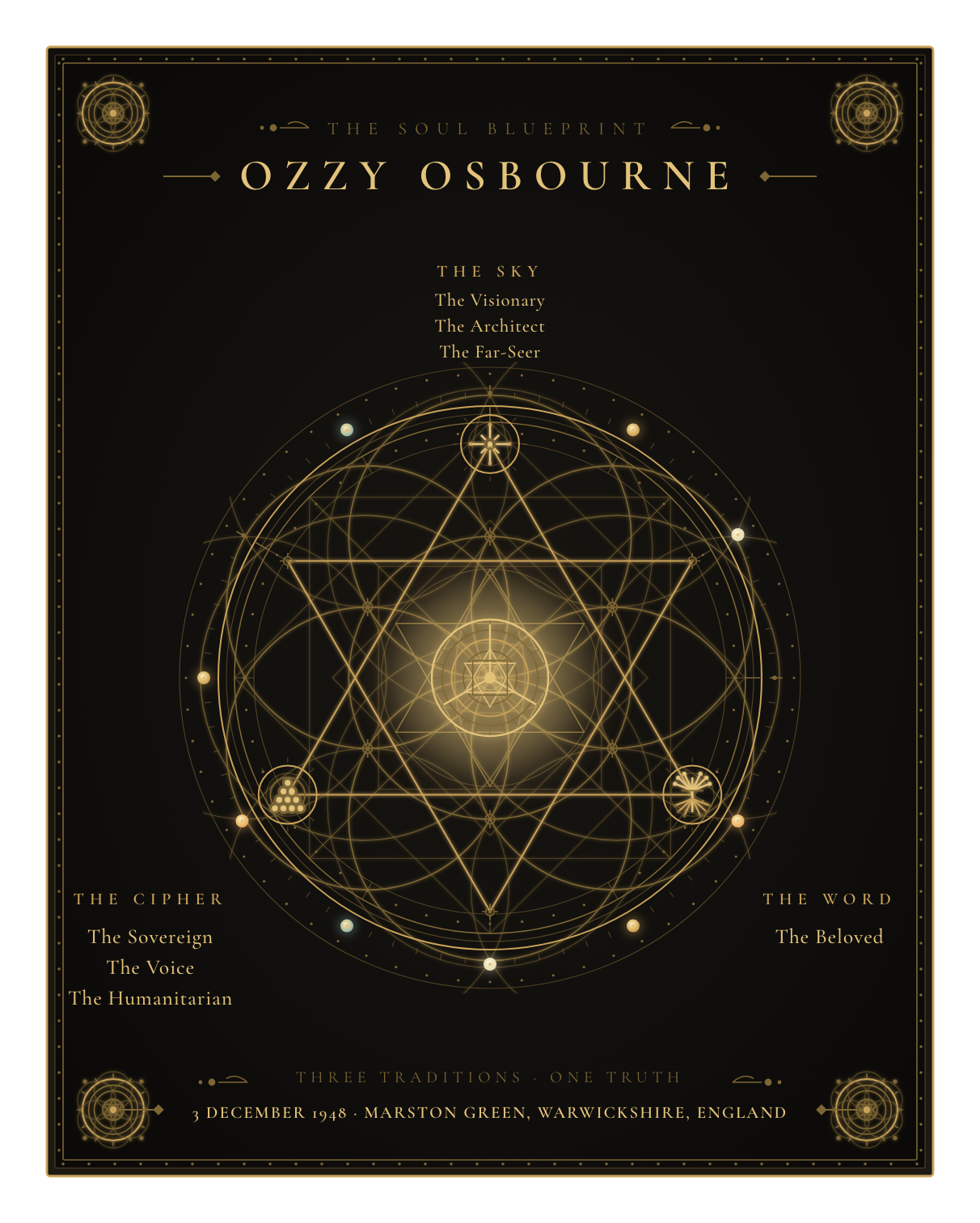
One seal, three languages. The sky he was born under at the apex, the numbers beneath his name at the lower left, the name itself at the lower right — three traditions engraved into one artifact. There is no rising sign, no houses, no angles: without a verified birth time they cannot be honestly drawn. What is true is what is shown.
At a Glance
- Full traditional name
- Ozzy Osbourne
- Born
- December 3, 1948 · Marston Green
- Sun
- Sagittarius 11.3° — the essential fire of the life
- Rising
- Birth time unverified — the Ascendant is offered conditionally, never asserted
- Moon
- Capricorn 14.5° — the inner life
- Mind · Value · Will
- Mercury Sagittarius · Venus Scorpio · Mars Capricorn
- Discipline · Direction
- Saturn Virgo · North Node Taurus
- Life Path
- 1 — The Pioneer
- Title-name Destiny
- 3 — The Communicator
- Birth-name Destiny
- 3 — The Communicator
- Master Numbers
- None preserved at the final layer
- Soul archetype
- The Communicator who lives the Pioneer’s path
In the dim recording studio light of 1980, a man stood before the microphone—hollow-eyed, addicted, fired from the only band he had ever known—and began to sing. The voice that emerged was not the voice of recovery or redemption. It was the voice of someone still descending, still seeking, still hungry for meaning in the only language his fractured nervous system could speak: sound, fury, the raw material of myth. The world would later call him the Prince of Darkness, the Madman of Rock, a circus act, a cautionary tale. But beneath the carnival mask—beneath the arrests and the excess and the performances of chaos—there moves a different current altogether: a soul that arrived on earth built for the quest, for the relentless pursuit of absolutes, for the translator’s work of bringing back what he finds in the far territories and rendering it into language the tribe can hear. The fragments the world calls them—the drunk, the satanist, the controversial figure—are the surface turbulence of a river whose source runs deeper and steadier than any single moment of transgression or spectacle can capture. This reading reads the source: not to excuse the life, but to see the blueprint underneath it, the architecture of what was asked and what was refused, what was offered and what was squandered, what called and what answered.
The reading moves through the eight chapters of the Soul Blueprint architecture — The Arrival, The Soul’s Inheritance, The Living of It, The Soul’s Calling, The Soul’s Territories, The Name You Carry, The Moment, and The Invitation — and at the end, the same instrument turns gently toward you.
The Arrival
He arrived carrying a paradox written into his very substance: a mind built to synthesize, to reach for the eternal and the universal, paired with a body and will designed for endurance, for the slow accumulation of force over time. The Sagittarius impulse—to quest, to philosophize, to expand consciousness toward the infinite—met the Capricorn steadiness: the need for a Great Work, the demand for self-discipline, the reigning requirement that the spirit be tested and proved through sustained, structured effort. This is not the paradox of contradiction but of compression. He came into the world as a seeker and a builder simultaneously: a philosopher who would need to build something real, lasting, that could hold the weight of what he was reaching toward. His mind naturally grasped principles, patterns, the big idea—he thought like a teacher, like a translator of meaning. But the heart that would beat beneath that expansive intellect was a Capricorn heart: needing solitude, needing the challenge of something worthy, steadied only by maturity and the long discipline of authentic work. The soul arrived ready to spend decades pursuing a single thread of truth. The will that would drive him was exalted, patient, strategic—not the will of impulse but of the general planning a campaign. He came prepared to transform desire into direction, to turn hunger into architecture. What this blueprint did not come prepared for—what no blueprint can—was how fiercely the depths would call to him, how the intensity that was meant to fuel a lifelong pilgrimage would become instead the fuel for a lifelong combustion.
The Soul’s Inheritance
He was born into the industrial grit of post-war England, in Marston Green, Warwickshire—a landscape of factory floors and toolmakers, of parents who worked with their hands and expected their children to do the same. His father was a toolmaker at General Electric; his mother worked at the Lucas factory. This was not a home of books or philosophy or the cultivation of artistic ambition—it was a home of necessity, of honest labor, of the assumption that a boy would grow into the kind of man who built things, fixed things, worked for his keep. He was given the nickname ‘Ozzy’ in childhood, a diminishment, a familiar name for a boy who would grow up in the Aston area of Birmingham, one of the great industrial hearts of the Midlands. The era itself was a particular inheritance: post-war austerity giving way to the birth of rock and roll, to the possibility that a working-class boy might escape the factory floor through music rather than manual labor. But the material he was born into—the working-class expectation, the absence of cultural privilege, the assumption of limitation—would shape him in ways deeper than escape. The soul arrived into a world where philosophy and the quest for meaning were not family inheritances but would have to be stolen, discovered, fought for. He would grow up hungry not just for food but for significance, for proof that his existence mattered beyond the production line. The body he was born into would carry the marks of that hunger: the early sexual abuse at age eleven, the suicide attempts as a teenager, the robberies, the six weeks in Winson Green Prison at seventeen—a young life already marked by the collision between the expansive soul and the constrictive world.
The Living of It
The living of this life was a long, relentless collision between the seeker’s mind and the addict’s body—between the philosophical impulse that wanted to understand everything and the chemical dependency that made understanding impossible. He worked as a construction labourer, a trainee plumber, an apprentice toolmaker, a car factory horn-tuner, a slaughterhouse worker: the jobs of a working-class boy with no escape route yet visible. Then came Black Sabbath in 1968, and for a decade he was the voice of something genuinely original—a band that took the philosophical despair and the existential hunger of the era and made it manifest in sound. He rose to prominence through the 1970s, his voice becoming the instrument through which millions heard the possibility that darkness itself could be examined, made into art, made meaningful. But the substance abuse was already present, already relentless. Cocaine, alcohol, LSD, prescription pills—they began not as recreation but as an attempt to manage the very intensity the soul had been built to contain. By 1979, the unreliability and the excess had become absolute: he was fired from Black Sabbath, the only kingdom he had ever known. The cost of this living was incalculable. The marriages collapsing under the weight of his addiction. The relationships fractured. The performances becoming increasingly erratic. The harm done to others—the affair, the violence, the rage turned outward because it could not be contained inward. And yet, simultaneously, the solo career beginning in 1980, the albums that would establish him as a major figure in his own right, the work continuing even as the machinery of his own body and mind was being consumed from within. The life was lived as a kind of controlled combustion, where the very fuel that destroyed was also what created.
Every soul arrives with a blueprint. What a life does with it is the whole of the reckoning.
The Soul’s Calling
His voice arrived as the instrument of a pilgrim-mind—a consciousness built to seek the far horizon and bring back what it found there to the threshold where ordinary people stood. The mind that grasps principle, that sees the pattern beneath the surface, that speaks in vast philosophical sweeps—this was the inheritance written into him from birth. He was given a natural teacher’s voice, one that could frame the big idea, the eternal question, the meaning that matters. The soul came to communicate the unseeable, to make the invisible audible.
There was in him a synthesizing intelligence, the kind that does not get lost in small detail but reaches instead for what connects all things, what unites the personal into the universal. His words were meant to be visionary, frank, unafraid—the voice of Hermes the philosopher, speaking across the vast distances to those who hunger for something beyond the merely personal. He was a natural framer, a composer not just of melody but of inquiry: What does it mean to live? What lies beyond the veil?
The calling was to speak truth in an age drowning in surfaces. To take the depths—the underworld journeys, the breakings, the transformations that most souls dare not name—and translate them into song, into testimony, into a message that could reach across stadiums and into the rooms of the solitary. The voice was meant to pioneer new territory for expression itself; to show that even from the darkest ground, communication could flower. He did not come to be comfortable or small. He came to speak what burns in the depths and to carry it out into the light where it could be heard by the many.
The Soul’s Territories
The first of his most-alive territories is the stage itself—the space where he became most fully present, most fully the instrument through which something larger than himself could flow. On stage, the addiction fell away temporarily, the chaos organized itself into structure, and the seeker’s mind found its true vehicle. The performances across five decades, the albums that achieved multi-platinum status, the Grammy Awards and Hall of Fame inductions—these were not achievements he pursued; they were the inevitable result of a soul that had found the terrain where it could speak most truthfully. The second territory is the dark mythos itself—not Satanism as literal belief, but Satanism as symbol, as the willingness to investigate the shadow, the forbidden, the aspects of human nature that religion and polite society refuse to acknowledge. He made it safe to look there, to be curious about the darkness, to understand that asking questions about evil and meaning and the nature of the human soul was not itself evil but rather a form of spiritual courage. He weaponized the demonic persona not as genuine allegiance but as a mirror held up to the hypocrisies of the religious right, the controllers, the ones who claimed to know God’s will. The third territory is the family itself—the marriages, the children, the relationships that persisted even through the chaos. Sharon Osbourne became not just his wife but his manager, his anchor, the one who offered him the possibility of a solo career when he was on the verge of ruin, who created Ozzfest and built something generative from the wreckage. The children—Jessica, Louis, Aimee, Kelly, Jack—became witnesses to the blueprint, inheritors of both the gifts and the wounds. These territories together form a deeper mythology: a soul attempting to integrate the seeker’s hunger, the builder’s discipline, and the depths that called so relentlessly that they nearly drowned him.
There are twelve domains in the kingdom of any life: The Mark, The Unfolding, The Unseen, The Long Return, The Inheritance, The Encounter, The Alchemy, The Living Tension, The Sight, The Body’s Knowing, The Crossing, The Calling.
The Name You Carry
The name Ozzy carries the resonance of diminishment and intimacy together—it is the child’s name, the nickname given to a boy in the Aston area of Birmingham, a diminutive that strips away formality and claims familiarity. There is democracy in the name, a refusal of grandiosity; it is the name you call someone you know, someone you’ve grown up with, not the name of a distant figure. And yet this nickname became the brand, the identity, the calling card—it transformed what was meant to be diminishing into something iconic. Osbourne, the family name, carries the weight of English working-class lineage, of toolmakers and factory workers, of the assumption that a man’s worth is measured in what his hands can make. Together, Ozzy Osbourne holds a paradox: the intimate, accessible child-name paired with the solid, working-class family identity. The numerology of this name carries the energy of the Communicator—the 3 that appears in both the Title Destiny and the Birth Destiny—which means the name itself is a perfect vehicle for what the soul came to do. The Communicator is not the keeper of secrets; the Communicator speaks, shares, makes meaning visible and audible. Every letter of his name resonates with the need to translate, to express, to ensure that what he sees and knows reaches the outer world. The numerical signature of his name is not a coincidence but a confirmation: he could not have chosen a more perfect instrument for the calling he carried. To be called Ozzy is to be called to speak plainly, without pretense; to be called Osbourne is to be anchored in solid ground. The combination is the soul’s own declaration of what it came to do—to bring the elevated, philosophical, far-reaching truth down into the language of the street, the language that working-class boys could understand and claim as their own.
The Moment
The moment that revealed everything arrived on August 19, 1989, in a house he shared with Sharon. He returned from Moscow, where Black Sabbath had performed at the Music Peace Festival, and the drugs and alcohol had reached a particular threshold where the chemistry of his body and the architecture of his will intersected in a way that released something catastrophic. What is documented is this: he attempted to strangle her. The hands that had held the microphone, that had signed contracts, that had built a career across two decades—these hands reached for the throat of the woman who had become his wife, his manager, his lifeline. The legal consequence was six months in rehabilitation. But the deeper consequence was the collision between the blueprint and its refusal. The soul that had arrived built to pursue absolutes, to question, to reach—that same soul, when the depths became too much and the will could not contain them, turned the intensity outward as violence. This was not the calling fulfilled; this was the calling corrupted, the architecture of the will turned against instead of toward. And yet something in this moment also became the pivot point. Sharon Osbourne chose not to abandon him; she chose instead to intervene at a level that mattered. The choice to manage him, to build Ozzfest, to anchor him to something real—this came not before the violence but after it, as a response to it. The moment revealed that the addiction, the rage, the chaos—these were not destiny but refusal, not fate but the will turned against itself. The violence of August 1989 was the sound of the blueprint breaking, the proof that the architecture could fail when the depths were not integrated but only endured. What followed was not redemption but a particular kind of continuation: the work persisting even as the damage was acknowledged, the albums continuing, the performances ongoing, the family rebuilding itself in the wreckage.
The Invitation
Everything in this reading has been moving toward a single point. The doubleness named in the first chapter, the inheritance, the wound, the calling, the territory, the name, the moment. These are not seven separate truths about Ozzy Osbourne. They are one truth, named from seven different angles. And they all converge here.
The invitation that arrived for Ozzy Osbourne was not coded in the language of comfort or permission—it came as a shattering, as a necessity that could not be refused without the soul itself fragmenting into irrelevance. The question placed before him was this: Will you carry the voice that speaks what others cannot say, the voice that walks into the darkness and returns with meaning? It was an invitation to be the threshold-walker, the one who stands between the world’s ordinariness and its shadow, and who speaks from that liminal place with such rawness that the culture cannot look away.
What he was being asked to release was the small self—the boy born John in Marston Green to a toolmaker and a factory worker, the child who worked his way through slaughterhouse labor and horn-tuning and plumbing apprenticeships, the young man who robbed a clothes shop and spent six weeks in prison, who was bullied and abused and who tried to end his own life multiple times before he was old enough to vote. That version of the soul had to be surrendered entirely. The invitation required the death of the ordinary—not metaphorically, but as a lived annihilation of the person who could have remained small, unremarkable, safe in the background of his own life. What was being asked him to relinquish was the possibility of being forgotten, of being nobody, of being allowed to fade.
There was also a second release required: the release of the pretense that addiction and crisis could remain private, interior struggles. The soul was being asked to make public its own disintegration, to let the world watch the exact mechanism by which a human being tears himself apart—not as confession performed for redemption, but as unflinching witness. When he bit the dove’s head in that executive meeting, when he urinated on the Alamo in a stupor, when he lived on television with his family’s raw grief and chaos visible in the living room, something was being witnessed that the culture had never allowed itself to see before: the celebrity who cannot hide. This was the medicine he was being asked to carry—the stripping away of the mask that usually protects the famous from their own humanity.
What he was being called toward was the vast, uncharted expanse of meaning-making—not the small meanings of personal achievement or recovery, but the archetypal meaning that lives in the voice itself, in the capacity to sing the dirge that the age needed to hear. The music that came through him, first with the band that bore the heavy crown of doom, then through the solo voice that would not be contained or refined—this was not entertainment in the ordinary sense. It was prophecy spoken in the language of amplified guitars and raw, untrained vocal cords that somehow carried more truth than trained technique ever could. He was being called to become the vessel for a particular kind of cultural truth-telling, the one who would speak the names of death and darkness and loss in an idiom that the young could hear, could feel in their bodies as real and important.
And what became available when the Yes was said—when he stepped into this crushing, relentless invitation—was a kind of immortality that had nothing to do with escape from consequence. He became, impossibly, beloved because of his visible struggle, not in spite of it. The reality television that exposed every contradiction, every moment of confusion and pain, the autobiography that named everything without filter, the reunion tours in which the aging body showed every cost the soul had paid—these did not diminish his significance but deepened it immeasurably. Over 100 million albums sold not because he was polished or protected, but because he was devastatingly, courageously real.
The invitation asked him to walk the line between annihilation and meaning for decades—to survive things that should have killed him, to continue singing even as his body began to fail, to show the world that the soul’s work is not finished when the body grows old or sick. When he performed that final show in Birmingham at seventy-six, returning to the place of his beginning, having outlasted his own predictions of doom, something was made visible: the trajectory of a soul that says yes to the hardest calling, and does not withdraw. This was the medicine, the kingdom that opened when the small self was released entirely and the archetypal voice was given permission to speak.
He was not late. He was exactly where the soul-clock said he should be. The mission had been inscribed at the threshold of his first breath. What was being asked of him, he has been walking. The naming has been done.
This Is Not Coincidence
The Sun in Sagittarius arrives as the self that comes alive by seeking meaning, the mind expanded to the far horizon in quest of eternal values—the pilgrim’s journey written into the cells themselves. The Title Destiny and Birth Destiny both arrive as 3, the Communicator, the voice that translates what it finds in the far territories and renders it audible, the teacher who speaks plainly about what matters. The name Ozzy Osbourne carries the intimacy of the child-name paired with the solidity of the working-class family lineage—diminishment and weight together, the accessible voice anchored in honest ground. Three entirely different languages. One truth: He arrived to be the voice that makes the forbidden knowable. The Life Path 1 arrives as the Pioneer, the soul that breaks open new territory and shows what becomes possible when the boundary is crossed. The Venus in Scorpio speaks of love that is intense, transformative, all-or-nothing—the capacity for total honesty and the merging that remakes both people. The Mars in Capricorn, exalted, patient, strategic—the will that sets a goal and reaches it through sustained, structured effort over decades. Three entirely different languages. One truth: He came built to endure the depths and return with what matters.
Three entirely different languages. One truth.
This is not coincidence. This is what three independent systems do when they are all telling the truth about the same soul.
The Numbers, Decoded
The numbers are computed, not intuited — each letter takes its Pythagorean value, each name reduces, and any Master Number is preserved rather than collapsed.
You have sat with the chart and the numbers and the name of another soul, and watched how a wound becomes a calling, how the place of least belonging becomes the place of greatest gift, how a life too precisely configured to be coincidence reveals itself when three independent languages are read together.
The reading you have just received was, in its outer form, a reading of his soul. But its inner form was a reading written for yours. You did not arrive without a Blueprint either. May this reading be the beginning of the reading you finally receive of yourself. May the light you carry — in whatever particular, irreplaceable form it has taken inside the specific life you were given.
Some lives carry a pattern this clear.
Yours does too.
The Soul Blueprint reads any life through the same three languages — the sky, the numbers, the name.
Or, when you’re ready, begin your own full Soul Blueprint reading →
Frequently Asked Questions
What is Ozzy Osbourne’s birth chart?
Ozzy Osbourne was born on December 3, 1948, with his Sun in Sagittarius—the self that arrives alive through seeking meaning and reaching toward eternal values. His birth time is unverified and circulated differently in various sources, so his rising sign cannot be reliably asserted. His Moon is in Capricorn, the emotional nature steadied by self-discipline and the need for a worthy Great Work. His Mercury is also in Sagittarius, giving him a synthesizing, philosophical mind that grasps principles and patterns; his Venus is in Scorpio, the capacity for profound, transformative intimacy; his Mars is in Capricorn, the exalted will that is disciplined, strategic, and enduring; and his Saturn is in Virgo, the demand for real competence and craft.
What is Ozzy Osbourne’s numerology?
Ozzy Osbourne’s Title Destiny number is 3, the Communicator—the archetype of the voice that translates meaning into language others can hear. His Birth Destiny is also 3, reinforcing this signature as the soul’s core identity. His Life Path, derived from his birth date (December 3, 1948), is 1—the Pioneer, the soul that breaks open new territory and shows what becomes possible when boundaries are crossed. Together, these numbers describe a soul built to speak, to lead, to make the forbidden knowable.
What does the name Ozzy Osbourne mean?
Ozzy is a diminutive, a child’s nickname derived from his first name, Osbourne, gained in childhood in Birmingham’s Aston area—it carries the intimacy of the familiar, the refusal of grandiosity, the sense of a person you know. Osbourne is the family name, solid English working-class lineage, the name of toolmakers and factory workers. Together, the name holds a paradox: the accessible, intimate child-name paired with the weight and solidity of the working-class family identity, the plain-spoken voice anchored in honest ground.
What is a Soul Blueprint?
A Soul Blueprint integrates three independent traditions — Western natal astrology, Pythagorean numerology, and the etymology of the full birth name — into a single document written as a personal letter to the soul. When you’re ready, you can begin your own.
This reading was prepared in the lineage and methodology of the Soul Blueprint Method — Pythagorean numerology with master numbers preserved, Western archetypal astrology, and a researched etymological reading of the full name. Ozzy Osbourne’s birth date (December 3, 1948) is sourced from the public record; the birth time is unverified, so the rising sign is offered conditionally and never asserted.
A Soul Blueprint reading · Astrology · Numerology · Etymology · shams-tabriz.com